

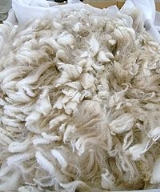
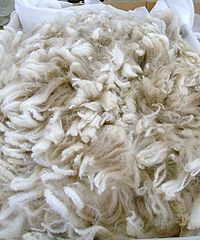
Alpaca fiber

Encyclopedia
Natural fiber
Fibers or fibres are a class of hair-like materials that are continuous filaments or are in discrete elongated pieces, similar to pieces of thread. They can be spun into filaments, thread, or rope. They can be used as a component of composite materials. They can also be matted into sheets to...
harvested from an alpaca
Alpaca
An alpaca is a domesticated species of South American camelid. It resembles a small llama in appearance.Alpacas are kept in herds that graze on the level heights of the Andes of southern Peru, northern Bolivia, Ecuador, and northern Chile at an altitude of to above sea level, throughout the year...
. It is light or heavy in weight, depending on how it is spun. It is a soft, durable, luxurious and silky natural
Natural fiber
Fibers or fibres are a class of hair-like materials that are continuous filaments or are in discrete elongated pieces, similar to pieces of thread. They can be spun into filaments, thread, or rope. They can be used as a component of composite materials. They can also be matted into sheets to...
fiber
Fiber
Fiber is a class of materials that are continuous filaments or are in discrete elongated pieces, similar to lengths of thread.They are very important in the biology of both plants and animals, for holding tissues together....
. While similar to sheep’s wool, it is warmer, not prickly, and has no lanolin
Lanolin
Lanolin , also called Adeps Lanae, wool wax or wool grease, is a yellow waxy substance secreted by the sebaceous glands of wool-bearing animals. Most lanolin used by humans comes from domestic sheep...
, which makes it hypoallergenic
Hypoallergenic
Hypoallergenic, meaning "below normal" or "slightly" allergenic, was a term first used in a cosmetics campaign in 1953. It is used to describe items that cause or are claimed to cause fewer allergic reactions...
. Alpaca is naturally water-repellent and difficult to ignite. Huacaya, an alpaca that grows soft spongy fiber, has natural crimp, thus making a naturally elastic yarn well-suited for knitting. Suri has far less crimp and thus is a better fit for woven goods. The designer Armani has used Suri alpaca to fashion men's and women's suits.. Alpaca fleece is made into various products, from very simple and inexpensive garments made by the aboriginal communities to sophisticated, industrially made and expensive products such as suits. In the United States, groups of smaller alpaca breeders have banded together to create "fiber co-ops," to make the manufacture of alpaca fiber products less expensive.
The preparing, carding
Carding
Carding is a mechanical process that breaks up locks and unorganised clumps of fibre and then aligns the individual fibres so that they are more or less parallel with each other. The word is derived from the Latin carduus meaning teasel, as dried vegetable teasels were first used to comb the raw wool...
, spinning
Spinning (textiles)
Spinning is a major industry. It is part of the textile manufacturing process where three types of fibre are converted into yarn, then fabric, then textiles. The textiles are then fabricated into clothes or other artifacts. There are three industrial processes available to spin yarn, and a...
, weaving
Weaving
Weaving is a method of fabric production in which two distinct sets of yarns or threads are interlaced at right angles to form a fabric or cloth. The other methods are knitting, lace making and felting. The longitudinal threads are called the warp and the lateral threads are the weft or filling...
and finishing process of alpaca is very similar to the process used for wool.
Types
History
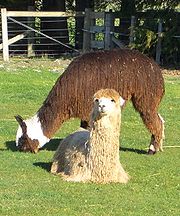
Alpacas have been bred in South America for thousands of years. VicuñaVicuña
The vicuña or vicugna is one of two wild South American camelids, along with the guanaco, which live in the high alpine areas of the Andes. It is a relative of the llama, and is now believed to share a wild ancestor with domesticated alpacas, which are raised for their fibre...
s were first domesticated and bred into alpacas by the ancient tribes of the Andean highlands of Peru, Argentina, Chile and Bolivia. Two thousand-year-old Paracas textiles
Paracas Textiles
The Paracas textiles were found at a necropolis in Peru in the 1920s. The necropolis held 420 bodies who had been mummified and wrapped in embroidered textiles in 200–300 BCE The examples in the British Museum show flying shamans who hold severed heads by their hair.-Description:These textiles were...
are thought to include alpaca fiber. In recent years, alpacas have also been exported to other countries. In countries such as the USA, Australia and New Zealand, breeders shear
Sheep shearing
Sheep shearing, shearing or clipping is the process by which the woollen fleece of a sheep is cut off. The person who removes the sheep's wool is called a shearer. Typically each adult sheep is shorn once each year...
their animals annually, weigh the fleeces and test them for fineness. With the resulting knowledge, they are able to breed heavier-fleeced animals with finer fiber. Fleece weights vary, with the top stud males reaching annual shear weights up to total fleece and good quality fleece. The discrepancy in weight is because an alpaca has guard hair
Guard hair
Guard hairs are the longest, coarsest hairs in a mammal's coat, forming the topcoat . They taper to a point and protect the undercoat from the elements. They are often water repellent and stick out above the rest of the coat...
, which is often removed before spinning.
History of fiber industry
The Amerindians of Peru used this fiber in the manufacture of many styles of fabrics for thousands of years before its introduction into Europe as a commercial product. The alpaca was a crucial component of ancient life in the Andes, as it provided not only warm clothing, but also meat. Many rituals and myths involved the alpaca, perhaps most notably the myth regarding the method of killing the animal: An alpaca was restrained by one or more people, and a specially trained person plunged his bare hand into the chest cavity of the animal, ripping out its heart. Today, this ritual is viewed by most as barbaric, but there are still some tribes in the Andes which practice it.The first European importations of alpaca fiber were into Spain
Spain
Spain , officially the Kingdom of Spain languages]] under the European Charter for Regional or Minority Languages. In each of these, Spain's official name is as follows:;;;;;;), is a country and member state of the European Union located in southwestern Europe on the Iberian Peninsula...
. Spain transferred that fiber to Germany
Germany
Germany , officially the Federal Republic of Germany , is a federal parliamentary republic in Europe. The country consists of 16 states while the capital and largest city is Berlin. Germany covers an area of 357,021 km2 and has a largely temperate seasonal climate...
and France
France
The French Republic , The French Republic , The French Republic , (commonly known as France , is a unitary semi-presidential republic in Western Europe with several overseas territories and islands located on other continents and in the Indian, Pacific, and Atlantic oceans. Metropolitan France...
. Apparently, alpaca yarn was spun in England
England
England is a country that is part of the United Kingdom. It shares land borders with Scotland to the north and Wales to the west; the Irish Sea is to the north west, the Celtic Sea to the south west, with the North Sea to the east and the English Channel to the south separating it from continental...
for the first time about the year 1808, but the fiber was condemned as an unworkable material. In 1830, Benjamin Outram, of Greetland
Greetland
Greetland is a village in the metropolitan borough of Calderdale in West Yorkshire, England. It is located west of nearby Elland and south of Halifax.-Local history:The village may have been the site of a Roman settlement named Cambodunum...
, near Halifax, appears to have reattempted spinning it, and again it was condemned. These two attempts failed due to the style of fabric into which the yarn was woven — a type of camlet
Camlet
Camlet, also commonly known as camelot or camblet, is a woven fabric that might have originally been made of camel or goat's hair, now chiefly of goat's hair and silk, or of wool and cotton...
. With the introduction of cotton warps into Bradford trade about 1836, the true qualities of alpaca could be assessed as it was developed into fabric. It is not known where the cotton warp and mohair
Mohair
Mohair usually refers to a silk-like fabric or yarn made from the hair of the Angora goat. The word "mohair" was adopted into English before 1570 from the Arabic: mukhayyar, a type of haircloth, literally 'choice', from khayyara, 'he chose'. Mohair fiber is approximately 25-45 microns in...
or alpaca weft
Weft
In weaving, weft or woof is the yarn which is drawn through the warp yarns to create cloth. In North America, it is sometimes referred to as the "fill" or the "filling yarn"....
plain-cloth came from, but it was this simple and ingenious structure which enabled Titus Salt
Titus Salt
Sir Titus Salt, 1st Baronet , born in Morley, near Leeds, was a manufacturer, politician and philanthropist in Bradford, West Yorkshire, England. His father Daniel Salt was a businessman and was sent Titus to Batley Grammar School...
, then a young Bradford manufacturer, to use alpaca successfully. Bradford is still the great spinning and manufacturing center for alpaca. Large quantities of yarns and cloths are exported annually to the European continent and the US, although the quantities vary with the fashions in vogue. The typical "alpaca fabric" is a very characteristic "dress fabric."
.jpg)
Domestic sheep
Sheep are quadrupedal, ruminant mammals typically kept as livestock. Like all ruminants, sheep are members of the order Artiodactyla, the even-toed ungulates. Although the name "sheep" applies to many species in the genus Ovis, in everyday usage it almost always refers to Ovis aries...
with alpaca. There is a cross between alpaca and llama — a true hybrid in every sense — producing a material placed upon the Liverpool market under the name "Huarizo
Huarizo
A huarizo is a cross between a male llama and a female alpaca. It is generally bred for its exceptional fleece. Huarizo are generally sterile, but recent genetic research conducted at the University of Minnesota Rochester suggests that it may be possible to preserve fertility with minimal genetic...
". Crosses between the alpaca and vicuña have not proved satisfactory, as the crosses that have produced offspring have a very short fleece, more characteristic of the vicuña. Current attempts to cross these two breeds are underway at farms in the US. Alpacas are now being bred in the US, Canada, Australia, New Zealand, UK, and numerous other places.
In recent years, interest in alpaca fiber clothing has surged, perhaps partly because alpaca ranching has a reasonably low impact on the environment. Individual U.S. farms are producing finished alpaca products like hats,mitts, scarves, socks, insoles, footwarmers, sweaters, jackets, as well as almost any other product. Outdoor sports enthusiasts recognize its lighter weight and better warmth provides them more comfort in colder weather, so outfitters such as R.E.I.
R.E.I.
REI is a privately held American retail corporation organized as a consumers' cooperative, selling outdoor recreation gear, sporting goods, and clothes via some 110 retail stores in about 30 states, catalogs, and the Internet. The company opens four to six new stores each year...
and others are beginning to stock more alpaca products. Using an alpaca and wool blend such as merino
Merino
The Merino is an economically influential breed of sheep prized for its wool. Merinos are regarded as having some of the finest and softest wool of any sheep...
is common to the alpaca fiber industry to improve processing and the qualities of the final product.
In December 2006, the General Assembly of the United Nations proclaimed 2009 to be the International Year of Natural Fibres
International Year of Natural Fibres
The United Nations General Assembly declared 2009 as the International Year of Natural Fibres, as well as the International Year of Astronomy.The proposal for this international year originated in FAO at a joint meeting of the Intergovernmental Group on Hard Fibres and the Intergovernmental Group...
, so as to raise the profile of alpaca and other natural fiber
Natural fiber
Fibers or fibres are a class of hair-like materials that are continuous filaments or are in discrete elongated pieces, similar to pieces of thread. They can be spun into filaments, thread, or rope. They can be used as a component of composite materials. They can also be matted into sheets to...
s.
Fiber structure
In physical structure, alpaca fiber is somewhat akin to hair, being very glossy. Alpaca fiber is similar to merino wool fiber, and alpaca yarns tend to be stronger than wool yarns. The heel hole that appears in wool socks or in elbows of wool sweaters is nonexistent in similar alpaca garments. In processing, sliverSliver (textiles)
A sliver is a long bundle of fibre that is generally used to spin yarn. A sliver is created by carding or combing the fibre, which is then drawn into long strips where the fibre is parallel. When sliver is drawn further and given a slight twist, it becomes roving....
s lack fiber cohesion and single alpaca roving
Roving
A roving is a long and narrow bundle of fibre. It is usually used to spin woollen yarn. A roving can be created by carding the fibre, and it is then drawn into long strips. Because it is carded, the fibres are not parallel, though drawing it into strips may line the fibres up a bit...
s lack strength. Blend these together and the durability is increased several times over. More twisting is necessary, especially in Suri, and this can reduce a yarn's softness.
The alpaca has a very fine and light fleece. It does not retain water, is thermal even when wet and can resist solar radiation effectively. These characteristics guarantee the animals a permanent and appropriate coat to fight against the extreme changes of temperature. This fiber offers the same protection to humans.
Medullation
Medullated fibres are fibres with a central core, which may be continuous, interrupted, or fragmented. Here, the cortical cells that make up the walls of the fibre, are wrapped around a medulla, or core, that is made up of another type of cell (called medullary cells). Later, thesecells may contract or disappear, forming air pockets which assist insulation.
Medullation can be an objectionable trait. Medullated fibers can take less dye, standing out in the finished garment, and are weaker. The proportion of medullated fibers is higher in the coarser, unwanted guard hairs: there is less or no medullation in the finer, lower micrometer fibers... These undesirable fibers are easy to see and give a garment a hairy appearance. Quality alpaca products should be free from these medullated fibers.
Quality
Good quality alpaca fiber is approximately 18 to 25 micrometreMicrometre
A micrometer , is by definition 1×10⁻⁶ of a meter .In plain English, it means one-millionth of a meter . Its unit symbol in the International System of Units is μm...
s in diameter. Whilst breeders report fiber can sell for US$2 to 4 per ounce
Ounce
The ounce is a unit of mass with several definitions, the most commonly used of which are equal to approximately 28 grams. The ounce is used in a number of different systems, including various systems of mass that form part of the imperial and United States customary systems...
, the world wholesale price for processed, spun alpaca “tops” is only between about $10 to $24/kg (according to quality), i.e. about $0.28 to $0.68 per oz.. Finer fleeces, ones with a smaller diameter, are preferred, so are more expensive. As an alpaca gets older, the diameter of the fibers gets thicker, between and per year. This is sometimes caused by overfeeding; as excess nutrients are converted to (thicker) fiber rather than to fat.
As with all fleece-producing animals, quality varies from animal to animal, and some alpacas produce fiber which is less than ideal. Fiber and conformation are the two most important factors in determining an alpaca's value.
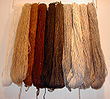
Alpacas come in 22 natural colors, with more than 300 shades from a true-blue black through browns-black, browns, fawns, white, silver-greys, and rose-greys. However, white is predominant, because of selective breeding
Selective breeding
Selective breeding is the process of breeding plants and animals for particular genetic traits. Typically, strains that are selectively bred are domesticated, and the breeding is sometimes done by a professional breeder. Bred animals are known as breeds, while bred plants are known as varieties,...
: the white fiber can be dyed in the largest ranges of colors. In South America, the preference is for white, as they generally have better fleece than the darker-colored animals. The demand for darker fiber sprung up in the United States and elsewhere, though, to reintroduce the colors, but the quality of the darker fiber has decreased slightly. Breeders have been diligently working on breeding dark animals with exceptional fiber, and much progress has been made over the last few years.
Dyeing
Before dyeing, the alpaca fiber must go through other stages:- Selection of wool, according to color, size and quality of fiber
- "Escarminado", removal of grass, dirt, thorns, and other impurities
- Washing, to remove all the dirt and grease
- Spinning
Once the fiber is clean, it is possible to begin the process of dyeing.
Natural dyeing: (recipe used by Andean artisans):
To dye 1 kg of alpaca wool with cochinilla (natural dye
Natural dye
Natural dyes are dyes or colorants derived from plants, invertebrates, or minerals. The majority of natural dyes are vegetable dyes from plant sources – roots, berries, bark, leaves, and wood — and other organic sources such as fungi and lichens....
),
- Boil 5 liters of water in an aluminum can with 100 g of cochinilla for an hour.
- Sift and put the fiber in the water.
- Boil again for an hour and add 50 lemons cut in halves.
- Then take out the wool and hang for drying.
Note: For dyeing with another natural dye (native plants), add 2 kg of the products to the water and boil.
Uses
Alpaca fiber is used for many purposes, including making clothing such as hats, mitts, scarves, gloves, and jumpers. It can also be used for rerooting dolls' hair, for example in Blythe dolls. Many breeders are coming up with new ways to use the fibre from their alpacas, from crafting, to wall hangings, to clothing.External links
- Preparing your Alpaca for showing
- PDF with information on the history, care, and knitting practicalities dealing with alpaca fiber. Published by Interweave Press.
- How to Care Your Alpaca Garments Published by Peru And Arts Press.