


Sheep shearing

Encyclopedia
Sheep shearing, shearing or clipping is the process by which the woollen fleece
of a sheep is cut off. The person who removes the sheep's wool is called a shearer
. Typically each adult sheep is shorn once each year (a sheep may be said to have been "shorn" or "sheared", depending upon dialect). The annual shearing most often occurs in a shearing shed
, a facility especially designed to process often hundreds and sometimes more than 3,000 sheep per day.
Sheep are shorn in all seasons, depending on the climate, management requirements and the availability of a woolclasser
and shearer
s. Ewes are normally shorn prior to lambing, but consideration is typically made as to the welfare of the lambs by not lambing during cold climate winters. Shorn sheep tolerate frosts well, but young sheep especially will suffer in cold, wet windy weather (even in cold climate summers). In this event they are shedded for several nights until the weather clears. Some sheep may also be shorn with stud combs which leave more wool on the animal, giving greater protection.
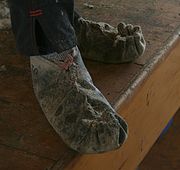 Up until the 1870s squatters
washed their sheep in nearby creeks prior to shearing. Later some expensive hot water installations were constructed on some of the larger stations
for the washing. Sheep washing in Australia was influenced by the Saxony
sheep breeders in Germany who washed their sheep and by the Spanish practice of washing the wool after shearing. There were three main reasons for the custom in Australia:
The practice of washing the wool rather than the sheep evolved from the fact that hotter water could be used to wash the wool, than that used to wash the sheep. When the practice of selling wool in the grease occurred in the 1890s, wool washing became obsolete.
Australia and New Zealand had to discard the old methods of wool harvesting and evolve more efficient systems to cope with the huge numbers of sheep involved. After 1888 machine shearing was introduced, reducing second cuts and shearing time. By 1915 most large sheep station
sheds in Australia had installed machines, driven by steam or later by internal combustion engines.
Shearing tables were invented in the 1950s and have not proved popular, although some are still used for crutching
.
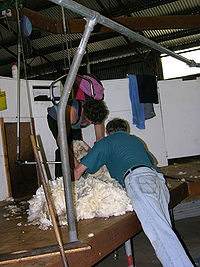
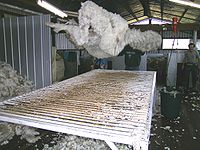 Today, large flocks of sheep are shorn by professional shearing teams working eight hour days, most often in spring, by machine shearing. These contractor teams will consist of shearers, shed hands and a cook (in the more isolated areas). The shed staff working hours and wages are regulated by industry awards. A working day starts at 7:30 AM
and the day is divided into four “runs” of two hours each. “Smoko” breaks of a half hour each are at 9:30 am and again at 3:00 pm. The lunch break is taken at 12:00 pm for one hour. Most shearers are paid on a piece rate, i.e., per sheep. Shearers who “tally” more than 200 sheep per day are known as “gun shearers”. Typical mass shearing of sheep today follows a well-defined workflow: remove the wool, throw the fleece onto the wool table, skirt, roll and class the fleece, place it in the appropriate wool bin, press and store the wool until it is transported. In 1984 Australia became the last country in the world to permit the use of wide combs, due to previous Australian Workers Union rules. Although they were rare in sheds, women now take a large part in the shearing industry by working as pressers, wool rollers, rouseabouts, wool classers and also shearing, too.
The CSIRO in Australia has developed a non-mechanical method of shearing sheep using an injected protein
that creates a natural break in the wool fibres. After fitting a retaining net to enclose the wool, sheep are injected with the protein. When the net is removed after a week, the fleece has separated and is removed by hand. In some breeds a similar process occurs naturally (see below).
, which is performed by a registered and qualified wool classer. Based on its type, the fleece is placed into the relevant wool bin ready to be pressed (mechanically compressed) when there is sufficient wool to make a wool bale
.
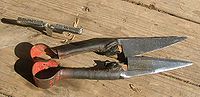
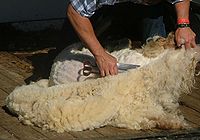
except that the hinge is at the end farthest from the point (not in the middle). The cutting edges pass each other as the shearer squeezes them together and shear the wool close to the animal's skin. Blade shears are still used today but in a more limited way. Blade shears leave some wool on a sheep and this is more suitable for cold climates where the sheep needs some protection from the elements. For those areas where no powered-machinery is available blade shears are the only option. Blades are more commonly used to shear stud rams.
. Smaller motors allowed the production of shears in which the motor is in the handpiece; these are generally not used by professional shearers as the weight and heat of the motor becomes bothersome with long use.
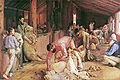 A culture has evolved out of the practice of sheep shearing, especially in post-colonial Australia and New Zealand. Shearing the Rams
, a painting by Australian impressionist painter Tom Roberts
is considered to be iconic of the livestock-growing culture or "life on the land" in Australia. It was parodied in Michael Leunig
's Ramming the Shears.
The expression that Australia's wealth rode on the sheep’s back in parts of the twentieth century no longer has the currency it once had.
In 2001, Mandy Francis of Hardy's Bay, NSW constructed a blackbutt seat for the Street Furniture Project at Walcha
, New South Wales. This seat was inspired by the combs, cutters, wool tables and grating associated with the craft and industry of shearing.
During the long weekend in June 2010, 111 machine shearers and 78 blade shearers shore 6,000 Merino ewes and 178 rams at the historic 72 stand North Tuppal station. Along with the shearers there were 107 wool handlers and penners-up and more than 10,000 visitors to witness this event in the restored shed. Over this weekend the scene in Tom Robert's Shearing of the Rams was twice re-enacted for the visitors.
Many stations across Australia no longer carry sheep due to lower wool prices, drought and other disasters, but their shearing shed
s remain, in a wide variety of materials and styles, and have been the subject of books and documentation for heritage authorities. Some farmers are reluctant to remove either the equipment or the sheds, and many unused sheds remain intact.
a sheep shearing contest is one of the events of the Royal Welsh Show
, the country's premier agricultural show held near Builth Wells
.
The world's largest sheep shearing and wool handling contest, the Golden Shears
, is held in the Wairarapa district, New Zealand.
has been World Champion a record 5 times.
In October, 2008 the event was hosted in Norway. It was the first time ever that the event was hosted by a non-English speaking country. The newly crowned World Machine Shearing champion is Paul Avery from New Zealand. New Zealand also won the team event, and the traditional blade-shears World Champion is Ziewilelle Hans from South Africa. A record 29 countries competed at the 2008 event. The next World Championship will be held at the Royal Welsh Show, Llanelwedd, Wales in July, 2010.
Wool
Wool is the textile fiber obtained from sheep and certain other animals, including cashmere from goats, mohair from goats, qiviut from muskoxen, vicuña, alpaca, camel from animals in the camel family, and angora from rabbits....
of a sheep is cut off. The person who removes the sheep's wool is called a shearer
Sheep shearer
A sheep shearer is a worker who uses -blade or machine shears to remove wool from domestic sheep during crutching or shearing.-History:...
. Typically each adult sheep is shorn once each year (a sheep may be said to have been "shorn" or "sheared", depending upon dialect). The annual shearing most often occurs in a shearing shed
Shearing shed
Shearing sheds are large sheds located on sheep stations to accommodate large scale sheep shearing activities.In countries where large numbers of sheep are kept for wool, sometimes many thousands in a flock, shearing sheds are vital to house the necessary shearing equipment, and to ensure that the...
, a facility especially designed to process often hundreds and sometimes more than 3,000 sheep per day.
Sheep are shorn in all seasons, depending on the climate, management requirements and the availability of a woolclasser
Wool classing
Wool classing is an occupation for which people are trained to produce uniform, predictable, low risk lines of wool. This is carried out by examining the characteristics of the wool in its raw state. The characteristics which a wool classer would examine are:Breed of the sheep: Shedding breeds will...
and shearer
Shearer
A shearer is someone who shears, such as a cloth shearer, or a sheep shearer.Additionally, Shearer is the surname of people:-In sports:*Alan Shearer , English footballer*Bobby Shearer , Scottish footballer...
s. Ewes are normally shorn prior to lambing, but consideration is typically made as to the welfare of the lambs by not lambing during cold climate winters. Shorn sheep tolerate frosts well, but young sheep especially will suffer in cold, wet windy weather (even in cold climate summers). In this event they are shedded for several nights until the weather clears. Some sheep may also be shorn with stud combs which leave more wool on the animal, giving greater protection.
History
Squatting (pastoral)
In Australian history, a squatter was one who occupied a large tract of Crown land in order to graze livestock. Initially often having no legal rights to the land, they gained its usage by being the first Europeans in the area....
washed their sheep in nearby creeks prior to shearing. Later some expensive hot water installations were constructed on some of the larger stations
Station (Australian agriculture)
Station is the term for a large Australian landholding used for livestock production. It corresponds to the North American term ranch or South American estancia...
for the washing. Sheep washing in Australia was influenced by the Saxony
Saxony
The Free State of Saxony is a landlocked state of Germany, contingent with Brandenburg, Saxony Anhalt, Thuringia, Bavaria, the Czech Republic and Poland. It is the tenth-largest German state in area, with of Germany's sixteen states....
sheep breeders in Germany who washed their sheep and by the Spanish practice of washing the wool after shearing. There were three main reasons for the custom in Australia:
- The English manufacturers demanded that Australian woolgrowers provide their fleeces free from vegetable matter, burrsBurr (fruit)A bur is a seed or dry fruit in which the seeds bear hooks or teeth which attach themselves to fur or clothing of passing animals or people. The hooks or teeth can be irritants and very hard to get off of clothing, such as wool or cotton...
, soil, etc. - The dirty fleeces were hard to shear and demanded that the metal blade shears be sharpened more often.
- Wool in Australia was carted by bullock teamOx-wagonAn ox-wagon or bullock wagon is a four-wheeled vehicle pulled by oxen . It was a traditional form of transport, especially in Southern Africa but also in New Zealand and Australia. Ox-wagons were also used in the United States...
or horse teams and charged by weight. Washed wool was lighter and did not cost as much to transport.
The practice of washing the wool rather than the sheep evolved from the fact that hotter water could be used to wash the wool, than that used to wash the sheep. When the practice of selling wool in the grease occurred in the 1890s, wool washing became obsolete.
Australia and New Zealand had to discard the old methods of wool harvesting and evolve more efficient systems to cope with the huge numbers of sheep involved. After 1888 machine shearing was introduced, reducing second cuts and shearing time. By 1915 most large sheep station
Sheep station
A sheep station is a large property in Australia or New Zealand whose main activity is the raising of sheep for their wool and meat. In Australia, sheep stations are usually in the south-east or south-west of the country. In New Zealand the Merinos are usually in the high country of the South...
sheds in Australia had installed machines, driven by steam or later by internal combustion engines.
Shearing tables were invented in the 1950s and have not proved popular, although some are still used for crutching
Crutching
Crutching refers to the removal of wool from around the tail and between the rear legs of a sheep. It can also refer to removing wool from the heads of sheep or from the bellies of male sheep .-Motivation:...
.
Modern shearing
12-hour clock
The 12-hour clock is a time conversion convention in which the 24 hours of the day are divided into two periods called ante meridiem and post meridiem...
and the day is divided into four “runs” of two hours each. “Smoko” breaks of a half hour each are at 9:30 am and again at 3:00 pm. The lunch break is taken at 12:00 pm for one hour. Most shearers are paid on a piece rate, i.e., per sheep. Shearers who “tally” more than 200 sheep per day are known as “gun shearers”. Typical mass shearing of sheep today follows a well-defined workflow: remove the wool, throw the fleece onto the wool table, skirt, roll and class the fleece, place it in the appropriate wool bin, press and store the wool until it is transported. In 1984 Australia became the last country in the world to permit the use of wide combs, due to previous Australian Workers Union rules. Although they were rare in sheds, women now take a large part in the shearing industry by working as pressers, wool rollers, rouseabouts, wool classers and also shearing, too.
Removing the wool
A sheep is caught by the shearer from the catching pen and taken to his “stand” on the shearing board. It is then shorn using mechanical handpiece (see Shearing devices below). The wool is removed by following an efficient set of movements, devised by Godfrey Bowen in c. 1950, (the Bowen Technique) or the Tally-Hi method. In 1963 the Tally-hi shearing system was developed by the Australian Wool Corporation and promoted using synchronised shearing demonstrations. Sheep struggle less using the Tally-Hi method, reducing strain on the shearer and there is a saving of about 30 seconds shearing each sheep. The shearer begins by removing the sheep's belly wool, which is separated from the main fleece by a rouseabout, while the sheep is still being shorn. A professional or "gun" shearer typically removes a fleece without badly marking or cutting the sheep in two to three minutes, depending on the size and condition of the sheep, or less than two in elite competitive shearing. The shorn sheep is moved from the board via a chute in the floor, or wall, to a counting out pen, efficiently removing it from the shed.The CSIRO in Australia has developed a non-mechanical method of shearing sheep using an injected protein
Protein
Proteins are biochemical compounds consisting of one or more polypeptides typically folded into a globular or fibrous form, facilitating a biological function. A polypeptide is a single linear polymer chain of amino acids bonded together by peptide bonds between the carboxyl and amino groups of...
that creates a natural break in the wool fibres. After fitting a retaining net to enclose the wool, sheep are injected with the protein. When the net is removed after a week, the fleece has separated and is removed by hand. In some breeds a similar process occurs naturally (see below).
Skirting the fleece
Once the entire fleece has been removed from the sheep, the fleece is thrown, clean side down, on to a wool table by a shed hand (commonly known in New Zealand and Australian sheds as a rouseabout or roustie). The wool table top consists of slats spaced approximately 12 cm apart. This enables short pieces of wool, the locks and other debris, to gather beneath the table separately from the fleece. The fleece is then skirted by one or more wool rollers to remove the sweat fribs and other less desirable parts of the fleece. The removed pieces largely consist of shorter, seeded, burry or dusty wool etc. which is still useful in the industry. As such they are placed in separate containers and sold along with fleece wool. Other items removed from the fleece on the table, such as faeces, skin fragments or twigs and leaves, are discarded a short distance from the wool table so as not to contaminate the wool and fleece.Wool classing
Following the skirting of the fleece, it is folded, rolled and examined for its quality in a process known as wool classingWool classing
Wool classing is an occupation for which people are trained to produce uniform, predictable, low risk lines of wool. This is carried out by examining the characteristics of the wool in its raw state. The characteristics which a wool classer would examine are:Breed of the sheep: Shedding breeds will...
, which is performed by a registered and qualified wool classer. Based on its type, the fleece is placed into the relevant wool bin ready to be pressed (mechanically compressed) when there is sufficient wool to make a wool bale
Wool bale
A wool bale is a standard sized and weighted pack of classed wool compressed by the mechanical means of a wool press. This is the regulation required method of packaging for wool, to keep it uncontaminated and readily identifiable...
.
Shearing devices
Blade shears
Blade shears consist of two blades arranged similarly to scissorsScissors
Scissors are hand-operated cutting instruments. They consist of a pair of metal blades pivoted so that the sharpened edges slide against each other when the handles opposite to the pivot are closed. Scissors are used for cutting various thin materials, such as paper, cardboard, metal foil, thin...
except that the hinge is at the end farthest from the point (not in the middle). The cutting edges pass each other as the shearer squeezes them together and shear the wool close to the animal's skin. Blade shears are still used today but in a more limited way. Blade shears leave some wool on a sheep and this is more suitable for cold climates where the sheep needs some protection from the elements. For those areas where no powered-machinery is available blade shears are the only option. Blades are more commonly used to shear stud rams.
Machine shears
Machine shears, known as handpieces, operate in a similar manner to human hair clippers in that a power-driven toothed blade, known as a cutter, is driven back and forth over the surface of a comb and the wool is cut from the animal. The original machine shears were powered by a fixed hand-crank linked to the handpiece by a shaft with only two universal joints, which afforded a very limited range of motion. Later models have more joints to allow easier positioning of the handpiece on the animal. Electric motors on each stand have generally replaced overhead gear for driving the handpieces. The jointed arm is replaced in many instances with a flexible shaftFlexible shaft
A flexible shaft is a device for transmitting rotary motion between two objects which are not fixed relative to one another. It consists of a rotating wire rope or coil which is flexible but has some torsional stiffness. It may or may not have a covering, which also bends but does not rotate...
. Smaller motors allowed the production of shears in which the motor is in the handpiece; these are generally not used by professional shearers as the weight and heat of the motor becomes bothersome with long use.
Shearing in Australian culture
Shearing the Rams
Shearing the Rams is an 1890 painting by the Australian artist Tom Roberts. The painting depicts sheep shearers plying their trade in a timber shearing shed...
, a painting by Australian impressionist painter Tom Roberts
Tom Roberts
Thomas William Roberts , usually known simply as Tom, was a prominent Australian artist and a key member of the Heidelberg School.-Life:...
is considered to be iconic of the livestock-growing culture or "life on the land" in Australia. It was parodied in Michael Leunig
Michael Leunig
Michael Leunig , typically referred to as Leunig, is an Australian poet, cartoonist and cultural commentator. His best known works include The Adventures of Vasco Pyjama and the Curly Flats series...
's Ramming the Shears.
The expression that Australia's wealth rode on the sheep’s back in parts of the twentieth century no longer has the currency it once had.
In 2001, Mandy Francis of Hardy's Bay, NSW constructed a blackbutt seat for the Street Furniture Project at Walcha
Walcha, New South Wales
Walcha is a parish and town at the south-eastern edge of the Northern Tablelands, New South Wales, Australia.The town serves as the seat of Walcha Shire. Walcha is located 425 kilometres by road from Sydney at the intersection of the Oxley Highway and Thunderbolts Way...
, New South Wales. This seat was inspired by the combs, cutters, wool tables and grating associated with the craft and industry of shearing.
During the long weekend in June 2010, 111 machine shearers and 78 blade shearers shore 6,000 Merino ewes and 178 rams at the historic 72 stand North Tuppal station. Along with the shearers there were 107 wool handlers and penners-up and more than 10,000 visitors to witness this event in the restored shed. Over this weekend the scene in Tom Robert's Shearing of the Rams was twice re-enacted for the visitors.
Many stations across Australia no longer carry sheep due to lower wool prices, drought and other disasters, but their shearing shed
Shearing shed
Shearing sheds are large sheds located on sheep stations to accommodate large scale sheep shearing activities.In countries where large numbers of sheep are kept for wool, sometimes many thousands in a flock, shearing sheds are vital to house the necessary shearing equipment, and to ensure that the...
s remain, in a wide variety of materials and styles, and have been the subject of books and documentation for heritage authorities. Some farmers are reluctant to remove either the equipment or the sheds, and many unused sheds remain intact.
Contests
Sheep shearing and wool handling competitions are held regularly in parts of the world, particularly Ireland, the UK, South Africa, New Zealand and Australia. As sheep shearing is an arduous task, speed shearers, for all types of equipment and sheep, are usually very fit and well trained. In WalesWales
Wales is a country that is part of the United Kingdom and the island of Great Britain, bordered by England to its east and the Atlantic Ocean and Irish Sea to its west. It has a population of three million, and a total area of 20,779 km²...
a sheep shearing contest is one of the events of the Royal Welsh Show
Royal Welsh Show
The Royal Welsh Show is the biggest agricultural show in Europe. It is organised by the Royal Welsh Agricultural Society, which was formed in 1904, and takes place in July of each year, at Llanelwedd, near Builth Wells, in Powys, Mid Wales....
, the country's premier agricultural show held near Builth Wells
Builth Wells
Builth Wells is a town in the county of Powys, within the historic boundaries of Brecknockshire, mid Wales, lying at the confluence of the River Wye and the River Irfon, in the Welsh of the Wye Valley. It has a population of 2,352....
.
The world's largest sheep shearing and wool handling contest, the Golden Shears
Golden Shears
The Golden Shears Championship is the world's most prestigious sheep shearing event.It is held in March each year in Masterton, New Zealand, it is the culmination of the national shearing circuit....
, is held in the Wairarapa district, New Zealand.
World championships
World Championships are hosted by different countries every 2–3 years and eight different countries have hosted the event. The first World Championships were held at the Bath & West showground, England, in 1977, and the first Machine-Shearing winner was Roger Cox from New Zealand. Other countries that have hosted the sheep shearing World Championships have been New Zealand (3 times), England (3 times), Australia (2 times), Wales, Ireland, Scotland, South Africa & Norway. Out of 13 World Championships, New Zealand have won the team Machine contest 10 times, and famous New Zealand sheep-shearer David FaganDavid Fagan
David Fagan ONZM is a New Zealand sheep shearer who has won the New Zealand Golden Shears contest a record 16 times. Setting 10 world records and winning 5 world, 6 world team, 16 national titles makes him New Zealand's most successful competition sheep shearer, and he continues to win nationally...
has been World Champion a record 5 times.
In October, 2008 the event was hosted in Norway. It was the first time ever that the event was hosted by a non-English speaking country. The newly crowned World Machine Shearing champion is Paul Avery from New Zealand. New Zealand also won the team event, and the traditional blade-shears World Champion is Ziewilelle Hans from South Africa. A record 29 countries competed at the 2008 event. The next World Championship will be held at the Royal Welsh Show, Llanelwedd, Wales in July, 2010.
Rooing
In some primitive sheep (for example in many Shetlands), there is a natural break in the growth of the wool in spring. By late spring this causes the fleece to begin to peel away from the body, and it may then be plucked by hand without cutting – this is known as rooing. Individual sheep may reach this stage at slightly different times.See also
- Micron (wool)Micron (wool)A micron is the measurement used to express the diameter of a wool fibre. The lower microns are the finer fibres. Fibre diameter is the most important characteristic of wool in determining its greasy value....
- Shearing shedShearing shedShearing sheds are large sheds located on sheep stations to accommodate large scale sheep shearing activities.In countries where large numbers of sheep are kept for wool, sometimes many thousands in a flock, shearing sheds are vital to house the necessary shearing equipment, and to ensure that the...
- Sheep shearerSheep shearerA sheep shearer is a worker who uses -blade or machine shears to remove wool from domestic sheep during crutching or shearing.-History:...
- Shrek (sheep)Shrek (sheep)Shrek was a Merino wether belonging to Bendigo Station, a sheep station near Tarras, New Zealand, who gained international fame in 2004 after he avoided being caught and shorn for six years. Merinos are normally shorn annually, but Shrek apparently hid in caves, avoiding muster...
– a hermit sheep that became notable in New Zealand for his extraordinarily thick fleece after avoiding being shorn for six years. - Station (Australian agriculture)Station (Australian agriculture)Station is the term for a large Australian landholding used for livestock production. It corresponds to the North American term ranch or South American estancia...
- Station (New Zealand agriculture)Station (New Zealand agriculture)A station, in the context of New Zealand agriculture, is a large farm dedicated to the grazing of sheep and cattle. The use of the word for the farm or farm buildings date back to the mid-nineteenth century....
- Wool baleWool baleA wool bale is a standard sized and weighted pack of classed wool compressed by the mechanical means of a wool press. This is the regulation required method of packaging for wool, to keep it uncontaminated and readily identifiable...
- Wool classingWool classingWool classing is an occupation for which people are trained to produce uniform, predictable, low risk lines of wool. This is carried out by examining the characteristics of the wool in its raw state. The characteristics which a wool classer would examine are:Breed of the sheep: Shedding breeds will...
External links
- Golden Shears
- World Championship shearing
- Walter Bowen
- Wool Production (corporate site)