

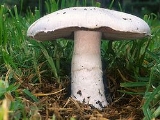
Agaricales

Encyclopedia
The fungal order
Agaricales, also known as gilled mushrooms (for their distinctive gill
s), or euagarics, contains some of the most familiar types of mushrooms. The order
has 33 extant families
, 413 genera
, and over 13000 described species
, along with five extinct genera known only from the fossil record. They range from the ubiquitous common mushroom to the deadly destroying angel
and the hallucinogen
ic fly agaric
to the bioluminescent
jack-o-lantern mushroom.
published between 1821 and 1832, Elias Fries put almost all of the fleshy, gill-forming mushrooms in the genus Agaricus
. He organized the large genus into "tribes", the names of many of which still exist as common genera of today. Fries later elevated several of these tribes to generic level, but later authors—including Gillet, Karsten, Kummer
, Quélet
, and Staude—made most of the changes. Fries based his classification on macroscopic characters of the fruit bodies and color of the spore print. His system had been widely used as it had the advantage that many genera could be readily identified based on characters observable in the field. Fries's classification was later challenged when microscopic studies of basidiocarp structure, initiated by Fayod
and Patouillard
, demonstrated several of Fries's groupings were unnatural. In more recent history, Rolf Singer's influential work The Agaricales in Modern Taxonomy, published in four editions spanning from 1951 to 1986, used both Fries's macroscopic characters and Fayod's microscopic characters to reorganize families
and genera; his most recent classification included 230 genera within 18 families. Singer treated three major groups within the Agaricales sensu lato: the Agaricales sensu stricto, Boletales
, and Russulales
. These groups are still accepted by modern treatments based on DNA analysis, as the euagarics clade, bolete clade, and russuloid clade.
Molecular phylogenetics research has demonstrated that the euagarics clade is roughly equivalent to Singer's Agaricales sensu stricto. A recent (2006) large-scale study by Brandon Matheny and colleagues used nucleic acid sequences representing six gene
regions from 238 species in 146 genera to explore the phylogenetic grouping within the Agaricales. The analysis showed that most of the species tested could be grouped into six clade
s that were named the Agaricoid, Tricholomatoid, Marasmioid, Pluteoid, Hygrophoroid and Plicaturopsidoid clades.
Some notable fungi with gill-like structures, such as chanterelle
s, have long been recognized as being substantially different from usual Agaricales. Interestingly, molecular studies are showing more groups of agarics as being more divergent than previously thought, such as the genera Russula
and Lactarius
belonging to a separate order Russulales
, and other gilled fungi, including such species as Paxillus involutus
and Hygrophoropsis aurantiaca
showing a closer affinity with Bolete
s in the order Boletales
.
Also, some other quite distinctive fungi, the puffball
s, and some clavaroid fungi, e.g. Typhula
, and the Beefsteak fungus have been recently been shown to lie within the Agaricales.
The term agaric
had traditionally referred to Agaricales, which were defined as exactly those fungi with gills. Given the discoveries described above, those two categories are not synonymous (although there is a very large overlap between the two groups).
, the only gilled mushroom known to fruit underwater.
Agaricals are known from five monotypic
genera found fossilized in amber
. The oldest records are from two Cretaceous
age genera; the Albian
age (approximately 100 Ma) Palaeoagaracites antiquus
from Burmese amber and the slightly younger Turonian
New Jersey Amber species Archaeomarasmius leggeti
. The three other species, Aureofungus yaniguaensis
, Coprinites dominicana
and Protomycena electra
are known from single specimens found in the Dominican amber
mines of Hispaniola
.
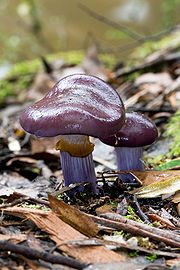
s of the agarics are typically fleshy, with a stipe
, often called a stem or stalk, a pileus
(or cap) and lamellae (or gills), where basidiospore
s are produced. This is the stereotypical structure of a mushroom
.
. Most fungi reproduce by spores and the fruit bodies are developed specifically for the production and dispersal of spores. The spores produced by fruit bodies are usually the result of sexual reproduction
.
The fruit body is the visible part of the growing fungus. It is supported by and develops from an extensive network of thread-like filaments called hypha
e. Hyphae are often collectively termed the mycelium
; the food-absorbing part of the fungus—as opposed to the spore-producing fruit body of the fungus—is called the vegetative mycelium. The individual hyphae that compose the mycelium absorb nutrients and water from the substratum in which they are growing. When the nutrient supply is adequte and envirnmental conditions are favorable, some fungi may grow in the same location for several years. Fungi cannot make their own food, namely carbohydrate
s, as can green plants. Some species are saprobic, obtaining nutrients from dead organic material
, whereas others are parasitic
on living plants or animals or even on other fungi. Many fungi, especially gilled mushroomes and boletes, have an extensive mycelium that lives in association with the roots of woody plants. This association, which is beneficial to both the fungus and host plant, is termed a mycorrhiza
.
When the environmental conditions are favorable and the mycelium is at the proper stage of development, one or more fruit bodies are produced by the fungus. The actual conditions necessary for fruit body formation and spore production are not clearly understood. Humidity
, light, temperature, aeration, and nutrition are all factors thought to be important in fruit body formation. The genetic makeup and the general physiology of the fungus hyphae are also important in the initiation and formation of young fruit bodies and their development to a mature stage. The spores produced by a fruit body are released when it is mature. When they land in a suitable environment, the spores germinate and the hyphae grow to initiate the life cycle anew.
with respect to familial placement). These include:
Order (biology)
In scientific classification used in biology, the order is# a taxonomic rank used in the classification of organisms. Other well-known ranks are life, domain, kingdom, phylum, class, family, genus, and species, with order fitting in between class and family...
Agaricales, also known as gilled mushrooms (for their distinctive gill
Gill (mushroom)
A lamella, or gill, is a papery hymenophore rib under the cap of some mushroom species, most often but not always agarics. The gills are used by the mushrooms as a means of spore dispersal, and are important for species identification...
s), or euagarics, contains some of the most familiar types of mushrooms. The order
Order (biology)
In scientific classification used in biology, the order is# a taxonomic rank used in the classification of organisms. Other well-known ranks are life, domain, kingdom, phylum, class, family, genus, and species, with order fitting in between class and family...
has 33 extant families
Family (biology)
In biological classification, family is* a taxonomic rank. Other well-known ranks are life, domain, kingdom, phylum, class, order, genus, and species, with family fitting between order and genus. As for the other well-known ranks, there is the option of an immediately lower rank, indicated by the...
, 413 genera
Genus
In biology, a genus is a low-level taxonomic rank used in the biological classification of living and fossil organisms, which is an example of definition by genus and differentia...
, and over 13000 described species
Species
In biology, a species is one of the basic units of biological classification and a taxonomic rank. A species is often defined as a group of organisms capable of interbreeding and producing fertile offspring. While in many cases this definition is adequate, more precise or differing measures are...
, along with five extinct genera known only from the fossil record. They range from the ubiquitous common mushroom to the deadly destroying angel
Amanita virosa
Amanita virosa, commonly known as the European destroying angel, is a deadly poisonous basidiomycete fungus, one of many in the genus Amanita. Occurring in Europe, A. virosa associates with various deciduous and coniferous trees...
and the hallucinogen
Psychedelics, dissociatives and deliriants
This general group of pharmacological agents can be divided into three broad categories: psychedelics, dissociatives, and deliriants. These classes of psychoactive drugs have in common that they can cause subjective changes in perception, thought, emotion and consciousness...
ic fly agaric
Amanita muscaria
Amanita muscaria, commonly known as the fly agaric or fly amanita , is a poisonous and psychoactive basidiomycete fungus, one of many in the genus Amanita...
to the bioluminescent
Bioluminescence
Bioluminescence is the production and emission of light by a living organism. Its name is a hybrid word, originating from the Greek bios for "living" and the Latin lumen "light". Bioluminescence is a naturally occurring form of chemiluminescence where energy is released by a chemical reaction in...
jack-o-lantern mushroom.
History, classification and phylogeny
In his three volumes of Systema MycologicumSystema Mycologicum
Systema Mycologicum is a systematic classification of fungi drawn up in 1821 by the Swedish mycologist and botanist Elias Fries. It took 11 years to complete....
published between 1821 and 1832, Elias Fries put almost all of the fleshy, gill-forming mushrooms in the genus Agaricus
Agaricus
Agaricus is a large and important genus of mushrooms containing both edible and poisonous species, with possibly over 300 members worldwide...
. He organized the large genus into "tribes", the names of many of which still exist as common genera of today. Fries later elevated several of these tribes to generic level, but later authors—including Gillet, Karsten, Kummer
Paul Kummer
Paul Kummer was a priest, teacher, and scientist in Zerbst, Germany, known chiefly for his contribution to mycological nomenclature. Earlier classification of agarics by pioneering fungal taxonomist Elias Magnus Fries designated only a very small number of genera, with most species falling into...
, Quélet
Lucien Quélet
thumb|Lucien QuéletLucien Quélet was a French mycologist and naturalist who discovered several species and was the founder of the Société mycologique de France, a society devoted to mycological studies....
, and Staude—made most of the changes. Fries based his classification on macroscopic characters of the fruit bodies and color of the spore print. His system had been widely used as it had the advantage that many genera could be readily identified based on characters observable in the field. Fries's classification was later challenged when microscopic studies of basidiocarp structure, initiated by Fayod
Victor Fayod
Victor Fayod was a Swiss mycologist. He is credited with the first description of the mushroom Cystoderma amianthinum. He studied in Lausanne and Zurich. Fayod first worked with Heinrich Anton de Bary in Strasbourg from 1881 to 1882, then as a tutor. He also assisted French bacteriologist André...
and Patouillard
Narcisse Théophile Patouillard
Narcisse Théophile Patouillard was a French pharmacist and mycologist.He was born in Macornay, a town in the department of Jura...
, demonstrated several of Fries's groupings were unnatural. In more recent history, Rolf Singer's influential work The Agaricales in Modern Taxonomy, published in four editions spanning from 1951 to 1986, used both Fries's macroscopic characters and Fayod's microscopic characters to reorganize families
Family (biology)
In biological classification, family is* a taxonomic rank. Other well-known ranks are life, domain, kingdom, phylum, class, order, genus, and species, with family fitting between order and genus. As for the other well-known ranks, there is the option of an immediately lower rank, indicated by the...
and genera; his most recent classification included 230 genera within 18 families. Singer treated three major groups within the Agaricales sensu lato: the Agaricales sensu stricto, Boletales
Boletales
The Boletales are an order of Agaricomycetes, containing over 1300 species with a diverse array of fruiting body types. The boletes are the best known members of this group, and until recently, the Boletales were thought to only contain boletes...
, and Russulales
Russulales
The Russulales are an order of the Agaricomycetes,...
. These groups are still accepted by modern treatments based on DNA analysis, as the euagarics clade, bolete clade, and russuloid clade.
Molecular phylogenetics research has demonstrated that the euagarics clade is roughly equivalent to Singer's Agaricales sensu stricto. A recent (2006) large-scale study by Brandon Matheny and colleagues used nucleic acid sequences representing six gene
Gene
A gene is a molecular unit of heredity of a living organism. It is a name given to some stretches of DNA and RNA that code for a type of protein or for an RNA chain that has a function in the organism. Living beings depend on genes, as they specify all proteins and functional RNA chains...
regions from 238 species in 146 genera to explore the phylogenetic grouping within the Agaricales. The analysis showed that most of the species tested could be grouped into six clade
Clade
A clade is a group consisting of a species and all its descendants. In the terms of biological systematics, a clade is a single "branch" on the "tree of life". The idea that such a "natural group" of organisms should be grouped together and given a taxonomic name is central to biological...
s that were named the Agaricoid, Tricholomatoid, Marasmioid, Pluteoid, Hygrophoroid and Plicaturopsidoid clades.
Some notable fungi with gill-like structures, such as chanterelle
Chanterelle
Cantharellus cibarius, commonly known as the chanterelle, golden chanterelle or girolle, is a fungus. It is probably the best known species of the genus Cantharellus, if not the entire family of Cantharellaceae. It is orange or yellow, meaty and funnel-shaped...
s, have long been recognized as being substantially different from usual Agaricales. Interestingly, molecular studies are showing more groups of agarics as being more divergent than previously thought, such as the genera Russula
Russula
Around 750 worldwide species of mycorrhizal mushrooms compose the genus Russula. They are typically common, fairly large, and brightly colored - making them one of the most recognizable genera among mycologists and mushroom collectors...
and Lactarius
Lactarius
Lactarius is a genus of mushroom-producing fungi. The genus, collectively known commonly as milk-caps, are characterized by the fact that they exude a milky fluid if cut or damaged...
belonging to a separate order Russulales
Russulales
The Russulales are an order of the Agaricomycetes,...
, and other gilled fungi, including such species as Paxillus involutus
Paxillus involutus
Paxillus involutus, commonly known as the brown roll-rim, common roll-rim, or poison pax, is a basidiomycete fungus widely distributed across the Northern Hemisphere. It has been unintentionally introduced to Australia, New Zealand, and South America, where it has likely been transported in soil...
and Hygrophoropsis aurantiaca
Hygrophoropsis aurantiaca
Hygrophoropsis aurantiaca, commonly known as the False Chanterelle, is an orange funnel-shaped mushroom which has been confused at times with the true chanterelles, however recent work shows its affinity lies with the Boletes in the order Boletales.-Description:The False chanterelle has an orange...
showing a closer affinity with Bolete
Bolete
A bolete is a type of fungal fruiting body characterized by the presence of a pileus that is clearly differentiated from the stipe, with a spongy surface of pores on the underside of the pileus...
s in the order Boletales
Boletales
The Boletales are an order of Agaricomycetes, containing over 1300 species with a diverse array of fruiting body types. The boletes are the best known members of this group, and until recently, the Boletales were thought to only contain boletes...
.
Also, some other quite distinctive fungi, the puffball
Puffball
A puffball is a member of any of several groups of fungus in the division Basidiomycota. The puffballs were previously treated as a taxonomic group called the Gasteromycetes or Gasteromycetidae, but they are now known to be a polyphyletic assemblage. The distinguishing feature of all puffballs is...
s, and some clavaroid fungi, e.g. Typhula
Typhula
Typhula is a genus of clavarioid fungi in the order Agaricales. Species of Typhula are saprotrophic, mostly decomposing leaves, twigs, and herbaceous material. Basidiocarps are club-shaped or narrowly cylindrical and are simple , often arising from sclerotia. The anamorphic genus Sclerotium is a...
, and the Beefsteak fungus have been recently been shown to lie within the Agaricales.
The term agaric
Agaric
An agaric is a type of fungal fruiting body characterized by the presence of a pileus that is clearly differentiated from the stipe , with lamellae on the underside of the pileus. "Agaric" can also refer to a basidiomycete species characterized by an agaric-type fruiting body...
had traditionally referred to Agaricales, which were defined as exactly those fungi with gills. Given the discoveries described above, those two categories are not synonymous (although there is a very large overlap between the two groups).
Distribution and habitat
Agarics are ubiquitous, being found across all continents. Most are terrestrial, their habitats including all types of woodland and grassland, varying largely from one genus to another. Agarics were long thought to be solely terrestrial, until the 2005 discovery of Psathyrella aquaticaPsathyrella aquatica
Psathyrella aquatica is a species of fungus from Oregon, described in the journal Mycologia in 2010. It represents the first report of a gilled mushroom fruiting underwater. It was found by Southern Oregon University professor Robert Coffan in the Rogue River in the U.S. state of Oregon...
, the only gilled mushroom known to fruit underwater.
Agaricals are known from five monotypic
Monotypic
In biology, a monotypic taxon is a taxonomic group with only one biological type. The term's usage differs slightly between botany and zoology. The term monotypic has a separate use in conservation biology, monotypic habitat, regarding species habitat conversion eliminating biodiversity and...
genera found fossilized in amber
Amber
Amber is fossilized tree resin , which has been appreciated for its color and natural beauty since Neolithic times. Amber is used as an ingredient in perfumes, as a healing agent in folk medicine, and as jewelry. There are five classes of amber, defined on the basis of their chemical constituents...
. The oldest records are from two Cretaceous
Cretaceous
The Cretaceous , derived from the Latin "creta" , usually abbreviated K for its German translation Kreide , is a geologic period and system from circa to million years ago. In the geologic timescale, the Cretaceous follows the Jurassic period and is followed by the Paleogene period of the...
age genera; the Albian
Albian
The Albian is both an age of the geologic timescale and a stage in the stratigraphic column. It is the youngest or uppermost subdivision of the Early/Lower Cretaceous epoch/series. Its approximate time range is 112.0 ± 1.0 Ma to 99.6 ± 0.9 Ma...
age (approximately 100 Ma) Palaeoagaracites antiquus
Palaeoagaracites
Palaeoagaracites is an extinct monotypic genus of gilled fungus in the order Agaricales. At present it contains the single species Palaeoagaracites antiquus....
from Burmese amber and the slightly younger Turonian
Turonian
The Turonian is, in the ICS' geologic timescale, the second age in the Late Cretaceous epoch, or a stage in the Upper Cretaceous series. It spans the time between 93.5 ± 0.8 Ma and 89.3 ± 1 Ma...
New Jersey Amber species Archaeomarasmius leggeti
Archaeomarasmius
Archaeomarasmius is an extinct genus of gilled fungus in the Agaricales family Tricholomataceae, containing the single species Archaeomarasmius leggetti. It is known from two fruit bodies recovered from amber, one consisting of a complete cap with a broken stem, the other consisting of a fragment...
. The three other species, Aureofungus yaniguaensis
Aureofungus
Aureofungus is an extinct monotypic genus of gilled fungus in the order Agaricales. At present it contains the single species Aureofungus yaniguaensis....
, Coprinites dominicana
Coprinites
Coprinites is an extinct monotypic genus of gilled fungus in the Agaricales family Agaricaceae. At present it contains the single species Coprinites dominicana....
and Protomycena electra
Protomycena
Protomycena is an extinct monotypic genus of gilled fungus in the Mycenaceae family, of order Agaricales. At present it contains the single species Protomycena electra, known from a single specimen collected in an amber mine in the Cordillera Septentrional area of the Dominican Republic...
are known from single specimens found in the Dominican amber
Dominican amber
Dominican amber is amber from the Dominican Republic. Resin from the extinct species Hymenaea protera is the source of Dominican amber and probably of most amber found in the tropics....
mines of Hispaniola
Hispaniola
Hispaniola is a major island in the Caribbean, containing the two sovereign states of the Dominican Republic and Haiti. The island is located between the islands of Cuba to the west and Puerto Rico to the east, within the hurricane belt...
.
Characteristics
BasidiocarpBasidiocarp
In fungi, a basidiocarp, basidiome or basidioma , is the sporocarp of a basidiomycete, the multicellular structure on which the spore-producing hymenium is borne. Basidiocarps are characteristic of the hymenomycetes; rusts and smuts do not produce such structures...
s of the agarics are typically fleshy, with a stipe
Stipe (mycology)
thumb|150px|right|Diagram of a [[basidiomycete]] stipe with an [[annulus |annulus]] and [[volva |volva]]In mycology a stipe refers to the stem or stalk-like feature supporting the cap of a mushroom. Like all tissues of the mushroom other than the hymenium, the stipe is composed of sterile hyphal...
, often called a stem or stalk, a pileus
Pileus (mycology)
The pileus is the technical name for the cap, or cap-like part, of a basidiocarp or ascocarp that supports a spore-bearing surface, the hymenium. The hymenium may consist of lamellae, tubes, or teeth, on the underside of the pileus...
(or cap) and lamellae (or gills), where basidiospore
Basidiospore
A basidiospore is a reproductive spore produced by Basidiomycete fungi. Basidiospores typically each contain one haploid nucleus that is the product of meiosis, and they are produced by specialized fungal cells called basidia. In grills under a cap of one common species in the phylum of...
s are produced. This is the stereotypical structure of a mushroom
Mushroom
A mushroom is the fleshy, spore-bearing fruiting body of a fungus, typically produced above ground on soil or on its food source. The standard for the name "mushroom" is the cultivated white button mushroom, Agaricus bisporus; hence the word "mushroom" is most often applied to those fungi that...
.
Life cycle
The fungus fruit body is the spore-producing stage of the life cycleBiological life cycle
A life cycle is a period involving all different generations of a species succeeding each other through means of reproduction, whether through asexual reproduction or sexual reproduction...
. Most fungi reproduce by spores and the fruit bodies are developed specifically for the production and dispersal of spores. The spores produced by fruit bodies are usually the result of sexual reproduction
Sexual reproduction
Sexual reproduction is the creation of a new organism by combining the genetic material of two organisms. There are two main processes during sexual reproduction; they are: meiosis, involving the halving of the number of chromosomes; and fertilization, involving the fusion of two gametes and the...
.
The fruit body is the visible part of the growing fungus. It is supported by and develops from an extensive network of thread-like filaments called hypha
Hypha
A hypha is a long, branching filamentous structure of a fungus, and also of unrelated Actinobacteria. In most fungi, hyphae are the main mode of vegetative growth, and are collectively called a mycelium; yeasts are unicellular fungi that do not grow as hyphae.-Structure:A hypha consists of one or...
e. Hyphae are often collectively termed the mycelium
Mycelium
thumb|right|Fungal myceliaMycelium is the vegetative part of a fungus, consisting of a mass of branching, thread-like hyphae. The mass of hyphae is sometimes called shiro, especially within the fairy ring fungi. Fungal colonies composed of mycelia are found in soil and on or within many other...
; the food-absorbing part of the fungus—as opposed to the spore-producing fruit body of the fungus—is called the vegetative mycelium. The individual hyphae that compose the mycelium absorb nutrients and water from the substratum in which they are growing. When the nutrient supply is adequte and envirnmental conditions are favorable, some fungi may grow in the same location for several years. Fungi cannot make their own food, namely carbohydrate
Carbohydrate
A carbohydrate is an organic compound with the empirical formula ; that is, consists only of carbon, hydrogen, and oxygen, with a hydrogen:oxygen atom ratio of 2:1 . However, there are exceptions to this. One common example would be deoxyribose, a component of DNA, which has the empirical...
s, as can green plants. Some species are saprobic, obtaining nutrients from dead organic material
Organic matter
Organic matter is matter that has come from a once-living organism; is capable of decay, or the product of decay; or is composed of organic compounds...
, whereas others are parasitic
Parasitism
Parasitism is a type of symbiotic relationship between organisms of different species where one organism, the parasite, benefits at the expense of the other, the host. Traditionally parasite referred to organisms with lifestages that needed more than one host . These are now called macroparasites...
on living plants or animals or even on other fungi. Many fungi, especially gilled mushroomes and boletes, have an extensive mycelium that lives in association with the roots of woody plants. This association, which is beneficial to both the fungus and host plant, is termed a mycorrhiza
Mycorrhiza
A mycorrhiza is a symbiotic association between a fungus and the roots of a vascular plant....
.
When the environmental conditions are favorable and the mycelium is at the proper stage of development, one or more fruit bodies are produced by the fungus. The actual conditions necessary for fruit body formation and spore production are not clearly understood. Humidity
Humidity
Humidity is a term for the amount of water vapor in the air, and can refer to any one of several measurements of humidity. Formally, humid air is not "moist air" but a mixture of water vapor and other constituents of air, and humidity is defined in terms of the water content of this mixture,...
, light, temperature, aeration, and nutrition are all factors thought to be important in fruit body formation. The genetic makeup and the general physiology of the fungus hyphae are also important in the initiation and formation of young fruit bodies and their development to a mature stage. The spores produced by a fruit body are released when it is mature. When they land in a suitable environment, the spores germinate and the hyphae grow to initiate the life cycle anew.
Genera Incertae sedis
There are several genera classified in the Agaricales that are poorly-known or have not been subjected to DNA analysis, and have not been assigned to a specific family (i.e., Incertae sedisIncertae sedis
, is a term used to define a taxonomic group where its broader relationships are unknown or undefined. Uncertainty at specific taxonomic levels is attributed by , , and similar terms.-Examples:*The fossil plant Paradinandra suecica could not be assigned to any...
with respect to familial placement). These include:
- AmogasterAmogasterAmogaster is a genus of fungi in the order Agaricales. It is incertae sedis with respect to familial placement within the order. The genus is monotypic, containing the single truffle-like species Amogaster viridigleba, found in the United States....
- †ExtinctionIn biology and ecology, extinction is the end of an organism or of a group of organisms , normally a species. The moment of extinction is generally considered to be the death of the last individual of the species, although the capacity to breed and recover may have been lost before this point...
AureofungusAureofungusAureofungus is an extinct monotypic genus of gilled fungus in the order Agaricales. At present it contains the single species Aureofungus yaniguaensis.... - BrunneocorticiumBrunneocorticiumBrunneocorticium is a genus of two fungi in the order Agaricales. It is incertae sedis with respect to familial placement within the order. The genus, described in 2007, contains two corticioid species....
- CheilophlebiumCheilophlebiumCheilophlebium is a fungal genus in the order Agaricales. It is incertae sedis with respect to familial placement within the order. The genus is monotypic, containing the single species Cheilophlebium villosum, described by Philipp Maximilian Opiz in 1856...
- CleistocybeCleistocybeCleistocybe is a genus of fungi in the order Agaricales. It is incertae sedis with respect to familial placement within the order. The genus was described in 2007, and contains three species....
- CribrosporaCribrosporaCribrospora is a genus of fungus in the order Agaricales. It is incertae sedis with respect to familial placement within the order. The genus is monotypic, containing the single species Cribrospora tulostomoides, found in Europe....
- DisporotrichumDisporotrichumDisporotrichum is a genus of anamorph fungus in the order Agaricales. It is incertae sedis with respect to familial placement within the order. The genus is monotypic, containing the single species Disporotrichum dimorphosporum, known from The Netherlands....
(anamorphTeleomorph, anamorph and holomorphThe terms teleomorph, anamorph, and holomorph apply to portions of the life cycles of fungi in the phyla Ascomycota and Basidiomycota.*Teleomorph: the sexual reproductive stage , typically a fruiting body....
) - MesophelliopsisMesophelliopsisMesophelliopsis is a genus of fungi in the order Agaricales. It is incertae sedis with respect to familial placement within the order. The genus is monotypic, containing the single species Mesophelliopsis pernambucensis, found in Brazil....
- †PalaeoagaracitesPalaeoagaracitesPalaeoagaracites is an extinct monotypic genus of gilled fungus in the order Agaricales. At present it contains the single species Palaeoagaracites antiquus....
- PanaeolinaPanaeolinaPanaeolina is a small genus of small mushrooms, containing only about four species. They are a subgroup of Panaeolus which have dark brown spores. The type species is Panaeolina foenisecii, a common lawn mushroom...
- PanaeolusPanaeolusPanaeolus is a genus of small, black-spored, saprotrophic agarics. The word Panaeolus is Greek for "all variegated", alluding to the spotted gills of the mushrooms produced.- Characteristics :...
- PhlebophyllumPhlebophyllumPhlebophyllum is a genus of fungi in the order Agaricales. It is incertae sedis with respect to familial placement within the order. The genus is monotypic, containing the single species Phlebophyllum vitellinum, discovered in Gabon and reported as new to science by mycologist Roger Heim in 1969....
- PlicaturaPlicaturaPlicatura is a fungal genus in the order Agaricales. It is incertae sedis with respect to familial placement within the order, although Kirk and colleagues consider it likely aligned with either the Amylocorticiaceae or the Tricholomataceae...
- PlicaturopsisPlicaturopsisPlicaturopsis is a genus of fungi in the order Agaricales. It is incertae sedis with respect to familial placement within the order, although Kirk and colleagues consider it likely aligned with either the Amylocorticiaceae or the Tricholomataceae. The genus was circumscribed by English mycologist...
- SedeculaSedeculaSedecula is a genus of fungi in the order Agaricales. It is incertae sedis with respect to familial placement within the order. The genus is monotypic, containing the single species Sedecula pulvinata, found in the United States, and first described by American mycologist Sanford Myron Zeller in...
- SetchelliogasterSetchelliogasterSetchelliogaster is a genus of fungi in the order Agaricales. It is incertae sedis with respect to familial placement within the order, although Kirk and colleagues consider it likely aligned with either the Bolbitiaceae or the Cortinariaceae. The genus is widespread in warm, dry areas, and...
- TrichocybeTrichocybeTrichocybe is a genus of fungi in the order Agaricales. It is incertae sedis with respect to familial placement within the order. The genus was created in 2010 to contain the species Trichocybe puberula, originally described as a Clitocybe by Thom Kuyper in 1983....
External links
- Mushroom Expert The Gilled Mushrooms ("Agaricales")
- Tree of Life: Agaricales