

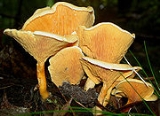
Hygrophoropsis aurantiaca

Encyclopedia
Hygrophoropsis aurantiaca, commonly known as the False Chanterelle, is an orange funnel-shaped mushroom which has been confused at times with the true chanterelles
, however recent work shows its affinity lies with the Boletes in the order Boletales
.
and conifer forests, in summer and autumn. It fruits from the ground or from decaying wood.
, which may account for the gastrointestinal symptoms some people experience. Recent taxonomic research has demonstrated that Hygrophoropsis is a close relative Paxillus
, a genus that includes Paxillus involutus
, a species known to have cumulative autoimmune toxicity. Hence, some guides recommend avoiding consumption of Hygrophoropsis as well.
; the distinguishing factors are color (true Chanterelle is uniform egg-yellow, while the false one is more orange in hue and graded, with darker center) and attachment of gills to the stem (true Chanterelle does not have true, blade-like gills--rather, has rib-like folds running down the stem).
The poisonous jack-o'-lantern mushroom
s are also sometimes confused with Chanterelles; straight, non-forked true gills is one of the factors distinguishing them from true Chanterelles.
Cantharellus
Cantharellus is a genus of popular edible mushrooms, commonly known as chanterelles . They are mycorrhizal fungi, meaning they form symbiotic associations with plants, making them very difficult to cultivate...
, however recent work shows its affinity lies with the Boletes in the order Boletales
Boletales
The Boletales are an order of Agaricomycetes, containing over 1300 species with a diverse array of fruiting body types. The boletes are the best known members of this group, and until recently, the Boletales were thought to only contain boletes...
.
Description
The False chanterelle has an orange cap up to 8 cm across, initially convex but becoming funnel-shaped. The decurrent gill-like structures are orange and forked, which is a distinctive and distinguishing feature. The spore print is white. The orange stipe is up to 5 cm high and lacks a ring.Distribution and habitat
It is widely distributed in Europe and North America, being found in both hardwoodHardwood
Hardwood is wood from angiosperm trees . It may also be used for those trees themselves: these are usually broad-leaved; in temperate and boreal latitudes they are mostly deciduous, but in tropics and subtropics mostly evergreen.Hardwood contrasts with softwood...
and conifer forests, in summer and autumn. It fruits from the ground or from decaying wood.
Edibility
It has been described as edible (though not tasty) by some experts, but other authors describe it as poisonous. This mushroom contains high levels of arabitolArabitol
Arabitol or arabinitol is a sugar alcohol. It can be formed by the reduction of either arabinose or lyxose. Some organic acid tests check for the presence of D-arabinitol, which may indicate overgrowth of intestinal parasites such as Candida albicans or other yeast/fungus species....
, which may account for the gastrointestinal symptoms some people experience. Recent taxonomic research has demonstrated that Hygrophoropsis is a close relative Paxillus
Paxillus
Paxillus is a genus of mushrooms of which most are known to be poisonous or inedible. The widespread genus contains 15 species. Species include Paxillus involutus and Paxillus vernalis...
, a genus that includes Paxillus involutus
Paxillus involutus
Paxillus involutus, commonly known as the brown roll-rim, common roll-rim, or poison pax, is a basidiomycete fungus widely distributed across the Northern Hemisphere. It has been unintentionally introduced to Australia, New Zealand, and South America, where it has likely been transported in soil...
, a species known to have cumulative autoimmune toxicity. Hence, some guides recommend avoiding consumption of Hygrophoropsis as well.
Similar species
This mushroom is commonly confused with the ChanterelleCantharellus
Cantharellus is a genus of popular edible mushrooms, commonly known as chanterelles . They are mycorrhizal fungi, meaning they form symbiotic associations with plants, making them very difficult to cultivate...
; the distinguishing factors are color (true Chanterelle is uniform egg-yellow, while the false one is more orange in hue and graded, with darker center) and attachment of gills to the stem (true Chanterelle does not have true, blade-like gills--rather, has rib-like folds running down the stem).
The poisonous jack-o'-lantern mushroom
Omphalotus
Omphalotus is a genus of Basidiomycete mushroom formally described by Victor Fayod in 1889. Members have the traditional cap and stem toadstool form. The best known and type species is the jack-o'-lantern mushroom . Species of Omphalotus, which are poisonous, have been mistaken for chanterelles...
s are also sometimes confused with Chanterelles; straight, non-forked true gills is one of the factors distinguishing them from true Chanterelles.