

944 Hidalgo

Encyclopedia
944 Hidalgo is a small Solar System body
with a semi-major axis
beyond Jupiter
's and an orbital period
of 13.77 years. This makes it a centaur, but it was discovered in 1920 and has hence traditionally been considered an asteroid
.
-like asteroid. (This designation is given to those objects that have orbits between Jupiter
and Neptune
.) Though Hidalgo has a semi-major axis
beyond Jupiter, the Minor Planet Center
(MPC) does not list it as a centaur.
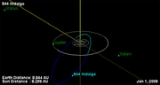
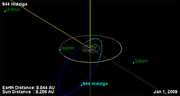
With a high eccentricity of 0.66, its perihelion of 1.95 AU
takes it to the inner edge of the asteroid belt, while its aphelion of 9.54 AU takes it right out to Saturn
's orbit, a characteristic normally associated with Saturn's family of comets. Some astronomers therefore suspect that it was once a comet
. Strictly speaking, Hidalgo is a Saturn-grazer rather than a Saturn-crosser
as its aphelion does not clear Saturn's. Hidalgo's severe orbital inclination of 43° is suspected to be the result of a close encounter with Jupiter. Even as recently as 1922, Hidalgo passed within 0.89AU of the powerful influence of Jupiter. Its diameter is estimated to be 38 km.
 944 Hidalgo was discovered
by Walter Baade
on October 31, 1920 at Bergedorf Observatory near Hamburg
, Germany
. It is named for Miguel Hidalgo y Costilla, who was responsible for declaring Mexico's independence in 1810. German astronomers who were in Mexico
to observe a total eclipse
on September 10, 1923, had an audience with President
Álvaro Obregón
. During this meeting, they asked his permission to name the asteroid after Hidalgo y Costilla.
It was one of five minor planets included in the 1993 study, Transition Comets -- UV Search for OH Emissions in Asteroids
, which was research involving amateur astronomers who were permitted to make use of the Hubble Space Telescope.
In the late 1990s, a network of astronomers worldwide gathered lightcurve data that was ultimately used to derive the spin states and shape models of 10 new asteroids, including (944) Hidalgo. Lightcurve data has also been recorded by observers at the Antelope Hills Observatory, which has been designated as an official observatory by the Minor Planet Center
.
When Pluto
was discovered Hidalgo was the furthest known asteroid from the Sun.
Small Solar System body
A small Solar System body is an object in the Solar System that is neither a planet nor a dwarf planet, nor a satellite of a planet or dwarf planet:...
with a semi-major axis
Semi-major axis
The major axis of an ellipse is its longest diameter, a line that runs through the centre and both foci, its ends being at the widest points of the shape...
beyond Jupiter
Jupiter
Jupiter is the fifth planet from the Sun and the largest planet within the Solar System. It is a gas giant with mass one-thousandth that of the Sun but is two and a half times the mass of all the other planets in our Solar System combined. Jupiter is classified as a gas giant along with Saturn,...
's and an orbital period
Orbital period
The orbital period is the time taken for a given object to make one complete orbit about another object.When mentioned without further qualification in astronomy this refers to the sidereal period of an astronomical object, which is calculated with respect to the stars.There are several kinds of...
of 13.77 years. This makes it a centaur, but it was discovered in 1920 and has hence traditionally been considered an asteroid
Asteroid
Asteroids are a class of small Solar System bodies in orbit around the Sun. They have also been called planetoids, especially the larger ones...
.
Description and classification
944 Hidalgo is a centaurCentaur (planetoid)
Centaurs are an unstable orbital class of minor planets that behave with characteristics of both asteroids and comets. They are named after the mythological race of beings, centaurs, which were a mixture of horse and human...
-like asteroid. (This designation is given to those objects that have orbits between Jupiter
Jupiter
Jupiter is the fifth planet from the Sun and the largest planet within the Solar System. It is a gas giant with mass one-thousandth that of the Sun but is two and a half times the mass of all the other planets in our Solar System combined. Jupiter is classified as a gas giant along with Saturn,...
and Neptune
Neptune
Neptune is the eighth and farthest planet from the Sun in the Solar System. Named for the Roman god of the sea, it is the fourth-largest planet by diameter and the third largest by mass. Neptune is 17 times the mass of Earth and is slightly more massive than its near-twin Uranus, which is 15 times...
.) Though Hidalgo has a semi-major axis
Semi-major axis
The major axis of an ellipse is its longest diameter, a line that runs through the centre and both foci, its ends being at the widest points of the shape...
beyond Jupiter, the Minor Planet Center
Minor Planet Center
The Minor Planet Center operates at the Smithsonian Astrophysical Observatory , which is part of the Center for Astrophysics along with the Harvard College Observatory ....
(MPC) does not list it as a centaur.
With a high eccentricity of 0.66, its perihelion of 1.95 AU
Astronomical unit
An astronomical unit is a unit of length equal to about or approximately the mean Earth–Sun distance....
takes it to the inner edge of the asteroid belt, while its aphelion of 9.54 AU takes it right out to Saturn
Saturn
Saturn is the sixth planet from the Sun and the second largest planet in the Solar System, after Jupiter. Saturn is named after the Roman god Saturn, equated to the Greek Cronus , the Babylonian Ninurta and the Hindu Shani. Saturn's astronomical symbol represents the Roman god's sickle.Saturn,...
's orbit, a characteristic normally associated with Saturn's family of comets. Some astronomers therefore suspect that it was once a comet
Comet
A comet is an icy small Solar System body that, when close enough to the Sun, displays a visible coma and sometimes also a tail. These phenomena are both due to the effects of solar radiation and the solar wind upon the nucleus of the comet...
. Strictly speaking, Hidalgo is a Saturn-grazer rather than a Saturn-crosser
Saturn-crosser asteroid
A Saturn-crosser is a minor planet whose orbit crosses that of Saturn. The known numbered Saturn-crossers are listed below. There is only one inner-grazer and no outer-grazers or co-orbitals known; most if not all of the crossers are centaurs.Notes: † inner-grazer.* 944 Hidalgo †* 2060 Chiron*...
as its aphelion does not clear Saturn's. Hidalgo's severe orbital inclination of 43° is suspected to be the result of a close encounter with Jupiter. Even as recently as 1922, Hidalgo passed within 0.89AU of the powerful influence of Jupiter. Its diameter is estimated to be 38 km.
Discovery and subsequent studies
Discovery (observation)
Discovery is the act of detecting something new, or something "old" that had been unknown. With reference to science and academic disciplines, discovery is the observation of new phenomena, new actions, or new events and providing new reasoning to explain the knowledge gathered through such...
by Walter Baade
Walter Baade
Wilhelm Heinrich Walter Baade was a German astronomer who worked in the USA from 1931 to 1959.-Biography:He took advantage of wartime blackout conditions during World War II, which reduced light pollution at Mount Wilson Observatory, to resolve stars in the center of the Andromeda galaxy for the...
on October 31, 1920 at Bergedorf Observatory near Hamburg
Hamburg
-History:The first historic name for the city was, according to Claudius Ptolemy's reports, Treva.But the city takes its modern name, Hamburg, from the first permanent building on the site, a castle whose construction was ordered by the Emperor Charlemagne in AD 808...
, Germany
Germany
Germany , officially the Federal Republic of Germany , is a federal parliamentary republic in Europe. The country consists of 16 states while the capital and largest city is Berlin. Germany covers an area of 357,021 km2 and has a largely temperate seasonal climate...
. It is named for Miguel Hidalgo y Costilla, who was responsible for declaring Mexico's independence in 1810. German astronomers who were in Mexico
Mexico
The United Mexican States , commonly known as Mexico , is a federal constitutional republic in North America. It is bordered on the north by the United States; on the south and west by the Pacific Ocean; on the southeast by Guatemala, Belize, and the Caribbean Sea; and on the east by the Gulf of...
to observe a total eclipse
Solar eclipse
As seen from the Earth, a solar eclipse occurs when the Moon passes between the Sun and the Earth, and the Moon fully or partially blocks the Sun as viewed from a location on Earth. This can happen only during a new moon, when the Sun and the Moon are in conjunction as seen from Earth. At least...
on September 10, 1923, had an audience with President
President of Mexico
The President of the United Mexican States is the head of state and government of Mexico. Under the Constitution, the president is also the Supreme Commander of the Mexican armed forces...
Álvaro Obregón
Álvaro Obregón
General Álvaro Obregón Salido was the President of Mexico from 1920 to 1924. He was assassinated in 1928, shortly after winning election to another presidential term....
. During this meeting, they asked his permission to name the asteroid after Hidalgo y Costilla.
It was one of five minor planets included in the 1993 study, Transition Comets -- UV Search for OH Emissions in Asteroids
Transition Comets -- UV Search for OH Emissions in Asteroids
Hubble search for transition comets was a study involving amateur astronomers and the use of the Hubble Space Telescope...
, which was research involving amateur astronomers who were permitted to make use of the Hubble Space Telescope.
In the late 1990s, a network of astronomers worldwide gathered lightcurve data that was ultimately used to derive the spin states and shape models of 10 new asteroids, including (944) Hidalgo. Lightcurve data has also been recorded by observers at the Antelope Hills Observatory, which has been designated as an official observatory by the Minor Planet Center
Minor Planet Center
The Minor Planet Center operates at the Smithsonian Astrophysical Observatory , which is part of the Center for Astrophysics along with the Harvard College Observatory ....
.
When Pluto
Pluto
Pluto, formal designation 134340 Pluto, is the second-most-massive known dwarf planet in the Solar System and the tenth-most-massive body observed directly orbiting the Sun...
was discovered Hidalgo was the furthest known asteroid from the Sun.
External links
- Orbital simulation from JPL (Java) / Horizons Ephemeris