

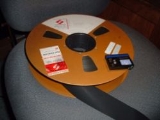
2 inch Quadruplex videotape

Encyclopedia
2-inch quadruplex videotape (also called 2″ quad, or just quad, for short) was the first practical and commercially successful analog recording
videotape
format. It was developed and released for the broadcast television industry in 1956 by Ampex
, an American
company based in Redwood City, California
. This format revolutionized broadcast television operations and television production, since the only recording medium available to the TV industry before then was film
used for kinescope
s, which was much more costly to utilize and took time to develop at a film laboratory
.
Since most United States
West Coast network broadcast delay
s done by the television network
s at the time were done with film kinescopes that needed time for developing, the networks wanted a more practical, cost-effective, and quicker way to time-shift
television program
ming for later airing on the West Coast. Broadcasters also sought a recording medium that was not as costly or time-consuming to edit and develop as film. Faced with these challenges, broadcasters sought to adapt magnetic tape recording technology (already in use for recording audio) for use with television
as well.
The name "quadruplex" refers to the use of four magnetic record/reproduce heads mounted on a headwheel spinning transversely (width-wise) across the tape at a rate of 14,400 rpm for NTSC
525 lines/30fps
-standard quad decks, and at 15,000 rpm for those using the PAL
625 lines/25fps
video standard. This method was called quadrature scanning, as opposed to the helical scan
transport used by later videotape formats. The tape ran at a speed of either 7.5 or per second for NTSC 525/30 video recording, or 15.625 in (396.875 mm) per second for PAL 625/25 video, and the audio, control, and cue tracks were recorded in a standard linear fashion near the edges of the tape. The cue track was used either as a second audio track, or for recording cue tone
s or time code
for linear video editing
.
A typical 4800 ft (1,463 m) reel of 2 in (50.8 mm) quad tape holds approximately one hour of recorded material at 15 in per second.
The quadruplex format employs segmented recording; each transversely recorded video track on a 2-inch quad videotape holds one-sixteenth of a field of video. This meant that 2-inch quad did not support "trick-play" functions, such as still, shuttle, and reverse or variable-speed playback. However, it was capable of producing extremely high-quality images containing about 400 horizontal lines of video resolution, and remained the de facto industry standard for television broadcasting from its inception in 1956 to the mid-1980s, when newer, smaller, and lower-maintenance videotape formats superseded it.
There were three different variations of 2-inch quad:
Most quad machines made later in the 1960s and 1970s by Ampex could play back both low and high-band 2-inch quad tape.
films was quite a rushed and perilous ordeal. This was due to there being only three hours for the West Coast branches of the TV networks to receive video for the programming from the East Coast (live via leased microwave relay or coaxial cable circuits provided by the phone company (AT&T
) at the time), and then to record such to kinescope films, and finally to develop the film to be aired three hours later on the West Coast. This usually meant the kinescope was aired almost immediately after it came straight out of the developing equipment, still warm from the film dryer. These were referred to by the networks as "hot kines". By 1954, the networks used more raw film stock for kinescopes than all of the Hollywood film studios combined, spending up to $4,000 per half hour. They were desperate to obtain a quicker, less expensive, and more practical solution.
In the early 1950s, Ampex and several other companies such as Bing Crosby Enterprises (BCE) and RCA
were competing to release a videotape format. RCA and BCE did release working prototypes of their recorders, but their downfall was that they all used a longitudinal (stationary-head) method of recording, much like audio tape recorders. This meant that the tape had to be recorded at an extremely high speed (around 120 in (3,048 mm)/s) in order to accommodate sufficient bandwidth to reproduce an adequate video image (at least 2-3 MHz for a watchable image), in turn requiring large amounts of tape on large reels. At the same time, the BBC developed a similar stationary-head video tape recorder
(VTR) system that saw some on-air use, called VERA
(Vision Electronic Recording Apparatus).
Ampex, seeing the impracticality of the prototype BCE and RCA VTRs, started to develop a more practical videotape format with tape economy in mind, as well as providing a solution to the networks' West Coast delay woes. Starting in 1952, Ampex built the Mark I prototype VTR, using 2 in (50.8 mm)-wide tape. Ampex decided that instead of having the tape move fast across the head to record enough bandwidth for video, that the head would move fast across the tape instead. This resulted in the Mark I using arcuate scanning, which consisted of a spinning disk with a face (where the heads were mounted) which contacted the tape (as opposed to the edge of the headwheel with transverse quadrature scanning). This resulted in an arc-shaped track being recorded across the width of the tape. Arcuate scanning resulted in a head-to-tape speed of about 2500 in (63,500 mm)/s, but problems with timebase stability of the reproduced video signal from the tape led Ampex to abandon arcuate scanning in favor of the more reliable transverse scanning system.
Ampex soldiered on throughout the mid-1950s with the Mark II and Mark III prototype recorders, which now used transverse scanning. The Mark II used frequency modulation
for recording video to tape, resulting in a much-improved, but still noisy, video image (the Mark I had used amplitude modulation
, which resulted in a very poor-quality video signal reproduced from the tape, underscored as well by the shortcomings of the machine's arcuate scanning), and the Mark III had improved signal-processing and servo
electronics, resulting in perfect video reproduction.
The Mark III worked perfectly, but its appearance was quite that of a prototype, and not a finished, saleable product. It was in a makeshift wooden case, with several parts of its chassis externally mounted in partially filled racks. Ampex took the same components used to make the Mark III, and then built it as another machine, this time into a sleek metal console and fully populated rack-mount cases, and this became the Mark IV.
The Mark IV was the machine first publicly demonstrated at the National Association of Radio and Television Broadcasters (now the NAB
) convention in Chicago on April 14, 1956. After William Lodge of CBS finished his speech, the Mark IV replayed his image and words almost immediately, causing "pandemonium" among the astonished attendees. The earlier Mark III was given some cosmetic improvements, and was also demonstrated at Ampex headquarters in Redwood City the same day. Both demonstrations were a success, and Ampex took $2 million in orders for the machine in four days.

Ampex later released the first manufactured models of Quad VTR based on the Mark IV which were also prototypes, the VRX-1000, of which 16 were made. Machines made afterward were the final production models, and were designated as the VR-1000.
In 1957, shortly after Ampex's introduction of the 2-inch quad format, RCA
introduced a quad-compatible VTR, the TRT-1A. RCA referred to it as a "Television Tape Recorder", since the word "Videotape" was a trademark of Ampex at the time. http://www.meldrum.co.uk/mhp/knackers/behind.html
RCA was able to make the TRT-1A and its later machines compatible with 2-inch quad because Ampex assisted RCA in doing so, as a expression of gratitude for RCA assisting Ampex with making their later Quad machines after the VR-1000 color capable. Initially, the VR-1000 was only natively capable of recording and playing back black and white video, but RCA had modified several VR-1000s to record color video for the NBC TV network (which RCA owned at the time) in the late 1950s, since NTSC color video programming was already underway at NBC.
Ampex developed and released updated and improved models of their quad decks, such as the second-generation VR-2000 in 1964 and its scaled-down economy version, the VR-1200, in 1966, and the AVR series of VTRs, AVR-1, AVR-2, and AVR-3 in the 1970s. The AVR-2 was the most compact of quad VTRs, using conventional 120 volt (V) single-phase household-type AC power to operate, rather than the 208 or 220V 3-phase AC power required by larger Quad machines.
RCA would also release later models of quad VTRs as well, such as the TR-22, TR-70, and TR-600.
The Fernseh
Div. of Bosch
in Germany released the BCM-40 quadruplex VTR in the 1970s. It was only marketed in Europe, and was not sold in the U.S.
CBS
was the first television network to use 2-inch quad videotape, using it for a West Coast delay of Douglas Edwards and the News
on November 30, 1956. The CBS show Arthur Godfrey's Talent Scouts
on December 24, 1956 became the first entertainment program to be broadcast live to the nation from New York and taped for a time-delayed rebroadcast in the Pacific Time Zone
. On January 22, 1957, the NBC game show Truth or Consequences
, produced in Hollywood, became the first program to be broadcast in all time zones from a prerecorded videotape. The Edsel Show
, on October 13, 1957 was the first CBS entertainment program to be broadcast live to the nation from Hollywood, then tape-delayed for rebroadcast in the Pacific time zone.
The engineers at Ampex who worked on the development of 2-inch quadruplex videotape from the Mark I to the VR-1000 were Charles Ginsburg
, Alex Maxey, Fred Pfost, Shelby Henderson, Charlie Anderson, and Ray Dolby
(who later went on to found Dolby Laboratories
).
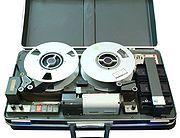 Because the Ampex VR-3000 model was self-contained portable, the U.S. military used it in a wide variety of reconnaissance applications in various vehicles and aircraft. Its ability to accurately record high frequency signals was a definite advantage for SIGINT
applications.
and Betacam
. Television and video industry changes to digital video tape (DVCAM, DVCPro and Digital Betacam) and high-definition
(HDCAM
) have made analog tape formats obsolete.
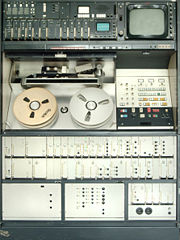
When it was in use, 2-inch quad VTRs required ongoing maintenance, usually 3-phase power
to operate, plus an air compressor
to provide air pressure for the air bearing that the spinning transverse headwheel rode on due to its high rotational speed (some quad VTRs, such as the portable Ampex VR-3000, used ball bearings instead due to the lack of availability of compressed air, but these wore out quickly).
Operation of 2" quad tape machines required the skills of a highly trained video engineer. When a tape is changed, the operator must spend as many as 15 minutes, and with problematic tapes possibly as much as half-an-hour, "lining-up" the VTR — that is, carrying out specialized technical adjustments to calibrate the machine to the tape before it is ready for playback and/or recording. Furthermore, because of the tendency of the settings of the analog electronics inside the VTRs to "drift" over time (often due to the heat generated internally), the machines had to be constantly monitored while in use, and recalibrated mid-session as necessary.
The few quadruplex VTRs which remain in service are used for the transfer and/or restoration of archival 2-inch quad videotape material to newer data storage formats.
Analog recording
Analog recording is a technique used for the recording of analog signals which among many possibilities include audio frequency, analog audio and analog video information for later playback.Analog recording methods store signals as a continual wave in or on the media...
videotape
Videotape
A videotape is a recording of images and sounds on to magnetic tape as opposed to film stock or random access digital media. Videotapes are also used for storing scientific or medical data, such as the data produced by an electrocardiogram...
format. It was developed and released for the broadcast television industry in 1956 by Ampex
Ampex
Ampex is an American electronics company founded in 1944 by Alexander M. Poniatoff. The name AMPEX is an acronym, created by its founder, which stands for Alexander M. Poniatoff Excellence...
, an American
United States
The United States of America is a federal constitutional republic comprising fifty states and a federal district...
company based in Redwood City, California
Redwood City, California
Redwood City is a California charter city located on the San Francisco Peninsula in Northern California, approximately 27 miles south of San Francisco, and 24 miles north of San Jose. Redwood City's history spans from its earliest inhabitation by the Ohlone people, to its tradition as a port for...
. This format revolutionized broadcast television operations and television production, since the only recording medium available to the TV industry before then was film
Film
A film, also called a movie or motion picture, is a series of still or moving images. It is produced by recording photographic images with cameras, or by creating images using animation techniques or visual effects...
used for kinescope
Kinescope
Kinescope , shortened to kine , also known as telerecording in Britain, is a recording of a television program made by filming the picture from a video monitor...
s, which was much more costly to utilize and took time to develop at a film laboratory
Film laboratory
A film laboratory is a commercial service enterprise and technical facility for the film industry where specialists develop, print, and conform film material for classical film production and distribution which is based on film material, such as negative and positive, black and white and color, on...
.
Since most United States
United States
The United States of America is a federal constitutional republic comprising fifty states and a federal district...
West Coast network broadcast delay
Broadcast delay
In radio and television, broadcast delay refers to the practice of intentionally delaying broadcast of live material. A short delay is often used to prevent profanity, bloopers, violence, or other undesirable material from making it to air, including more mundane problems such as technical...
s done by the television network
Television network
A television network is a telecommunications network for distribution of television program content, whereby a central operation provides programming to many television stations or pay TV providers. Until the mid-1980s, television programming in most countries of the world was dominated by a small...
s at the time were done with film kinescopes that needed time for developing, the networks wanted a more practical, cost-effective, and quicker way to time-shift
Time shifting
Time shifting is the recording of programming to a storage medium to be viewed or listened to at a time more convenient to the consumer. Typically, this refers to TV programming but can also refer to radio shows via podcasts....
television program
Television program
A television program , also called television show, is a segment of content which is intended to be broadcast on television. It may be a one-time production or part of a periodically recurring series...
ming for later airing on the West Coast. Broadcasters also sought a recording medium that was not as costly or time-consuming to edit and develop as film. Faced with these challenges, broadcasters sought to adapt magnetic tape recording technology (already in use for recording audio) for use with television
Television
Television is a telecommunication medium for transmitting and receiving moving images that can be monochrome or colored, with accompanying sound...
as well.
The name "quadruplex" refers to the use of four magnetic record/reproduce heads mounted on a headwheel spinning transversely (width-wise) across the tape at a rate of 14,400 rpm for NTSC
NTSC
NTSC, named for the National Television System Committee, is the analog television system that is used in most of North America, most of South America , Burma, South Korea, Taiwan, Japan, the Philippines, and some Pacific island nations and territories .Most countries using the NTSC standard, as...
525 lines/30fps
480i
480i is the shorthand name for a video mode, namely the US NTSC television system or digital television systems with the same characteristics. The i, which is sometimes uppercase, stands for interlaced, the 480 for a vertical frame resolution of 480 lines containing picture information; while NTSC...
-standard quad decks, and at 15,000 rpm for those using the PAL
PAL
PAL, short for Phase Alternating Line, is an analogue television colour encoding system used in broadcast television systems in many countries. Other common analogue television systems are NTSC and SECAM. This page primarily discusses the PAL colour encoding system...
625 lines/25fps
576i
576i is a standard-definition video mode used in PAL and SECAM countries. In digital applications it is usually referred to as "576i", in analogue contexts it is often quoted as "625 lines"...
video standard. This method was called quadrature scanning, as opposed to the helical scan
Helical scan
Helical scan is a method of recording high bandwidth signals onto magnetic tape. It is used in reel-to-reel video tape recorders, video cassette recorders, digital audio tape recorders, and some computer tape drives....
transport used by later videotape formats. The tape ran at a speed of either 7.5 or per second for NTSC 525/30 video recording, or 15.625 in (396.875 mm) per second for PAL 625/25 video, and the audio, control, and cue tracks were recorded in a standard linear fashion near the edges of the tape. The cue track was used either as a second audio track, or for recording cue tone
Cue tone
A cue tone is a message consisting of audio tones, used to prompt an action.In broadcast networks, a DTMF cue tone or subaudible tone is often used to prompt insertion of a local TV commercial or radio advertisement by the broadcast automation equipment at the broadcast station or cable headend.Cue...
s or time code
Time code
A timecode is a sequence of numeric codes generated at regular intervals by a timing system.- Video and film timecode :...
for linear video editing
Linear video editing
Linear video editing is a video editing post-production process of selecting, arranging and modifying images and sound in a predetermined, ordered sequence. Regardless whether captured by a video camera, tapeless camcorder, recorded in a television studio on a video tape recorder the content must...
.
A typical 4800 ft (1,463 m) reel of 2 in (50.8 mm) quad tape holds approximately one hour of recorded material at 15 in per second.
The quadruplex format employs segmented recording; each transversely recorded video track on a 2-inch quad videotape holds one-sixteenth of a field of video. This meant that 2-inch quad did not support "trick-play" functions, such as still, shuttle, and reverse or variable-speed playback. However, it was capable of producing extremely high-quality images containing about 400 horizontal lines of video resolution, and remained the de facto industry standard for television broadcasting from its inception in 1956 to the mid-1980s, when newer, smaller, and lower-maintenance videotape formats superseded it.
There were three different variations of 2-inch quad:
- Low-band, which was the first variety of quad introduced by Ampex in 1956,
- High-band, which used a wider bandwidth for recording video to the tape, resulting in higher-resolution video from the VTR, and
- Super High-band, which used a pilot tone for better timebase stability, and higher coercivityCoercivityIn materials science, the coercivity, also called the coercive field or coercive force, of a ferromagnetic material is the intensity of the applied magnetic field required to reduce the magnetization of that material to zero after the magnetization of the sample has been driven to saturation...
tape.
Most quad machines made later in the 1960s and 1970s by Ampex could play back both low and high-band 2-inch quad tape.
History
Time-shifting of television programming for the West Coast of the United States by the networks in the 1950s (in order to broadcast their programming at the same local time on the East and West Coasts) using kinescopeKinescope
Kinescope , shortened to kine , also known as telerecording in Britain, is a recording of a television program made by filming the picture from a video monitor...
films was quite a rushed and perilous ordeal. This was due to there being only three hours for the West Coast branches of the TV networks to receive video for the programming from the East Coast (live via leased microwave relay or coaxial cable circuits provided by the phone company (AT&T
AT&T
AT&T Inc. is an American multinational telecommunications corporation headquartered in Whitacre Tower, Dallas, Texas, United States. It is the largest provider of mobile telephony and fixed telephony in the United States, and is also a provider of broadband and subscription television services...
) at the time), and then to record such to kinescope films, and finally to develop the film to be aired three hours later on the West Coast. This usually meant the kinescope was aired almost immediately after it came straight out of the developing equipment, still warm from the film dryer. These were referred to by the networks as "hot kines". By 1954, the networks used more raw film stock for kinescopes than all of the Hollywood film studios combined, spending up to $4,000 per half hour. They were desperate to obtain a quicker, less expensive, and more practical solution.
In the early 1950s, Ampex and several other companies such as Bing Crosby Enterprises (BCE) and RCA
RCA
RCA Corporation, founded as the Radio Corporation of America, was an American electronics company in existence from 1919 to 1986. The RCA trademark is currently owned by the French conglomerate Technicolor SA through RCA Trademark Management S.A., a company owned by Technicolor...
were competing to release a videotape format. RCA and BCE did release working prototypes of their recorders, but their downfall was that they all used a longitudinal (stationary-head) method of recording, much like audio tape recorders. This meant that the tape had to be recorded at an extremely high speed (around 120 in (3,048 mm)/s) in order to accommodate sufficient bandwidth to reproduce an adequate video image (at least 2-3 MHz for a watchable image), in turn requiring large amounts of tape on large reels. At the same time, the BBC developed a similar stationary-head video tape recorder
Video tape recorder
A video tape recorder is a tape recorder that can record video material, usually on a magnetic tape. VTRs originated as individual tape reels, serving as a replacement for motion picture film stock and making recording for television applications cheaper and quicker. An improved form included the...
(VTR) system that saw some on-air use, called VERA
VERA videotape format
Vision electronic recording apparatus was an early analog recording videotape format developed from 1952 by the BBC under project manager Dr Peter Axon....
(Vision Electronic Recording Apparatus).
Ampex, seeing the impracticality of the prototype BCE and RCA VTRs, started to develop a more practical videotape format with tape economy in mind, as well as providing a solution to the networks' West Coast delay woes. Starting in 1952, Ampex built the Mark I prototype VTR, using 2 in (50.8 mm)-wide tape. Ampex decided that instead of having the tape move fast across the head to record enough bandwidth for video, that the head would move fast across the tape instead. This resulted in the Mark I using arcuate scanning, which consisted of a spinning disk with a face (where the heads were mounted) which contacted the tape (as opposed to the edge of the headwheel with transverse quadrature scanning). This resulted in an arc-shaped track being recorded across the width of the tape. Arcuate scanning resulted in a head-to-tape speed of about 2500 in (63,500 mm)/s, but problems with timebase stability of the reproduced video signal from the tape led Ampex to abandon arcuate scanning in favor of the more reliable transverse scanning system.
Ampex soldiered on throughout the mid-1950s with the Mark II and Mark III prototype recorders, which now used transverse scanning. The Mark II used frequency modulation
Frequency modulation
In telecommunications and signal processing, frequency modulation conveys information over a carrier wave by varying its instantaneous frequency. This contrasts with amplitude modulation, in which the amplitude of the carrier is varied while its frequency remains constant...
for recording video to tape, resulting in a much-improved, but still noisy, video image (the Mark I had used amplitude modulation
Amplitude modulation
Amplitude modulation is a technique used in electronic communication, most commonly for transmitting information via a radio carrier wave. AM works by varying the strength of the transmitted signal in relation to the information being sent...
, which resulted in a very poor-quality video signal reproduced from the tape, underscored as well by the shortcomings of the machine's arcuate scanning), and the Mark III had improved signal-processing and servo
Servomechanism
thumb|right|200px|Industrial servomotorThe grey/green cylinder is the [[Brush |brush-type]] [[DC motor]]. The black section at the bottom contains the [[Epicyclic gearing|planetary]] [[Reduction drive|reduction gear]], and the black object on top of the motor is the optical [[rotary encoder]] for...
electronics, resulting in perfect video reproduction.
The Mark III worked perfectly, but its appearance was quite that of a prototype, and not a finished, saleable product. It was in a makeshift wooden case, with several parts of its chassis externally mounted in partially filled racks. Ampex took the same components used to make the Mark III, and then built it as another machine, this time into a sleek metal console and fully populated rack-mount cases, and this became the Mark IV.
The Mark IV was the machine first publicly demonstrated at the National Association of Radio and Television Broadcasters (now the NAB
National Association of Broadcasters
The National Association of Broadcasters is a trade association, workers union, and lobby group representing the interests of for-profit, over-the-air radio and television broadcasters in the United States...
) convention in Chicago on April 14, 1956. After William Lodge of CBS finished his speech, the Mark IV replayed his image and words almost immediately, causing "pandemonium" among the astonished attendees. The earlier Mark III was given some cosmetic improvements, and was also demonstrated at Ampex headquarters in Redwood City the same day. Both demonstrations were a success, and Ampex took $2 million in orders for the machine in four days.
Ampex later released the first manufactured models of Quad VTR based on the Mark IV which were also prototypes, the VRX-1000, of which 16 were made. Machines made afterward were the final production models, and were designated as the VR-1000.
In 1957, shortly after Ampex's introduction of the 2-inch quad format, RCA
RCA
RCA Corporation, founded as the Radio Corporation of America, was an American electronics company in existence from 1919 to 1986. The RCA trademark is currently owned by the French conglomerate Technicolor SA through RCA Trademark Management S.A., a company owned by Technicolor...
introduced a quad-compatible VTR, the TRT-1A. RCA referred to it as a "Television Tape Recorder", since the word "Videotape" was a trademark of Ampex at the time. http://www.meldrum.co.uk/mhp/knackers/behind.html
RCA was able to make the TRT-1A and its later machines compatible with 2-inch quad because Ampex assisted RCA in doing so, as a expression of gratitude for RCA assisting Ampex with making their later Quad machines after the VR-1000 color capable. Initially, the VR-1000 was only natively capable of recording and playing back black and white video, but RCA had modified several VR-1000s to record color video for the NBC TV network (which RCA owned at the time) in the late 1950s, since NTSC color video programming was already underway at NBC.
Ampex developed and released updated and improved models of their quad decks, such as the second-generation VR-2000 in 1964 and its scaled-down economy version, the VR-1200, in 1966, and the AVR series of VTRs, AVR-1, AVR-2, and AVR-3 in the 1970s. The AVR-2 was the most compact of quad VTRs, using conventional 120 volt (V) single-phase household-type AC power to operate, rather than the 208 or 220V 3-phase AC power required by larger Quad machines.
RCA would also release later models of quad VTRs as well, such as the TR-22, TR-70, and TR-600.
The Fernseh
Fernseh
The Fernseh AG television company was registered in Berlin on July 3, 1929 by John Logie Baird, Robert Bosch and other partners with an initial capital of 100,000 Reichsmark....
Div. of Bosch
Robert Bosch GmbH
Robert Bosch GmbH is a multinational engineering and electronics company headquartered in Gerlingen, near Stuttgart, Germany. It is the world's largest supplier of automotive components...
in Germany released the BCM-40 quadruplex VTR in the 1970s. It was only marketed in Europe, and was not sold in the U.S.
CBS
CBS
CBS Broadcasting Inc. is a major US commercial broadcasting television network, which started as a radio network. The name is derived from the initials of the network's former name, Columbia Broadcasting System. The network is sometimes referred to as the "Eye Network" in reference to the shape of...
was the first television network to use 2-inch quad videotape, using it for a West Coast delay of Douglas Edwards and the News
CBS Evening News
CBS Evening News is the flagship nightly television news program of the American television network CBS. The network has broadcast this program since 1948, and has used the CBS Evening News title since 1963....
on November 30, 1956. The CBS show Arthur Godfrey's Talent Scouts
Arthur Godfrey's Talent Scouts
Arthur Godfrey's Talent Scouts is an American radio and television variety show which ran on CBS from 1946 until 1958...
on December 24, 1956 became the first entertainment program to be broadcast live to the nation from New York and taped for a time-delayed rebroadcast in the Pacific Time Zone
Pacific Time Zone
The Pacific Time Zone observes standard time by subtracting eight hours from Coordinated Universal Time . The clock time in this zone is based on the mean solar time of the 120th meridian west of the Greenwich Observatory. During daylight saving time, its time offset is UTC-7.In the United States...
. On January 22, 1957, the NBC game show Truth or Consequences
Truth or Consequences
Truth or Consequences is an American quiz show originally hosted on NBC radio by Ralph Edwards and later on television by Edwards , Jack Bailey , Bob Barker , Bob Hilton and Larry Anderson . The television show ran on CBS, NBC and also in syndication...
, produced in Hollywood, became the first program to be broadcast in all time zones from a prerecorded videotape. The Edsel Show
The Edsel Show
The Edsel Show is an hour-long television special broadcast live on CBS in the United States on October 13, 1957, intended to promote Ford Motor Company's new Edsel cars...
, on October 13, 1957 was the first CBS entertainment program to be broadcast live to the nation from Hollywood, then tape-delayed for rebroadcast in the Pacific time zone.
The engineers at Ampex who worked on the development of 2-inch quadruplex videotape from the Mark I to the VR-1000 were Charles Ginsburg
Charles Ginsburg
Charles Ginsburg was an engineer and the leader of a research team at Ampex which developed one of the first practical videotape recorders....
, Alex Maxey, Fred Pfost, Shelby Henderson, Charlie Anderson, and Ray Dolby
Ray Dolby
Ray Dolby is the American engineer and inventor of the noise reduction system known as Dolby NR. He was also a co-inventor of video tape recording while at Ampex. He is the founder of Dolby Laboratories.-Biography:...
(who later went on to found Dolby Laboratories
Dolby Laboratories
Dolby Laboratories, Inc. , often shortened to Dolby Labs, is an American company specializing in audio noise reduction and audio encoding/compression.-History:...
).
Edit control
- At first, editing was accomplished by physically cutting and splicing the 2" magnetic tape. The tape was "developed" using fine iron powder suspended in a liquid solvent, a solution marketed as "Edivue" Magnetic Developer. Using a special splicing block (such as the then-industry standard "Smith Splicer") equipped with a microscope to view the developed tracks, the editor could then see their patterns and then cut between them. Some 2" splicing blocks instead used a read-only tape head connected to an oscilloscope that enabled the editor to electronically view cue tones or the control track pulses on the tape to determine where the tape should be cut. See linear video editingLinear video editingLinear video editing is a video editing post-production process of selecting, arranging and modifying images and sound in a predetermined, ordered sequence. Regardless whether captured by a video camera, tapeless camcorder, recorded in a television studio on a video tape recorder the content must...
for details. - Ampex developed its breakthrough Editec system in 1963; by recording cue tones on the tape, the editor could make frame-accurate edits.
- RCA had an "Electronic Splicer" in their TR-4/5 and TR-22 VTRs for frame-accurate edits.
- In 1967, EECO created and introduced the EECO-900 edit controller, which used their proprietary "On-Time" time code (the later and more standard SMPTE time code had not yet been developed), which was used in conjunction with the Quad machines of the time, and was the successor to Ampex's Editec. The EECO-900 and "On-Time" timecode were developed from EECO's previous work and products developed for NASANASAThe National Aeronautics and Space Administration is the agency of the United States government that is responsible for the nation's civilian space program and for aeronautics and aerospace research...
for logging and timecoding of their telemetryTelemetryTelemetry is a technology that allows measurements to be made at a distance, usually via radio wave transmission and reception of the information. The word is derived from Greek roots: tele = remote, and metron = measure...
tapes during space missions. - In 1971, CMXCMX SystemsCMX Editing Systems was a company founded jointly by CBS and Memorex, that developed some of the very first computerized systems for linear and non-linear editing of videotape for post production...
, a collaborative between CBSCBSCBS Broadcasting Inc. is a major US commercial broadcasting television network, which started as a radio network. The name is derived from the initials of the network's former name, Columbia Broadcasting System. The network is sometimes referred to as the "Eye Network" in reference to the shape of...
and MemorexMemorexMemorex began as a computer tape producer and expanded to become a major IBM plug compatible peripheral supplier. It is now a consumer electronics brand of Imation specializing in disk recordable media for CD and DVD drives, flash memory, computer accessories and other electronics.Established in...
, introduced the first computer-based edit controller using SMPTE time code for editing. The CMX 200 could control both the source (A-roll) and record (B-Roll) Quad VTRs. CMX continued to make more powerful edit controllers capable of controlling more VTRs and peripheral devices, such as switchersVision mixerA vision mixer is a device used to select between several different video sources and in some cases Compositing video sources together to create special effects...
, DVEs and character generatorCharacter generatorA character generator, often abbreviated as CG, is a device or software that produces static or animated text for keying into a video stream. Modern character generators are computer-based, and can generate graphics as well as text...
s. - In 1976, Robert Bosch GmbHRobert Bosch GmbHRobert Bosch GmbH is a multinational engineering and electronics company headquartered in Gerlingen, near Stuttgart, Germany. It is the world's largest supplier of automotive components...
introduced the "Mach One" list-management edit controller, a lower-cost (and less powerful) post-productionPost-productionPost-production is part of filmmaking and the video production process. It occurs in the making of motion pictures, television programs, radio programs, advertising, audio recordings, photography, and digital art...
alternative to CMX edit controllers. At the time, both CMX and Bosch edit controllers utilized similar DECDigital Equipment CorporationDigital Equipment Corporation was a major American company in the computer industry and a leading vendor of computer systems, software and peripherals from the 1960s to the 1990s...
computers as their basic hardware. - As 1" Type B and 1" Type C VTRs came on the market, list-management editing bays sometimes used a combination of both 1" and 2" VTRs; however, 2" VTRs soon began to disappear from both broadcast and post-production facilities, as the newer 1" machines were smaller, more dependable, used tape that was far less expensive to purchase, and were capable of recording stereoSTEREOSTEREO is a solar observation mission. Two nearly identical spacecraft were launched into orbits that cause them to respectively pull farther ahead of and fall gradually behind the Earth...
audio tracks.
Product models
- Ampex:
- VR-1000 (1956) (VRX-1000) FMFrequency modulationIn telecommunications and signal processing, frequency modulation conveys information over a carrier wave by varying its instantaneous frequency. This contrasts with amplitude modulation, in which the amplitude of the carrier is varied while its frequency remains constant...
Low band, 3 racks of tubesVacuum tubeIn electronics, a vacuum tube, electron tube , or thermionic valve , reduced to simply "tube" or "valve" in everyday parlance, is a device that relies on the flow of electric current through a vacuum...
, monochromeMonochromeMonochrome describes paintings, drawings, design, or photographs in one color or shades of one color. A monochromatic object or image has colors in shades of limited colors or hues. Images using only shades of grey are called grayscale or black-and-white...
. No timebase correctionTimebase correctionTime base correction is a technique to reduce or eliminate errors caused by mechanical instability present in analog recordings on mechanical media. Without time base correction, a signal from a videotape recorder or videocassette recorder cannot be mixed with other, more time stable devices...
. - VR-1000 "Allen" update kit (made for Ampex by Allen Electronics) to color solid state, FMFrequency modulationIn telecommunications and signal processing, frequency modulation conveys information over a carrier wave by varying its instantaneous frequency. This contrasts with amplitude modulation, in which the amplitude of the carrier is varied while its frequency remains constant...
high band updateable. - VR-1001 VR-1000 with the transport vertical.
- VR-1100E (1966) Ampex Solid State "of VR-1000," defective circuitry designed by Sony.
- VR-1195 (1966) VR1100 with many Ampex updates.
- VR-1200 (1966) Solid state, color high band. Analog TBC. Optional Editec.
- VR-2000 (1967) Solid state, color high band. Optional Editec, Dropout compensation. Mark 10 headRecording headA recording head is the physical interface between a recording apparatus and a moving recording medium. Recording heads are generally classified according to the physical principle that allows them to impress their data upon their medium...
. Analog TBCTimebase correctionTime base correction is a technique to reduce or eliminate errors caused by mechanical instability present in analog recordings on mechanical media. Without time base correction, a signal from a videotape recorder or videocassette recorder cannot be mixed with other, more time stable devices...
. - VR-3000 (1967) Portable VTR with a Mark 11 ball-bearing head. All-format VTR (NTSC/PAL/SECAM, 15 ips/7.5 ips, High-Band/Low-Band). Digital TBC was possible, but required extensive mechanical modifications to the basic unit. Battery or line powered.
- VR-3000B Portable VTR Improved version of VR-3000. Digital TBC was available as a plug-in accessory, and required no modifications to the basic unit. Improved batteries.
- AVR-1 (1973) Very fast VTR, vacuum columns, vacuum capstan, air transport. NTSCNTSCNTSC, named for the National Television System Committee, is the analog television system that is used in most of North America, most of South America , Burma, South Korea, Taiwan, Japan, the Philippines, and some Pacific island nations and territories .Most countries using the NTSC standard, as...
/PALPALPAL, short for Phase Alternating Line, is an analogue television colour encoding system used in broadcast television systems in many countries. Other common analogue television systems are NTSC and SECAM. This page primarily discusses the PAL colour encoding system...
switchable. Analog TBC. - ACR-25 (1974) Cart VTR, with two AVR-1 type decks.
- ACR-25B (1975) Cart VTR, ACR-25 with AVR-2 digitalDigitalA digital system is a data technology that uses discrete values. By contrast, non-digital systems use a continuous range of values to represent information...
TBC. - AVR-2 (1974) Digital TBC, compact Quad used in studios and remote trucks. Uses 110-volt single-phase AC (other quad models required 220-volt or 3-phase AC service).
- AVR-3 (1975) Last Ampex Quad, digital TBC. Vacuum capstan. Super high band.
- VR-1000 (1956) (VRX-1000) FM
- VR-2000, VR-1200 and some updated VR-1000, VR-1100E, VR-1195 used modules to correct the playback of the videotape. The list of modules are:
- Amtec: Horizontal TBCTimebase correctionTime base correction is a technique to reduce or eliminate errors caused by mechanical instability present in analog recordings on mechanical media. Without time base correction, a signal from a videotape recorder or videocassette recorder cannot be mixed with other, more time stable devices...
. All that was needed for B&WMonochromeMonochrome describes paintings, drawings, design, or photographs in one color or shades of one color. A monochromatic object or image has colors in shades of limited colors or hues. Images using only shades of grey are called grayscale or black-and-white...
playback. - Colortec: Color TBC in line after the Amtec for color playback.
- Velcomp: Color velocity TBC correction for better color playback. Optional on some models.
- Procamp: Processing amplifierAmplifierGenerally, an amplifier or simply amp, is a device for increasing the power of a signal.In popular use, the term usually describes an electronic amplifier, in which the input "signal" is usually a voltage or a current. In audio applications, amplifiers drive the loudspeakers used in PA systems to...
on the final output. New Composite syncComponent video syncComponent video requires an extra synchronization signal to be sent along with the video. Component video sync signals can be sent in several different ways:...
insertion, level adjustment. - Dropout compensation: Replaced snowy video spots where the FM signal on the tapeVideotapeA videotape is a recording of images and sounds on to magnetic tape as opposed to film stock or random access digital media. Videotapes are also used for storing scientific or medical data, such as the data produced by an electrocardiogram...
is missing momentary, caused by a defect in the tape. (optional on some models) AmpexAmpexAmpex is an American electronics company founded in 1944 by Alexander M. Poniatoff. The name AMPEX is an acronym, created by its founder, which stands for Alexander M. Poniatoff Excellence...
and 3M3M3M Company , formerly known as the Minnesota Mining and Manufacturing Company, is an American multinational conglomerate corporation based in Maplewood, Minnesota, United States....
made different models for the VTR. - Editec: (1963) Cue tone editor for frame accurate editing.
- The components of the VTR were the Servo System, Video Record (Modulator) and Playback De-modulator) and Power Supply.
- Amtec: Horizontal TBC
- RCA
- TRT-1A (1957) Tube VTR, 4 racks of tubesVacuum tubeIn electronics, a vacuum tube, electron tube , or thermionic valve , reduced to simply "tube" or "valve" in everyday parlance, is a device that relies on the flow of electric current through a vacuum...
. - TRT-1B (1959) Tube VTR, 3 racks. an available option for color expanded this machine to six racks, which included the color processing equipment and color monitor.
- TR-2 (1960) Tube VTR with some solid state. Low band or monochromeMonochromeMonochrome describes paintings, drawings, design, or photographs in one color or shades of one color. A monochromatic object or image has colors in shades of limited colors or hues. Images using only shades of grey are called grayscale or black-and-white...
. - TR-11 (1961) Tube VTR with solid state PS-Power supplyPower supplyA power supply is a device that supplies electrical energy to one or more electric loads. The term is most commonly applied to devices that convert one form of electrical energy to another, though it may also refer to devices that convert another form of energy to electrical energy...
. - TR-22 (1961) Monochrome low band, later color version.
- TR-22C (1964) High-band color.
- TR-2 (1964) Record-only solid state.
- TR-3 (1964) Playback-only solid state.
- TR-4 (1964) Both, solid state.
- TR-5 (1964) Console portable solid state.
- TR-22
- TR-70 (1966) Solid state, high/low band with dropout compensation.
- TR-50 (1967) TR-4 high band.
- TR-60 (1969) High-band & low band color or monochrome. RCA's Multi standard machine 405/525/625 lines. The TR-60 & TR-70 were used in the Master Slave Configuration With the TCR-100 Cart Machines timesharing the video processing circuitry of the TR-60 and TR-70 machines when a SPU was not installed with the TCR100.
- TR-70 High-band & low band color or monochrome. RCA's Multi standard machine
- TCR-100 (1970) Dual-deck video cartridge machine.
- TR-61 (1972) High-band color, digital servoServomechanismthumb|right|200px|Industrial servomotorThe grey/green cylinder is the [[Brush |brush-type]] [[DC motor]]. The black section at the bottom contains the [[Epicyclic gearing|planetary]] [[Reduction drive|reduction gear]], and the black object on top of the motor is the optical [[rotary encoder]] for...
system, NTSCNTSCNTSC, named for the National Television System Committee, is the analog television system that is used in most of North America, most of South America , Burma, South Korea, Taiwan, Japan, the Philippines, and some Pacific island nations and territories .Most countries using the NTSC standard, as...
/PALPALPAL, short for Phase Alternating Line, is an analogue television colour encoding system used in broadcast television systems in many countries. Other common analogue television systems are NTSC and SECAM. This page primarily discusses the PAL colour encoding system...
switchable. - TPR-10 (1975) High-band color portable.
- TR-600 (1972) Last RCA Quad. Digital TBC, compact Quad used in studios and remote trucks.
- TRT-1A (1957) Tube VTR, 4 racks of tubes
- Bosch Fernseh
- BCM-40 (1970) Solid state, analog TBC.
Military applications
SIGINT
Signals intelligence is intelligence-gathering by interception of signals, whether between people , whether involving electronic signals not directly used in communication , or combinations of the two...
applications.
2-inch quad today
2-inch quad is no longer used as a mainstream format in TV broadcasting and video production, having long ago been supplanted by easier-to-use, more practical and lower-maintenance analog tape formats like 1" Type C (1976), U-maticU-matic
U-matic is an analog recording videocassette format first shown by Sony in prototype in October 1969, and introduced to the market in September 1971. It was among the first video formats to contain the videotape inside a cassette, as opposed to the various Reel-to-Reel or open-reel formats of the...
and Betacam
Betacam
Betacam is family of half-inch professional videocassette products developed by Sony in 1982. In colloquial use, "Betacam" singly is often used to refer to a Betacam camcorder, a Betacam tape, a Betacam video recorder or the format itself....
. Television and video industry changes to digital video tape (DVCAM, DVCPro and Digital Betacam) and high-definition
High-definition video
High-definition video or HD video refers to any video system of higher resolution than standard-definition video, and most commonly involves display resolutions of 1,280×720 pixels or 1,920×1,080 pixels...
(HDCAM
HDCAM
HDCAM, introduced in 1997, is an High-definition video digital recording videocassette version of Digital Betacam, using an 8-bit DCT compressed 3:1:1 recording, in 1080i-compatible downsampled resolution of 1440×1080, and adding 24p and 23.976 PsF modes to later models...
) have made analog tape formats obsolete.
When it was in use, 2-inch quad VTRs required ongoing maintenance, usually 3-phase power
Three-phase electric power
Three-phase electric power is a common method of alternating-current electric power generation, transmission, and distribution. It is a type of polyphase system and is the most common method used by grids worldwide to transfer power. It is also used to power large motors and other heavy loads...
to operate, plus an air compressor
Air compressor
An air compressor is a device that converts power into kinetic energy by compressing and pressurizing air, which, on command, can be released in quick bursts...
to provide air pressure for the air bearing that the spinning transverse headwheel rode on due to its high rotational speed (some quad VTRs, such as the portable Ampex VR-3000, used ball bearings instead due to the lack of availability of compressed air, but these wore out quickly).
Operation of 2" quad tape machines required the skills of a highly trained video engineer. When a tape is changed, the operator must spend as many as 15 minutes, and with problematic tapes possibly as much as half-an-hour, "lining-up" the VTR — that is, carrying out specialized technical adjustments to calibrate the machine to the tape before it is ready for playback and/or recording. Furthermore, because of the tendency of the settings of the analog electronics inside the VTRs to "drift" over time (often due to the heat generated internally), the machines had to be constantly monitored while in use, and recalibrated mid-session as necessary.
The few quadruplex VTRs which remain in service are used for the transfer and/or restoration of archival 2-inch quad videotape material to newer data storage formats.
See also
- VTRVideo tape recorderA video tape recorder is a tape recorder that can record video material, usually on a magnetic tape. VTRs originated as individual tape reels, serving as a replacement for motion picture film stock and making recording for television applications cheaper and quicker. An improved form included the...
- VideotapeVideotapeA videotape is a recording of images and sounds on to magnetic tape as opposed to film stock or random access digital media. Videotapes are also used for storing scientific or medical data, such as the data produced by an electrocardiogram...
- Contrast with Helical scanHelical scanHelical scan is a method of recording high bandwidth signals onto magnetic tape. It is used in reel-to-reel video tape recorders, video cassette recorders, digital audio tape recorders, and some computer tape drives....
recording - Erhard KietzErhard Kietzthumb|Erhard KietzDr. Erhard Karl Kietz was a German-born physicist, who researched frequency constancy of video signals.-Life:...
's work at Ampex - Ampex 2 inch helical VTRAmpex 2 inch helical VTRFrom 1963 to 1970, Ampex manufactured several models of VTR 2 inch helical VTRs, capable of recording and playing back analog black & white video. Recording employed non-segmented helical scanning, with one wrap of the tape around the video head drum being a little more than 180 degrees,...
- Lunar Orbiter Image Recovery ProjectLunar Orbiter Image Recovery ProjectThe Lunar Orbiter Image Recovery Project is a project funded by NASA, SkyCorp Inc, SpaceRef Interactive, Inc., and private individuals to digitize the original analog data tapes from the five Lunar Orbiter spacecraft that were sent to the Moon in 1966 and 1967.-Background:The images taken by the...
, recovered still images from physically similar tapes
External links
- Video systems theory, with expanded information on the history of 2-inch Quad.
- Quadruplex Park, Museum of 2-inch Quad VTRs.
- The Edsel Show was the first TV entertainment program originating from the West Coast to be delayed for the West Coast on videotape.
- The History of Recording Technology, with a section with pictures on 2-inch Quad and Ampex's development and introduction of it.
- The Birth of Video Recording.
- Promotional kinescope extolling the benefits of producing commercials on videotape instead of film.
- CED Magic's page on 2" Quad.
- Color Television History page about early Color VTR.
- Bosch 2" VTR 1970.
- RCA VTRs.
- RCA VTR details.
- Quad Videotape Group, helping to preserve the content, machines and the knowledge to use them in conjunction with the Library of Congress. Has historical information and discussion list.
