

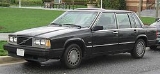
Volvo 700 series

Encyclopedia
The 760 was Volvo's attempt to cement a place in the prestige market, after building a reputation for being solid and safe rather than out-and-out luxurious cars. Jan Wilsgaard, head of Volvo's Design and Styling team, proposed over 50 new designs for the new car. It was introduced to the US
in 1982 for the 1983 model year as the 760 GLE sedan. This new design was criticized by the media when released: Gordon Murray
of Autocar Magazine said, "To me it's obscene! That goes right against the grain of what everybody else is trying to do. To me it looks like a European version of a North American car. It produces the same amount of power as a 2600 or 3500
— in this day and age it disgusts me to see something about like that. It's a definite step backwards." All that changed however when Autocar and Car & Driver got their hands on a turbo intercooled 760; they said it was one of the best handling and fastest accelerating cars they had seen in a while, thundering from 0-60 mph (97 km/h) in under 8 seconds.
Turbocharged and intercooled variants were added in 1984, station wagon variants and the 740 – the 760's lower-specification sibling – were introduced for the 1985 model year. In 1985 Electronic Traction Control
system was introduced.
For the 1988 model year, the 760 received numerous updates. From the outside, the most noticeable of the over 2,000 changes were the revised front sheetmetal, including an aluminium hood, recessed windscreen wipers, and new aerodynamic headlights. Inside, all 760s were equipped with a new electronic climate control (ECC), a revised dashboard, three-position tilt steering, and a new stereo system. Underneath, sedans received the same multi-link independent rear suspension that was used on the 780. Along with the revised dash, the interior saw the addition of a revised dome light and many fabric accent pieces.
The Volvo 760 was also used as a police car
in several countries. East German leader Erich Honecker
also often used this Volvo in his governmental car pool.
For its final year of production, 1990, 760 sedans received tail lights in the style of the Volvo 780 (see below), and minor interior changes. The 760 was discontinued after the 1990 model year (with production ending on 27 June 1990), and was replaced by the Volvo 960, an evolutionary update of the 760 chassis. The Volvo 740 outlived the 760, remaining for another two years.
The Volvo 760 was built in Kalmar
, Sweden, Halifax, Nova Scotia
, Canada, or Ghent
, Belgium.
debuted at the International Auto Show in Geneva
, Switzerland
in 1985, marking Volvo's return to the two-door coupé market following the departure of the 262C in 1981. The 780 became available in Europe in 1986 and in United States a year later.
Like its predecessor, the 780 was designed and built by Carrozzeria Bertone in Turin
, Italy. The hood, trunk, and roof lines were all slightly lower than the standard 700 series profile, and the C-pillar was wider and had a more gradual slope down to the trunk. Headroom was improved over the 262C because of Bertone’s mere 1 cm lowering of the roofline. Window frames all had black matte trim, and were accented with chrome. Chrome also highlighted the door handles, bumpers, and side mouldings. Originally, it had been planned to use a smaller 2,458 cc turbocharged version of the PRV
V6 (as seen in the Renault 25
and Alpine
), which had been successfully tested in 740s and 760s. In the smaller engine room of the 780, however, the engine overheated and the PRV V6 Turbo never appeared in a Volvo.
In the first two years the 780 was available worldwide ('86 and '87) the 780 was available with the B280F V6 engine and a solid (live) rear axle. In the Italian market, originally only the Volkswagen built TD24
was to be offered, with 129 PS, but soon the V6 also became available and a 155 PS 2.0-litre turbo (B200ET) Italian tax special was also added in 1986. In the following year, the 780 came equipped with Volvo's independent rear suspension, which used self-leveling Nivomat shocks, to keep ride height correct.
The B280F at this point had roughly 150 hp, but the car itself was nearly 3400 lb (1,542.2 kg). To address concerns over performance, Volvo introduced the B230FT+; a B230FT with Volvo's boost controller, Turbo+, increasing the engine output to 175 hp. The following model year saw it increase to 188 hp. In Italy, late 780s were available with the B204GT. This was a 16 Valve Turbo motor producing 200 hp. In the car's final year, 1991, it was rebadged simply as "Coupé". At this point, the car came only in turbo guise.
Volvo's official production total for the 780 is 8,518 cars built between 1986 and 1991. As before, a coupé would remain absent from Volvo's model line for several years, until the front-wheel drive
C70
premiered in 1995 for the following model year.
North American model availability:
United States
The United States of America is a federal constitutional republic comprising fifty states and a federal district...
in 1982 for the 1983 model year as the 760 GLE sedan. This new design was criticized by the media when released: Gordon Murray
Gordon Murray
Prof. Gordon Murray , is a renowned designer of Formula One race cars and the McLaren F1 road car.-Early life:...
of Autocar Magazine said, "To me it's obscene! That goes right against the grain of what everybody else is trying to do. To me it looks like a European version of a North American car. It produces the same amount of power as a 2600 or 3500
Rover SD1
Rover SD1 is both the code name and eventual production name given to a series of large executive cars made by British Leyland or BL through its Specialist, Rover Triumph and Austin Rover divisions from 1976 until 1986....
— in this day and age it disgusts me to see something about like that. It's a definite step backwards." All that changed however when Autocar and Car & Driver got their hands on a turbo intercooled 760; they said it was one of the best handling and fastest accelerating cars they had seen in a while, thundering from 0-60 mph (97 km/h) in under 8 seconds.
Turbocharged and intercooled variants were added in 1984, station wagon variants and the 740 – the 760's lower-specification sibling – were introduced for the 1985 model year. In 1985 Electronic Traction Control
Traction control system
A traction control system , also known as anti-slip regulation , is typically a secondary function of the anti-lock braking system on production motor vehicles, designed to prevent loss of traction of driven road wheels...
system was introduced.
For the 1988 model year, the 760 received numerous updates. From the outside, the most noticeable of the over 2,000 changes were the revised front sheetmetal, including an aluminium hood, recessed windscreen wipers, and new aerodynamic headlights. Inside, all 760s were equipped with a new electronic climate control (ECC), a revised dashboard, three-position tilt steering, and a new stereo system. Underneath, sedans received the same multi-link independent rear suspension that was used on the 780. Along with the revised dash, the interior saw the addition of a revised dome light and many fabric accent pieces.
The Volvo 760 was also used as a police car
Police car
A police car is a ground vehicle used by police, to assist with their duties in patrolling and responding to incidents. Typical uses of a police car include transportation for officers to reach the scene of an incident quickly, to transport criminal suspects, or to patrol an area, while providing a...
in several countries. East German leader Erich Honecker
Erich Honecker
Erich Honecker was a German communist politician who led the German Democratic Republic as General Secretary of the Socialist Unity Party from 1971 until 1989, serving as Head of State as well from Willi Stoph's relinquishment of that post in 1976....
also often used this Volvo in his governmental car pool.
For its final year of production, 1990, 760 sedans received tail lights in the style of the Volvo 780 (see below), and minor interior changes. The 760 was discontinued after the 1990 model year (with production ending on 27 June 1990), and was replaced by the Volvo 960, an evolutionary update of the 760 chassis. The Volvo 740 outlived the 760, remaining for another two years.
The Volvo 760 was built in Kalmar
Kalmar
Kalmar is a city in Småland in the south-east of Sweden, situated by the Baltic Sea. It had 62,767 inhabitants in 2010 and is the seat of Kalmar Municipality. It is also the capital of Kalmar County, which comprises 12 municipalities with a total of 233,776 inhabitants .From the thirteenth to the...
, Sweden, Halifax, Nova Scotia
Nova Scotia
Nova Scotia is one of Canada's three Maritime provinces and is the most populous province in Atlantic Canada. The name of the province is Latin for "New Scotland," but "Nova Scotia" is the recognized, English-language name of the province. The provincial capital is Halifax. Nova Scotia is the...
, Canada, or Ghent
Ghent
Ghent is a city and a municipality located in the Flemish region of Belgium. It is the capital and biggest city of the East Flanders province. The city started as a settlement at the confluence of the Rivers Scheldt and Lys and in the Middle Ages became one of the largest and richest cities of...
, Belgium.
Volvo 780
The Volvo 780 CoupéCoupé
A coupé or coupe is a closed car body style , the precise definition of which varies from manufacturer to manufacturer, and over time...
debuted at the International Auto Show in Geneva
Geneva
Geneva In the national languages of Switzerland the city is known as Genf , Ginevra and Genevra is the second-most-populous city in Switzerland and is the most populous city of Romandie, the French-speaking part of Switzerland...
, Switzerland
Switzerland
Switzerland name of one of the Swiss cantons. ; ; ; or ), in its full name the Swiss Confederation , is a federal republic consisting of 26 cantons, with Bern as the seat of the federal authorities. The country is situated in Western Europe,Or Central Europe depending on the definition....
in 1985, marking Volvo's return to the two-door coupé market following the departure of the 262C in 1981. The 780 became available in Europe in 1986 and in United States a year later.
Like its predecessor, the 780 was designed and built by Carrozzeria Bertone in Turin
Turin
Turin is a city and major business and cultural centre in northern Italy, capital of the Piedmont region, located mainly on the left bank of the Po River and surrounded by the Alpine arch. The population of the city proper is 909,193 while the population of the urban area is estimated by Eurostat...
, Italy. The hood, trunk, and roof lines were all slightly lower than the standard 700 series profile, and the C-pillar was wider and had a more gradual slope down to the trunk. Headroom was improved over the 262C because of Bertone’s mere 1 cm lowering of the roofline. Window frames all had black matte trim, and were accented with chrome. Chrome also highlighted the door handles, bumpers, and side mouldings. Originally, it had been planned to use a smaller 2,458 cc turbocharged version of the PRV
PRV engine
The PRV engine is an automobile petrol V6 engine that was developed jointly by Peugeot, Renault and Volvo Cars – and sold from 1974 to 1998. It was gradually replaced after 1994 by another joint PSA-Renault design, known as the ES engine at PSA and the L engine at Renault.-Corporate history:The...
V6 (as seen in the Renault 25
Renault 25
The Renault 25 is an executive car produced by the French automaker Renault from 1983 to 1992. During its time, the 25 was Renault's flagship, the most expensive, prestigious, and largest vehicle in the company's line-up. It placed second in the 1985 European Car of the Year contest...
and Alpine
Renault Alpine GTA/A610
The Alpine A610 was a coupe automobile produced by the Renault-owned French manufacturer Alpine. It was launched in 1991. Due to a limited budget at the beginning of the project, its appearance does not differ much from the GTA, and it looks quite similar to the USA GTA with its pop-up headlights...
), which had been successfully tested in 740s and 760s. In the smaller engine room of the 780, however, the engine overheated and the PRV V6 Turbo never appeared in a Volvo.
In the first two years the 780 was available worldwide ('86 and '87) the 780 was available with the B280F V6 engine and a solid (live) rear axle. In the Italian market, originally only the Volkswagen built TD24
Volkswagen D24TIC engine
The Volkswagen D24TIC is a 2.4 litre inline-six cylinder single overhead camshaft diesel engine, formerly manufactured by Volkswagen Group from August 1991 to December 1995.-Technical description and rated outputs:...
was to be offered, with 129 PS, but soon the V6 also became available and a 155 PS 2.0-litre turbo (B200ET) Italian tax special was also added in 1986. In the following year, the 780 came equipped with Volvo's independent rear suspension, which used self-leveling Nivomat shocks, to keep ride height correct.
The B280F at this point had roughly 150 hp, but the car itself was nearly 3400 lb (1,542.2 kg). To address concerns over performance, Volvo introduced the B230FT+; a B230FT with Volvo's boost controller, Turbo+, increasing the engine output to 175 hp. The following model year saw it increase to 188 hp. In Italy, late 780s were available with the B204GT. This was a 16 Valve Turbo motor producing 200 hp. In the car's final year, 1991, it was rebadged simply as "Coupé". At this point, the car came only in turbo guise.
Volvo's official production total for the 780 is 8,518 cars built between 1986 and 1991. As before, a coupé would remain absent from Volvo's model line for several years, until the front-wheel drive
Front-wheel drive
Front-wheel drive is a form of engine/transmission layout used in motor vehicles, where the engine drives the front wheels only. Most modern front-wheel drive vehicles feature a transverse engine, rather than the conventional longitudinal engine arrangement generally found in rear-wheel drive and...
C70
Volvo C70
The Volvo C70 is a luxury automobile manufactured by Volvo Cars in two generations: the first from model years 1997-2002 as coupé and from 1999 to 2006 as a softtop convertible...
premiered in 1995 for the following model year.
Models
Beginning in 1985, the 740 and 760 models were available in both saloon and estate forms.North American model availability:
| 740 | 740 GL | 740 GLE | 740 GLE 16 Valve | 740 GLE Turbo Diesel | 740 Turbo | 740 SE | 760 GLE | 760 GLE Turbo Diesel | 760 Turbo | |
| 1983 | X | X | ||||||||
| 1984 | X | X | X | |||||||
| 1985 | X | X | X | X | X | X | ||||
| 1986 | X | X | X | X | X | |||||
| 1987 | X | X | X | X | ||||||
| 1988 | X | X | X | X | ||||||
| 1989 | X | X | X | X | X | |||||
| 1990 | X | X | X | X | X | X | ||||
| 1991 | X | X | X | |||||||
| 1991 | X | X | ||||||||
| 1992 | X | (wagon) |
Engines
These engines were offered on 700 series vehicles:- B19E: 2.0 L inline-4 (83.04-84.07, sedan only)
- B19ET: 2.0 L turbo inline-4 (83.12-84.07, sedan only)
- B23E: 2.3 L inline-4, naturally aspirated, Bosch K-Jetronic fuel injectionFuel injectionFuel injection is a system for admitting fuel into an internal combustion engine. It has become the primary fuel delivery system used in automotive petrol engines, having almost completely replaced carburetors in the late 1980s....
('84) - B23ET: 2.3 L turbo inline-4, utilizing Bosch MotronicMotronicMotronic is the trade name given to a range of digital engine-management systems developed by Robert Bosch GmbH, commonly known as Bosch.-Motronic ML1.x:Motronic ML1.x was one of the first digital engine-management systems developed by Bosch...
engine management ('84) - B23FT: 2.3 L turbocharged inline-4
- B28APRV engineThe PRV engine is an automobile petrol V6 engine that was developed jointly by Peugeot, Renault and Volvo Cars – and sold from 1974 to 1998. It was gradually replaced after 1994 by another joint PSA-Renault design, known as the ES engine at PSA and the L engine at Renault.-Corporate history:The...
: 2.8 L V6, naturally aspirated, carburatedCarburetorA carburetor , carburettor, or carburetter is a device that blends air and fuel for an internal combustion engine. It is sometimes shortened to carb in North America and the United Kingdom....
('82-85) - B28EPRV engineThe PRV engine is an automobile petrol V6 engine that was developed jointly by Peugeot, Renault and Volvo Cars – and sold from 1974 to 1998. It was gradually replaced after 1994 by another joint PSA-Renault design, known as the ES engine at PSA and the L engine at Renault.-Corporate history:The...
: 2.8 L V6, naturally aspirated, Bosch K-Jetronic, high output ('82-86) - B28FPRV engineThe PRV engine is an automobile petrol V6 engine that was developed jointly by Peugeot, Renault and Volvo Cars – and sold from 1974 to 1998. It was gradually replaced after 1994 by another joint PSA-Renault design, known as the ES engine at PSA and the L engine at Renault.-Corporate history:The...
: 2.8 L V6, naturally aspirated, odd fire crankshaft ('82-86) - B200E: 2.0 L inline-4, naturally aspirated, Bosch K-Jetronic 115 hp
- B200F: 2.0 L inline-4, naturally aspirated, Bosch LH-Jetronic 111 hp
- B200K: 2.0 L inline-4, naturally aspirated, RenixRenixRenix made automobile electronic ignitions, fuel injection systems, electronic automatic transmission controls, and various engine sensors.The term Renix also has a number of applications...
ignition, 200K had standard head unlike 230K (introduced for the '85 model year) - B200ET: 2.0 L inline-4, turbocharged, Bosch MotronicMotronicMotronic is the trade name given to a range of digital engine-management systems developed by Robert Bosch GmbH, commonly known as Bosch.-Motronic ML1.x:Motronic ML1.x was one of the first digital engine-management systems developed by Bosch...
engine management (155 hp, introduced for the '85 model year) - B200FT: 2.0 L inline-4, turbocharged, Bosch LH-Jetronic 156 hp
- B204E: 2.0 L 16-valve, DOHC, inline-4, naturally aspirated (introduced for the '89 model year)
- B204FT: 2.0 L 16-valve, DOHC, inline-4, turbocharged (introduced for the '89 model year)
- B204GT: 2.0 L 16-valve, DOHC, inline-4, turbocharged (introduced for the '89 model year)
- B230A: 2.3 L inline-4, naturally aspirated, carburated (1985–86)
- B230E: 2.3 L inline-4, naturally aspirated, BoschRobert Bosch GmbHRobert Bosch GmbH is a multinational engineering and electronics company headquartered in Gerlingen, near Stuttgart, Germany. It is the world's largest supplier of automotive components...
K-Jetronic fuel injectionFuel injectionFuel injection is a system for admitting fuel into an internal combustion engine. It has become the primary fuel delivery system used in automotive petrol engines, having almost completely replaced carburetors in the late 1980s....
(introduced in the '85 model year) - B230F: 2.3 L inline-4, naturally aspirated, 114 hp ('85-88 740GLE, '89-90 740GL, '90-92 740)
- B230K: 2.3 L inline-4, naturally aspirated, RenixRenixRenix made automobile electronic ignitions, fuel injection systems, electronic automatic transmission controls, and various engine sensors.The term Renix also has a number of applications...
ignition, Heron headHeron cylinder headA Heron cylinder head or simply Heron head, is a design for the combustion chambers of the cylinder head on an internal combustion piston engine. The head is machined flat, with recesses only for inlet and exhaust valves, spark plugs, injectors and so on. The combustion chamber itself is contained...
(introduced for the '85 model year) - B230ET: 2.3 L inline-4, turbocharged, Bosch Motronic (introduced in the '85 model year)
- B230FT: 2.3 L inline-4, turbocharged, 160 hp ('85-92 740 Turbo **NOTE: '90-92 models produced 162 hp**)
- B234F: 2.3 L 16-valve, DOHC, inline-4, naturally aspirated, 153 hp ('89-90 740 GLE/GLT)
- B280EPRV engineThe PRV engine is an automobile petrol V6 engine that was developed jointly by Peugeot, Renault and Volvo Cars – and sold from 1974 to 1998. It was gradually replaced after 1994 by another joint PSA-Renault design, known as the ES engine at PSA and the L engine at Renault.-Corporate history:The...
: 2.8 L V6, naturally aspirated, Bosch LH-Jetronic 2.2, 154 hp Nordic or 168 hp European version even fire crankshaft (introduced in the '87 model year) - B280FPRV engineThe PRV engine is an automobile petrol V6 engine that was developed jointly by Peugeot, Renault and Volvo Cars – and sold from 1974 to 1998. It was gradually replaced after 1994 by another joint PSA-Renault design, known as the ES engine at PSA and the L engine at Renault.-Corporate history:The...
: 2.8 L V6, naturally aspirated, Bosch LH-Jetronic 147 hp, even fire crankshaft ('87-90) - D24Volkswagen D24 engineThe Volkswagen D24 engine is a 2.4 litre inline-six cylinder , naturally aspirated diesel engine, formerly manufactured by Volkswagen Group from 1978 to 1995....
: 2.4 L inline-6 dieselDiesel engineA diesel engine is an internal combustion engine that uses the heat of compression to initiate ignition to burn the fuel, which is injected into the combustion chamber...
, naturally aspirated (Volkswagen) - D24T: 2.4 L inline-6, turbodieselDiesel engineA diesel engine is an internal combustion engine that uses the heat of compression to initiate ignition to burn the fuel, which is injected into the combustion chamber...
, 107 hp, variant of the LT35 engine manufactured by VolkswagenVolkswagenVolkswagen is a German automobile manufacturer and is the original and biggest-selling marque of the Volkswagen Group, which now also owns the Audi, Bentley, Bugatti, Lamborghini, SEAT, and Škoda marques and the truck manufacturer Scania.Volkswagen means "people's car" in German, where it is...
. - D24TIC: 2.4 L inline-6, turbodieselDiesel engineA diesel engine is an internal combustion engine that uses the heat of compression to initiate ignition to burn the fuel, which is injected into the combustion chamber...
, intercooled, 124 hp, variant of the LT35 engine manufactured by VolkswagenVolkswagenVolkswagen is a German automobile manufacturer and is the original and biggest-selling marque of the Volkswagen Group, which now also owns the Audi, Bentley, Bugatti, Lamborghini, SEAT, and Škoda marques and the truck manufacturer Scania.Volkswagen means "people's car" in German, where it is...
.
Transmissions
Volvo offered various transmissions depending on the year/model/engine combinations including the:- M46 manual transmissionManual transmissionA manual transmission, also known as a manual gearbox or standard transmission is a type of transmission used in motor vehicle applications...
(4-speed + Laycock de Normanville overdrive) - M47 manual transmission (5-speed)
- M90 manual transmission (5-speed)
- AW30-40 electronically controlled automatic transmissionAutomatic transmissionAn automatic transmission is one type of motor vehicle transmission that can automatically change gear ratios as the vehicle moves, freeing the driver from having to shift gears manually...
(4-speed, lockup torque converter) - AW70/AW70L automatic transmissionAutomatic transmissionAn automatic transmission is one type of motor vehicle transmission that can automatically change gear ratios as the vehicle moves, freeing the driver from having to shift gears manually...
(3-speed + overdrive, lockup torque converter on some models) - AW71 automatic transmissionAutomatic transmissionAn automatic transmission is one type of motor vehicle transmission that can automatically change gear ratios as the vehicle moves, freeing the driver from having to shift gears manually...
(3-speed + overdrive) - AW72L automatic transmissionAutomatic transmissionAn automatic transmission is one type of motor vehicle transmission that can automatically change gear ratios as the vehicle moves, freeing the driver from having to shift gears manually...
(4-speed, lockup torque converter) - ZF4HP22 automatic transmissionAutomatic transmissionAn automatic transmission is one type of motor vehicle transmission that can automatically change gear ratios as the vehicle moves, freeing the driver from having to shift gears manually...
(4-speed, lockup torque converter)
Suspension and axle
There were also different suspension combinations depending on the model chosen:- 1030: Standard rear axle
- 1031: Heavy-duty version of the 1030
- 1041: Rear axle with Eaton locking mechanism