

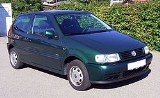
Volkswagen Polo Mk3

Encyclopedia
.jpg)
Volkswagen Polo
The Volkswagen Polo is a supermini car manufactured by Volkswagen. It is sold in Europe and other markets worldwide in hatchback, saloon, coupé and estate variants....
supermini
Supermini car
A supermini is a British term that describes automobiles larger than a city car but smaller than a small family car. This car class is also known as the B-segment across Europe, and as subcompact in North America....
, produced from 1994 until late 1999 and some in 2000. It was produced in two forms, the initial car (1994–2000) being known as the Mark 4 or IIII, and the facelifted version (2000–2002) known as the Mark 4 Phase II or unofficially as the Mark 3F or IIIF.
Overview
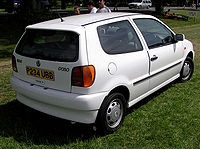
The third generation Polo (known internally as the Typ 6N) was launched in September 1994, and was a completely new model/chassis from the old Polo, although early versions used the engines from the Mark 2. The Mark 4 was the first Polo to be made available as a five-door as well as three-door hatchback; these were built in 1995-1999.The platform used for this model used a modified version of the floorpan of the Volkswagen Golf
Volkswagen Golf
The Volkswagen Golf is a small family car manufactured by Volkswagen since 1974 and marketed worldwide across six generations, in various body configurations and under various nameplates – as the Volkswagen Rabbit in the United States and Canada , and as the Volkswagen Caribe in Mexico .The...
Mark 3, as did the SEAT Ibiza Mk2. A multitude of mechanical parts and all of the suspension components were intechangeable among the three models. Although the dashboard
Dashboard
A dashboard is a control panel placed in front of the driver of an automobile, housing instrumentation and controls for operation of the vehicle....
and a number of mechanical components, including engines, were shared with the Ibiza, outwardly the Polo models were entirely different with no body panels shared with the SEAT model.
Initially, only three- and five-door hatchback
Hatchback
A Hatchback is a car body style incorporating a shared passenger and cargo volume, with rearmost accessibility via a rear third or fifth door, typically a top-hinged liftgate—and features such as fold-down rear seats to enable flexibility within the shared passenger/cargo volume. As a two-box...
versions were available. In 1995, four-door saloon ("Polo Classic/Sedan/Derby") and five-door estate
Station wagon
A station wagon is a body style variant of a sedan/saloon with its roof extended rearward over a shared passenger/cargo volume with access at the back via a third or fifth door , instead of a trunk lid...
("Polo Wagon/Variant") versions were added to the range — these were badge engineered versions of the SEAT Córdoba
SEAT Córdoba
The first generation SEAT Córdoba was presented at the 1993 Frankfurt Motor Show and launched in the summer of the same year, penned by Italian designer Giorgetto Giugiaro and based on the chassis of the SEAT Ibiza Mk2 which would spawn the Volkswagen Polo Mk3 the following year.Its 1.4, 1.6, 1.8...
(the saloon and estate versions of the Ibiza). They were referred to internally by VW as the Typ 6KV, and shared body panels with the SEAT model rather than the hatchback models.
A convertible version was not produced, although a version with an electrically sliding full length sunroof, called the Polo Open Air, was available.
Engines
Initially the car was available with the 1043cc putting out 45 PS, and the 1272cc putting out 55 PS engines from the previous generation Polo, along with a new 1598cc unit. A new 1.4L engine replaced the 1.3L in 1996. In 1997 the 1043cc engine was replaced by an all-new aluminium block multi-point injection 999cc developing 50 PS. The Classic and Variant models featured a 75 PS or 100 PS 1.6L and a 64 PS 1.9L diesel. For the first time, a turbo-diesel engine (1.9L) was available in a Polo, although only in the 6K models. Due to its smaller engine bay, the standard 3 and 5-door 6N did not get a turbo-diesel engine until the facelift in 2000.Trim levels
The Polo Mark 3 was much better equipped than its predecessor. A range of models featured items such as colour coded bumpers, heated/electrically adjustable mirrors, four speaker stereo, pollen filters, central locking, rear head restraints, split rear seats, fog lights, alloy wheels, air bags and so on. The car was available originally in four trim levels ranging from the L at the bottom level of the scale through the CL and GL to the range topping GLX model.In 1994, the Polo SE or Special Equipment was launched. Based on the 1.4 L it featured a number of features from higher spec models such as the GLX bumpers, Sport Rader alloy wheels, tinted rear light clusters and clear indicators. The Mark 3 came to the end of its production run in 1999 with another Polo Match.
Unlike the Volkswagen Polo Mk1
Volkswagen Polo Mk1
The Volkswagen Polo Mk1 is the first generation of the Volkswagen Polo supermini. It was produced from 1975 until 1981.-Polo Mark 1 :...
and Volkswagen Polo Mk2
Volkswagen Polo Mk2
The Volkswagen Polo Mk2 is the second generation of the Volkswagen Polo supermini, it was produced from late 1981 until 1994.-Polo Mark 2:...
, trim levels were not the same across Europe
Europe
Europe is, by convention, one of the world's seven continents. Comprising the westernmost peninsula of Eurasia, Europe is generally 'divided' from Asia to its east by the watershed divides of the Ural and Caucasus Mountains, the Ural River, the Caspian and Black Seas, and the waterways connecting...
; the United Kingdom
United Kingdom
The United Kingdom of Great Britain and Northern IrelandIn the United Kingdom and Dependencies, other languages have been officially recognised as legitimate autochthonous languages under the European Charter for Regional or Minority Languages...
's were L, CL, GL, GLX, 16v (later E, S, SE and GTi); models sold in Europe had trim levels which were individual to the country they were marketed in.
Sporting variants
Hot hatch
Hot hatch was originally an informal automotive industry term, shortened from hot hatchback, initially coined by the British motoring press in 1984, for a high-performance derivative of a car body style consisting of a three- or five-door hatchback automobile.Vehicles of this class are based on...
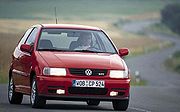
market. With a limited production run of 3000 units, the 6N GTI was available only in continental Europe. Featuring a 1.6 16V 125 PS (92 kW) version of the unit that would later be found in the Mark 3F model, the car came with 15" BBS alloys and could sprint to 100 km/h (62 mph) in just 9.1 seconds. The 16V, introduced to replace the GLX, was one of the most popular Mark 3 versions with modifiers, it used a 1.4 16V unit pushed to 100 PS (74 kW) as standard. This car was not a pure sporting model, and with a 0–100 km/h time of 10.6 seconds and a 190 km/h (118 mph) top speed, it was not as fast as the sporting Ibiza model (which used a 2.0 L 16V engine). The Polo GTI was often seen as over priced for the performance it delivered.
Polo Harlequin
In Europe, a special "Harlekin" or "Harlequin" model was released in 1995. The Polo Harlekin was an unusual edition featuring a multi-coloured body with each panel in a different colour: Flash red, Ginster yellow, Pistachio green and Chagall blue. It used the same engines as regular Polos—only the colour of the panels was the difference. Originally limited to 1,000, around 3,800 of this series were produced. There were 112 Polo Harlequins made in the UK between 1996 to 1998. The breakdown of these figures is that there were 103 sold in the UK in 1996, 8 in 1997 and 1 in 1998. Approximately there were 74 polo harlequins left in the UK at the end of 2010.Polo Mark 3 Phase II (2000-2002)
The Polo was facelifted in 2000 (internal designation Typ 6N2, unofficially known as the Mark 3F), with the hatchback models featuring updated styling including new headlights and bumpers and an all new interior based on that of the LupoVolkswagen Lupo
The Lupo is a city car manufactured by German automaker Volkswagen from 1998 to 2005.-Model history:The Lupo was introduced in 1998 to fill a gap at the bottom of the VW model range caused by the increasing size and weight of the VW Polo. Rivals included the Ford Ka, the Opel/Vauxhall Agila and...
. Although the car was similar in appearance to the Mark 3 (the bodyshell was fully galvanised and stiffened but not fully redesigned, although some panels were changed), Volkswagen claimed that 70% of the components were new. Power steering, antilock brakes and twin airbags were made standard. The saloon and estate versions received the new interior, but not the full exterior facelift. Also, the three-cylinder 1.4-litre TDI
TDI
-Chemistry:*Tolerable Daily Intake ,*Toluene diisocyanate, an organic chemical-Entertainment:*Total Drama Island, an animated reality series that started July 8, 2007...
engine was introduced for the three and five-door hatchbacks.
Specification options ranged from power steering, tinted glass, split rear seats, electric windows and cup holders to ABS, air conditioning, Xenon headlights and satellite navigation. Thirty-two models with seven engines ranging from the 1.4 diesel to the 1.6 L 16V GTI made the choice of Polo the widest ever seen. The base model was the Comfortline with the option of no less than 5 engines ranging from the 1.0 50 PS (37 kW) to the 1.9 TDI unit found across the VW range, producing 90 PS (66 kW). The 1.0 L hatchback was considered cheap for the build quality and spec list when compared to other cars. Then came the Trendline and Highline models. With engine options ranging from 60 PS (44 kW) to a 110 PS (81 kW) diesel they offered a range of features usually found on the more sporty models but without the insurance or running cost woes.
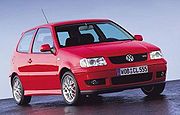
Polo GTI
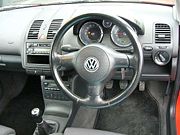
Climatronic
Climatronic is a fully electronic climate control system. Main difference between classic air conditioner and Climatronic is that it uses computer system instead of manual controls to adjust air distribution, temperature and flow to provide desired climate conditions. User defines basic parameters...
fully automatic air conditioning, Xenon headlights (with a headlight washer system), a 6 disc CD autochanger, exclusive sports interior with leather steering wheel and gearstick, chrome inserts and driver aids such as ABS with EBD and an EDL (a system to aid traction). Leather and satellite navigation were also optional extras. The Mark 3F Polo GTI
Volkswagen Polo GTI
The Volkswagen Polo GTI is a hot hatch version of the Volkswagen Polo supermini, produced by German automaker Volkswagen.-Mk2 Polo GT G40 and Mk2F Polo G40:...
however missed the new six-speed gearbox that was introduced in the smaller Lupo GTI
Volkswagen Lupo
The Lupo is a city car manufactured by German automaker Volkswagen from 1998 to 2005.-Model history:The Lupo was introduced in 1998 to fill a gap at the bottom of the VW model range caused by the increasing size and weight of the VW Polo. Rivals included the Ford Ka, the Opel/Vauxhall Agila and...
.
Awards
- 1999 Used Car Buyer Greatest Used Car Buy Awards Best Economy Car
- 1998 Top Gear Magazine Top Cars - Best Supermini
- 1997 Which?Which?Which? is a product-testing and consumer campaigning charity with a magazine, website and various other services run by Which? Ltd ....
Magazine Best Buys - Best Supermini - 1997 Auto ExpressAuto ExpressAuto Express is a weekly motoring magazine sold in the United Kingdom published by Dennis Publishing. The Editor-in-Chief is Steve Fowler.Launched in September 1988, its 1000th issue was published on 20 February 2008. It's only weekly competitor in Britain is the long established Autocar...
New Car Honours - Best Supermini - 1997 Complete Car of the Year Awards - Best Supermini
- 1996 Semperit Irish Car of the YearSemperit Irish Car of the YearThe Semperit Irish Car of the Year award was established in 1978. It is organised and judged by the Irish Motoring Writers Association . It is sponsored by tyre manufactuer Semperit and specifically by their brand - 'Semperit'....
- 1995 What Car?What Car?What Car? is a long-running UK monthly automobile magazine and website, currently edited by Steve Fowler and published by Haymarket Motoring. First published in 1973, it is intended primarily as a magazine for consumers rather than dedicated automobile enthusiasts...
- Car of the Year
The Polo outside Europe
- In some Asia Pacific markets, the Polo Classic (1995-2002MY) was sold as the Derby.
- In ChinaChinaChinese civilization may refer to:* China for more general discussion of the country.* Chinese culture* Greater China, the transnational community of ethnic Chinese.* History of China* Sinosphere, the area historically affected by Chinese culture...
, FAW-VolkswagenVolkswagen Group ChinaVolkswagen Group China is division of the German automotive concern Volkswagen Group in the People's Republic of China....
simply rebadged the SEAT CordobaSEAT CórdobaThe first generation SEAT Córdoba was presented at the 1993 Frankfurt Motor Show and launched in the summer of the same year, penned by Italian designer Giorgetto Giugiaro and based on the chassis of the SEAT Ibiza Mk2 which would spawn the Volkswagen Polo Mk3 the following year.Its 1.4, 1.6, 1.8...
without the exterior modifications of the European Derby (i.e. rear and front bumpers/headlights).
It was sold & assembled as the FAW-VW City-Golf during 1996.
It is not to be confused with the Canadian Mark 4 City Golf
Volkswagen Golf
The Volkswagen Golf is a small family car manufactured by Volkswagen since 1974 and marketed worldwide across six generations, in various body configurations and under various nameplates – as the Volkswagen Rabbit in the United States and Canada , and as the Volkswagen Caribe in Mexico .The...
released in 2006 in Canada
Canada
Canada is a North American country consisting of ten provinces and three territories. Located in the northern part of the continent, it extends from the Atlantic Ocean in the east to the Pacific Ocean in the west, and northward into the Arctic Ocean...
.
- In ArgentinaArgentinaArgentina , officially the Argentine Republic , is the second largest country in South America by land area, after Brazil. It is constituted as a federation of 23 provinces and an autonomous city, Buenos Aires...
, VW still produce a 2002 facelifted Polo Classic which is sold as Derby in MexicoMexicoThe United Mexican States , commonly known as Mexico , is a federal constitutional republic in North America. It is bordered on the north by the United States; on the south and west by the Pacific Ocean; on the southeast by Guatemala, Belize, and the Caribbean Sea; and on the east by the Gulf of...
and a Volkswagen CaddyVolkswagen CaddyReleased in 1980, the first Volkswagen Caddy is a coupe utility, and van based on the Volkswagen Group A1 platform, shared with the small family car Volkswagen Golf Mk1.Volkswagen Typ is:*147 = LHD*148 = RHD-Caddy debuts internationally as a Rabbit:...
, the SEAT IncaSEAT IncaThe SEAT Inca is a panel van, manufactured between 1996 and 2003. It was designed and assembled in Spain by SEAT, and based upon the SEAT Ibiza Mk2....
-derived van which shares the same platform and front end styling as the South American Type 6K. The 6K Polo Classic and 9K Caddy have been produced since 2000. All facelifted Type 6K/9K models are Argentine-built models.
The Polo Classic (Type 6K) and the facelifted Caddy (Type 9K) are still sold in Latin America
Latin America
Latin America is a region of the Americas where Romance languages – particularly Spanish and Portuguese, and variably French – are primarily spoken. Latin America has an area of approximately 21,069,500 km² , almost 3.9% of the Earth's surface or 14.1% of its land surface area...
, and are expected to be replaced in 2007 or 2008 by a sedan and panel van versions of the Gol V
Volkswagen Gol
The Volkswagen Gol is a subcompact car manufactured by Volkswagen do Brasil since 1980 as Volkswagen's entry-level car in the South American market—where it succeeded the South American VW Beetle ...
.
Latin America
Latin America
Latin America is a region of the Americas where Romance languages – particularly Spanish and Portuguese, and variably French – are primarily spoken. Latin America has an area of approximately 21,069,500 km² , almost 3.9% of the Earth's surface or 14.1% of its land surface area...
had its own trim levels, although some of the trim level names were similar to their European counterparts. The CL and GL were available from 1996 onwards in Brazil
Brazil
Brazil , officially the Federative Republic of Brazil , is the largest country in South America. It is the world's fifth largest country, both by geographical area and by population with over 192 million people...
; these were similar to their European counterparts, although slightly more expensive due to import tariff
Tariff
A tariff may be either tax on imports or exports , or a list or schedule of prices for such things as rail service, bus routes, and electrical usage ....
s.
Related models
- The SEAT IbizaSEAT IbizaThe SEAT Ibiza is a car in the European supermini class, constructed by the Spanish car maker SEAT S.A., is SEAT's best-selling car and perhaps the most popular model in the Spanish firm's range....
Mark 2 was based on the same platform as the Mark 3 Polo, as were the SEAT IncaSEAT IncaThe SEAT Inca is a panel van, manufactured between 1996 and 2003. It was designed and assembled in Spain by SEAT, and based upon the SEAT Ibiza Mk2....
and Volkswagen CaddyVolkswagen CaddyReleased in 1980, the first Volkswagen Caddy is a coupe utility, and van based on the Volkswagen Group A1 platform, shared with the small family car Volkswagen Golf Mk1.Volkswagen Typ is:*147 = LHD*148 = RHD-Caddy debuts internationally as a Rabbit:...
panel vanPanel vanA panel van is a form of solid van, smaller than a lorry or truck, without rear side windows...
s.
- The South African built Volkswagen Polo PlayaVolkswagen Polo PlayaThe Volkswagen Polo Playa is a supermini produced and sold in South Africa. From 1996 until 2002, it was a rebadged version of the SEAT Ibiza Mk2 five-door hatchback. A separate model, the Polo Mk3 was sold in most markets during this period - this model shared its mechanical components with the...
was a rebadged version of the SEAT IbizaSEAT IbizaThe SEAT Ibiza is a car in the European supermini class, constructed by the Spanish car maker SEAT S.A., is SEAT's best-selling car and perhaps the most popular model in the Spanish firm's range....
Mark 2, and was sold instead of the European Polo in South Africa until the introduction of the Polo Mark 4.
- The Volkswagen LupoVolkswagen LupoThe Lupo is a city car manufactured by German automaker Volkswagen from 1998 to 2005.-Model history:The Lupo was introduced in 1998 to fill a gap at the bottom of the VW model range caused by the increasing size and weight of the VW Polo. Rivals included the Ford Ka, the Opel/Vauxhall Agila and...
and SEAT ArosaSEAT ArosaThe SEAT Arosa is a city car from the Spanish automaker SEAT, a subsidiary of the Volkswagen Group, built between 1997 and 2004. The pre-facelift model debuted at the Geneva Motor Show in March 1997, while its facelifted model was presented at the Paris Motor Show in Autumn 2000 and was in...
city carCity carA city car is a small car intended for use primarily in an urban area.City cars are sold worldwide and most automotive industry manufacturers have one or two in their line-up. In North-America city cars are often referred to simply as "subcompacts" alongside the superminis. These kind of cars...
s were based on a shortened version of the 6N platform, and shared many components.
See also
- Volkswagen PoloVolkswagen PoloThe Volkswagen Polo is a supermini car manufactured by Volkswagen. It is sold in Europe and other markets worldwide in hatchback, saloon, coupé and estate variants....
for an overview of all models - Volkswagen Polo Mk1Volkswagen Polo Mk1The Volkswagen Polo Mk1 is the first generation of the Volkswagen Polo supermini. It was produced from 1975 until 1981.-Polo Mark 1 :...
- Volkswagen Polo Mk2Volkswagen Polo Mk2The Volkswagen Polo Mk2 is the second generation of the Volkswagen Polo supermini, it was produced from late 1981 until 1994.-Polo Mark 2:...
- Volkswagen Polo Mk4Volkswagen Polo Mk4The Volkswagen Polo Mk4 is the fourth generation of the Volkswagen Polo that has been sold by the German automaker Volkswagen from early 2002 to 2009 in most countries. It is still being manufactured in South Africa, where it is sold as the Polo Vivo. The MK4 replaced the Volkswagen Polo Mk3 in the...
External links
- Volkswagen UK's Polo Site
- Volkswagen Australia's Polo Site
- Club Polo UK Website (source for some of the model history information)
- uk-polos.net, THE UK Polo Forum (UK based VW Polo Forum)