

Felsic

Encyclopedia
The word "felsic" is a term used in geology
to refer to silicate minerals
, magma
, and rocks
which are enriched in the lighter elements such as silicon
, oxygen
, aluminium
, sodium
, and potassium
.
They are usually light in color and have specific gravities
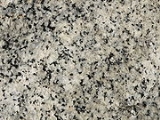
less than 3. The most common felsic rock is granite
, but others include quartz
, muscovite
, orthoclase
, and the sodium-rich plagioclase
feldspar
s. In terms of chemistry, felsic rocks are on the other side of the rock spectrum from the mafic
rocks.
In modern usage, the term acid rock, although sometimes used as a synonym, refers to a high-silica-content (greater than 63% SiO2 by weight) volcanic rock
, such as rhyolite
. The term was used more broadly in older geologic literature. It is considered archaic now, as the terms "acidic" and "basic rock" were based on an incorrect idea, dating from the 19th century, that silicic acid
was the chief form of silicon occurring in rocks.
The term "felsic" combines the words "feldspar
" and "silica". The similarity of the term felsic to the German words Fels, meaning "rock", and felsig, meaning "rocky", is purely accidental, as feldspar is a borrowing from German Feldspat, which derives from German Feld, meaning "field".
Felsite
is a petrologic
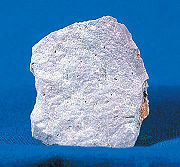
field term used to refer to very fine-grained or aphanitic, light-colored volcanic rocks which might be later reclassified after a more detailed microscopic or chemical analysis.
In some cases, felsic volcanic rocks may contain phenocryst
s of mafic
minerals, usually hornblende
, pyroxene
or a feldspar mineral, and may need to be named after their phenocryst mineral, such as 'hornblende-bearing felsite'.
The chemical name of a felsic rock is given according to the TAS classification
of Le Maitre (1975). However, this only applies to volcanic rocks. If the rock is analyzed and found to be felsic but is metamorphic
and has no definite volcanic protolith
, it may be sufficient to simply call it a 'felsic schist'. There are examples known of highly sheared granites which can be mistaken for rhyolites.
For phaneritic
felsic rocks, the QAPF diagram
should be used, and a name given according to the granite
nomenclature. Often the species of mafic minerals is included in the name, for instance, hornblende-bearing granite, pyroxene
tonalite
or augite
megacrystic monzonite
, because the term "granite" already assumes content with feldspar and quartz.
The rock texture thus determines the basic name of a felsic rock.

Geology
Geology is the science comprising the study of solid Earth, the rocks of which it is composed, and the processes by which it evolves. Geology gives insight into the history of the Earth, as it provides the primary evidence for plate tectonics, the evolutionary history of life, and past climates...
to refer to silicate minerals
Silicate minerals
The silicate minerals make up the largest and most important class of rock-forming minerals, constituting approximately 90 percent of the crust of the Earth. They are classified based on the structure of their silicate group...
, magma
Magma
Magma is a mixture of molten rock, volatiles and solids that is found beneath the surface of the Earth, and is expected to exist on other terrestrial planets. Besides molten rock, magma may also contain suspended crystals and dissolved gas and sometimes also gas bubbles. Magma often collects in...
, and rocks
Rock (geology)
In geology, rock or stone is a naturally occurring solid aggregate of minerals and/or mineraloids.The Earth's outer solid layer, the lithosphere, is made of rock. In general rocks are of three types, namely, igneous, sedimentary, and metamorphic...
which are enriched in the lighter elements such as silicon
Silicon
Silicon is a chemical element with the symbol Si and atomic number 14. A tetravalent metalloid, it is less reactive than its chemical analog carbon, the nonmetal directly above it in the periodic table, but more reactive than germanium, the metalloid directly below it in the table...
, oxygen
Oxygen
Oxygen is the element with atomic number 8 and represented by the symbol O. Its name derives from the Greek roots ὀξύς and -γενής , because at the time of naming, it was mistakenly thought that all acids required oxygen in their composition...
, aluminium
Aluminium
Aluminium or aluminum is a silvery white member of the boron group of chemical elements. It has the symbol Al, and its atomic number is 13. It is not soluble in water under normal circumstances....
, sodium
Sodium
Sodium is a chemical element with the symbol Na and atomic number 11. It is a soft, silvery-white, highly reactive metal and is a member of the alkali metals; its only stable isotope is 23Na. It is an abundant element that exists in numerous minerals, most commonly as sodium chloride...
, and potassium
Potassium
Potassium is the chemical element with the symbol K and atomic number 19. Elemental potassium is a soft silvery-white alkali metal that oxidizes rapidly in air and is very reactive with water, generating sufficient heat to ignite the hydrogen emitted in the reaction.Potassium and sodium are...
.
They are usually light in color and have specific gravities
Specific gravity
Specific gravity is the ratio of the density of a substance to the density of a reference substance. Apparent specific gravity is the ratio of the weight of a volume of the substance to the weight of an equal volume of the reference substance. The reference substance is nearly always water for...
less than 3. The most common felsic rock is granite
Granite
Granite is a common and widely occurring type of intrusive, felsic, igneous rock. Granite usually has a medium- to coarse-grained texture. Occasionally some individual crystals are larger than the groundmass, in which case the texture is known as porphyritic. A granitic rock with a porphyritic...
, but others include quartz
Quartz
Quartz is the second-most-abundant mineral in the Earth's continental crust, after feldspar. It is made up of a continuous framework of SiO4 silicon–oxygen tetrahedra, with each oxygen being shared between two tetrahedra, giving an overall formula SiO2. There are many different varieties of quartz,...
, muscovite
Muscovite
Muscovite is a phyllosilicate mineral of aluminium and potassium with formula KAl22, or 236. It has a highly-perfect basal cleavage yielding remarkably-thin laminæ which are often highly elastic...
, orthoclase
Orthoclase
Orthoclase is an important tectosilicate mineral which forms igneous rock. The name is from the Greek for "straight fracture," because its two cleavage planes are at right angles to each other. Alternate names are alkali feldspar and potassium feldspar...
, and the sodium-rich plagioclase
Plagioclase
Plagioclase is an important series of tectosilicate minerals within the feldspar family. Rather than referring to a particular mineral with a specific chemical composition, plagioclase is a solid solution series, more properly known as the plagioclase feldspar series...
feldspar
Feldspar
Feldspars are a group of rock-forming tectosilicate minerals which make up as much as 60% of the Earth's crust....
s. In terms of chemistry, felsic rocks are on the other side of the rock spectrum from the mafic
Mafic
Mafic is an adjective describing a silicate mineral or rock that is rich in magnesium and iron; the term is a portmanteau of the words "magnesium" and "ferric". Most mafic minerals are dark in color and the relative density is greater than 3. Common rock-forming mafic minerals include olivine,...
rocks.
In modern usage, the term acid rock, although sometimes used as a synonym, refers to a high-silica-content (greater than 63% SiO2 by weight) volcanic rock
Volcanic rock
Volcanic rock is a rock formed from magma erupted from a volcano. In other words, it is an igneous rock of volcanic origin...
, such as rhyolite
Rhyolite
This page is about a volcanic rock. For the ghost town see Rhyolite, Nevada, and for the satellite system, see Rhyolite/Aquacade.Rhyolite is an igneous, volcanic rock, of felsic composition . It may have any texture from glassy to aphanitic to porphyritic...
. The term was used more broadly in older geologic literature. It is considered archaic now, as the terms "acidic" and "basic rock" were based on an incorrect idea, dating from the 19th century, that silicic acid
Silicic acid
Silicic acid is a general name for a family of chemical compounds of the element silicon, hydrogen, and oxygen, with the general formula [SiOx4-2x]n...
was the chief form of silicon occurring in rocks.
The term "felsic" combines the words "feldspar
Feldspar
Feldspars are a group of rock-forming tectosilicate minerals which make up as much as 60% of the Earth's crust....
" and "silica". The similarity of the term felsic to the German words Fels, meaning "rock", and felsig, meaning "rocky", is purely accidental, as feldspar is a borrowing from German Feldspat, which derives from German Feld, meaning "field".
Classification of felsic rocks
In order for a rock to be classified as felsic, it generally needs to contain >75% felsic minerals; namely quartz, orthoclase and plagioclase. Rocks with greater than 90% felsic minerals can also be called leucocratic, meaning 'light-coloured'.Felsite
Felsite
Felsite is a very fine grained volcanic rock that may or may not contain larger crystals. Felsite is a field term for a light colored rock that typically requires petrographic examination or chemical analysis for more precise definition...
is a petrologic
Petrology
Petrology is the branch of geology that studies rocks, and the conditions in which rocks form....
field term used to refer to very fine-grained or aphanitic, light-colored volcanic rocks which might be later reclassified after a more detailed microscopic or chemical analysis.
In some cases, felsic volcanic rocks may contain phenocryst
Phenocryst
thumb|right|300px|[[Granite]]s often have large [[feldspar|feldspatic]] phenocrysts. This granite, from the [[Switzerland|Swiss]] side of the [[Mont Blanc]] massif, has large white [[plagioclase]] phenocrysts, [[triclinic]] [[mineral]]s that give [[trapezium|trapezoid]] shapes when cut through)...
s of mafic
Mafic
Mafic is an adjective describing a silicate mineral or rock that is rich in magnesium and iron; the term is a portmanteau of the words "magnesium" and "ferric". Most mafic minerals are dark in color and the relative density is greater than 3. Common rock-forming mafic minerals include olivine,...
minerals, usually hornblende
Hornblende
Hornblende is a complex inosilicate series of minerals .It is not a recognized mineral in its own right, but the name is used as a general or field term, to refer to a dark amphibole....
, pyroxene
Pyroxene
The pyroxenes are a group of important rock-forming inosilicate minerals found in many igneous and metamorphic rocks. They share a common structure consisting of single chains of silica tetrahedra and they crystallize in the monoclinic and orthorhombic systems...
or a feldspar mineral, and may need to be named after their phenocryst mineral, such as 'hornblende-bearing felsite'.
The chemical name of a felsic rock is given according to the TAS classification
TAS classification
The TAS classification can be used to assign names to many common types of volcanic rocks based upon the relationships between the combined alkali content and the silica content. These chemical parameters are useful, because the relative proportions of alkalis and silica play an important role in...
of Le Maitre (1975). However, this only applies to volcanic rocks. If the rock is analyzed and found to be felsic but is metamorphic
Metamorphic rock
Metamorphic rock is the transformation of an existing rock type, the protolith, in a process called metamorphism, which means "change in form". The protolith is subjected to heat and pressure causing profound physical and/or chemical change...
and has no definite volcanic protolith
Protolith
Protolith refers to the precursor lithology of a metamorphic rock.For example, the protolith of a slate is a shale or mudstone. Metamorphic rocks can be derived from any other rock and thus have a wide variety of protoliths. Identifying a protolith is a major aim of metamorphic geology.Sedimentary...
, it may be sufficient to simply call it a 'felsic schist'. There are examples known of highly sheared granites which can be mistaken for rhyolites.
For phaneritic
Phaneritic
Phaneritic is a term usually used to refer to igneous rock grain size. It means that the size of matrix grains in the rock are large enough to be distinguished with the unaided eye as opposed to aphanitic . This texture forms by slow cooling of magma deep underground in the plutonic environment...
felsic rocks, the QAPF diagram
QAPF diagram
A QAPF diagram is a double triangle diagram which is used to classify igneous rocks based on mineralogic composition. The acronym, QAPF, stands for "Quartz, Alkali feldspar, Plagioclase, Feldspathoid ". These are the mineral groups used for classification in QAPF diagram...
should be used, and a name given according to the granite
Granite
Granite is a common and widely occurring type of intrusive, felsic, igneous rock. Granite usually has a medium- to coarse-grained texture. Occasionally some individual crystals are larger than the groundmass, in which case the texture is known as porphyritic. A granitic rock with a porphyritic...
nomenclature. Often the species of mafic minerals is included in the name, for instance, hornblende-bearing granite, pyroxene
Pyroxene
The pyroxenes are a group of important rock-forming inosilicate minerals found in many igneous and metamorphic rocks. They share a common structure consisting of single chains of silica tetrahedra and they crystallize in the monoclinic and orthorhombic systems...
tonalite
Tonalite
Tonalite is an igneous, plutonic rock, of felsic composition, with phaneritic texture. Feldspar is present as plagioclase with 10% or less alkali feldspar. Quartz is present as more than 20% of the rock. Amphiboles and pyroxenes are common accessory minerals.In older references tonalite is...
or augite
Augite
Augite is a single chain inosilicate mineral, 2O6. The crystals are monoclinic and prismatic. Augite has two prominent cleavages, meeting at angles near 90 degrees.-Characteristics:Augite is a solid solution in the pyroxene group...
megacrystic monzonite
Monzonite
Monzonite is an intermediate igneous intrusive rock composed of approximately equal amounts of sodic to intermediate plagioclase and orthoclase feldspars with minor amounts of hornblende, biotite and other minerals...
, because the term "granite" already assumes content with feldspar and quartz.
The rock texture thus determines the basic name of a felsic rock.
| Rock Texture | Name of Felsic Rock |
| Pegmatitic | Granite Granite Granite is a common and widely occurring type of intrusive, felsic, igneous rock. Granite usually has a medium- to coarse-grained texture. Occasionally some individual crystals are larger than the groundmass, in which case the texture is known as porphyritic. A granitic rock with a porphyritic... pegmatite Pegmatite A pegmatite is a very crystalline, intrusive igneous rock composed of interlocking crystals usually larger than 2.5 cm in size; such rocks are referred to as pegmatitic.... |
| Coarse-grained (phaneritic Phaneritic Phaneritic is a term usually used to refer to igneous rock grain size. It means that the size of matrix grains in the rock are large enough to be distinguished with the unaided eye as opposed to aphanitic . This texture forms by slow cooling of magma deep underground in the plutonic environment... ) | Granite Granite Granite is a common and widely occurring type of intrusive, felsic, igneous rock. Granite usually has a medium- to coarse-grained texture. Occasionally some individual crystals are larger than the groundmass, in which case the texture is known as porphyritic. A granitic rock with a porphyritic... |
| Coarse-grained and porphyritic Porphyritic Porphyritic is an adjective used in geology, specifically for igneous rocks, for a rock that has a distinct difference in the size of the crystals, with at least one group of crystals obviously larger than another group... | Porphyritic granite Granite Granite is a common and widely occurring type of intrusive, felsic, igneous rock. Granite usually has a medium- to coarse-grained texture. Occasionally some individual crystals are larger than the groundmass, in which case the texture is known as porphyritic. A granitic rock with a porphyritic... |
| Fine-grained (aphanitic) | Rhyolite Rhyolite This page is about a volcanic rock. For the ghost town see Rhyolite, Nevada, and for the satellite system, see Rhyolite/Aquacade.Rhyolite is an igneous, volcanic rock, of felsic composition . It may have any texture from glassy to aphanitic to porphyritic... |
| Fine-grained and porphyritic | Porphyritic rhyolite Rhyolite This page is about a volcanic rock. For the ghost town see Rhyolite, Nevada, and for the satellite system, see Rhyolite/Aquacade.Rhyolite is an igneous, volcanic rock, of felsic composition . It may have any texture from glassy to aphanitic to porphyritic... |
| Pyroclastic | Rhyolitic tuff Tuff Tuff is a type of rock consisting of consolidated volcanic ash ejected from vents during a volcanic eruption. Tuff is sometimes called tufa, particularly when used as construction material, although tufa also refers to a quite different rock. Rock that contains greater than 50% tuff is considered... or breccia Breccia Breccia is a rock composed of broken fragments of minerals or rock cemented together by a fine-grained matrix, that can be either similar to or different from the composition of the fragments.... |
| Vesicular Vesicular texture Vesicular texture is a volcanic rock texture characterised by a rock being pitted with many cavities at its surface and inside. The texture is often found in extrusive aphanitic, or glassy, igneous rock... | Pumice Pumice Pumice is a textural term for a volcanic rock that is a solidified frothy lava typically created when super-heated, highly pressurized rock is violently ejected from a volcano. It can be formed when lava and water are mixed. This unusual formation is due to the simultaneous actions of rapid... |
| Amygdaloidal | None |
| Vitreous (Glassy) | Obsidian Obsidian Obsidian is a naturally occurring volcanic glass formed as an extrusive igneous rock.It is produced when felsic lava extruded from a volcano cools rapidly with minimum crystal growth... or porcellanite |
See also
- QAPF diagramQAPF diagramA QAPF diagram is a double triangle diagram which is used to classify igneous rocks based on mineralogic composition. The acronym, QAPF, stands for "Quartz, Alkali feldspar, Plagioclase, Feldspathoid ". These are the mineral groups used for classification in QAPF diagram...
- List of minerals
- List of rock types
- GraniteGraniteGranite is a common and widely occurring type of intrusive, felsic, igneous rock. Granite usually has a medium- to coarse-grained texture. Occasionally some individual crystals are larger than the groundmass, in which case the texture is known as porphyritic. A granitic rock with a porphyritic...
- MaficMaficMafic is an adjective describing a silicate mineral or rock that is rich in magnesium and iron; the term is a portmanteau of the words "magnesium" and "ferric". Most mafic minerals are dark in color and the relative density is greater than 3. Common rock-forming mafic minerals include olivine,...