

Rhamnaceae

Encyclopedia
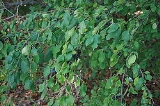
Rhamnaceae, the Buckthorn family, is a large family of flowering plant
s, mostly trees, shrub
s and some vines.
The family contains 50-60 genera and approximately 870-900 species. The Rhamnaceae have a worldwide distribution, but are more common in the subtropical and tropical regions. The earliest fossil evidence of Rhamnaceae is from the Eocene
.
The simple leaves
can be either alternate and spiraling, or opposite. Stipules are present. These leaves are modified into spines in many genera, in some (e.g. Paliurus spina-christi
and Colletia
cruciata) spectacularly so. Colletia stands out by having two axillary buds instead of one, one developing into a thorn, the other one into a shoot.
 The flower
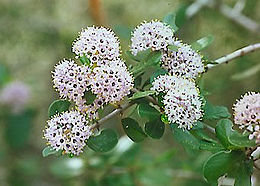
s are radially symmetrical. There are 5 (sometimes 4) separate sepals and 5 (sometimes 4 or none) separate petals. The petals may be white, yellowish, greenish, pink or blue, and are small and inconspicuous in most genera, though in some (e.g. Ceanothus) the dense clusters of flowers are conspicuous. The 5 or 4 stamen
s are isomerous with the petals (i.e. one stamen opposite each petal). The ovary
is superior, with 2 or 3 ovule
s (or one by abortion).
The fruit
s are mostly berries, fleshy drupe
s or nuts. Some are adapted to wind carriage, but most are dispersed by mammals and birds. Chinese jujube is the fruit of the jujube
tree (Ziziphus zizyphus) and is a major fruit in China
.
The American genus Ceanothus
, which has several showy ornamental
species, has nitrogen-fixing root nodule
s.
Economic uses of the Rhamnaceae are chiefly as ornamental plants and as the source of many brilliant green and yellow dye
s. The wood
of Rhamnus
was also the most favoured species to make charcoal
for use in gunpowder
before the development of modern propellants.
Flowering plant
The flowering plants , also known as Angiospermae or Magnoliophyta, are the most diverse group of land plants. Angiosperms are seed-producing plants like the gymnosperms and can be distinguished from the gymnosperms by a series of synapomorphies...
s, mostly trees, shrub
Shrub
A shrub or bush is distinguished from a tree by its multiple stems and shorter height, usually under 5–6 m tall. A large number of plants may become either shrubs or trees, depending on the growing conditions they experience...
s and some vines.
The family contains 50-60 genera and approximately 870-900 species. The Rhamnaceae have a worldwide distribution, but are more common in the subtropical and tropical regions. The earliest fossil evidence of Rhamnaceae is from the Eocene
Eocene
The Eocene Epoch, lasting from about 56 to 34 million years ago , is a major division of the geologic timescale and the second epoch of the Paleogene Period in the Cenozoic Era. The Eocene spans the time from the end of the Palaeocene Epoch to the beginning of the Oligocene Epoch. The start of the...
.
The simple leaves
Leaf
A leaf is an organ of a vascular plant, as defined in botanical terms, and in particular in plant morphology. Foliage is a mass noun that refers to leaves as a feature of plants....
can be either alternate and spiraling, or opposite. Stipules are present. These leaves are modified into spines in many genera, in some (e.g. Paliurus spina-christi
Paliurus spina-christi
Paliurus spina-christi, commonly known as Jerusalem Thorn, Garland Thorn, Christ's Thorn, or Crown of Thorns, is a species of Paliurus native to the Mediterranean region and southwest and central Asia, from Morocco and Spain east to Iran and Tajikistan.It is a deciduous shrub or small tree growing...
and Colletia
Colletia
Colletia is a genus of flowering plants in the family Rhamnaceae, with 15 to 17 species of spiny shrubs. All species of this genus are native to southern South America. They are non-legume nitrogen fixers.-Selected species:*Colletia armata...
cruciata) spectacularly so. Colletia stands out by having two axillary buds instead of one, one developing into a thorn, the other one into a shoot.
Flower
A flower, sometimes known as a bloom or blossom, is the reproductive structure found in flowering plants . The biological function of a flower is to effect reproduction, usually by providing a mechanism for the union of sperm with eggs...
s are radially symmetrical. There are 5 (sometimes 4) separate sepals and 5 (sometimes 4 or none) separate petals. The petals may be white, yellowish, greenish, pink or blue, and are small and inconspicuous in most genera, though in some (e.g. Ceanothus) the dense clusters of flowers are conspicuous. The 5 or 4 stamen
Stamen
The stamen is the pollen producing reproductive organ of a flower...
s are isomerous with the petals (i.e. one stamen opposite each petal). The ovary
Ovary (plants)
In the flowering plants, an ovary is a part of the female reproductive organ of the flower or gynoecium. Specifically, it is the part of the pistil which holds the ovule and is located above or below or at the point of connection with the base of the petals and sepals...
is superior, with 2 or 3 ovule
Ovule
Ovule means "small egg". In seed plants, the ovule is the structure that gives rise to and contains the female reproductive cells. It consists of three parts: The integument forming its outer layer, the nucellus , and the megaspore-derived female gametophyte in its center...
s (or one by abortion).
The fruit
Fruit
In broad terms, a fruit is a structure of a plant that contains its seeds.The term has different meanings dependent on context. In non-technical usage, such as food preparation, fruit normally means the fleshy seed-associated structures of certain plants that are sweet and edible in the raw state,...
s are mostly berries, fleshy drupe
Drupe
In botany, a drupe is a fruit in which an outer fleshy part surrounds a shell of hardened endocarp with a seed inside. These fruits develop from a single carpel, and mostly from flowers with superior ovaries...
s or nuts. Some are adapted to wind carriage, but most are dispersed by mammals and birds. Chinese jujube is the fruit of the jujube
Jujube
Ziziphus zizyphus , commonly called jujube , red date, Chinese date, Korean date, or Indian date is a species of Ziziphus in the buckthorn family Rhamnaceae, used primarily as a fruiting shade tree.-Distribution:Its precise natural distribution is uncertain due to extensive cultivation,...
tree (Ziziphus zizyphus) and is a major fruit in China
China
Chinese civilization may refer to:* China for more general discussion of the country.* Chinese culture* Greater China, the transnational community of ethnic Chinese.* History of China* Sinosphere, the area historically affected by Chinese culture...
.
The American genus Ceanothus
Ceanothus
Ceanothus L. is a genus of about 50–60 species of shrubs or small trees in the buckthorn family Rhamnaceae. The genus is confined to North America, the center of its distribution in California, with some species in the eastern United States and southeast Canada, and others extending as far south...
, which has several showy ornamental
Ornamental plant
Ornamental plants are plants that are grown for decorative purposes in gardens and landscape design projects, as house plants, for cut flowers and specimen display...
species, has nitrogen-fixing root nodule
Root nodule
Root nodules occur on the roots of plants that associate with symbiotic nitrogen-fixing bacteria. Under nitrogen-limiting conditions, capable plants form a symbiotic relationship with a host-specific strain of bacteria known as rhizobia...
s.
Economic uses of the Rhamnaceae are chiefly as ornamental plants and as the source of many brilliant green and yellow dye
Dye
A dye is a colored substance that has an affinity to the substrate to which it is being applied. The dye is generally applied in an aqueous solution, and requires a mordant to improve the fastness of the dye on the fiber....
s. The wood
Wood
Wood is a hard, fibrous tissue found in many trees. It has been used for hundreds of thousands of years for both fuel and as a construction material. It is an organic material, a natural composite of cellulose fibers embedded in a matrix of lignin which resists compression...
of Rhamnus
Buckthorn
The Buckthorns are a genus of about 100 species of shrubs or small trees from 1-10 m tall , in the buckthorn family Rhamnaceae...
was also the most favoured species to make charcoal
Charcoal
Charcoal is the dark grey residue consisting of carbon, and any remaining ash, obtained by removing water and other volatile constituents from animal and vegetation substances. Charcoal is usually produced by slow pyrolysis, the heating of wood or other substances in the absence of oxygen...
for use in gunpowder
Gunpowder
Gunpowder, also known since in the late 19th century as black powder, was the first chemical explosive and the only one known until the mid 1800s. It is a mixture of sulfur, charcoal, and potassium nitrate - with the sulfur and charcoal acting as fuels, while the saltpeter works as an oxidizer...
before the development of modern propellants.
Genera
Tribe Ampelozizipheae Ampelozizyphus Ampelozizyphus is a genus of plants in the family Rhamnaceae. It includes a single species Ampelozizyphus amazonicus found in Brazil....
Tribe Bathiorhamneae
Tribe Colletieae
Tribe Doerpfeldieae
Tribe Gouanieae
|
Tribe Maesopsideae
Tribe Paliurieae
Tribe Phyliceae
Tribe Pomaderreae
|
Tribe Rhamneae
Tribe Ventilagineae
|
Incertae sedis
|