

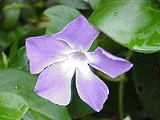
Vinca major

Encyclopedia
Vinca major, with the common name
s Bigleaf Periwinkle, Large Periwinkle, Greater Periwinkle and Blue Periwinkle, is an herbaceous
, perennial, rhizomatous and stoloniferous flowering plant
in the genus Vinca
belonging to the family Apocynaceae
.
L.
trailing vine, spreading along the ground and rooting along the stems to form dense masses of groundcover
individually 2-5 m across and scrambling up to 50-70 cm high.
The leaves
are opposite, nearly orbicular at the base of the stems and lanceolate at the apex, 3-9 cm long and 2-6 cm broad, glossy dark green with a leathery texture and an entire but distinctly ciliate margin, and a hairy petiole
1-2 cm long.
The flower
s are hermaphrodite
, axillary and solitary, violet-purple, 3-5 cm diameter, with a five-lobed corolla. The calyx surrounding the base of the flower is 10–17 mm (0.393700787401575–0.669291338582677 ) long with hairy margins. The flowering period extends from early spring to autumn.
, with geographically separate ranges:
The closely related species Vinca minor
is similar but smaller, with narrower, hairless leaves.
and northern Africa is distributed from Spain
and southern France
east to the western Balkans
, and also in northeastern Turkey
and the western Caucasus
.
in temperate gardens for its evergreen foliage, spring flowers, and groundcover
or vine
use.
s are available, with differences in flowers, such as white to dark violet flowers, and different patterns and colors of variegated
foliage.
in temperate parts of the United States
, Australia
, and New Zealand
. It is especially a common noxious weed 'smothering' native plant
s and diversity in riparian area and oak woodland
habitat
s of coastal California
.
Common name
A common name of a taxon or organism is a name in general use within a community; it is often contrasted with the scientific name for the same organism...
s Bigleaf Periwinkle, Large Periwinkle, Greater Periwinkle and Blue Periwinkle, is an herbaceous
Herbaceous
A herbaceous plant is a plant that has leaves and stems that die down at the end of the growing season to the soil level. They have no persistent woody stem above ground...
, perennial, rhizomatous and stoloniferous flowering plant
Flowering plant
The flowering plants , also known as Angiospermae or Magnoliophyta, are the most diverse group of land plants. Angiosperms are seed-producing plants like the gymnosperms and can be distinguished from the gymnosperms by a series of synapomorphies...
in the genus Vinca
Vinca
Vinca is a genus of six species in the family Apocynaceae, native to Europe, northwest Africa and southwest Asia. The English name periwinkle is shared with the related genus Catharanthus .-Description:Vinca plants are subshrubs or herbaceous, and have slender trailing stems 1–2 m long...
belonging to the family Apocynaceae
Apocynaceae
The Apocynaceae or dogbane family is a family of flowering plants that includes trees, shrubs, herbs, and lianas.Many species are tall trees found in tropical rainforests, and most are from the tropics and subtropics, but some grow in tropical dry, xeric environments. There are also perennial herbs...
.
Etymology
The genus name probably derives from the Latin word vincire, meaning bind, as the long creeping vines were used to prepare garlands. The species name major refers to the larger size in respect of the similar Vinca minorVinca minor
Vinca minor, Lesser periwinkle and Dwarf periwinkle, is a plant native to central and southern Europe, from Portugal and France north to the Netherlands and the Baltic States, and east to the Caucasus, and also in southwestern Asia in Turkey...
L.
Description
Vinca major is an evergreenEvergreen
In botany, an evergreen plant is a plant that has leaves in all seasons. This contrasts with deciduous plants, which completely lose their foliage during the winter or dry season.There are many different kinds of evergreen plants, both trees and shrubs...
trailing vine, spreading along the ground and rooting along the stems to form dense masses of groundcover
Groundcover
Groundcover refers to any plant that grows over an area of ground, used to provide protection from erosion and drought, and to improve its aesthetic appearance .- Ecosystem :...
individually 2-5 m across and scrambling up to 50-70 cm high.
The leaves
Leaf
A leaf is an organ of a vascular plant, as defined in botanical terms, and in particular in plant morphology. Foliage is a mass noun that refers to leaves as a feature of plants....
are opposite, nearly orbicular at the base of the stems and lanceolate at the apex, 3-9 cm long and 2-6 cm broad, glossy dark green with a leathery texture and an entire but distinctly ciliate margin, and a hairy petiole
Petiole (botany)
In botany, the petiole is the stalk attaching the leaf blade to the stem. The petiole usually has the same internal structure as the stem. Outgrowths appearing on each side of the petiole are called stipules. Leaves lacking a petiole are called sessile, or clasping when they partly surround the...
1-2 cm long.
The flower
Flower
A flower, sometimes known as a bloom or blossom, is the reproductive structure found in flowering plants . The biological function of a flower is to effect reproduction, usually by providing a mechanism for the union of sperm with eggs...
s are hermaphrodite
Hermaphrodite
In biology, a hermaphrodite is an organism that has reproductive organs normally associated with both male and female sexes.Many taxonomic groups of animals do not have separate sexes. In these groups, hermaphroditism is a normal condition, enabling a form of sexual reproduction in which both...
, axillary and solitary, violet-purple, 3-5 cm diameter, with a five-lobed corolla. The calyx surrounding the base of the flower is 10–17 mm (0.393700787401575–0.669291338582677 ) long with hairy margins. The flowering period extends from early spring to autumn.
Subspecies
There are two subspeciesSubspecies
Subspecies in biological classification, is either a taxonomic rank subordinate to species, ora taxonomic unit in that rank . A subspecies cannot be recognized in isolation: a species will either be recognized as having no subspecies at all or two or more, never just one...
, with geographically separate ranges:
- Vinca major subsp. major. Leaf petioles finely hairy, hairs short. Southern Europe.
- Vinca major subsp. hirsuta (Boiss.) Stearn (syn. V. pubescens d'Urv.). Leaf petioles densely hairy, hairs longer; petals much narrower. Caucasus, northeastern Turkey.
The closely related species Vinca minor
Vinca minor
Vinca minor, Lesser periwinkle and Dwarf periwinkle, is a plant native to central and southern Europe, from Portugal and France north to the Netherlands and the Baltic States, and east to the Caucasus, and also in southwestern Asia in Turkey...
is similar but smaller, with narrower, hairless leaves.
Distribution
This species native to southern EuropeEurope
Europe is, by convention, one of the world's seven continents. Comprising the westernmost peninsula of Eurasia, Europe is generally 'divided' from Asia to its east by the watershed divides of the Ural and Caucasus Mountains, the Ural River, the Caspian and Black Seas, and the waterways connecting...
and northern Africa is distributed from Spain
Spain
Spain , officially the Kingdom of Spain languages]] under the European Charter for Regional or Minority Languages. In each of these, Spain's official name is as follows:;;;;;;), is a country and member state of the European Union located in southwestern Europe on the Iberian Peninsula...
and southern France
France
The French Republic , The French Republic , The French Republic , (commonly known as France , is a unitary semi-presidential republic in Western Europe with several overseas territories and islands located on other continents and in the Indian, Pacific, and Atlantic oceans. Metropolitan France...
east to the western Balkans
Balkans
The Balkans is a geopolitical and cultural region of southeastern Europe...
, and also in northeastern Turkey
Turkey
Turkey , known officially as the Republic of Turkey , is a Eurasian country located in Western Asia and in East Thrace in Southeastern Europe...
and the western Caucasus
Caucasus
The Caucasus, also Caucas or Caucasia , is a geopolitical region at the border of Europe and Asia, and situated between the Black and the Caspian sea...
.
Habitat
Vinca major prefers moisty undergrowth, woodlands, hedgerows and banks along the rivers at an altitude of 0–800 m (0–2,624.7 ) above sea level. It grows well in full sun and in deep shade.Cultivation and uses
Vinca major is a commonly grown ornamental plantOrnamental plant
Ornamental plants are plants that are grown for decorative purposes in gardens and landscape design projects, as house plants, for cut flowers and specimen display...
in temperate gardens for its evergreen foliage, spring flowers, and groundcover
Groundcover
Groundcover refers to any plant that grows over an area of ground, used to provide protection from erosion and drought, and to improve its aesthetic appearance .- Ecosystem :...
or vine
Vine
A vine in the narrowest sense is the grapevine , but more generally it can refer to any plant with a growth habit of trailing or scandent, that is to say climbing, stems or runners...
use.
Cultivars
Many cultivarCultivar
A cultivar'Cultivar has two meanings as explained under Formal definition. When used in reference to a taxon, the word does not apply to an individual plant but to all those plants sharing the unique characteristics that define the cultivar. is a plant or group of plants selected for desirable...
s are available, with differences in flowers, such as white to dark violet flowers, and different patterns and colors of variegated
Variegation
Variegation is the appearance of differently coloured zones in the leaves, and sometimes the stems, of plants. This may be due to a number of causes...
foliage.
Invasive plant species
Vinca major is an invasive speciesInvasive species
"Invasive species", or invasive exotics, is a nomenclature term and categorization phrase used for flora and fauna, and for specific restoration-preservation processes in native habitats, with several definitions....
in temperate parts of the United States
United States
The United States of America is a federal constitutional republic comprising fifty states and a federal district...
, Australia
Australia
Australia , officially the Commonwealth of Australia, is a country in the Southern Hemisphere comprising the mainland of the Australian continent, the island of Tasmania, and numerous smaller islands in the Indian and Pacific Oceans. It is the world's sixth-largest country by total area...
, and New Zealand
New Zealand
New Zealand is an island country in the south-western Pacific Ocean comprising two main landmasses and numerous smaller islands. The country is situated some east of Australia across the Tasman Sea, and roughly south of the Pacific island nations of New Caledonia, Fiji, and Tonga...
. It is especially a common noxious weed 'smothering' native plant
Native plant
Native plant is a term to describe plants endemic or naturalized to a given area in geologic time.This includes plants that have developed, occur naturally, or existed for many years in an area...
s and diversity in riparian area and oak woodland
California oak woodland
California oak woodland is a plant community found throughout the California chaparral and woodlands ecoregion of California in the United States and northwestern Baja California in Mexico...
habitat
Habitat
* Habitat , a place where a species lives and grows*Human habitat, a place where humans live, work or play** Space habitat, a space station intended as a permanent settlement...
s of coastal California
California
California is a state located on the West Coast of the United States. It is by far the most populous U.S. state, and the third-largest by land area...
.