

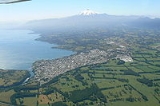
Villarrica, Chile

Encyclopedia
Villarrica is a city and commune in southern Chile
located on the western shore of Villarrica Lake in the Province of Cautín
, Araucanía Region
746 km (464 mi) south of Santiago
and close to the Villarrica Volcano
ski center to the south east. Residents of Villarrica are known as Villarriquences.
Tourism, grain and dairy farming, and forestry are the main economic activities of the community. The climate is mild and humid with the greatest rainfall experienced between May and July (autumn and winter). The dry season is between December and February (Summer).
Other lakes found nearby include Calafquén
, Caburgua
, Huilipilún and Colico
. In the summer water sports and sunbathing are popular activities in the warm temperatures experienced at the low altitudes ranging from 200 to 500m above sea level.
Fishing and rafting are popular activities in the various rivers in the area, which include the Toltén
, Voipir, Trancura
, Llancahue and Lincura. Popular waterfalls include León, La China, Palguín, Ojos del Caburga. Thanks to the numerous volcanos, hot springs with temperatures ranging from 48°C to 90°C, are found nearby. Included are Coñaripe
(48°C), San Luis (43°C), Huife (49°C), Palguín (57°C) and Liquiñe
(87°C).
Villarrica National Park
is 36 km (22 mi) away, and was created to preserve the natural beauty of the volcano. The area is noted for using wood as its principal building material.
. Abandoned after his death in 1554, it was refounded five years later by García Hurtado de Mendoza. It grew into a small city, despite suffering destruction by a great earthquake on December 16, 1575
. It had opened communications with Buenos Aires
in its last years.
Following the Battle of Curalaba in the Arauco War
, the last Spanish city to the south of the Bío Bío River was destroyed after a three-year-long siege, surrendering on February 7, 1603. Before its destruction it had more than 600 Spanish inhabitants, not counting its Indian servants. At its surrender only 11 men and 13 women were taken captive.
The city was refounded on the site of the old city in the 1880s during the occupation of Araucanía. The population in 2002 was 45,531. Population growth and economic development has increased, due to a global reputation as a tourist destination for nature lovers, summer recreation and winter sports enthusiasts, and to purchase vacation/second-homes by Europe
an and American
expatriates.
After the city's refounding, the Chilean government established a land sale program to encourage settlement and invited European, esp. Swiss, German
and Austrian
immigrants in the last half of the 19th century to populate an area previously under control of the indigenous Mapuche. Every August 1, Swiss National Day
festivities are observed in the old city to commemorate the Germanic roots of Villarricanos. Also in large numbers are descendants of Basque, Dutch
, British
, Scandinavian
, Italian
and Greek
immigrants.
of the National Statistics Institute
, Villarrica spans an area of 1291.1 sqkm and has 45,531 inhabitants (22,694 men and 22,837 women). Of these, 30,859 (67.8%) lived in urban area
s and 14,672 (32.2%) in rural areas. The population grew by 26.9% (9,664 persons) between the 1992 and 2002 censuses.
, headed by an alcalde
who is directly elected every four years. The 2008-2012 alcalde is Pablo Astete Mermoud (RN
).
Within the electoral divisions of Chile, Villarrica is represented in the Chamber of Deputies
by René Manuel García (RN) and Fernando Meza (PRSD
) as part of the 52nd electoral district, (together with Cunco
, Pucón
, Curarrehue
, Loncoche
, Gorbea
and Toltén
). The commune is represented in the Senate
by José Garcia Ruminot (RN) and Eugenio Tuma Zedan (PPD
) as part of the 15th senatorial constituency (Araucanía-South).
Chile
Chile ,officially the Republic of Chile , is a country in South America occupying a long, narrow coastal strip between the Andes mountains to the east and the Pacific Ocean to the west. It borders Peru to the north, Bolivia to the northeast, Argentina to the east, and the Drake Passage in the far...
located on the western shore of Villarrica Lake in the Province of Cautín
Cautín Province
Cautín Province is one of two provinces in the southern Chilean region of Araucanía , bounded on the north by Arauco and Malleco provinces, on the east by Argentina, on the south by Valdivia Province, and on the west by the Pacific Ocean. Its population at the 2002 census was of 667,920. The most...
, Araucanía Region
Araucanía Region
The IX Araucanía Region is one of Chile's 15 first order administrative divisions and comprises two provinces: Malleco in the north and Cautín in the south....
746 km (464 mi) south of Santiago
Santiago
Santiago is the capital city of Chile. Santiago may also refer to:*Santiago *Santiago , a Spanish given name*Santiago!, a shortened form of the Reconquista battle cry "Santiago y cierra, España"...
and close to the Villarrica Volcano
Villarrica (volcano)
Villarrica is one of Chile's most active volcanoes, rising above the lake and town of the same name. The volcano is also known as Rucapillán, a Mapuche word meaning "House of the Pillán". It is the westernmost of three large stratovolcanoes that trend perpendicular to the Andean chain along the...
ski center to the south east. Residents of Villarrica are known as Villarriquences.
Tourism, grain and dairy farming, and forestry are the main economic activities of the community. The climate is mild and humid with the greatest rainfall experienced between May and July (autumn and winter). The dry season is between December and February (Summer).
Other lakes found nearby include Calafquén
Calafquén Lake
Calafquén Lake is a lake of Chile, which straddles the border between the Araucanía Region and Los Ríos Region. It is one of the Seven Lakes and forms part of the drainage basin of the Valdivia River....
, Caburgua
Caburgua Lake
Caburgua Lake is located 23 km northeast of the city of Pucón, in the Araucanía Region of Chile. Huerquehue National Park lies to the east of the lake. Like Villarrica Lake, it is part of Toltén River basin...
, Huilipilún and Colico
Colico Lake
Colico Lake is located in the Araucanía Region of Chile. The neighboring Caburgua Lake lies to the east of the lake and the Villarrica Lake to the south....
. In the summer water sports and sunbathing are popular activities in the warm temperatures experienced at the low altitudes ranging from 200 to 500m above sea level.
Fishing and rafting are popular activities in the various rivers in the area, which include the Toltén
Toltén River
Toltén River is a river located in the Araucanía Region of Chile. It rises at Villarrica Lake, close to the city of the same name. Its major tributary is Allipén River...
, Voipir, Trancura
Trancura River
Trancura River is a river located in the Araucanía Region of Chile. Its headwaters drain the southeasternmost portion of Villarrica National Park, including the northwestern slope of Lanín volcano...
, Llancahue and Lincura. Popular waterfalls include León, La China, Palguín, Ojos del Caburga. Thanks to the numerous volcanos, hot springs with temperatures ranging from 48°C to 90°C, are found nearby. Included are Coñaripe
Coñaripe
Coñaripe is a Chilean town and resort area, located on the shore of Calafquén Lake. Administratively it belongs to Panguipulli commune in Valdivia Province of Los Ríos Region....
(48°C), San Luis (43°C), Huife (49°C), Palguín (57°C) and Liquiñe
Liquiñe
Liquiñe is a town in Liquiñe Valley, in Panguipulli commune, Valdivia Province, Chile. The area around the village is home to South America's densest collection of hot springs. There are literally hundred of sites where geothermal waters flow up out of the earth. The water emerges from the ground...
(87°C).
Villarrica National Park
Villarrica National Park
Villarrica National Park is located in the Andes, in the Araucanía and Los Ríos regions of Chile, near Pucón. The centerpiece of the park is a line of three volcanoes stretching transversely to the Andean range: Villarrica, Quetrupillán, and Lanín....
is 36 km (22 mi) away, and was created to preserve the natural beauty of the volcano. The area is noted for using wood as its principal building material.
History
Villarrica was founded as Santa María Magdalena de Villa Rica in 1552 by Jerónimo de AldereteJerónimo de Alderete
Jerónimo de Alderete y Mercado was a Spanish conquistador who was later named governor Chile, but died before he could assume his post.-Early life:...
. Abandoned after his death in 1554, it was refounded five years later by García Hurtado de Mendoza. It grew into a small city, despite suffering destruction by a great earthquake on December 16, 1575
1575 Valdivia earthquake
The 1575 Valdivia earthquake was an earthquake in Chile that caused the subsequent flood of Valdivia much like the 1960 Valdivia earthquake caused the ensuing Riñihuazo flooding. It occurred at 14:30 local time on December 16, 1575. It had an estimated magnitude of 8.5 on the surface wave...
. It had opened communications with Buenos Aires
Buenos Aires
Buenos Aires is the capital and largest city of Argentina, and the second-largest metropolitan area in South America, after São Paulo. It is located on the western shore of the estuary of the Río de la Plata, on the southeastern coast of the South American continent...
in its last years.
Following the Battle of Curalaba in the Arauco War
Arauco War
The Arauco War was a conflict between colonial Spaniards and the Mapuche people in what is now the Araucanía and Biobío regions of modern Chile...
, the last Spanish city to the south of the Bío Bío River was destroyed after a three-year-long siege, surrendering on February 7, 1603. Before its destruction it had more than 600 Spanish inhabitants, not counting its Indian servants. At its surrender only 11 men and 13 women were taken captive.
The city was refounded on the site of the old city in the 1880s during the occupation of Araucanía. The population in 2002 was 45,531. Population growth and economic development has increased, due to a global reputation as a tourist destination for nature lovers, summer recreation and winter sports enthusiasts, and to purchase vacation/second-homes by Europe
Europe
Europe is, by convention, one of the world's seven continents. Comprising the westernmost peninsula of Eurasia, Europe is generally 'divided' from Asia to its east by the watershed divides of the Ural and Caucasus Mountains, the Ural River, the Caspian and Black Seas, and the waterways connecting...
an and American
United States
The United States of America is a federal constitutional republic comprising fifty states and a federal district...
expatriates.
After the city's refounding, the Chilean government established a land sale program to encourage settlement and invited European, esp. Swiss, German
Germans
The Germans are a Germanic ethnic group native to Central Europe. The English term Germans has referred to the German-speaking population of the Holy Roman Empire since the Late Middle Ages....
and Austrian
Austrians
Austrians are a nation and ethnic group, consisting of the population of the Republic of Austria and its historical predecessor states who share a common Austrian culture and Austrian descent....
immigrants in the last half of the 19th century to populate an area previously under control of the indigenous Mapuche. Every August 1, Swiss National Day
Swiss National Day
The Swiss National Day is the national holiday of Switzerland, set on 1 August. It is an official national holiday since 1994, although the day had been suggested for the celebration of the foundation of the Swiss Confederacy as early as 1889.-History:...
festivities are observed in the old city to commemorate the Germanic roots of Villarricanos. Also in large numbers are descendants of Basque, Dutch
Netherlands
The Netherlands is a constituent country of the Kingdom of the Netherlands, located mainly in North-West Europe and with several islands in the Caribbean. Mainland Netherlands borders the North Sea to the north and west, Belgium to the south, and Germany to the east, and shares maritime borders...
, British
United Kingdom
The United Kingdom of Great Britain and Northern IrelandIn the United Kingdom and Dependencies, other languages have been officially recognised as legitimate autochthonous languages under the European Charter for Regional or Minority Languages...
, Scandinavian
Scandinavians
Scandinavians are a group of Germanic peoples, inhabiting Scandinavia and to a lesser extent countries associated with Scandinavia, and speaking Scandinavian languages. The group includes Danes, Norwegians and Swedes, and additionally the descendants of Scandinavian settlers such as the Icelandic...
, Italian
Italy
Italy , officially the Italian Republic languages]] under the European Charter for Regional or Minority Languages. In each of these, Italy's official name is as follows:;;;;;;;;), is a unitary parliamentary republic in South-Central Europe. To the north it borders France, Switzerland, Austria and...
and Greek
Greece
Greece , officially the Hellenic Republic , and historically Hellas or the Republic of Greece in English, is a country in southeastern Europe....
immigrants.
Demographics
According to the 2002 censusCensus
A census is the procedure of systematically acquiring and recording information about the members of a given population. It is a regularly occurring and official count of a particular population. The term is used mostly in connection with national population and housing censuses; other common...
of the National Statistics Institute
National Statistics Institute (Chile)
The National Statistics Institute of Chile is a state-run organization of the Government of Chile, created in the second half of the 19th century and tasked with performing a general census of population and housing, then collecting, producing and publishing official demographic statistics of...
, Villarrica spans an area of 1291.1 sqkm and has 45,531 inhabitants (22,694 men and 22,837 women). Of these, 30,859 (67.8%) lived in urban area
Urban area
An urban area is characterized by higher population density and vast human features in comparison to areas surrounding it. Urban areas may be cities, towns or conurbations, but the term is not commonly extended to rural settlements such as villages and hamlets.Urban areas are created and further...
s and 14,672 (32.2%) in rural areas. The population grew by 26.9% (9,664 persons) between the 1992 and 2002 censuses.
Administration
As a commune, Villarrica is a third-level administrative division of Chile administered by a municipal councilMunicipal council
A municipal council is the local government of a municipality. Specifically the term can refer to the institutions of various countries that can be translated by this term...
, headed by an alcalde
Alcalde
Alcalde , or Alcalde ordinario, is the traditional Spanish municipal magistrate, who had both judicial and administrative functions. An alcalde was, in the absence of a corregidor, the presiding officer of the Castilian cabildo and judge of first instance of a town...
who is directly elected every four years. The 2008-2012 alcalde is Pablo Astete Mermoud (RN
National Renewal (Chile)
National Renewal , is a liberal conservative political party belonging to the Chilean right-wing political coalition Coalition for Change in conjunction with the Independent Democratic Union and the Chile First movement...
).
Within the electoral divisions of Chile, Villarrica is represented in the Chamber of Deputies
Chamber of Deputies of Chile
The Chamber of Deputies of the Republic of Chile is the lower house of Chile's bicameral Congress. Its organisation and its powers and duties are defined in articles 42 to 59 of Chile's current constitution....
by René Manuel García (RN) and Fernando Meza (PRSD
Social Democrat Radical Party
The Social Democratic Radical Party is a social democratic party in Chile.The party is a member of Socialist International....
) as part of the 52nd electoral district, (together with Cunco
Cunco, Chile
Cunco is a Chilean commune and city in Cautín Province, Araucanía Region. The town is located 60 km southeast of the city of Temuco and 77 km west of Icalma International Pass....
, Pucón
Pucón
Pucón is a Chilean city and commune administered by the municipality of Pucón located in the Province of Cautín, Araucanía Region, 100 km to the southeast of Temuco and 780 km to the south of Santiago....
, Curarrehue
Curarrehue
Curarrehue is a town and commune in Cautín Province of Araucanía Region, Chile. The origin of Curarrehue dates back to the occupation of Araucanía and the Conquest of the Desert by the Chilean and Argentine army respectively in the 1870s and 1880s when Mapuches were pushed by the Argentine Army...
, Loncoche
Loncoche
Loncoche is a city and commune in the Araucanía Region, southern Chile. It is located near the border to Los Ríos Region and the city of Lanco.Loncoche is a major centre for milk production...
, Gorbea
Gorbea, Chile
Gorbea is a Chilean city and commune located in Cautín Province, Araucanía Region.-Demographics:According to the 2002 census of the National Statistics Institute, Gorbea spans an area of and has 15,222 inhabitants . Of these, 9,413 lived in urban areas and 5,809 in rural areas...
and Toltén
Toltén
Toltén is a Chilean commune located at the lower flows Toltén River at the southern coast of Cautín Province which is part of Araucanía Region...
). The commune is represented in the Senate
Senate of Chile
The Senate of the Republic of Chile is the upper house of Chile's bicameral National Congress, as established in the current Constitution of Chile.-Composition:...
by José Garcia Ruminot (RN) and Eugenio Tuma Zedan (PPD
Party for Democracy
The Party for Democracy is a political party in Chile; it is social democratic in its political orientation. It was founded in December 1987 by Ricardo Lagos, who aimed at forming a legal social democratic party . The party continued to function after the defeat of Pinochet...
) as part of the 15th senatorial constituency (Araucanía-South).