


Vedem

Encyclopedia
Vedem was a Czech-language
literary magazine that existed from 1942 to 1944 in the Terezín
concentration camp, during the Holocaust. It was hand-produced by a group of boys living in the Home One barracks, led by editor-in-chief Petr Ginz. Altogether, some 700 pages of Vedem survived World War II
.
The inspiration for the authors of Vedem was their teacher, twenty-eight year old "Professor" Valtr Eisinger, who was appointed to supervise the boys in that barracks. He fostered their love of literature and encouraged them to express themselves creatively, describing both what they witnessed (often in a humorous tone) and their hopes for the future. It was probably under his influence that the boys adopted a rocket ship, inspired by Jules Verne
, flying past a book to a star, as the symbol of their barracks and of their magazine.
Eisinger himself never contributed directly to Vedem, but did add the occasional editorial or translation from Russian. The work itself was done by the boys, who wandered around Terezin looking for themes. Each boy took a nickname to sign their articles. This might have been obscure initials, a pseudonym, or some personal quirk like "Dummy" or "Bolshevik." Sometimes, the nicknames would change. For instance, one prolific contributor, Jiří Grünbaum, called himself "Medic Šnajer," "Socialist Šnajer," or just "Šnajer," depending on his mood. Today, many of the contributors can only be identified by their nickname, and we no longer know who they really were. At some point in 1943, ten of the most prolific contributors began to refer to themselves as the "Academy."
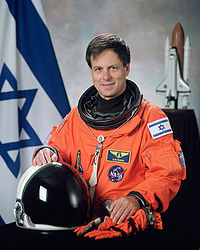 One of the outstanding contributors to Vedem was "nz," or Petr Ginz (1928–1944), who at 14 was editor-in-chief of the magazine. At 15, Ginz was deported to Auschwitz, where he was gassed. A drawing by him of the planet Earth
as seen from the Moon
was taken by Israel
i astronaut
Ilan Ramon
onto the Space Shuttle Columbia
, which disintegrated upon its reentry into the Earth's atmosphere.
The boys tried as much as possible to create a real magazine, even jokingly adding a price on the cover. The material included poetry, adventure stories, essays, and book reviews, as well as popular features such as the "Quote of the Week," chosen from among silly things the boys said. For instance, "Medic Šnajer" was once quoted as saying, "I am afraid to speak. I might say something stupid." "Embryo" was quoted as saying, "Football
is the best game, right after Monopoly
."
In one edition, a book review on Uncle Tom's Cabin
compares the fate of African American
slaves
with that of the Jews in Terezín, noting that until the deportations began, African-Americans had it worse because their families were torn apart: now that there are deportations, the two groups are suffering about the same. Another popular feature was the 'Rambles through Terezín, by Petr Ginz, in which he visited various institutions throughout the Ghetto and interviewed people there. His rambles include visits to the bakery, the maternity hospital, the fire station, and a very chilling ramble to the crematorium.
s of Auschwitz
, and no more issues were produced. Of the one hundred boys who participated in the effort to produce Vedem, only about fifteen survived. Only one of them, Zdeněk Taussig, remained in Terezín until its liberation in May, 1945. He had hidden it in a blacksmith shop where his father had worked, and brought it back with him to Prague after he was liberated.
After the war, efforts to publish Vedem were thwarted under the communist regime of Czechoslovakia, but excerpts were smuggled to Paris
, where they were printed in the Czech émigré magazine Svĕdectví. A type-written samizdat
version was published in Czechoslovakia
that same year, and re-released in the 1980s. This version was exhibited in the Frankfurt Book Fair
in 1990.
Selections from Vedem, illustrated by art that appeared in the magazine and that was created by other children in Terezín, were published with an introduction by Václav Havel
as We Are Children Just the Same: Vedem, the Secret Magazine of the Boys of Terezín in 1994
. The editors of this selection included Kurt Jiři Kotouč and Zdenĕk Ornest, two of the original contributors from Terezín.
Czech language
Czech is a West Slavic language with about 12 million native speakers; it is the majority language in the Czech Republic and spoken by Czechs worldwide. The language was known as Bohemian in English until the late 19th century...
literary magazine that existed from 1942 to 1944 in the Terezín
Terezín
Terezín is the name of a former military fortress and adjacent walled garrison town in the Ústí nad Labem Region of the Czech Republic.-Early history:...
concentration camp, during the Holocaust. It was hand-produced by a group of boys living in the Home One barracks, led by editor-in-chief Petr Ginz. Altogether, some 700 pages of Vedem survived World War II
World War II
World War II, or the Second World War , was a global conflict lasting from 1939 to 1945, involving most of the world's nations—including all of the great powers—eventually forming two opposing military alliances: the Allies and the Axis...
.
History of the magazine
The magazine was written, edited, and illustrated entirely by young boys, aged twelve to fifteen, who lived in Barracks L417, or Home One, which the boys referred to as the Republic of Shkid. The content of Vedem included poems, essays, jokes, dialogues, literary reviews, stories, and drawings. The issues were then copied manually and read around the barracks on Friday night. For some time, it was also posted on the barracks bulletin board, however, it was decided to discontinue this practice because it was deemed dangerous in case of SS inspections.The inspiration for the authors of Vedem was their teacher, twenty-eight year old "Professor" Valtr Eisinger, who was appointed to supervise the boys in that barracks. He fostered their love of literature and encouraged them to express themselves creatively, describing both what they witnessed (often in a humorous tone) and their hopes for the future. It was probably under his influence that the boys adopted a rocket ship, inspired by Jules Verne
Jules Verne
Jules Gabriel Verne was a French author who pioneered the science fiction genre. He is best known for his novels Twenty Thousand Leagues Under the Sea , A Journey to the Center of the Earth , and Around the World in Eighty Days...
, flying past a book to a star, as the symbol of their barracks and of their magazine.
Eisinger himself never contributed directly to Vedem, but did add the occasional editorial or translation from Russian. The work itself was done by the boys, who wandered around Terezin looking for themes. Each boy took a nickname to sign their articles. This might have been obscure initials, a pseudonym, or some personal quirk like "Dummy" or "Bolshevik." Sometimes, the nicknames would change. For instance, one prolific contributor, Jiří Grünbaum, called himself "Medic Šnajer," "Socialist Šnajer," or just "Šnajer," depending on his mood. Today, many of the contributors can only be identified by their nickname, and we no longer know who they really were. At some point in 1943, ten of the most prolific contributors began to refer to themselves as the "Academy."
Earth
Earth is the third planet from the Sun, and the densest and fifth-largest of the eight planets in the Solar System. It is also the largest of the Solar System's four terrestrial planets...
as seen from the Moon
Moon
The Moon is Earth's only known natural satellite,There are a number of near-Earth asteroids including 3753 Cruithne that are co-orbital with Earth: their orbits bring them close to Earth for periods of time but then alter in the long term . These are quasi-satellites and not true moons. For more...
was taken by Israel
Israel
The State of Israel is a parliamentary republic located in the Middle East, along the eastern shore of the Mediterranean Sea...
i astronaut
Astronaut
An astronaut or cosmonaut is a person trained by a human spaceflight program to command, pilot, or serve as a crew member of a spacecraft....
Ilan Ramon
Ilan Ramon
Ilan Ramon was a fighter pilot in the Israeli Air Force, and later the first Israeli astronaut....
onto the Space Shuttle Columbia
Space Shuttle Columbia
Space Shuttle Columbia was the first spaceworthy Space Shuttle in NASA's orbital fleet. First launched on the STS-1 mission, the first of the Space Shuttle program, it completed 27 missions before being destroyed during re-entry on February 1, 2003 near the end of its 28th, STS-107. All seven crew...
, which disintegrated upon its reentry into the Earth's atmosphere.
The boys tried as much as possible to create a real magazine, even jokingly adding a price on the cover. The material included poetry, adventure stories, essays, and book reviews, as well as popular features such as the "Quote of the Week," chosen from among silly things the boys said. For instance, "Medic Šnajer" was once quoted as saying, "I am afraid to speak. I might say something stupid." "Embryo" was quoted as saying, "Football
Football (soccer)
Association football, more commonly known as football or soccer, is a sport played between two teams of eleven players with a spherical ball...
is the best game, right after Monopoly
Monopoly (game)
Marvin Gardens, the leading yellow property on the board shown, is actually a misspelling of the original location name, Marven Gardens. The misspelling was said to be introduced by Charles Todd and passed on when his home-made Monopoly board was copied by Charles Darrow and thence to Parker...
."
In one edition, a book review on Uncle Tom's Cabin
Uncle Tom's Cabin
Uncle Tom's Cabin; or, Life Among the Lowly is an anti-slavery novel by American author Harriet Beecher Stowe. Published in 1852, the novel "helped lay the groundwork for the Civil War", according to Will Kaufman....
compares the fate of African American
African American
African Americans are citizens or residents of the United States who have at least partial ancestry from any of the native populations of Sub-Saharan Africa and are the direct descendants of enslaved Africans within the boundaries of the present United States...
slaves
Slavery
Slavery is a system under which people are treated as property to be bought and sold, and are forced to work. Slaves can be held against their will from the time of their capture, purchase or birth, and deprived of the right to leave, to refuse to work, or to demand compensation...
with that of the Jews in Terezín, noting that until the deportations began, African-Americans had it worse because their families were torn apart: now that there are deportations, the two groups are suffering about the same. Another popular feature was the 'Rambles through Terezín, by Petr Ginz, in which he visited various institutions throughout the Ghetto and interviewed people there. His rambles include visits to the bakery, the maternity hospital, the fire station, and a very chilling ramble to the crematorium.
Preservation and publication
By 1944, most of the inhabitants of Barracks L417 had been deported to the gas chamberGas chamber
A gas chamber is an apparatus for killing humans or animals with gas, consisting of a sealed chamber into which a poisonous or asphyxiant gas is introduced. The most commonly used poisonous agent is hydrogen cyanide; carbon dioxide and carbon monoxide have also been used...
s of Auschwitz
Auschwitz concentration camp
Concentration camp Auschwitz was a network of Nazi concentration and extermination camps built and operated by the Third Reich in Polish areas annexed by Nazi Germany during World War II...
, and no more issues were produced. Of the one hundred boys who participated in the effort to produce Vedem, only about fifteen survived. Only one of them, Zdeněk Taussig, remained in Terezín until its liberation in May, 1945. He had hidden it in a blacksmith shop where his father had worked, and brought it back with him to Prague after he was liberated.
After the war, efforts to publish Vedem were thwarted under the communist regime of Czechoslovakia, but excerpts were smuggled to Paris
Paris
Paris is the capital and largest city in France, situated on the river Seine, in northern France, at the heart of the Île-de-France region...
, where they were printed in the Czech émigré magazine Svĕdectví. A type-written samizdat
Samizdat
Samizdat was a key form of dissident activity across the Soviet bloc in which individuals reproduced censored publications by hand and passed the documents from reader to reader...
version was published in Czechoslovakia
Czechoslovakia
Czechoslovakia or Czecho-Slovakia was a sovereign state in Central Europe which existed from October 1918, when it declared its independence from the Austro-Hungarian Empire, until 1992...
that same year, and re-released in the 1980s. This version was exhibited in the Frankfurt Book Fair
Frankfurt Book Fair
The Frankfurt Book Fair is the world's largest trade fair for books, based on the number of publishing companies represented. As to the number of visitors, the Turin Book Fair attracts about as many visitors, viz. some 300,000....
in 1990.
Selections from Vedem, illustrated by art that appeared in the magazine and that was created by other children in Terezín, were published with an introduction by Václav Havel
Václav Havel
Václav Havel is a Czech playwright, essayist, poet, dissident and politician. He was the tenth and last President of Czechoslovakia and the first President of the Czech Republic . He has written over twenty plays and numerous non-fiction works, translated internationally...
as We Are Children Just the Same: Vedem, the Secret Magazine of the Boys of Terezín in 1994
1994 in literature
The year 1994 in literature involved some significant events and new books.-New books:*Kevin J. Anderson - Champions of the Force, Dark Apprentice and Jedi Search*Reed Arvin - The Wind in the Wheat*Greg Bear - Songs of Earth and Power...
. The editors of this selection included Kurt Jiři Kotouč and Zdenĕk Ornest, two of the original contributors from Terezín.
Further reading
- Terezín. Council of Jewish Communities in the Czech Lands, 1965.
- We Are Children Just the Same: Vedem, the Secret Magazine by the Boys of Terezin. Ed. Zdenek Ornest, Marie Rut Krizkova, et al. Philadelphia: Jewish Publication Society of America, 1995. ISBN 978-0-8276-0534-3.