


Frankfurt Book Fair

Encyclopedia
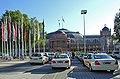

Trade fair
A trade fair is an exhibition organized so that companies in a specific industry can showcase and demonstrate their latest products, service, study activities of rivals and examine recent market trends and opportunities...
for books, based on the number of publishing companies represented. As to the number of visitors, the Turin Book Fair attracts about as many visitors, viz. some 300,000.
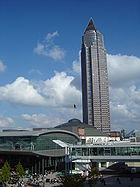
It is held annually in mid-October at the Frankfurt Trade Fair
Frankfurt Trade Fair
Frankfurt Trade Fair , with 448,000,000 Euros in sales and over 1,600 active employees, is one of the world's largest trade fair companies. The group has a global network of 28 subsidiaries, five branch offices, and 52 international sales partners. Thus, the Messe Frankfurt is present in over 150...
, Germany. The first three days are restricted exclusively to trade visitors; the general public can attend on the last two.
Representatives from book publishing and multimedia companies from all over the world come to the Frankfurt Book Fair in order to negotiate international publishing
Publishing
Publishing is the process of production and dissemination of literature or information—the activity of making information available to the general public...
rights and licensing fees. The fair is organised by a subsidiary company of the German Publishers and Booksellers Association. For five days more than 7,000 exhibitors from over 100 countries and more than 286,000 visitors take part. The Frankfurt Book Fair is considered to be the most important book fair in the world for international deals and trading.
Origins
Printing
Printing is a process for reproducing text and image, typically with ink on paper using a printing press. It is often carried out as a large-scale industrial process, and is an essential part of publishing and transaction printing....
in movable letters in Mainz
Mainz
Mainz under the Holy Roman Empire, and previously was a Roman fort city which commanded the west bank of the Rhine and formed part of the northernmost frontier of the Roman Empire...
near Frankfurt, the first book fair was held by local booksellers
Bookselling
Bookselling is the commercial trading of books, the retail and distribution end of the publishing process. People who engage in bookselling are called booksellers or bookmen.-Bookstores today:...
. Until the end of the 17th century, it was the most important book fair in Europe. As a consequence of political and cultural developments, it was eclipsed by the Leipzig Book Fair
Leipzig Book Fair
The Leipzig Book Fair is the second largest book fair in Germany after the Frankfurt Book Fair. The fair takes place annually over four days at the Leipzig Trade Fairground in the northern part of Leipzig, Saxony...
during the Enlightenment
Age of Enlightenment
The Age of Enlightenment was an elite cultural movement of intellectuals in 18th century Europe that sought to mobilize the power of reason in order to reform society and advance knowledge. It promoted intellectual interchange and opposed intolerance and abuses in church and state...
. After World War II, the first book fair was held again in 1949 at the St. Paul's Church
St. Paul's Church, Frankfurt
St. Paul's Church in Frankfurt am Main is a church with important political symbolism in Germany. It was opened as a Protestant church in 1789, coincidentally the same year as the French Revolution, and in 1848-1849 it became the seat of the Frankfurt Parliament, the first publicly and freely...
. Since then, it has regained its pre-eminent position.
Significance
The Frankfurt Book Fair is a critical marketing event for the launching of books, but it is also an important event to facilitate the negotiation of the international sale of rights and licences. Visitors take the opportunity to obtain information about the publishing market, to network, and to do business. Publishers, agentsLiterary agent
A literary agent is an agent who represents writers and their written works to publishers, theatrical producers and film producers and assists in the sale and deal negotiation of the same. Literary agents most often represent novelists, screenwriters and major non-fiction writers...
, booksellers, librarians, academics, illustrators, service providers, film producer
Film producer
A film producer oversees and delivers a film project to all relevant parties while preserving the integrity, voice and vision of the film. They will also often take on some financial risk by using their own money, especially during the pre-production period, before a film is fully financed.The...
s, translators, printers
Printer (publisher)
In publishing, printers are both companies providing printing services and individuals who directly operate printing presses. With the invention of the moveable type printing press by Johannes Gutenberg around 1450, printing—and printers—proliferated throughout Europe.Today, printers are found...
, professional
Professional body
A professional association is usually a nonprofit organization seeking to further a particular profession, the interests of individuals engaged in that profession, and the public interest.The roles of these professional associations have been variously defined: "A group of people in a...
and trade associations
Industry trade group
A trade association, also known as an industry trade group, business association or sector association, is an organization founded and funded by businesses that operate in a specific industry...
, institutions, artists, authors, antiquarians, software and multimedia
Multimedia
Multimedia is media and content that uses a combination of different content forms. The term can be used as a noun or as an adjective describing a medium as having multiple content forms. The term is used in contrast to media which use only rudimentary computer display such as text-only, or...
suppliers all take part in the events and business climate of Frankfurt Book Fair. In 2006, more than 11,000 journalists from 66 countries reported on the fair which brought together 7,272 individual exhibitors from 113 countries, and more than 183,000 trade visitors. In 2009, there were 7,314 indivudual exhibitors from some 100 countries, presenting over 400,000 books. Some 300,000 visitors attended the fair.
During the fair the Peace Prize of the German Book Trade
Peace Prize of the German Book Trade
The Peace Prize of the German Book Trade is an international peace prize given yearly at the Frankfurt Book Fair in the Paulskirche in Frankfurt am Main, Germany...
is given, during a ceremony in the Paulskirche. The prize has been awarded each year since 1950.
The fair is also the birthplace of the Bookseller/Diagram Prize for Oddest Title of the Year
Bookseller/Diagram Prize for Oddest Title of the Year
The Bookseller/Diagram Prize for Oddest Title of the Year, originally known as the Diagram Group Prize for the Oddest Title at the Frankfurt Book Fair, commonly known as the Diagram Prize for short, is a humorous literary award that is given annually to the book with the oddest title...
, a humorous award which is given to the book with the oddest title.
Recently introduced events
Since June 2006, a joint ventureJoint venture
A joint venture is a business agreement in which parties agree to develop, for a finite time, a new entity and new assets by contributing equity. They exercise control over the enterprise and consequently share revenues, expenses and assets...
has been added: the annual Cape Town Bookfair
Cape Town Bookfair
The Cape Town Book Fair started in 2006 at the Cape Town International Convention Centre. The annual fair is a joint venture between South-African publisher-association PASA and the Frankfurt Book Fair....
. The Abu Dhabi International Book Fair
Abu Dhabi International Book Fair
The Abu Dhabi International Book Fair is an annual book fair held in Abu Dhabi. It provides a platform where publishers, booksellers, agents, cultural organisations and press can meet, exchange ideas and identify business opportunities...
is another joint venture now.
In 2006, Litcam, a campaign first of all against analphabetism began. In this context, the Frankfurt Book Fair in 2007 also started a short story
Short story
A short story is a work of fiction that is usually written in prose, often in narrative format. This format tends to be more pointed than longer works of fiction, such as novellas and novels. Short story definitions based on length differ somewhat, even among professional writers, in part because...
project named "Who's on the line? Call for free" by and for people with migration
Human migration
Human migration is physical movement by humans from one area to another, sometimes over long distances or in large groups. Historically this movement was nomadic, often causing significant conflict with the indigenous population and their displacement or cultural assimilation. Only a few nomadic...
background.
Guests of honour, focuses of interests
Since 1976, a guest of honour, or a focus of interest is named for the fair. A special literary programme is organised for the occasion (readings, arts exhibitions, public discussion panels, theatre productions, and radio and TV programmes). A special exhibition hall is set up for the guest country, and the major publishing houses are present at the fair.| Year | Guest of honour / Focus of interest | Motto | |
|---|---|---|---|
| 1976 | Latin America Latin America Latin America is a region of the Americas where Romance languages – particularly Spanish and Portuguese, and variably French – are primarily spoken. Latin America has an area of approximately 21,069,500 km² , almost 3.9% of the Earth's surface or 14.1% of its land surface area... |
Latin American literature Latin American literature Latin American literature consists of the oral and written literature of Latin America in several languages, particularly in Spanish, Portuguese, and indigenous languages of the Americas. It rose to particular prominence globally during the second half of the 20th century, largely due to the... |
|
| 1978 | Kind und Buch (Child and book) | ||
| 1980 | Subsaharan Africa | ||
| 1982 | Religion Religion Religion is a collection of cultural systems, belief systems, and worldviews that establishes symbols that relate humanity to spirituality and, sometimes, to moral values. Many religions have narratives, symbols, traditions and sacred histories that are intended to give meaning to life or to... s |
||
| 1984 | George Orwell George Orwell Eric Arthur Blair , better known by his pen name George Orwell, was an English author and journalist... |
||
| 1986 | India India India , officially the Republic of India , is a country in South Asia. It is the seventh-largest country by geographical area, the second-most populous country with over 1.2 billion people, and the most populous democracy in the world... |
Indian literature Indian literature Indian literature refers to the literature produced on the Indian subcontinent until 1947 and in the Republic of India thereafter. The Republic of India has 22 officially recognized languages.... |
Wandel in Tradition (Change in tradition) |
| 1988 | Italy Italy Italy , officially the Italian Republic languages]] under the European Charter for Regional or Minority Languages. In each of these, Italy's official name is as follows:;;;;;;;;), is a unitary parliamentary republic in South-Central Europe. To the north it borders France, Switzerland, Austria and... |
Italian literature Italian literature Italian literature is literature written in the Italian language, particularly within Italy. It may also refer to literature written by Italians or in Italy in other languages spoken in Italy, often languages that are closely related to modern Italian.... |
Italienisches Tagebuch (Italien diary) |
| 1989 | France France The French Republic , The French Republic , The French Republic , (commonly known as France , is a unitary semi-presidential republic in Western Europe with several overseas territories and islands located on other continents and in the Indian, Pacific, and Atlantic oceans. Metropolitan France... |
French literature French literature French literature is, generally speaking, literature written in the French language, particularly by citizens of France; it may also refer to literature written by people living in France who speak traditional languages of France other than French. Literature written in French language, by citizens... |
L’Automne français (French autumn) |
| 1990 | Japan Japan Japan is an island nation in East Asia. Located in the Pacific Ocean, it lies to the east of the Sea of Japan, China, North Korea, South Korea and Russia, stretching from the Sea of Okhotsk in the north to the East China Sea and Taiwan in the south... |
Japanese literature Japanese literature Early works of Japanese literature were heavily influenced by cultural contact with China and Chinese literature, often written in Classical Chinese. Indian literature also had an influence through the diffusion of Buddhism in Japan... |
Then and Now |
| 1991 | Spain Spain Spain , officially the Kingdom of Spain languages]] under the European Charter for Regional or Minority Languages. In each of these, Spain's official name is as follows:;;;;;;), is a country and member state of the European Union located in southwestern Europe on the Iberian Peninsula... |
Spanish literature Spanish literature Spanish literature generally refers to literature written in the Spanish language within the territory that presently constitutes the state of Spain... |
La Hora de España (Spain's hour) |
| 1992 | Mexico Mexico The United Mexican States , commonly known as Mexico , is a federal constitutional republic in North America. It is bordered on the north by the United States; on the south and west by the Pacific Ocean; on the southeast by Guatemala, Belize, and the Caribbean Sea; and on the east by the Gulf of... |
Mexican literature | Ein offenes Buch (An open book) |
| 1993 | Flanders Flanders Flanders is the community of the Flemings but also one of the institutions in Belgium, and a geographical region located in parts of present-day Belgium, France and the Netherlands. "Flanders" can also refer to the northern part of Belgium that contains Brussels, Bruges, Ghent and Antwerp... and the Netherlands Netherlands The Netherlands is a constituent country of the Kingdom of the Netherlands, located mainly in North-West Europe and with several islands in the Caribbean. Mainland Netherlands borders the North Sea to the north and west, Belgium to the south, and Germany to the east, and shares maritime borders... |
Dutch literature Dutch literature Dutch literature comprises all writings of literary merit written through the ages in the Dutch language, a language which currently has around 23 million native speakers... |
Weltoffen (Open-minded) |
| 1994 | Brasil | Brazilian literature Brazilian literature Brazilian literature is written in the Portuguese language by Brazilians or in Brazil, even if prior to Brazil's independence from Portugal, in 1822... |
Begegnung von Kulturen (Encounter of cultures) |
| 1995 | Austria Austria Austria , officially the Republic of Austria , is a landlocked country of roughly 8.4 million people in Central Europe. It is bordered by the Czech Republic and Germany to the north, Slovakia and Hungary to the east, Slovenia and Italy to the south, and Switzerland and Liechtenstein to the... |
Austrian literature Austrian literature Austrian literature is the literature written in Austria, which is mostly, but not exclusively, written in the German language. Some scholars speak about Austrian literature in a strict sense from the year 1806 on when Francis II disbanded the Holy Roman Empire and established the Austrian Empire... |
|
| 1996 | Ireland Ireland Ireland is an island to the northwest of continental Europe. It is the third-largest island in Europe and the twentieth-largest island on Earth... |
Irish literature Irish literature For a comparatively small island, Ireland has made a disproportionately large contribution to world literature. Irish literature encompasses the Irish and English languages.-The beginning of writing in Irish:... |
Und seine Diaspora (And its diaspora) |
| 1997 | Portugal Portugal Portugal , officially the Portuguese Republic is a country situated in southwestern Europe on the Iberian Peninsula. Portugal is the westernmost country of Europe, and is bordered by the Atlantic Ocean to the West and South and by Spain to the North and East. The Atlantic archipelagos of the... |
Portuguese literature Portuguese literature This is a survey of Portuguese literature.The Portuguese language was developed gradually from the Vulgar language spoken in the countries which formed part of the Roman Empire and, both in morphology and syntax, it represents an organic transformation of Latin without the direct intervention of... |
Wege in die Welt (Paths into the world) |
| 1998 | Switzerland Switzerland Switzerland name of one of the Swiss cantons. ; ; ; or ), in its full name the Swiss Confederation , is a federal republic consisting of 26 cantons, with Bern as the seat of the federal authorities. The country is situated in Western Europe,Or Central Europe depending on the definition.... |
Swiss literature Swiss literature There is no such thing as a Swiss national vernacular literature, as there is no dominant national language. The four main languages of French, Italian, German and Romansch form the four branches which make up a literature of Switzerland... |
Hoher Himmel – enges Tal (High skies – narrow valleys) |
| 1999 | Hungary Hungary Hungary , officially the Republic of Hungary , is a landlocked country in Central Europe. It is situated in the Carpathian Basin and is bordered by Slovakia to the north, Ukraine and Romania to the east, Serbia and Croatia to the south, Slovenia to the southwest and Austria to the west. The... |
Hungarian literature Hungarian literature Hungarian literature is literature written in the Hungarian language, predominantly by Hungarians.There is a limited amount of Old Hungarian literature dating to between the late 12th and the early 16th centuries... |
Unbegrenzt (unlimited) |
| 2000 | Poland Poland Poland , officially the Republic of Poland , is a country in Central Europe bordered by Germany to the west; the Czech Republic and Slovakia to the south; Ukraine, Belarus and Lithuania to the east; and the Baltic Sea and Kaliningrad Oblast, a Russian exclave, to the north... |
Polish literature Polish literature Polish literature is the literary tradition of Poland. Most Polish literature has been written in the Polish language, though other languages, used in Poland over the centuries, have also contributed to Polish literary traditions, including Yiddish, Lithuanian, Ukrainian, Belarusian, German and... |
©Poland |
| 2001 | Greece Greece Greece , officially the Hellenic Republic , and historically Hellas or the Republic of Greece in English, is a country in southeastern Europe.... |
Greek literature Greek literature Greek literature refers to writings composed in areas of Greek influence, typically though not necessarily in one of the Greek dialects, throughout the whole period in which the Greek-speaking people have existed.-Ancient Greek literature :... |
Neue Wege nach Ithaka (New ways to Ithaka) |
| 2002 | Lithuania Lithuania Lithuania , officially the Republic of Lithuania is a country in Northern Europe, the biggest of the three Baltic states. It is situated along the southeastern shore of the Baltic Sea, whereby to the west lie Sweden and Denmark... |
Lithuanian literature Lithuanian literature Lithuanian literature concerns the art of written works compiled by Lithuanians throughout their history.-Latin language:A wealth of Lithuanian literature was written in Latin, the main scholarly language in the Middle Ages.-Lithuanian language:... |
Fortsetzung folgt (To be continued) |
| 2003 | Russia Russia Russia or , officially known as both Russia and the Russian Federation , is a country in northern Eurasia. It is a federal semi-presidential republic, comprising 83 federal subjects... |
Russian literature Russian literature Russian literature refers to the literature of Russia or its émigrés, and to the Russian-language literature of several independent nations once a part of what was historically Russia or the Soviet Union... |
Neue Seiten (New pages/perspectives) |
| 2004 | Arab world Arab world The Arab world refers to Arabic-speaking states, territories and populations in North Africa, Western Asia and elsewhere.The standard definition of the Arab world comprises the 22 states and territories of the Arab League stretching from the Atlantic Ocean in the west to the Arabian Sea in the... |
Arab literature | |
| 2005 | Korea Korea Korea ) is an East Asian geographic region that is currently divided into two separate sovereign states — North Korea and South Korea. Located on the Korean Peninsula, Korea is bordered by the People's Republic of China to the northwest, Russia to the northeast, and is separated from Japan to the... |
Korean literature Korean literature Korean literature is the body of literature produced in Korea or by Korean writers. For much of its 3,000 years of literature history, it was written both in Hanja and in Korean, first using the transcription systems idu and gugyeol, and finally using the Korean script Hangul. It is commonly... |
|
| 2006 | India India India , officially the Republic of India , is a country in South Asia. It is the seventh-largest country by geographical area, the second-most populous country with over 1.2 billion people, and the most populous democracy in the world... |
Indian literature Indian literature Indian literature refers to the literature produced on the Indian subcontinent until 1947 and in the Republic of India thereafter. The Republic of India has 22 officially recognized languages.... |
Today’s India |
| 2007 | Catalan Countries | Catalan literature Catalan literature Catalan literature is the name conventionally used to refer to literature written in the Catalan language. The Catalan literary tradition is extensive, starting in the Middle Ages.... |
Singular i Universal (Singular and general) |
| 2008 | Turkey Turkey Turkey , known officially as the Republic of Turkey , is a Eurasian country located in Western Asia and in East Thrace in Southeastern Europe... |
Turkish literature Turkish literature Turkish literature comprises both oral compositions and written texts in the Turkish language, either in its Ottoman form or in less exclusively literary forms, such as that spoken in the Republic of Turkey today... |
Faszinierend farbig (Fascinatingly colourful) |
| 2009 | China People's Republic of China China , officially the People's Republic of China , is the most populous country in the world, with over 1.3 billion citizens. Located in East Asia, the country covers approximately 9.6 million square kilometres... |
Chinese literature Chinese literature Chinese literature extends thousands of years, from the earliest recorded dynastic court archives to the mature fictional novels that arose during the Ming Dynasty to entertain the masses of literate Chinese... |
Tradition & Innovation |
| 2010 | Argentina Argentina Argentina , officially the Argentine Republic , is the second largest country in South America by land area, after Brazil. It is constituted as a federation of 23 provinces and an autonomous city, Buenos Aires... |
Argentine literature Argentine literature Argentine literature is the body of literary work produced in Argentina. Among Argentina's best-known and most influential authors are Domingo Faustino Sarmiento, José Hernández, Jorge Luis Borges, Adolfo Bioy Casares, Roberto Arlt, Julio Cortázar, Manuel Puig, and Ernesto Sabato... |
Kultur in Bewegung (Culture in motion) |
| 2011 | Iceland Iceland Iceland , described as the Republic of Iceland, is a Nordic and European island country in the North Atlantic Ocean, on the Mid-Atlantic Ridge. Iceland also refers to the main island of the country, which contains almost all the population and almost all the land area. The country has a population... |
Icelandic literature Icelandic literature Icelandic literature refers to literature written in Iceland or by Icelandic people. It is best known for the sagas written in medieval times, starting in the 13th century. As Icelandic and Old Norse are almost the same, and because Icelandic works constitute most of Old Norse literature, Old Norse... |
Sagenhaftes Island (Fabulous Iceland) |
| 2012 | New Zealand New Zealand New Zealand is an island country in the south-western Pacific Ocean comprising two main landmasses and numerous smaller islands. The country is situated some east of Australia across the Tasman Sea, and roughly south of the Pacific island nations of New Caledonia, Fiji, and Tonga... |
New Zealand literature New Zealand literature New Zealand literature is essentially literature in English that is either written by New Zealanders, or migrants, dealing with New Zealand themes or places and is primarily a 20th Century creation... |
|
| 2013 | Brazil Brazil Brazil , officially the Federative Republic of Brazil , is the largest country in South America. It is the world's fifth largest country, both by geographical area and by population with over 192 million people... |
Brazilian literature Brazilian literature Brazilian literature is written in the Portuguese language by Brazilians or in Brazil, even if prior to Brazil's independence from Portugal, in 1822... |
|
| 2014 | Finland Finland Finland , officially the Republic of Finland, is a Nordic country situated in the Fennoscandian region of Northern Europe. It is bordered by Sweden in the west, Norway in the north and Russia in the east, while Estonia lies to its south across the Gulf of Finland.Around 5.4 million people reside... |
Finnish literature Finnish literature Finnish literature refers to literature written in Finland. Earliest texts in Finland were written in Swedish or Latin during the Finnish Middle Age . Finnish-language literature was slowly developing from the 16th century onwards. First artistic heyday of the Finnish literature was the mid-19th... |
Some choices aroused criticism and controversy. The 2007 fair attracted criticism from both the Spanish and German media. German news magazine Der Spiegel
Der Spiegel
Der Spiegel is a German weekly news magazine published in Hamburg. It is one of Europe's largest publications of its kind, with a weekly circulation of more than one million.-Overview:...
described it as "closed-minded" for its policy of not including the many Catalans who write in Spanish in its definition of Catalan literature. The decision to exclude any element of "Spanishness", defined as literature exclusively done in Spanish, from the fair was made in spite of the fact that the Spanish government contributed more than 6 million euros towards the cost of the fair.
See also
- Peace Prize of the German Book TradePeace Prize of the German Book TradeThe Peace Prize of the German Book Trade is an international peace prize given yearly at the Frankfurt Book Fair in the Paulskirche in Frankfurt am Main, Germany...
- German Book PrizeGerman Book PrizeThe German Book Prize is awarded annually by the Börsenverein des Deutschen Buchhandels, the German Publishers and Booksellers Association, to the best German language novel of the year. The winner is awarded € 25,000, the five shortlisted authors receive € 2,500 each...