

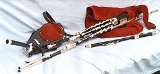
Uilleann pipes

Encyclopedia
Ireland
Ireland is an island to the northwest of continental Europe. It is the third-largest island in Europe and the twentieth-largest island on Earth...
, their current name, earlier known in English as "union pipes", is a part translation of the Irish-language term píobaí uilleann (literally, "pipes of the elbow"), from their method of inflation.
The bag of the uilleann pipes is inflated by means of a small set of bellows
Bellows
A bellows is a device for delivering pressurized air in a controlled quantity to a controlled location.Basically, a bellows is a deformable container which has an outlet nozzle. When the volume of the bellows is decreased, the air escapes through the outlet...
strapped around the waist and the right arm. The bellows not only relieve the player from the effort needed to blow into a bag to maintain pressure, they also allow relatively dry air to power the reeds, reducing the adverse effects of moisture on tuning and longevity. Some pipers can converse or sing at the same time as playing.
The uilleann pipes are distinguished from many other forms of bagpipes by their tone and wide range of notes — the chanter
Chanter
The chanter is the part of the bagpipe upon which the player creates the melody. It consists of a number of finger-holes, and in its simpler forms looks similar to a recorder...
has a range of two full octaves, including sharps and flats — together with the unique blend of chanter, drones, and "regulators". The regulators are equipped with closed keys which can be opened by the piper's wrist action enabling the piper to play simple chords, giving a rhythmic and harmonic accompaniment as needed. There are also many ornaments based on multiple or single grace note
Grace note
A grace note is a kind of music notation used to denote several kinds of musical ornaments. When occurring by itself, a single grace note normally indicates the intention of either an appoggiatura or an acciaccatura...
s. The chanter can also be played staccato by resting the bottom of the chanter on the piper's thigh to close off the bottom hole and then open and close only the tone holes required. If one tone hole is closed before the next one is opened, a staccato
Staccato
Staccato is a form of musical articulation. In modern notation it signifies a note of shortened duration and separated from the note that may follow by silence...
effect can be created because the sound stops completely when no air can escape at all.
The uilleann pipes have a different harmonic structure, sounding sweeter and quieter than many other bagpipes, such as the Great Irish Warpipes
Great Irish Warpipes
The Great Irish Warpipes are an instrument that in modern practice is identical, and historically was analogous or identical to the Great Highland Bagpipe. "Warpipes" is an English term; The first use of the Gaelic term in Ireland is recorded in a poem by John O'Naughton , in which the bagpipes...
, Great Highland Bagpipe
Great Highland Bagpipe
The Great Highland Bagpipe is a type of bagpipe native to Scotland. It has achieved widespread recognition through its usage in the British military and in pipe bands throughout the world. It is closely related to the Great Irish Warpipes....
s or the Italian Zampogna
Zampogna
Zampogna is a generic term for a number of Italian double chantered pipes that can be found as far north as the southern part of the Marche, throughout areas in Abruzzo, Latium, Molise, Basilicata, Campania, Calabria, and Sicily...
s. The uilleann pipes are often played indoors, and are almost always played sitting down.
Etymology
The word uilleann comes from the Irish (Gaelic) word uille with genitive of "uilleann", meaning elbow, emphasizing the use of the elbow when playing the uilleann pipes. However, the pipes were originally called "Union pipes", the first printed instance of this at the end of the 18th century, perhaps to denote the union of the chanter, drones, and regulators. Another theory is that it was played throughout a prototypical full union of England, Wales, Ireland and Scotland. This was only realized, however, in 1800, with the Act of UnionAct of Union 1800
The Acts of Union 1800 describe two complementary Acts, namely:* the Union with Ireland Act 1800 , an Act of the Parliament of Great Britain, and...
; the name for the bagpipe slightly precedes this. Alternatively Union pipes were certainly a favourite of the upper classes in Scotland, Ireland and the North-East of England and were fashionable for a time in formal social settings, where the term Union pipes may also originate.
The term "uilleann pipes" came into use at the beginning of the 20th century. William Henry Grattan Flood
W. H. Grattan Flood
Chevalier William Henry Grattan Flood , renowned musicologist and historian, was born in Lismore in 1857. As a writer and ecclesiastical composer, his personal contributions to Irish musical form produced enduring works. As an historian his output was prolific on topics of local and national...
, an Irish music scholar, proposed the theory that the name "uilleann" came from the Irish word for "elbow". He cited to this effect William Shakespeare
William Shakespeare
William Shakespeare was an English poet and playwright, widely regarded as the greatest writer in the English language and the world's pre-eminent dramatist. He is often called England's national poet and the "Bard of Avon"...
's play The Merchant of Venice
The Merchant of Venice
The Merchant of Venice is a tragic comedy by William Shakespeare, believed to have been written between 1596 and 1598. Though classified as a comedy in the First Folio and sharing certain aspects with Shakespeare's other romantic comedies, the play is perhaps most remembered for its dramatic...
published in 1600 (Act IV, sc. I, l. 55) where the expression "woollen pipes" appears. This theory originated in correspondence between two earlier antiquarians, and was adopted as gospel by the Gaelic League. The use of "uilleann" was perhaps also a rebellion against the term "union" with its connotations of English rule. It was however shown by Breandán Breathnach
Breandán Breathnach
Breandán Breathnach was an Irish music collector and Uilleann piper.Breathnach worked as a civil servant with the Department of Education and was responsible for collecting music from around Ireland. By the time of his death he had collected over 7,000 tunes published from 1963...
that it would be difficult to explain the Anglicization of the word uillin into 'woollen' before the 16th century (when the instrument did not exist as such) and then its adaptation as 'union' two centuries later. See Folk Music and Dances of Ireland, Cork, The Mercier Press, 1971, p. 77. A much more likely explanation is the fact that many bagpipe bags of that earlier type were made from goatskins which still had the fur attached.
History
The first bagpipes to be well-attested to for Ireland were similar, if not identical, to the Highland pipes that are now played in Scotland. These are known as the "Great Irish WarpipesGreat Irish Warpipes
The Great Irish Warpipes are an instrument that in modern practice is identical, and historically was analogous or identical to the Great Highland Bagpipe. "Warpipes" is an English term; The first use of the Gaelic term in Ireland is recorded in a poem by John O'Naughton , in which the bagpipes...
". In Irish and Scottish Gaelic
Scottish Gaelic language
Scottish Gaelic is a Celtic language native to Scotland. A member of the Goidelic branch of the Celtic languages, Scottish Gaelic, like Modern Irish and Manx, developed out of Middle Irish, and thus descends ultimately from Primitive Irish....
, this instrument was called the píob mhór ("great pipe").
While the warpipe was alive and well upon the battlefields of France, the warpipe had almost disappeared in Ireland. The union or uilleann pipe required the joining of a bellows under the right arm, which pumped air via a tube to the bagpipe under the left arm. The uilleann or union pipes developed around the beginning of the 18th century, the history of which is here depicted in prints of carvings and pictures from contemporary sources. Geoghegan's tutor of the 1740s calls this early form of the uilleann pipes the "Pastoral or New bagpipe". The Pastoral pipes
Pastoral pipes
The Pastoral Pipe was a bellows-blown bagpipe, widely recognised as the forerunner and ancestor of the 19th-century Union pipes, which became the Uilleann Pipes of today...
were bellows blown and played in either a seated or standing position. The conical bored chanter
Chanter
The chanter is the part of the bagpipe upon which the player creates the melody. It consists of a number of finger-holes, and in its simpler forms looks similar to a recorder...
was played "open", that is, legato
Legato
In musical notation the Italian word legato indicates that musical notes are played or sung smoothly and connected. That is, in transitioning from note to note, there should be no intervening silence...
, unlike the uilleann pipes, which can also be played "closed", that is, staccato
Staccato
Staccato is a form of musical articulation. In modern notation it signifies a note of shortened duration and separated from the note that may follow by silence...
. The early Pastoral pipes had two drones
Drone (music)
In music, a drone is a harmonic or monophonic effect or accompaniment where a note or chord is continuously sounded throughout most or all of a piece. The word drone is also used to refer to any part of a musical instrument that is just used to produce such an effect.-A musical effect:A drone...
, and later examples had one (or rarely, two) regulator(s). The Pastoral and later flat set Union pipes developed with ideas on the instrument being traded back-and-forth between Ireland, Scotland and England, around the 18th and early 19th century.
The earliest surviving sets of uilleann pipes date from the second half of the 18th century but it must be said that datings are not definitive. Only recently has scientific attention begun to be paid to the instrument and problems relating to various stages of its development have yet to be resolved. It is gradually becoming accepted that the union pipes originated from the Pastoral pipes and gained popularity in Ireland within the Protestant Anglo-Irish community and its gentlemen pipers. Certainly many of the early players in Ireland were Protestant, possibly the best known being the mid-18th century piper Jackson from Co Limerick and the 18th century Tandragee pipemaker William Kennedy. The pipes were certainly frequently used by the Protestant clergy who employed them as an alternative to the church organ. As late as the 19th century the instrument was still commonly associated with the Anglo-Irish e.g. the Anglican clergyman Canon James Goodman
Canon James Goodman
Canon James Goodman was a collector of Irish music. Raised in Ventry, County Kerry, a Gaeltacht area, he was a native Irish language speaker.-As a cleric:Goodman studied at Trinity College, Dublin, having gained a scholarship in 1847...
(1828–1896) from Kerry, who interestingly had his uilleann pipes buried with him at Creagh (Church of Ireland) cemetery near Baltimore, County Cork
Baltimore, County Cork
Baltimore is located in western County Cork, Ireland. Baltimore is the principal village of the parish of Rath and the Islands, the southernmost parish in Ireland...
. His friend, and Trinity College colleague, John Hingston from Skibbereen
Skibbereen
Skibbereen , is a town in County Cork, Ireland. It is the most southerly town in Ireland. It is located on the N71 national secondary road.The name "Skibbereen" means "little boat harbour." The River Ilen which runs through the town reaches the sea at Baltimore.-History:Prior to 1600 most of the...
also played the uilleann pipes.
Tuning
The instrument most typically is tuned in the key of D, although "flat" sets do exist in other keys, such as C♯, C, B and B♭, and a few sets in E♭ have been tried. These terms only began to be used in the 1970s, when pipemakers began to receive requests for pipes that would be in tune with Generation tin whistleTin whistle
The tin whistle, also called the penny whistle, English Flageolet, Scottish penny whistle, Tin Flageolet, Irish whistle and Clarke London Flageolet is a simple six-holed woodwind instrument. It is an end blown fipple flute, putting it in the same category as the recorder, American Indian flute, and...
s, which are stamped with the key they play in: C, B♭, etc. The chanter length determines the overall tuning; accompanying pieces of the instrument, such as drones and regulators, are tuned to the same key as the chanter. Chanters of around 362mm (14¼") length produce a bottom note on or near D above middle C on the piano (where A=440 Hz
Hertz
The hertz is the SI unit of frequency defined as the number of cycles per second of a periodic phenomenon. One of its most common uses is the description of the sine wave, particularly those used in radio and audio applications....
, i.e. modern "concert pitch"). The modern concert pitch pipes are a relatively recent invention, pioneered by the Taylor brothers, originally of Drogheda
Drogheda
Drogheda is an industrial and port town in County Louth on the east coast of Ireland, 56 km north of Dublin. It is the last bridging point on the River Boyne before it enters the Irish Sea....
, Ireland and later of Philadelphia, Pennsylvania
Philadelphia, Pennsylvania
Philadelphia is the largest city in the Commonwealth of Pennsylvania and the county seat of Philadelphia County, with which it is coterminous. The city is located in the Northeastern United States along the Delaware and Schuylkill rivers. It is the fifth-most-populous city in the United States,...
, in the late nineteenth century. Concert pitch pipes typically have wider bores and larger tone holes than the earlier "flat" pitch sets, and as a consequence are a good deal louder, though by no means as loud as the Highland pipes of Scotland. They were developed by the Taylors to meet the requirements of playing in larger venues in the United States; today they are the most common type of uilleann pipes encountered, though many players still prefer the mellower sound of the earlier style narrow-bore pipes, which exist in pitches ranging from D, through C♯, C, and B down to B♭. Pipemakers before the Taylors had, however, built concert pitch pipes using the narrower bores and smaller fingerholes of the flat pipes. Some of these instruments seem to have been designed with lower pitch standards in mind, such as A=415. The Taylors also built many instruments with higher pitch standards in mind, such as the Old Philharmonic pitch of A=453 that was commonplace in late 19th century America.
The D pipes are most commonly used in ensembles, while the flat-pitched pipes are more often used for solo playing — often a fiddler will "tune down" his or her instrument to play with a piper's flat set, but the inflexibility of other instruments used in Irish music (accordion
Accordion
The accordion is a box-shaped musical instrument of the bellows-driven free-reed aerophone family, sometimes referred to as a squeezebox. A person who plays the accordion is called an accordionist....
s, flute
Flute
The flute is a musical instrument of the woodwind family. Unlike woodwind instruments with reeds, a flute is an aerophone or reedless wind instrument that produces its sound from the flow of air across an opening...
s, etc.) usually disallows this. It is noteworthy that Irish music was predominately solo music until the late 19th century, when these fixed-pitch instruments began to play more of a role. Like pipe organs, uilleann pipes are not normally tuned to even temperament
Musical tuning
In music, there are two common meanings for tuning:* Tuning practice, the act of tuning an instrument or voice.* Tuning systems, the various systems of pitches used to tune an instrument, and their theoretical bases.-Tuning practice:...
, but rather to just intonation
Just intonation
In music, just intonation is any musical tuning in which the frequencies of notes are related by ratios of small whole numbers. Any interval tuned in this way is called a just interval. The two notes in any just interval are members of the same harmonic series...
, so that the chanter and regulators can blend sweetly with the three drones. Equal temperament
Equal temperament
An equal temperament is a musical temperament, or a system of tuning, in which every pair of adjacent notes has an identical frequency ratio. As pitch is perceived roughly as the logarithm of frequency, this means that the perceived "distance" from every note to its nearest neighbor is the same for...
is almost universal with the fixed pitch instruments used in Irish music, which can clash with the tuning of the pipes.
Starting out — The "practice set"
Because of the instrument's complexity, beginning uilleann pipers often start out with partial sets known as practice sets.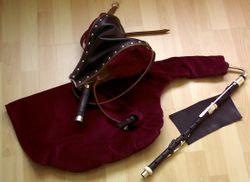
Chanter
The chanter is the part of the bagpipe upon which the player creates the melody. It consists of a number of finger-holes, and in its simpler forms looks similar to a recorder...
, with no drones or regulators. The chanter is available in keys ranging from the "concert pitch" D chanter in half-note steps downward to a B♭ chanter, the latter of which regularly is referred to as a "flat set" (as are any sets below the key of D).
In order to play the uilleann pipes effectively, students must learn to pump the bellows steadily while controlling the pressure on the bag and playing the chanter simultaneously. Therefore, beginning students often play on practice sets until they become comfortable with those basic mechanics. Despite their name, however, practice sets are used not only by beginning players but also by some advanced players when they wish to play just the chanter with other musicians, either live or in recording sessions. In these instances, the practice sets can be tuned to equal temperament
Equal temperament
An equal temperament is a musical temperament, or a system of tuning, in which every pair of adjacent notes has an identical frequency ratio. As pitch is perceived roughly as the logarithm of frequency, this means that the perceived "distance" from every note to its nearest neighbor is the same for...
if needed.
"Half set"
A half set is the next stage up from a practice set. As with other forms of bagpipes, uilleann pipes use "dronesDrone (music)
In music, a drone is a harmonic or monophonic effect or accompaniment where a note or chord is continuously sounded throughout most or all of a piece. The word drone is also used to refer to any part of a musical instrument that is just used to produce such an effect.-A musical effect:A drone...
", which are most commonly three pipes accompanying the melody of the chanter with a constant background tonic note. The pipes are generally equipped with three drones: a) the tenor
Tenor
The tenor is a type of male singing voice and is the highest male voice within the modal register. The typical tenor voice lies between C3, the C one octave below middle C, to the A above middle C in choral music, and up to high C in solo work. The low extreme for tenors is roughly B2...
drone—the highest sounding pipe which is pitched the same as the lowest note of the chanter, b) the baritone
Baritone
Baritone is a type of male singing voice that lies between the bass and tenor voices. It is the most common male voice. Originally from the Greek , meaning deep sounding, music for this voice is typically written in the range from the second F below middle C to the F above middle C Baritone (or...
drone which is pitched one octave below that and c) the bass drone—the lowest sounding pipe, two octaves below the bottom note of the chanter. The Pastoral pipes had four drones, these three plus one more which would play a harmony note at the fourth or fifth interval
Interval (music)
In music theory, an interval is a combination of two notes, or the ratio between their frequencies. Two-note combinations are also called dyads...
. These drones are connected to the pipe bag by a "stock". This is an intricately made wooden cylinder tied into the bag (as any other stock) by a thick yarn or hemp thread. The drones connect to the stock, as do the "regulators" (see "Full Set" below). The stock and drones are laid across the right thigh. This is distinct from other forms of bagpipes, in which the drones are usually carried over the shoulder or over the right arm.
The drones can be switched off. This is made possible by a key connected to the stock. The original design of the stock was a hollow cylinder, with two metal tubes running through it to both hold the regulators, and independently supply air to them. Thus the regulators could be played with the drones silenced. In the late 19th century it became more common to build the stock from a solid piece of wood, with 5 holes bored through it end-to-end. This was less susceptible to damage than the earlier design. The piper is also able to switch on and off various drones individually (applying slightly more pressure to the bag and tapping the end of a drone), which is generally used to aid in tuning (a technique used in almost all bagpipes which have drones) or all of them at the same time using this key. This makes the instrument more versatile and usable not only as a half set, but also to allow playing the chanter by itself. The drones use a single-bladed reed (the actual part creating sound), unlike the double reed
Double reed
A double reed is a type of reed used to produce sound in various wind instruments. The term double reed comes from the fact that there are two pieces of cane vibrating against each other. A single reed consists of one piece of cane which vibrates against a mouthpiece made of metal, hardened...
used in the chanter and the regulators. These drone reeds were generally made from elderberry
Elderberry
Sambucus is a genus of between 5 and 30 species of shrubs or small trees in the moschatel family, Adoxaceae. It was formerly placed in the honeysuckle family, Caprifoliaceae, but was reclassified due to genetic evidence...
twigs in the past — cane began to be used in the late 19th century.
"Full set"
A "full set", as the name implies, is a complete set of uilleann pipes. This would be a half set with the addition of three "regulators". These are three closed pipes, similar to the chanter, held in the stock. Like the drones, they are usually given the terms tenor, baritone, and bass, from smallest to largest. A regulator uses keys (five on the tenor and four on both baritone and bass) to accompany the melody of the chanter; these keys are arranged in rows to give limited two note "chords", or, alternatively, single notes for emphasis on phrases or specific notes. The notes of the regulators, from highest to lowest (given a nominal pitch of D) are as follows: Tenor: C, B, A, G, F#. Baritone: A, G, F#, D. Bass: C, B, A, G. The tenor and baritone regulators fit into the front face of the stock, on top of the drones; the bass regulator is attached to the side of the stock (furthest from the piper), and is of complex construction.Another method of using the regulators is to play what are referred to as "hand chords": when the melody (usually in a slower piece of music such as an air
Sean-nós song
Sean-nós is a highly ornamented style of unaccompanied traditional Irish singing. It is a sean-nós activity, which also includes sean-nós dancing...
) is being played on the chanter exclusively with the left hand, the right hand will be free to create more complex chords, using all three regulators at once if so desired. Many airs end a section on a G or A note in the first octave, at which point a piper will often play one of these hand chords for dramatic effect.
Chanter
The chanterChanter
The chanter is the part of the bagpipe upon which the player creates the melody. It consists of a number of finger-holes, and in its simpler forms looks similar to a recorder...
is the part of the uilleann pipes that is used to play the melody
Melody
A melody , also tune, voice, or line, is a linear succession of musical tones which is perceived as a single entity...
. It has eight finger holes (example given of a D pitched chanter): Bottom D, E♭, E, F♯, G, A, B, C, C♯, D' (also called "back D"). To achieve the "bottom D" the chanter is lifted off the knee, exposing the exit of the chanter's bore, where the note is produced. The chanter is set on the right knee thus closing off the bottom hole. Many players use a strip of leather placed over the knee, called a "popping strap", which provides for an airtight seal. More rarely, a simple gravity- or spring- operated flap valve attached to the bottom of the chanter achieves the same end. Generally, for all other notes (except for special effects, or to vary the volume and tone) the chanter stays on the knee.
One characteristic of the chanter is that it can produce staccato notes, because the piper seals it off at the bottom; with all of the finger holes closed, the chanter is silenced. This is also necessary for obtaining the second octave; the chanter must be closed and the bag pressure increased, and then fingered notes will sound in the second octave. A great range of different timbres can be achieved by varying the fingering of notes and also raising the chanter off the knee, which gives the uilleann pipes a degree of dynamic range not found in other forms of bagpipes. Pipers who use staccato fingering often are termed "closed-style" pipers. Those who use legato fingering more predominately are referred to as "open-style" pipers. Open piping has historical associations with musicians (often Irish travelling people
Irish Traveller
Irish Travellers are a traditionally nomadic people of ethnic Irish origin, who maintain a separate language and set of traditions. They live predominantly in the Republic of Ireland, the United Kingdom and the United States.-Etymology:...
) who played on the street or outdoors, since the open fingering is somewhat louder, especially with the chanter played off-the-knee (which can, however, lead to faulty pitch with the second octave notes).
A type of simultaneous vibrato
Vibrato
Vibrato is a musical effect consisting of a regular, pulsating change of pitch. It is used to add expression to vocal and instrumental music. Vibrato is typically characterised in terms of two factors: the amount of pitch variation and the speed with which the pitch is varied .-Vibrato and...
and tremolo
Tremolo
Tremolo, or tremolando, is a musical term that describes various trembling effects, falling roughly into two types. The first is a rapid reiteration...
can be achieved by tapping a finger below the open note hole on the chanter. The bottom note also has two different "modes", namely the "soft D" and the "hard D". The hard bottom D sounds louder and more strident than the soft D and is accomplished by applying slightly more pressure to the bag and flicking a higher note finger as it is sounded. Pipemakers tune the chanter so the hard D is the in-tune note, the soft D usually being slightly flat.
Many chanters are fitted with keys to allow accurate playing of all the semitones of the scale. Four keys will give all the semitones: F natural, G sharp, B flat, C natural. Older chanters usually had another key for producing d3 in the third octave, and often another small key for e3, and another for D#' (as opposed to the E♭ fingerhole, which could be slightly off-pitch). Most uilleann chanters are very responsive to "half-holing" or "sliding", which is the practice of obtaining a note by leaving a fingerhole only half covered. This is why many chanters sold in Ireland are sold without keys. With this technique and some practice, many pipers can accurately play the semi-tones which would otherwise require a chromatic key to be installed. The exception to this is the C natural in the second octave, which cannot be cross-fingered or half-holed, and requires the key. This is the most commonly fitted key.
The chanter uses a double reed
Double reed
A double reed is a type of reed used to produce sound in various wind instruments. The term double reed comes from the fact that there are two pieces of cane vibrating against each other. A single reed consists of one piece of cane which vibrates against a mouthpiece made of metal, hardened...
, similar to that of the oboe
Oboe
The oboe is a double reed musical instrument of the woodwind family. In English, prior to 1770, the instrument was called "hautbois" , "hoboy", or "French hoboy". The spelling "oboe" was adopted into English ca...
or bassoon
Bassoon
The bassoon is a woodwind instrument in the double reed family that typically plays music written in the bass and tenor registers, and occasionally higher. Appearing in its modern form in the 19th century, the bassoon figures prominently in orchestral, concert band and chamber music literature...
. Unlike most reed instruments, the uilleann pipe reed must be crafted so that it can play two full octaves accurately, without the fine tuning allowed by the use of a player's lips; only bag pressure and fingering patterns can be used to maintain the correct pitch of each note. It is for this reason that making uilleann pipe chanter reeds is a demanding task. Uilleann pipe reeds are also often called "the piper's despair" for the immense difficulty of maintaining, tuning and especially making the double reed of the regulators and, most importantly, the chanter.
See also
- Types of bagpipesTypes of bagpipes-France:*Musette de cour: A French open ended smallpipe, believed by some to be an ancestor of the Northumbrian smallpipes, used for classical compositions in 'folk' style in the 18th Century French court...
- Pastoral PipesPastoral pipesThe Pastoral Pipe was a bellows-blown bagpipe, widely recognised as the forerunner and ancestor of the 19th-century Union pipes, which became the Uilleann Pipes of today...
- List of All Ireland Uilleann pipe champions
- List of bagpipers
- List of pipe makers
- List of published bagpipe music
- List of nontraditional bagpipe usage
- List of bagpipe technology books
- Glossary of bagpipe termsGlossary of bagpipe termsThis article defines a number of terms that are exclusive, or whose meaning is exclusive, to piping and pipers.-A:Arm Strap : When playing a bellowspipe, this attaches the player's arm to the bellows allowing him to control them....
- Tomas O'CanainnTomas O'CanainnTomás Ó Canainn is an Irish Uilleann piper, accordion player, singer, composer and writer. He was a founder of the group Na Fili with fiddler Matt Cranitch and whistle player Tom Barry in the late 1960s and 1970s...
External links
- Article on uilleann pipes.
- The Irish piping organization Na Píobairí Uilleann ("the uilleann pipers")
- Amateur recordings of the uilleann pipes
- Interview with piper Brian McNamara
- 'Alan Pipes - The Warm Up' by Sligo uilleann piper Alan Roberts (Download from iTunes)
- 'Tools of the Trade' - An interview with Liam O'Flynn about the Uilleann Pipes
- A rough guide to the history of the Uilleann (Irish) Pipes
- Angus Pipes - Specialist maker of hand crafted uilleann pipes.
- Russian community of Uilleann Pipers in Live Journal