

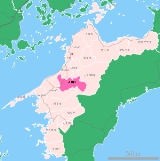
Uchiko, Ehime

Encyclopedia
is a town
located in Kita District
, Ehime
, Japan
.
On January 1, 2005 the town of Ikazaki
, from Kita District
; and the town of Oda
, from Kamiukena District
, were merged into Uchiko.
As of January 1, 2005 (after this merger), the town has an estimated population
of 20,782 and a density
of 69.4 persons per km². The total area is 299.50 km².
 The traditional town of Uchiko is surrounded by much natural beauty and is located about 42 kilometers southwest of Matsuyama in the Ehime prefecture
. Three streams run through the area: the Oda, the Nakayama and the Fumoto. Uchiko has few flat areas and about 70% of the land is forest. The soil is fertile and the main industry is agriculture
, particularly leaf tobacco
, shiitake
mushrooms, and fruits such as persimmon
s, grapes and nashi pear
s. The riversides are used mainly by farms and farmland can extend to the hills and the steep mountainsides. As of April 2005, the population in Uchiko was approximately 20,650.
All year round, the stunning views and the very green, fertile mountains and valleys give the people of Uchiko both the feeling of restfulness and economic sustenance.
From the end of the Edo Period
(1603–1867) to the end of the Meiji Period
(1868–1912), Uchiko developed and thrived as a manufacturing center of Japanese paper
and Japanese wax
. At that time the Yokaichi and Gokoku districts became industrialised and their historical houses still retain some vestige of Uchiko’s former glory. In the Yokaichi and Gokoku districts is a street of merchant houses, which have solemn white or cream coloured plaster walls, lattices, decorative walls and old-style Japanese desks. This traditional street is about 600 meters long and around 90 of these historical houses are still lived in.
The campaign to preserve this old town area has been ongoing since 1975 and the national government designated this area as an “Important Traditional Construction Preservation Area” in 1982.
The Nobel laureate
Kenzaburō Ōe
was born in Uchiko.
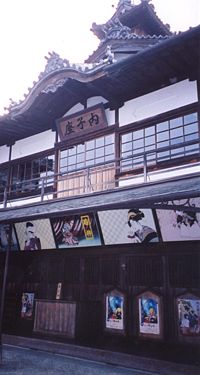
theatre in 1916 and was famous for its Kabuki
and Bunraku
(traditional puppet show) performances. In the course of time, it became used for film shows, variety shows and lectures, amongst other things. In 1985, the theatre was restored to its original appearance. Today, Uchiko-za presents plays, concerts and other events, including the very popular Bunraku performances. The Uchiko-za is unique and traditional because of its open Taiko
-drum tower, the boxed seating area, the broad ramp leading to the stage along one side of the audience and the wooden, revolving stage. The Uchiko-za is considered a showpiece of Japanese culture and architecture.
Now, this elegant and traditional property, with its spacious garden, is used a museum that has exhibitions on commerce, the lifestyle of the merchants and the production of wax. These grounds are designated as an Important Cultural Property
and have been since 1990.
Towns of Japan
A town is a local administrative unit in Japan. It is a local public body along with prefecture , city , and village...
located in Kita District
Kita District, Ehime
The is a district located in Ehime Prefecture, Japan. As of 2005, the estimated population is 20,782 with a total area is 299.50 km².The district includes one town.*Uchiko-Origin of name:...
, Ehime
Ehime Prefecture
is a prefecture in northwestern Shikoku, Japan. The capital is Matsuyama.-History:Until the Meiji Restoration, Ehime prefecture was known as Iyo Province...
, Japan
Japan
Japan is an island nation in East Asia. Located in the Pacific Ocean, it lies to the east of the Sea of Japan, China, North Korea, South Korea and Russia, stretching from the Sea of Okhotsk in the north to the East China Sea and Taiwan in the south...
.
On January 1, 2005 the town of Ikazaki
Ikazaki, Ehime
was a town located in Kita District, Ehime, Japan.On January 1, 2005 Ikazaki, along with the town of Oda, from Kamiukena District, was merged into the expanded town of Uchiko and no longer exists as an independent municipality....
, from Kita District
Kita District, Ehime
The is a district located in Ehime Prefecture, Japan. As of 2005, the estimated population is 20,782 with a total area is 299.50 km².The district includes one town.*Uchiko-Origin of name:...
; and the town of Oda
Oda, Ehime
was a town located in Kamiukena District, Ehime, Japan.On January 1, 2005 Oda, along with the town of Ikazaki, from Kita District, was merged into the expanded town of Uchiko and no longer exists as an independent municipality....
, from Kamiukena District
Kamiukena District, Ehime
The is a district located in Ehime Prefecture, Japan. As of 2004 — The estimated population is 11,222 with a total area of 583.66 km².It consists of one town.*Kumakōgen-History:...
, were merged into Uchiko.
As of January 1, 2005 (after this merger), the town has an estimated population
Population
A population is all the organisms that both belong to the same group or species and live in the same geographical area. The area that is used to define a sexual population is such that inter-breeding is possible between any pair within the area and more probable than cross-breeding with individuals...
of 20,782 and a density
Population density
Population density is a measurement of population per unit area or unit volume. It is frequently applied to living organisms, and particularly to humans...
of 69.4 persons per km². The total area is 299.50 km².
Overview
Ehime Prefecture
is a prefecture in northwestern Shikoku, Japan. The capital is Matsuyama.-History:Until the Meiji Restoration, Ehime prefecture was known as Iyo Province...
. Three streams run through the area: the Oda, the Nakayama and the Fumoto. Uchiko has few flat areas and about 70% of the land is forest. The soil is fertile and the main industry is agriculture
Agriculture
Agriculture is the cultivation of animals, plants, fungi and other life forms for food, fiber, and other products used to sustain life. Agriculture was the key implement in the rise of sedentary human civilization, whereby farming of domesticated species created food surpluses that nurtured the...
, particularly leaf tobacco
Tobacco
Tobacco is an agricultural product processed from the leaves of plants in the genus Nicotiana. It can be consumed, used as a pesticide and, in the form of nicotine tartrate, used in some medicines...
, shiitake
Shiitake
The Shiitake is an edible mushroom native to East Asia, which is cultivated and consumed in many Asian countries, as well as being dried and exported to many countries around the world. It is a feature of many Asian cuisines including Vietnamese, Chinese, Japanese, Korean and Thai...
mushrooms, and fruits such as persimmon
Persimmon
A persimmon is the edible fruit of a number of species of trees in the genus Diospyros in the ebony wood family . The word Diospyros means "the fire of Zeus" in ancient Greek. As a tree, it is a perennial plant...
s, grapes and nashi pear
Nashi Pear
Pyrus pyrifolia is a pear tree species native to China, Japan, and Korea. The tree's edible fruit is known by many names, including: Asian pear, Chinese pear, Korean pear, Japanese pear, Taiwan pear, and sand pear.....
s. The riversides are used mainly by farms and farmland can extend to the hills and the steep mountainsides. As of April 2005, the population in Uchiko was approximately 20,650.
All year round, the stunning views and the very green, fertile mountains and valleys give the people of Uchiko both the feeling of restfulness and economic sustenance.
From the end of the Edo Period
Edo period
The , or , is a division of Japanese history which was ruled by the shoguns of the Tokugawa family, running from 1603 to 1868. The political entity of this period was the Tokugawa shogunate....
(1603–1867) to the end of the Meiji Period
Meiji period
The , also known as the Meiji era, is a Japanese era which extended from September 1868 through July 1912. This period represents the first half of the Empire of Japan.- Meiji Restoration and the emperor :...
(1868–1912), Uchiko developed and thrived as a manufacturing center of Japanese paper
Paper
Paper is a thin material mainly used for writing upon, printing upon, drawing or for packaging. It is produced by pressing together moist fibers, typically cellulose pulp derived from wood, rags or grasses, and drying them into flexible sheets....
and Japanese wax
Wax
thumb|right|[[Cetyl palmitate]], a typical wax ester.Wax refers to a class of chemical compounds that are plastic near ambient temperatures. Characteristically, they melt above 45 °C to give a low viscosity liquid. Waxes are insoluble in water but soluble in organic, nonpolar solvents...
. At that time the Yokaichi and Gokoku districts became industrialised and their historical houses still retain some vestige of Uchiko’s former glory. In the Yokaichi and Gokoku districts is a street of merchant houses, which have solemn white or cream coloured plaster walls, lattices, decorative walls and old-style Japanese desks. This traditional street is about 600 meters long and around 90 of these historical houses are still lived in.
The campaign to preserve this old town area has been ongoing since 1975 and the national government designated this area as an “Important Traditional Construction Preservation Area” in 1982.
The Nobel laureate
Nobel Prize in Literature
Since 1901, the Nobel Prize in Literature has been awarded annually to an author from any country who has, in the words from the will of Alfred Nobel, produced "in the field of literature the most outstanding work in an ideal direction"...
Kenzaburō Ōe
Kenzaburo Oe
is a Japanese author and a major figure in contemporary Japanese literature. His works, strongly influenced by French and American literature and literary theory, deal with political, social and philosophical issues including nuclear weapons, social non-conformism and existentialism.Ōe was awarded...
was born in Uchiko.
Uchiko Theatre
The Uchiko-za was built as a traditional KabukiKabuki
is classical Japanese dance-drama. Kabuki theatre is known for the stylization of its drama and for the elaborate make-up worn by some of its performers.The individual kanji characters, from left to right, mean sing , dance , and skill...
theatre in 1916 and was famous for its Kabuki
Kabuki
is classical Japanese dance-drama. Kabuki theatre is known for the stylization of its drama and for the elaborate make-up worn by some of its performers.The individual kanji characters, from left to right, mean sing , dance , and skill...
and Bunraku
Bunraku
, also known as Ningyō jōruri , is a form of traditional Japanese puppet theater, founded in Osaka in 1684.Three kinds of performers take part in a bunraku performance:* Ningyōtsukai or Ningyōzukai—puppeteers* Tayū—the chanters* Shamisen players...
(traditional puppet show) performances. In the course of time, it became used for film shows, variety shows and lectures, amongst other things. In 1985, the theatre was restored to its original appearance. Today, Uchiko-za presents plays, concerts and other events, including the very popular Bunraku performances. The Uchiko-za is unique and traditional because of its open Taiko
Taiko
means "drum" in Japanese . Outside Japan, the word is often used to refer to any of the various Japanese drums and to the relatively recent art-form of ensemble taiko drumming...
-drum tower, the boxed seating area, the broad ramp leading to the stage along one side of the audience and the wooden, revolving stage. The Uchiko-za is considered a showpiece of Japanese culture and architecture.
The Kamihaga Residence and Japanese Wax Museum
The Kamihaga Residence was built in 1894 by a family who were a branch of the Honhaga household (the main household in Uchiko). The Kamihaga family was one of the most influential families in Uchiko. They established the production of wax in Uchiko and thus, the family became very wealthy and powerful.Now, this elegant and traditional property, with its spacious garden, is used a museum that has exhibitions on commerce, the lifestyle of the merchants and the production of wax. These grounds are designated as an Important Cultural Property
Important Cultural Properties of Japan
The term is often shortened into just are items officially already classified as Tangible Cultural Properties of Japan by the Japanese Agency for Cultural Affairs and judged to be of particular importance to the Japanese people....
and have been since 1990.
Annual events
- Late April: The Raft Festival at the River Oda, Oda.
- May 5: The Kite Flying Festival in IkazakiIkazaki, Ehimewas a town located in Kita District, Ehime, Japan.On January 1, 2005 Ikazaki, along with the town of Oda, from Kamiukena District, was merged into the expanded town of Uchiko and no longer exists as an independent municipality....
. - Late May–Early June: RiceRiceRice is the seed of the monocot plants Oryza sativa or Oryza glaberrima . As a cereal grain, it is the most important staple food for a large part of the world's human population, especially in East Asia, Southeast Asia, South Asia, the Middle East, and the West Indies...
planting in IkazakiIkazaki, Ehimewas a town located in Kita District, Ehime, Japan.On January 1, 2005 Ikazaki, along with the town of Oda, from Kamiukena District, was merged into the expanded town of Uchiko and no longer exists as an independent municipality....
. - August 6–8: The BambooBambooBamboo is a group of perennial evergreens in the true grass family Poaceae, subfamily Bambusoideae, tribe Bambuseae. Giant bamboos are the largest members of the grass family....
Festival in Uchiko. - August 15: The Fire Festival in Oda.
- October: The Autumn Festival, The Japanese Lion Dance.
- November: Momiji – Autumn leaf viewing.
- December: Solfa Ski Resort opens in Oda.