

Transcaspian Region

Encyclopedia
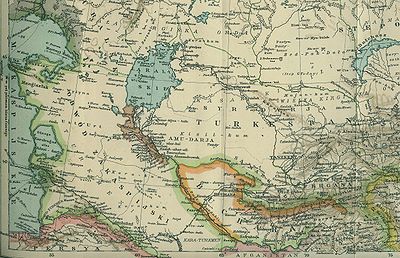
Transcaspian Region or Transcaspia, was the name used from the second half of the 19th century until 1924 for the section of Russian Empire
(and, for a few years, early Soviet Russia) to the east of the Caspian Sea
, bounded to the south by Iran
's Khorasan Province and Afghanistan
, to the north by the former Russian province of Uralsk, and to the northeast by the former Russian protectorate
s of Khiva
and Bukhara
. Area, 212,545 sq. miles.. Part of Russian Turkestan
, the Transcaspian Region corresponds roughly to the territory of present-day Turkmenistan
.
 The name of the Region (literally, "Beyond Caspian") is explained by the fact that until the construction of the Trans-Aral Railway
in the early 20th century the easiest way to reach this region from central Russia (or from Russian Transcaucasia) was across the Caspian Sea
, by boat from Astrakhan
or Baku
.
in 1879-1885, in a series of campaigns led by Generals Lomakin, Skobelev
, and Annenkov. The construction of the Transcaspian Railway was started from the shores of the Caspian
in 1879 in order to secure Russian control over the region and provide a rapid military route to the Afghan border. In 1885 a crisis was precipated by the Russian annexation of the Panjdeh oasis
, to the south of Merv
, which nearly led to war with Britain
, as it was thought that the Russians were planning to march on to Herat
in Afghanistan. Until 1898 Transcaspia was part of the Governor-Generalship
of Caucasus
administered from Tiflis, but in that year it was made an oblast
(province) of Russian Turkestan
governed from Tashkent
. The best known Military Governor to have ruled the region from Ashkhabad was probably General Kuropatkin
, whose authoritarian methods and personal style of governance made the province very difficult for his successors to control. Consequently the administration of Transcaspia became a byword for corruption and brutality within Russian Turkestan, as Russian administrators turned their districts into petty fiefdoms and extorted money from the local population. These abuses were fully exposed by the Pahlen Report of 1908-10. During the revolutionary period of 1917-19 parts of Transcaspia were briefly occupied by British Indian forces from Meshed. The region was one of the last centres of Basmachi resistance to Bolshevik rule, with the last of the rebellious Turkmen
fleeing across the border to Afghanistan and Iran in 1922-23.
Russian Empire
The Russian Empire was a state that existed from 1721 until the Russian Revolution of 1917. It was the successor to the Tsardom of Russia and the predecessor of the Soviet Union...
(and, for a few years, early Soviet Russia) to the east of the Caspian Sea
Caspian Sea
The Caspian Sea is the largest enclosed body of water on Earth by area, variously classed as the world's largest lake or a full-fledged sea. The sea has a surface area of and a volume of...
, bounded to the south by Iran
Iran
Iran , officially the Islamic Republic of Iran , is a country in Southern and Western Asia. The name "Iran" has been in use natively since the Sassanian era and came into use internationally in 1935, before which the country was known to the Western world as Persia...
's Khorasan Province and Afghanistan
Afghanistan
Afghanistan , officially the Islamic Republic of Afghanistan, is a landlocked country located in the centre of Asia, forming South Asia, Central Asia and the Middle East. With a population of about 29 million, it has an area of , making it the 42nd most populous and 41st largest nation in the world...
, to the north by the former Russian province of Uralsk, and to the northeast by the former Russian protectorate
Protectorate
In history, the term protectorate has two different meanings. In its earliest inception, which has been adopted by modern international law, it is an autonomous territory that is protected diplomatically or militarily against third parties by a stronger state or entity...
s of Khiva
Khanate of Khiva
The Khanate of Khiva was the name of a Uzbek state that existed in the historical region of Khwarezm from 1511 to 1920, except for a period of Persian occupation by Nadir Shah between 1740–1746. It was the patrilineal descendants of Shayban , the fifth son of Jochi and grandson of Genghis Khan...
and Bukhara
Emirate of Bukhara
The Emirate of Bukhara was a Central Asian state that existed from 1785 to 1920. It occupied the land between the Amu Darya and Syr Darya rivers, known formerly as Transoxiana. Its core territory was the land along the lower Zarafshan River, and its urban centres were the ancient cities of...
. Area, 212,545 sq. miles.. Part of Russian Turkestan
Russian Turkestan
Russian Turkestan was the western part of Turkestan within the Russian Empire , comprising the oasis region to the south of the Kazakh steppes, but not the protectorates of the Emirate of Bukhara and the Khanate of Khiva.-History:-Establishment:Although Russia had been pushing south into the...
, the Transcaspian Region corresponds roughly to the territory of present-day Turkmenistan
Turkmenistan
Turkmenistan , formerly also known as Turkmenia is one of the Turkic states in Central Asia. Until 1991, it was a constituent republic of the Soviet Union, the Turkmen Soviet Socialist Republic . Turkmenistan is one of the six independent Turkic states...
.
Trans-Aral Railway
The broad gauge Trans-Aral Railway was built in 1906 connecting Orenburg and Tashkent, then both in the Russian Empire. For the first part of the 20th century it was the only railway-connection between European Russia and Central Asia.There were plans to construct the Orenburg-Tashkent line as...
in the early 20th century the easiest way to reach this region from central Russia (or from Russian Transcaucasia) was across the Caspian Sea
Caspian Sea
The Caspian Sea is the largest enclosed body of water on Earth by area, variously classed as the world's largest lake or a full-fledged sea. The sea has a surface area of and a volume of...
, by boat from Astrakhan
Astrakhan
Astrakhan is a major city in southern European Russia and the administrative center of Astrakhan Oblast. The city lies on the left bank of the Volga River, close to where it discharges into the Caspian Sea at an altitude of below the sea level. Population:...
or Baku
Baku
Baku , sometimes spelled as Baki or Bakou, is the capital and largest city of Azerbaijan, as well as the largest city on the Caspian Sea and of the Caucasus region. It is located on the southern shore of the Absheron Peninsula, which projects into the Caspian Sea. The city consists of two principal...
.
History
Transcaspia was conquered by RussiaRussian Empire
The Russian Empire was a state that existed from 1721 until the Russian Revolution of 1917. It was the successor to the Tsardom of Russia and the predecessor of the Soviet Union...
in 1879-1885, in a series of campaigns led by Generals Lomakin, Skobelev
Mikhail Skobelev
Mikhail Dmitrievich Skobelev was a Russian general famous for his conquest of Central Asia and heroism during the Russo-Turkish War of 1877-78. Dressed in white uniform and mounted on a white horse, and always in the thickest of the fray, he was known and adored by his soldiers as the "White...
, and Annenkov. The construction of the Transcaspian Railway was started from the shores of the Caspian
Caspian Sea
The Caspian Sea is the largest enclosed body of water on Earth by area, variously classed as the world's largest lake or a full-fledged sea. The sea has a surface area of and a volume of...
in 1879 in order to secure Russian control over the region and provide a rapid military route to the Afghan border. In 1885 a crisis was precipated by the Russian annexation of the Panjdeh oasis
Panjdeh Incident
The Panjdeh Incident or Panjdeh Scare was a battle that occurred in 1885 when Russian forces seized Afghan territory south of the Oxus River around an oasis at Panjdeh . The incident created a diplomatic crisis between Russia and Great Britain...
, to the south of Merv
Merv
Merv , formerly Achaemenid Satrapy of Margiana, and later Alexandria and Antiochia in Margiana , was a major oasis-city in Central Asia, on the historical Silk Road, located near today's Mary in Turkmenistan. Several cities have existed on this site, which is significant for the interchange of...
, which nearly led to war with Britain
United Kingdom of Great Britain and Ireland
The United Kingdom of Great Britain and Ireland was the formal name of the United Kingdom during the period when what is now the Republic of Ireland formed a part of it....
, as it was thought that the Russians were planning to march on to Herat
Herat
Herāt is the capital of Herat province in Afghanistan. It is the third largest city of Afghanistan, with a population of about 397,456 as of 2006. It is situated in the valley of the Hari River, which flows from the mountains of central Afghanistan to the Karakum Desert in Turkmenistan...
in Afghanistan. Until 1898 Transcaspia was part of the Governor-Generalship
Guberniya
A guberniya was a major administrative subdivision of the Russian Empire usually translated as government, governorate, or province. Such administrative division was preserved for sometime upon the collapse of the empire in 1917. A guberniya was ruled by a governor , a word borrowed from Latin ,...
of Caucasus
Caucasus
The Caucasus, also Caucas or Caucasia , is a geopolitical region at the border of Europe and Asia, and situated between the Black and the Caspian sea...
administered from Tiflis, but in that year it was made an oblast
Oblast
Oblast is a type of administrative division in Slavic countries, including some countries of the former Soviet Union. The word "oblast" is a loanword in English, but it is nevertheless often translated as "area", "zone", "province", or "region"...
(province) of Russian Turkestan
Russian Turkestan
Russian Turkestan was the western part of Turkestan within the Russian Empire , comprising the oasis region to the south of the Kazakh steppes, but not the protectorates of the Emirate of Bukhara and the Khanate of Khiva.-History:-Establishment:Although Russia had been pushing south into the...
governed from Tashkent
Tashkent
Tashkent is the capital of Uzbekistan and of the Tashkent Province. The officially registered population of the city in 2008 was about 2.2 million. Unofficial sources estimate the actual population may be as much as 4.45 million.-Early Islamic History:...
. The best known Military Governor to have ruled the region from Ashkhabad was probably General Kuropatkin
Aleksey Kuropatkin
Alexei Nikolayevich Kuropatkin was the Russian Imperial Minister of War who is often held responsible for major Russian drawbacks in the Russian-Japanese War, notably the Battle of Mukden and the Battle of Liaoyang.-Early years:Kuropatkin was born in 1848 in what is now Pskov, in the Russian...
, whose authoritarian methods and personal style of governance made the province very difficult for his successors to control. Consequently the administration of Transcaspia became a byword for corruption and brutality within Russian Turkestan, as Russian administrators turned their districts into petty fiefdoms and extorted money from the local population. These abuses were fully exposed by the Pahlen Report of 1908-10. During the revolutionary period of 1917-19 parts of Transcaspia were briefly occupied by British Indian forces from Meshed. The region was one of the last centres of Basmachi resistance to Bolshevik rule, with the last of the rebellious Turkmen
Turkmen people
The Turkmen are a Turkic people located primarily in the Central Asian states of Turkmenistan, Afghanistan, and northeastern Iran. They speak the Turkmen language, which is classified as a part of the Western Oghuz branch of the Turkic languages family together with Turkish, Azerbaijani, Qashqai,...
fleeing across the border to Afghanistan and Iran in 1922-23.