

Toss bombing

Encyclopedia
Toss bombing is a method of bombing where the attacking aircraft
pulls upwards when releasing its bomb load, giving the bomb additional time of flight by starting its ballistic path with an upward vector.
The purpose of toss bombing is to compensate for the gravity drop of the missile in flight.
, where the plane pitches downwards to aim at its target, toss bombing is often performed with a short dive before the bomber raises its nose and releases its bomb. This variant is known as "dive tossing". This gives both the bomb and aircraft extra momentum
, thereby helping the aircraft regain altitude
after the release and also ensuring that airspeed at the calculated release point is still sufficient to get the bomb to the target.
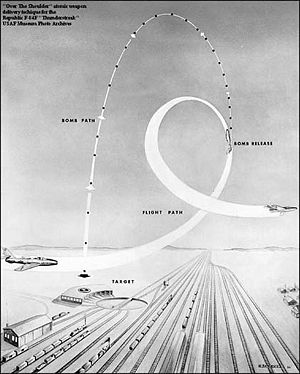 A more dynamic variant of toss bombing, called over-the-shoulder bombing, or the LABS (Low Altitude Bombing System) maneuver (known to pilots as the "idiot's loop"), is a particular kind of loft bombing where the bomb is released past the vertical
so it is tossed back towards the target. This tactic was first made public on 7 May 1957 at Eglin AFB
, when a B–47
entered its bombing run at low altitude, pulled up sharply (3.5 g
) into a half loop
, releasing its bomb under computer control at a predetermined point in its climb, then executed a half roll, completing a maneuver similar to an Immelmann turn
or Half Cuban Eight. The bomb continued upward for some time in a high arc
before falling on a target which was a considerable distance from its point of release. In the meantime, the maneuver had allowed the bomber to change direction and distance itself from the target.
Author and retired USAF pilot Richard Bach
describes such an attack in his book Stranger to the Ground:
whenever it is not desirable to overfly the target with the aircraft at an altitude sufficient for dive-bombing or level bombing. Such cases include heavy anti-air defenses such as AAA and SAMs
, when deploying powerful weapons such as 2,000 lb. "iron bombs" or even tactical nuclear bombs, and the use of limited-aspect targeting devices for guided munitions.
To counter air defenses en route to the target, remaining at a low altitude for as long as possible allows the bomber to avoid radar
and visual tracking and the launch envelope of older missile systems designed to be fired at targets overflying the missile site. However, a level pass at the target at low altitude will not only expose the aircraft to short-range defenses surrounding the target, but will place the aircraft in the bomb's blast radius. By executing a "pop-up" loft, on the other hand, the pilot releases the munition well outside the target area, out of range of air defenses. After release, the pilot can either dive back to low altitude or maintain the climb, in either case generally executing a sharp turn or "slice" away from the target. The blast
produced by powerful munitions is thus avoided.
The value of toss-bombing was increased with the introduction of precision-guided munitions such as the laser-guided bomb
. Previous "dumb bombs" required a very high degree of pilot and fire control computer precision to loft the bomb accurately to the target. Unguided loft bombing also generally called for the use of a larger bomb than would be necessary for a direct hit, in order to generate a larger blast that would destroy the target even if the bomb did not hit accurately due to windage or computer/pilot error. Laser-targeting (and other methods like GPS as used in the JDAM system) allows the bomb to correct minor deviations from the intended ballistic path after it has been released, making toss-bombing as accurate as level bombing while still providing most of the advantages of toss-bombing using unguided munitions. However, the targeting pods used to deliver guided munitions generally have a limit to their field of view; most specifically, the pod usually cannot look behind the aircraft at more than a certain angle. Lofting the bomb allows the pilot to keep the target in front of the aircraft and thus within the targeting pod's field of view for as long as possible.
"Dive-tossing" is generally used at moderate altitude (to allow for the dive) when the target, for whatever reason, cannot be designated precisely by radar. A target for instance may present too small a signature to be visible on radar (such as the entrance to an underground bunker) or may be indistinguishable in a group of radar returns. The pilot can in this case use a special "boresight" mode that allows the pilot to designate a target by pointing his aircraft directly at it. For a target on the ground, this means entering a dive. Thus designated, the pilot can then begin a climb, lofting the bomb at the target from a distance and regaining lost altitude at the same time.
system, altitude inputs from the static system, attitude inputs from the gyroscopic system and inputs from weapons selectors signifying the type of bomb to calculate the appropriate release point of the ordnance. Instead of triggering the release directly, the pilot instead "consents" to release the weapon, then begins a steady climb. The computer then calculates the desired ballistic path, and when that path will be produced by the current aircraft attitude and airspeed, the computer releases the bomb. While deployed in Europe
with NATO, RCAF CF-104 fighter-bombers carried a Toss Bomb Computer until their nuclear role was eliminated by the Canadian government
effective 1 January 1972.
The same computational solutions used in the LABS system are now incorporated into two of the major bombing modes (the computer-controlled CCRP and a dedicated visually oriented "Dive-Toss" mode) of the Fire Control Computer of modern strike fighters such as the F-15E and F-16. As with LABS, the pilot designates their desired impact point, then consents to release while executing a climb, and the computer controls the actual release of the bomb. The integration into the FCC simplifies the pilot's workload by allowing the same bombing mode (CCRP) to be used for level, dive and loft bombing, providing similar cues in the pilot's displays regardless of the tactics used.
Aircraft
An aircraft is a vehicle that is able to fly by gaining support from the air, or, in general, the atmosphere of a planet. An aircraft counters the force of gravity by using either static lift or by using the dynamic lift of an airfoil, or in a few cases the downward thrust from jet engines.Although...
pulls upwards when releasing its bomb load, giving the bomb additional time of flight by starting its ballistic path with an upward vector.
The purpose of toss bombing is to compensate for the gravity drop of the missile in flight.
Pop-up
In pop-up bombing, the pilot approaches from low altitude in level flight, and on cues from the computer pulls up at the last moment to release the bomb. Release usually occurs between 20°–75° above the horizontal, causing the bomb to be tossed upward and forward, much like an underarm throw of a ball.Level toss
Although "pop-up" bombing is generally characterized by its low-level approach, the same technique of a toss starting from level flight can be used at any altitude when it is not desirable to overfly the target. Additional altitude at release gives the bomb additional time of flight and range, at the cost (in the case of unguided munitions) of accuracy due to windage and the increased effect of a slight deviation in flight path.Dive toss
Although toss bombing might seem the direct opposite to dive bombingDive bomber
A dive bomber is a bomber aircraft that dives directly at its targets in order to provide greater accuracy for the bomb it drops. Diving towards the target reduces the distance the bomb has to fall, which is the primary factor in determining the accuracy of the drop...
, where the plane pitches downwards to aim at its target, toss bombing is often performed with a short dive before the bomber raises its nose and releases its bomb. This variant is known as "dive tossing". This gives both the bomb and aircraft extra momentum
Momentum
In classical mechanics, linear momentum or translational momentum is the product of the mass and velocity of an object...
, thereby helping the aircraft regain altitude
Altitude
Altitude or height is defined based on the context in which it is used . As a general definition, altitude is a distance measurement, usually in the vertical or "up" direction, between a reference datum and a point or object. The reference datum also often varies according to the context...
after the release and also ensuring that airspeed at the calculated release point is still sufficient to get the bomb to the target.
Over-the-shoulder
Vertical direction
In astronomy, geography, geometry and related sciences and contexts, a direction passing by a given point is said to be vertical if it is locally aligned with the gradient of the gravity field, i.e., with the direction of the gravitational force at that point...
so it is tossed back towards the target. This tactic was first made public on 7 May 1957 at Eglin AFB
Eglin Air Force Base
Eglin Air Force Base is a United States Air Force base located approximately 3 miles southwest of Valparaiso, Florida in Okaloosa County....
, when a B–47
B-47 Stratojet
The Boeing Model 450 B-47 Stratojet was a long-range, six-engined, jet-powered medium bomber built to fly at high subsonic speeds and at high altitudes. It was primarily designed to drop nuclear bombs on the Soviet Union...
entered its bombing run at low altitude, pulled up sharply (3.5 g
G-force
The g-force associated with an object is its acceleration relative to free-fall. This acceleration experienced by an object is due to the vector sum of non-gravitational forces acting on an object free to move. The accelerations that are not produced by gravity are termed proper accelerations, and...
) into a half loop
Aerobatic maneuver
Aerobatic maneuvers are flight paths putting aircraft in unusual attitudes, in air shows, dog fights or competition aerobatics. Aerobatics can be performed by a single aircraft or in formation with several others...
, releasing its bomb under computer control at a predetermined point in its climb, then executed a half roll, completing a maneuver similar to an Immelmann turn
Immelmann turn
The Immelmann turn refers to two different aircraft maneuvers.-In aerobatics:In modern aerobatical parlance, an Immelmann turn is an aerobatic maneuver of little practical use in aerial combat, and is a different maneuver altogether from the original dogfighting tactic of World War I from which it...
or Half Cuban Eight. The bomb continued upward for some time in a high arc
Arc (geometry)
In geometry, an arc is a closed segment of a differentiable curve in the two-dimensional plane; for example, a circular arc is a segment of the circumference of a circle...
before falling on a target which was a considerable distance from its point of release. In the meantime, the maneuver had allowed the bomber to change direction and distance itself from the target.
Author and retired USAF pilot Richard Bach
Richard Bach
Richard David Bach is an American writer. He is widely known as the author of the hugely popular 1970s best-sellers Jonathan Livingston Seagull, Illusions: The Adventures of a Reluctant Messiah, and others. His books espouse his philosophy that our apparent physical limits and mortality are merely...
describes such an attack in his book Stranger to the Ground:
The last red-roofed village flashes below me, and the target, a pyramid of white barrels, is just visible at the end of its run-in line. Five hundred knots. Switch down, button pressed. Timers begin their timing, circuits are alerted for the drop. Inch down to treetop altitude. I do not often fly at 500 knots on the deck, and it is apparent that I am moving quickly. The barrels inflate. I see that their white paint is flaking. And the pyramid streaks beneath me. Back on the stick smoothly firmly to read four G on the accelerometer and center the needles of the indicator that is only used in nuke weapon drops and center them and hold it there and I'll bet those computers are grinding their little hearts out and all I can see is sky in the windscreen hold the G's keep the needles centered there's the sun going beneath me and WHAM.
My airplane rolls hard to the right and tucks more tightly into her loop and strains ahead even though we are upside down. The Shape has released me more than I have released it. The little white barrels are now six thousand feet directly beneath my canopy. I have no way to tell if it was a good drop or not. That was decided back with the charts and graphs and the dividers and the angles. I kept the needles centered, the computers did their task automatically, and the Device is on its way.
Tactical use
Toss bombing is generally used by pilotsAviator
An aviator is a person who flies an aircraft. The first recorded use of the term was in 1887, as a variation of 'aviation', from the Latin avis , coined in 1863 by G. de la Landelle in Aviation Ou Navigation Aérienne...
whenever it is not desirable to overfly the target with the aircraft at an altitude sufficient for dive-bombing or level bombing. Such cases include heavy anti-air defenses such as AAA and SAMs
Surface-to-air missile
A surface-to-air missile or ground-to-air missile is a missile designed to be launched from the ground to destroy aircraft or other missiles...
, when deploying powerful weapons such as 2,000 lb. "iron bombs" or even tactical nuclear bombs, and the use of limited-aspect targeting devices for guided munitions.
To counter air defenses en route to the target, remaining at a low altitude for as long as possible allows the bomber to avoid radar
Radar
Radar is an object-detection system which uses radio waves to determine the range, altitude, direction, or speed of objects. It can be used to detect aircraft, ships, spacecraft, guided missiles, motor vehicles, weather formations, and terrain. The radar dish or antenna transmits pulses of radio...
and visual tracking and the launch envelope of older missile systems designed to be fired at targets overflying the missile site. However, a level pass at the target at low altitude will not only expose the aircraft to short-range defenses surrounding the target, but will place the aircraft in the bomb's blast radius. By executing a "pop-up" loft, on the other hand, the pilot releases the munition well outside the target area, out of range of air defenses. After release, the pilot can either dive back to low altitude or maintain the climb, in either case generally executing a sharp turn or "slice" away from the target. The blast
Explosion
An explosion is a rapid increase in volume and release of energy in an extreme manner, usually with the generation of high temperatures and the release of gases. An explosion creates a shock wave. If the shock wave is a supersonic detonation, then the source of the blast is called a "high explosive"...
produced by powerful munitions is thus avoided.
The value of toss-bombing was increased with the introduction of precision-guided munitions such as the laser-guided bomb
Laser-guided bomb
A laser-guided bomb is a guided bomb that uses semi-active laser homing to strike a designated target with greater accuracy than an unguided bomb. LGBs are one of the most common and widespread guided bombs, used by a large number of the world's air forces.- Overview :Laser-guided munitions use a...
. Previous "dumb bombs" required a very high degree of pilot and fire control computer precision to loft the bomb accurately to the target. Unguided loft bombing also generally called for the use of a larger bomb than would be necessary for a direct hit, in order to generate a larger blast that would destroy the target even if the bomb did not hit accurately due to windage or computer/pilot error. Laser-targeting (and other methods like GPS as used in the JDAM system) allows the bomb to correct minor deviations from the intended ballistic path after it has been released, making toss-bombing as accurate as level bombing while still providing most of the advantages of toss-bombing using unguided munitions. However, the targeting pods used to deliver guided munitions generally have a limit to their field of view; most specifically, the pod usually cannot look behind the aircraft at more than a certain angle. Lofting the bomb allows the pilot to keep the target in front of the aircraft and thus within the targeting pod's field of view for as long as possible.
"Dive-tossing" is generally used at moderate altitude (to allow for the dive) when the target, for whatever reason, cannot be designated precisely by radar. A target for instance may present too small a signature to be visible on radar (such as the entrance to an underground bunker) or may be indistinguishable in a group of radar returns. The pilot can in this case use a special "boresight" mode that allows the pilot to designate a target by pointing his aircraft directly at it. For a target on the ground, this means entering a dive. Thus designated, the pilot can then begin a climb, lofting the bomb at the target from a distance and regaining lost altitude at the same time.
Technology
Due to the intense pilot workload involved with flying and entering the window of opportunity, some aircraft are equipped with a “Toss Bomb Computer” (in US nuclear delivery, a part of the Low Altitude Bombing System) that enables the pilot to release the bomb at the correct angle. The Toss Bomb Computer takes airspeed inputs from the aircraft’s PitotPitot tube
A pitot tube is a pressure measurement instrument used to measure fluid flow velocity. The pitot tube was invented by the French engineer Henri Pitot Ulo in the early 18th century and was modified to its modern form in the mid-19th century by French scientist Henry Darcy...
system, altitude inputs from the static system, attitude inputs from the gyroscopic system and inputs from weapons selectors signifying the type of bomb to calculate the appropriate release point of the ordnance. Instead of triggering the release directly, the pilot instead "consents" to release the weapon, then begins a steady climb. The computer then calculates the desired ballistic path, and when that path will be produced by the current aircraft attitude and airspeed, the computer releases the bomb. While deployed in Europe
Europe
Europe is, by convention, one of the world's seven continents. Comprising the westernmost peninsula of Eurasia, Europe is generally 'divided' from Asia to its east by the watershed divides of the Ural and Caucasus Mountains, the Ural River, the Caspian and Black Seas, and the waterways connecting...
with NATO, RCAF CF-104 fighter-bombers carried a Toss Bomb Computer until their nuclear role was eliminated by the Canadian government
Canada
Canada is a North American country consisting of ten provinces and three territories. Located in the northern part of the continent, it extends from the Atlantic Ocean in the east to the Pacific Ocean in the west, and northward into the Arctic Ocean...
effective 1 January 1972.
The same computational solutions used in the LABS system are now incorporated into two of the major bombing modes (the computer-controlled CCRP and a dedicated visually oriented "Dive-Toss" mode) of the Fire Control Computer of modern strike fighters such as the F-15E and F-16. As with LABS, the pilot designates their desired impact point, then consents to release while executing a climb, and the computer controls the actual release of the bomb. The integration into the FCC simplifies the pilot's workload by allowing the same bombing mode (CCRP) to be used for level, dive and loft bombing, providing similar cues in the pilot's displays regardless of the tactics used.
External links
- “Over-the-Shoulder” Fact Sheet, National Museum of the United States Air ForceNational Museum of the United States Air ForceThe National Museum of the United States Air Force is the official museum of the United States Air Force located at Wright-Patterson Air Force Base northeast of Dayton, Ohio. The NMUSAF is the world's largest and oldest military aviation museum with more than 360 aircraft and missiles on display...
(Archive.org)