


Throne Room, Knossos

Encyclopedia
The Throne Room was a chamber built for ceremonial purposes during the 15th century BC inside the palatial complex of Knossos
, Crete
, in Greece
. It is found at the heart of the Bronze Age
palace of Knossos, one of the main centers of the Minoan civilization
and is considered the oldest throne room in Europe
.
archaeologist Arthur Evans
, during the first phase of his excavations in Knossos. It was found in the center of the palatial complex and west of the central court. This throne room is considered the oldest stone throne of the Aegean
region, indeed the oldest in Europe. The chamber contains an alabaster
seat on the north wall, identified by Evans as a "throne
", while two Griffin
s rest on each side are staring at it. Moreover, on three sides it contains gypsum
benches. It was part of a larger suite that also included an anteroom and an inner chamber with a ledge that was possibly a chapel. The throne room was accessed from the anteroom through two double doors. According to Evan's estimates, a total of thirty people could be accommodated both in the throne room and its anteroom. The room received its final form in Late Minoan IIIA
period, since it was a latter addition to the palace that occurred during the last phase of occupation after 1450 BC.
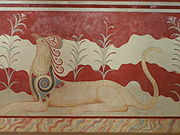 Initially, Evans believed that this area was designed to serve a religious purpose, while he claimed that this was the priest-king's seat and that the presence of the griffins confirmed that this king was somehow beyond mortal realms. He also identified the stone throne as the seat of the mythical king of Crete
, Minos
, evidently applied Greek mythology
. On the other hand, archaeologists Helga Reusch and Friedriech Matz suggested that the throne room was a sanctuary of a female divinity and that a priestess that sat there was her impersonator. The stone benches around the walls suggest a sitting council or perhaps a court, while a sunken area, called by Evans "lustral basin", partially partitioned off at one side, was used for ritual bathing. In view of the civil and religious powers held by the king, there can be little argument against the notion that proceedings of an official character began with sacred ceremonials.
According to various views, the throne itself may have actually had more religious than political significance, functioning in the re-enactment of epiphany rituals involving a High Priestess, as suggested by the iconography of griffins, palms, and altars in the wall-paintings. More recently, it has been suggested that the room was only used at dawn at certain times of the year for specific ceremonies.
takeover circa after 1450 BC when political conditions in Crete were entirely different, as indicated by the concurrent appearance of elite tombs, individual burials and the presence of the Mycenaean Greek
Linear B
script. At that time, the palace at Knossos seems to have been modified in a minor way in order to include features such as the Throne Room. Especially, the stylized paintings of heraldically opposed griffins were popular in later era Mycenaean wall painting but not seen before in Crete. For instance, similar wall decoration was also found in the throne room of the Mycenaean palace of Pylos
in the Peloponnese
.
Knossos
Knossos , also known as Labyrinth, or Knossos Palace, is the largest Bronze Age archaeological site on Crete and probably the ceremonial and political centre of the Minoan civilization and culture. The palace appears as a maze of workrooms, living spaces, and store rooms close to a central square...
, Crete
Crete
Crete is the largest and most populous of the Greek islands, the fifth largest island in the Mediterranean Sea, and one of the thirteen administrative regions of Greece. It forms a significant part of the economy and cultural heritage of Greece while retaining its own local cultural traits...
, in Greece
Greece
Greece , officially the Hellenic Republic , and historically Hellas or the Republic of Greece in English, is a country in southeastern Europe....
. It is found at the heart of the Bronze Age
Bronze Age
The Bronze Age is a period characterized by the use of copper and its alloy bronze as the chief hard materials in the manufacture of some implements and weapons. Chronologically, it stands between the Stone Age and Iron Age...
palace of Knossos, one of the main centers of the Minoan civilization
Minoan civilization
The Minoan civilization was a Bronze Age civilization that arose on the island of Crete and flourished from approximately the 27th century BC to the 15th century BC. It was rediscovered at the beginning of the 20th century through the work of the British archaeologist Arthur Evans...
and is considered the oldest throne room in Europe
Europe
Europe is, by convention, one of the world's seven continents. Comprising the westernmost peninsula of Eurasia, Europe is generally 'divided' from Asia to its east by the watershed divides of the Ural and Caucasus Mountains, the Ural River, the Caspian and Black Seas, and the waterways connecting...
.
Environment
The throne room was unearthed in 1900 by BritishBritish people
The British are citizens of the United Kingdom, of the Isle of Man, any of the Channel Islands, or of any of the British overseas territories, and their descendants...
archaeologist Arthur Evans
Arthur Evans
Sir Arthur John Evans FRS was a British archaeologist most famous for unearthing the palace of Knossos on the Greek island of Crete and for developing the concept of Minoan civilization from the structures and artifacts found there and elsewhere throughout eastern Mediterranean...
, during the first phase of his excavations in Knossos. It was found in the center of the palatial complex and west of the central court. This throne room is considered the oldest stone throne of the Aegean
Aegean Sea
The Aegean Sea[p] is an elongated embayment of the Mediterranean Sea located between the southern Balkan and Anatolian peninsulas, i.e., between the mainlands of Greece and Turkey. In the north, it is connected to the Marmara Sea and Black Sea by the Dardanelles and Bosporus...
region, indeed the oldest in Europe. The chamber contains an alabaster
Alabaster
Alabaster is a name applied to varieties of two distinct minerals, when used as a material: gypsum and calcite . The former is the alabaster of the present day; generally, the latter is the alabaster of the ancients...
seat on the north wall, identified by Evans as a "throne
Throne
A throne is the official chair or seat upon which a monarch is seated on state or ceremonial occasions. "Throne" in an abstract sense can also refer to the monarchy or the Crown itself, an instance of metonymy, and is also used in many expressions such as "the power behind the...
", while two Griffin
Griffin
The griffin, griffon, or gryphon is a legendary creature with the body of a lion and the head and wings of an eagle...
s rest on each side are staring at it. Moreover, on three sides it contains gypsum
Gypsum
Gypsum is a very soft sulfate mineral composed of calcium sulfate dihydrate, with the chemical formula CaSO4·2H2O. It is found in alabaster, a decorative stone used in Ancient Egypt. It is the second softest mineral on the Mohs Hardness Scale...
benches. It was part of a larger suite that also included an anteroom and an inner chamber with a ledge that was possibly a chapel. The throne room was accessed from the anteroom through two double doors. According to Evan's estimates, a total of thirty people could be accommodated both in the throne room and its anteroom. The room received its final form in Late Minoan IIIA
Minoan chronology
Sir Arthur Evans developed a relative dating scheme of Minoan chronology based on the excavations initiated and managed by him at the site of the ancient city of Knossos. He called the civilization that he discovered there Minoan...
period, since it was a latter addition to the palace that occurred during the last phase of occupation after 1450 BC.
Purpose
Crete
Crete is the largest and most populous of the Greek islands, the fifth largest island in the Mediterranean Sea, and one of the thirteen administrative regions of Greece. It forms a significant part of the economy and cultural heritage of Greece while retaining its own local cultural traits...
, Minos
Minos
In Greek mythology, Minos was a king of Crete, son of Zeus and Europa. Every year he made King Aegeus pick seven men and seven women to go to Daedalus' creation, the labyrinth, to be eaten by The Minotaur. After his death, Minos became a judge of the dead in Hades. The Minoan civilization of Crete...
, evidently applied Greek mythology
Greek mythology
Greek mythology is the body of myths and legends belonging to the ancient Greeks, concerning their gods and heroes, the nature of the world, and the origins and significance of their own cult and ritual practices. They were a part of religion in ancient Greece...
. On the other hand, archaeologists Helga Reusch and Friedriech Matz suggested that the throne room was a sanctuary of a female divinity and that a priestess that sat there was her impersonator. The stone benches around the walls suggest a sitting council or perhaps a court, while a sunken area, called by Evans "lustral basin", partially partitioned off at one side, was used for ritual bathing. In view of the civil and religious powers held by the king, there can be little argument against the notion that proceedings of an official character began with sacred ceremonials.
According to various views, the throne itself may have actually had more religious than political significance, functioning in the re-enactment of epiphany rituals involving a High Priestess, as suggested by the iconography of griffins, palms, and altars in the wall-paintings. More recently, it has been suggested that the room was only used at dawn at certain times of the year for specific ceremonies.
Mycenaean influence
Various archaeologists claim that the room and its furniture most likely date to the time of the MycenaeanMycenaean Greece
Mycenaean Greece was a cultural period of Bronze Age Greece taking its name from the archaeological site of Mycenae in northeastern Argolis, in the Peloponnese of southern Greece. Athens, Pylos, Thebes, and Tiryns are also important Mycenaean sites...
takeover circa after 1450 BC when political conditions in Crete were entirely different, as indicated by the concurrent appearance of elite tombs, individual burials and the presence of the Mycenaean Greek
Mycenaean language
Mycenaean Greek is the most ancient attested form of the Greek language, spoken on the Greek mainland, Crete and Cyprus in the 16th to 12th centuries BC, before the hypothesised Dorian invasion which was often cited as the terminus post quem for the coming of the Greek language to Greece...
Linear B
Linear B
Linear B is a syllabic script that was used for writing Mycenaean Greek, an early form of Greek. It pre-dated the Greek alphabet by several centuries and seems to have died out with the fall of Mycenaean civilization...
script. At that time, the palace at Knossos seems to have been modified in a minor way in order to include features such as the Throne Room. Especially, the stylized paintings of heraldically opposed griffins were popular in later era Mycenaean wall painting but not seen before in Crete. For instance, similar wall decoration was also found in the throne room of the Mycenaean palace of Pylos
Pylos
Pylos , historically known under its Italian name Navarino, is a town and a former municipality in Messenia, Peloponnese, Greece. Since the 2011 local government reform it is part of the municipality Pylos-Nestoras, of which it is the seat and a municipal unit. It was the capital of the former...
in the Peloponnese
Peloponnese
The Peloponnese, Peloponnesos or Peloponnesus , is a large peninsula , located in a region of southern Greece, forming the part of the country south of the Gulf of Corinth...
.