


Thermionic emission

Encyclopedia
Binding potential
In pharmacokinetics and receptor-ligand kinetics the binding potential is a combined measure of the density of "available" neuroreceptors and the affinity of a drug to that neuroreceptor.- Description :Consider a ligand receptor binding system...
, also known as work function
Work function
In solid-state physics, the work function is the minimum energy needed to remove an electron from a solid to a point immediately outside the solid surface...
of the metal. The charge carriers can be electron
Electron
The electron is a subatomic particle with a negative elementary electric charge. It has no known components or substructure; in other words, it is generally thought to be an elementary particle. An electron has a mass that is approximately 1/1836 that of the proton...
s or ion
Ion
An ion is an atom or molecule in which the total number of electrons is not equal to the total number of protons, giving it a net positive or negative electrical charge. The name was given by physicist Michael Faraday for the substances that allow a current to pass between electrodes in a...
s, and in older literature are sometimes referred to as "thermions". After emission, a charge will initially be left behind in the emitting region that is equal in magnitude and opposite in sign to the total charge emitted. But if the emitter is connected to a battery, then this charge left behind will be neutralized by charge supplied by the battery, as the emitted charge carriers move away from the emitter, and finally the emitter will be in the same state as it was before emission. The thermionic emission of electrons is also known as thermal electron emission.
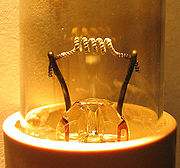
The classical example of thermionic emission is the emission of electrons from a hot cathode
Hot cathode
In vacuum tubes, a hot cathode is a cathode electrode which emits electrons due to thermionic emission. In the accelerator community, these are referred to as thermionic cathodes. The heating element is usually an electrical filament...
, into a vacuum (archaically
Archaism
In language, an archaism is the use of a form of speech or writing that is no longer current. This can either be done deliberately or as part of a specific jargon or formula...
known as the Edison effect) in a vacuum tube
Vacuum tube
In electronics, a vacuum tube, electron tube , or thermionic valve , reduced to simply "tube" or "valve" in everyday parlance, is a device that relies on the flow of electric current through a vacuum...
. The hot cathode can be a metal filament, a coated metal filament, or a separate structure of metal or carbides or borides of transition metals. Vacuum emission from metals tends to become significant only for temperatures over 1000 K. The science dealing with this phenomenon has been known as thermionics, but this name seems to be gradually falling into disuse.
The term "thermionic emission" is now also used to refer to any thermally-excited charge emission process, even when the charge is emitted from one solid-state
Solid-state physics
Solid-state physics is the study of rigid matter, or solids, through methods such as quantum mechanics, crystallography, electromagnetism, and metallurgy. It is the largest branch of condensed matter physics. Solid-state physics studies how the large-scale properties of solid materials result from...
region into another. This process is crucially important in the operation of a variety of electronic devices and can be used for power generation
Thermionic converter
A thermionic converter consists of a hot electrode which thermionically emits electrons over a potential energy barrier to a cooler electrode, producing a useful electric power output...
or cooling. The magnitude of the charge flow increases dramatically with increasing temperature.
History
In reading this history, it is necessary to remember that the electronElectron
The electron is a subatomic particle with a negative elementary electric charge. It has no known components or substructure; in other words, it is generally thought to be an elementary particle. An electron has a mass that is approximately 1/1836 that of the proton...
was not identified as a separate physical particle until the 1897 work of J. J. Thomson
J. J. Thomson
Sir Joseph John "J. J." Thomson, OM, FRS was a British physicist and Nobel laureate. He is credited for the discovery of the electron and of isotopes, and the invention of the mass spectrometer...
. One therefore has to be careful in using the word "electron" when discussing experiments that took place before this date.
The phenomenon was initially reported in 1873 by Frederick Guthrie
Frederick Guthrie
Frederick Guthrie was a British scientific writer and professor. He helped found the Physical Society of London in 1874 and was president of the society from 1884-1886. He believed that science should be based on experimentation rather than discussion...
in Britain. While doing work on charged objects, Guthrie discovered that a red-hot iron sphere with a positive charge would lose its charge (by somehow discharging it into air). He also found that this did not happen if the sphere had a negative charge. Other early contributors included Hittorf
Johann Wilhelm Hittorf
Johann Wilhelm Hittorf was a German physicist who was born in Bonn and died in Münster, Germany.Hittorf was the first to compute the electricity-carrying capacity of charged atoms and molecules , an important factor in understanding electrochemical reactions...
(1869–1883), Goldstein
Eugen Goldstein
Eugen Goldstein was a German physicist. He was an early investigator of discharge tubes, the discoverer of anode rays, and is sometimes credited with the discovery of the proton.- Life :...
(1885), and Elster and Geitel (1882–1889).
The effect was rediscovered by Thomas Edison
Thomas Edison
Thomas Alva Edison was an American inventor and businessman. He developed many devices that greatly influenced life around the world, including the phonograph, the motion picture camera, and a long-lasting, practical electric light bulb. In addition, he created the world’s first industrial...
on February 13, 1880, while trying to discover the reason for breakage of lamp filaments and uneven blackening (darkest near one terminal of the filament) of the bulbs in his incandescent lamps.
Edison built several experiment bulbs, some with an extra wire, a metal plate, or foil inside the bulb which was electrically separate from the filament, and thus could serve as an electrode. He connected a galvanometer
Galvanometer
A galvanometer is a type of ammeter: an instrument for detecting and measuring electric current. It is an analog electromechanical transducer that produces a rotary deflection of some type of pointer in response to electric current flowing through its coil in a magnetic field. .Galvanometers were...
, a device used to measure current, to the output of the extra metal electrode. When the foil was charged negatively relative to the filament, no charge flowed between the filament and the foil. We now know that this was because the filament was emitting electrons, and thus were not attracted to the negatively charged foil. In addition, charge did not flow from the foil to the filament because the foil was not heated enough to emit charge (later called thermionic emission). However, when the foil was given a more positive charge than the filament, negative charge (in the form of electrons) could flow from the filament through the vacuum to the foil. This one-way current was called the Edison effect (although the term is occasionally used to refer to thermionic emission itself). He found that the current emitted by the hot filament increased rapidly with increasing voltage, and filed a patent application for a voltage-regulating device using the effect on November 15, 1883 (U.S. patent 307,031, the first US patent for an electronic device). He found that sufficient current would pass through the device to operate a telegraph sounder. This was exhibited at the International Electrical Exposition in Philadelphia in September 1884. William Preece, a British scientist took back with him several of the Edison Effect bulbs, and presented a paper on them in 1885, where he referred to thermionic emission as the "Edison Effect." The British physicist John Ambrose Fleming
John Ambrose Fleming
Sir John Ambrose Fleming was an English electrical engineer and physicist. He is known for inventing the first thermionic valve or vacuum tube, the diode, then called the kenotron in 1904. He is also famous for the left hand rule...
, working for the British "Wireless Telegraphy" Company, discovered that the Edison Effect could be used to detect radio waves. Fleming went on to develop the two-element vacuum tube
Vacuum tube
In electronics, a vacuum tube, electron tube , or thermionic valve , reduced to simply "tube" or "valve" in everyday parlance, is a device that relies on the flow of electric current through a vacuum...
known as the diode
Diode
In electronics, a diode is a type of two-terminal electronic component with a nonlinear current–voltage characteristic. A semiconductor diode, the most common type today, is a crystalline piece of semiconductor material connected to two electrical terminals...
, which he patented on November 16, 1904.
The thermionic diode can also be configured as a device that converts a heat difference to electric power directly without moving parts (a thermionic converter
Thermionic converter
A thermionic converter consists of a hot electrode which thermionically emits electrons over a potential energy barrier to a cooler electrode, producing a useful electric power output...
, a type of heat engine
Heat engine
In thermodynamics, a heat engine is a system that performs the conversion of heat or thermal energy to mechanical work. It does this by bringing a working substance from a high temperature state to a lower temperature state. A heat "source" generates thermal energy that brings the working substance...
).
Following J. J. Thomson's identification of the electron, the British physicist Owen Willans Richardson
Owen Willans Richardson
Sir Owen Willans Richardson, FRS was a British physicist who won the Nobel Prize in Physics in 1928 for his work on thermionic emission, which led to Richardson's Law.-Biography:...
began work on the topic that he later called "thermionic emission". He received a Nobel Prize in Physics
Nobel Prize in Physics
The Nobel Prize in Physics is awarded once a year by the Royal Swedish Academy of Sciences. It is one of the five Nobel Prizes established by the will of Alfred Nobel in 1895 and awarded since 1901; the others are the Nobel Prize in Chemistry, Nobel Prize in Literature, Nobel Peace Prize, and...
in 1928 "for his work on the thermionic phenomenon and especially for the discovery of the law named after him".
Richardson's Law
In any solid metal, there are one or two electrons per atom
Atom
The atom is a basic unit of matter that consists of a dense central nucleus surrounded by a cloud of negatively charged electrons. The atomic nucleus contains a mix of positively charged protons and electrically neutral neutrons...
that are free to move from atom to atom. This is sometimes collectively referred to as a "sea of electrons". Their velocities follow a statistical distribution, rather than being uniform, and occasionally an electron will have enough velocity to exit the metal without being pulled back in. The minimum amount of energy needed for an electron to leave a surface is called the work function
Work function
In solid-state physics, the work function is the minimum energy needed to remove an electron from a solid to a point immediately outside the solid surface...
. The work function is characteristic of the material and for most metals is on the order of several electronvolt
Electronvolt
In physics, the electron volt is a unit of energy equal to approximately joule . By definition, it is equal to the amount of kinetic energy gained by a single unbound electron when it accelerates through an electric potential difference of one volt...
s. Thermionic currents can be increased by decreasing the work function. This often-desired goal can be achieved by applying various oxide coatings to the wire.
In 1901 Richardson
Owen Willans Richardson
Sir Owen Willans Richardson, FRS was a British physicist who won the Nobel Prize in Physics in 1928 for his work on thermionic emission, which led to Richardson's Law.-Biography:...
published the results of his experiments: the current from a heated wire seemed to depend exponentially on the temperature of the wire with a mathematical form similar to the Arrhenius equation
Arrhenius equation
The Arrhenius equation is a simple, but remarkably accurate, formula for the temperature dependence of the reaction rate constant, and therefore, rate of a chemical reaction. The equation was first proposed by the Dutch chemist J. H. van 't Hoff in 1884; five years later in 1889, the Swedish...
. Later, he proposed that the emission law should have the mathematical form

where J is the emission current density
Current density
Current density is a measure of the density of flow of a conserved charge. Usually the charge is the electric charge, in which case the associated current density is the electric current per unit area of cross section, but the term current density can also be applied to other conserved...
[SI unit: A/m2], T is the thermodynamic temperature of the metal [SI unit: kelvin
Kelvin
The kelvin is a unit of measurement for temperature. It is one of the seven base units in the International System of Units and is assigned the unit symbol K. The Kelvin scale is an absolute, thermodynamic temperature scale using as its null point absolute zero, the temperature at which all...
(K)], W is the work function
Work function
In solid-state physics, the work function is the minimum energy needed to remove an electron from a solid to a point immediately outside the solid surface...
of the metal, k is the Boltzmann constant, and AG is a parameter discussed next.
Taking the logarithm of both sides

Thus, the equation showing the relationship between current densities at two temperatures is


In the period 1911 to 1930, as physical understanding of the behaviour of electrons in metals increased, various different theoretical expressions (based on different physical assumptions) were put forwards for AG, by Richardson, Dushman, Fowler, Sommerfeld and Nordheim. Over 60 years later, there is still no consensus amongst interested theoreticians as to what the precise form of the expression for AG should be, but there is agreement that AG must be written in the form

where λR is a material-specific correction factor that is typically of order 0.5, and A0 is a universal constant given by

where m and −e are the mass and charge of an electron, and h is Planck's constant.
In fact, by about 1930 there was agreement that, due to the wave-like nature of electrons, some proportion rav of the outgoing electrons would be reflected as they reached the emitter surface, so the emission current density would be reduced, and λR would have the value (1-rav). Thus, one sometimes sees the thermionic emission equation written in the form
 .
.However, a modern theoretical treatment by Modinos assumes that the band-structure of the emitting material must also be taken into account. This would introduce a second correction factor λB into λR, giving
 . Experimental values for the "generalized" coefficient AG are generally of the order of magnitude of A0, but do differ significantly as between different emitting materials, and can differ as between different crystallographic faces of the same material. At least qualitatively, these experimental differences can be explained as due to differences in the value of λR.
Considerable confusion exists in the literature of this area because: (1) many sources do not distinguish between AG and A0, but just use the symbol A (and sometimes the name "Richardson constant") indiscriminately; (2) equations with and without the correction factor here denoted by λR are both given the same name; and (3) a variety of names exist for these equations, including "Richardson equation", "Dushman's equation", "Richardson-Dushman equation" and "Richard-Laue-Dushman equation". In the literature, the elementary equation is sometimes given in circumstances where the generalized equation would be more appropriate, and this in itself can cause confusion. To avoid misunderstandings, the meaning of any "A-like" symbol should always be explicitly defined in terms of the more fundamental quantities involved.
Because of the exponential function, the current increases rapidly with temperature when kT is less than W. (For essentially every material, melting occurs well before kT=W.)
Schottky emission
In electron emission devices, especially electron gunElectron gun
An electron gun is an electrical component that produces an electron beam that has a precise kinetic energy and is most often used in television sets and computer displays which use cathode ray tube technology, as well as in other instruments, such as electron microscopes and particle...
s, the thermionic electron emitter will be biased negative relative to its surroundings. This creates an electric field of magnitude F at the emitter surface. Without the field, the surface barrier seen by an escaping Fermi-level electron has height W equal to the local work-function. The electric field lowers the surface barrier by an amount ΔW, and increases the emission current. This is known as the "Schottky effect" or field enhanced thermionic emission. It can be modeled by a simple modification of the Richardson equation, by replacing W by (W − ΔW). This gives the equation


where ε0 is the electric constant (also, formerly, called the vacuum permittivity).
Electron emission that takes place in the field-and-temperature-regime where this modified equation applies is often called Schottky emission. This equation is relatively accurate for electric field strengths lower than about 108 V m−1. For electric field strengths higher than 108 V m−1, so-called Fowler-Nordheim (FN) tunneling begins to contribute significant emission current. In this regime, the combined effects of field-enhanced thermionic and field emission can be modeled by the Murphy-Good equation for thermo-field (T-F) emission. At even higher fields, FN tunneling becomes the dominant electron emission mechanism, and the emitter operates in the so-called "cold field electron emission (CFE)" regime.
Thermionic emission can also be enhanced by interaction with other forms of excitation such as light. For example, excited Cs-vapours in thermionic converters form clusters of Cs-Rydberg matter
Rydberg matter
Rydberg matter is a phase of matter formed by Rydberg atoms; it was predicted around 1980 by É. A. Manykin, M. I. Ozhovan and P. P. Poluéktov. It has been formed from various elements like caesium, potassium, hydrogen and nitrogen; studies have been conducted on theoretical possibilities like...
which yield a decrease of collector emitting work function from 1.5 eV to 1.0–0.7 eV. Due to long-lived nature of Rydberg matter
Rydberg matter
Rydberg matter is a phase of matter formed by Rydberg atoms; it was predicted around 1980 by É. A. Manykin, M. I. Ozhovan and P. P. Poluéktov. It has been formed from various elements like caesium, potassium, hydrogen and nitrogen; studies have been conducted on theoretical possibilities like...
this low work function remains low which essentially increases the low-temperature converter’s efficiency.
Photon-enhanced thermionic emission
Photon-enhanced thermionic emission (PETE), a process developed by engineers at Stanford UniversityStanford University
The Leland Stanford Junior University, commonly referred to as Stanford University or Stanford, is a private research university on an campus located near Palo Alto, California. It is situated in the northwestern Santa Clara Valley on the San Francisco Peninsula, approximately northwest of San...
, that harnesses both the light and heat of the sun to generate electricity and increases the efficiency of solar power production by more than twice the current levels. The device developed for the process reaches peak efficiency after it reaches 200°C; most silicon solar cell
Solar cell
A solar cell is a solid state electrical device that converts the energy of light directly into electricity by the photovoltaic effect....
s become inert after reaching 100°C. Such device will work best in parabolic trough
Parabolic trough
A parabolic trough is a type of solar thermal energy collector. It is constructed as a long parabolic mirror with a Dewar tube running its length at the focal point. Sunlight is reflected by the mirror and concentrated on the Dewar tube...
collectors, which reach temperatures around 800°C. Although the team used a gallium nitride semiconductor in its "proof of concept" device, it claims that the use of gallium arsenide can increase the device's efficiency to 55–60 percent, nearly triple that of existing systems, which is only 12 - 17 percent more than existing 43 percent multi-junction solar cells.
See also
- CathodeCathodeA cathode is an electrode through which electric current flows out of a polarized electrical device. Mnemonic: CCD .Cathode polarity is not always negative...
- Cold cathodeCold cathodeA cold cathode is a cathode used within nixie tubes, gas discharge lamps, discharge tubes, and some types of vacuum tube which is not electrically heated by the circuit to which it is connected...
- Space chargeSpace chargeSpace charge is a concept in which excess electric charge is treated as a continuum of charge distributed over a region of space rather than distinct point-like charges...
- Thermionic converterThermionic converterA thermionic converter consists of a hot electrode which thermionically emits electrons over a potential energy barrier to a cooler electrode, producing a useful electric power output...
- Thermoelectric effectThermoelectric effectThe thermoelectric effect is the direct conversion of temperature differences to electric voltage and vice-versa. A thermoelectric device creates a voltage when there is a different temperature on each side. Conversely, when a voltage is applied to it, it creates a temperature difference...
- Vacuum tubeVacuum tubeIn electronics, a vacuum tube, electron tube , or thermionic valve , reduced to simply "tube" or "valve" in everyday parlance, is a device that relies on the flow of electric current through a vacuum...
- Work functionWork functionIn solid-state physics, the work function is the minimum energy needed to remove an electron from a solid to a point immediately outside the solid surface...
- X-ray tubeX-ray tubeAn X-ray tube is a vacuum tube that produces X-rays. They are used in X-ray machines. X-rays are part of the electromagnetic spectrum, an ionizing radiation with wavelengths shorter than ultraviolet light...
External links
- How vacuum tubes really work with a section on thermionic emission, with equations, john-a-harper.com.
- Owen Richardson's Nobel lecture on thermionics, nobel.se, December 12, 1929. (PDF)
- Derivations of thermionic emission equations from an undergraduate lab, csbsju.edu.