

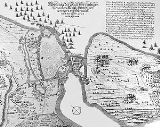
The assault on Copenhagen

Encyclopedia
The assault on Copenhagen
11 February 1659 was a major battle during the Second Northern War
, taking place during the siege of Copenhagen by the Swedish army
.
, the Swedish army under Charles X Gustav of Sweden
, after invading the Danish mainland of Jutland
, swiftly crossed the frozen straits and occupied most of the Danish island of Zealand, with the invasion beginning on February 11, 1658. This forced the Danes to sue for peace. A preliminary treaty, the Treaty of Taastrup
, was signed on February 18, 1658 with the final treaty, the Treaty of Roskilde
, signed on February 26, 1658, granting Sweden major territorial gains.
The Swedish king, however, was not content with his stunning victory, and at the Privy Council
held at Gottorp
on July 7, Charles X Gustav resolved to wipe his inconvenient rival from the map of Europe. Without any warning, in defiance of international treaty, he ordered his troops to attack Denmark-Norway a second time.
The Swedish armies had never left Denmark after the peace and already occupied all of Denmark apart from the capital, Copenhagen. After a failed assault, Copenhagen was put under siege in the hope of breaking the defence by starvation. In November 1658 however a Dutch relief fleet under Lieutenant-Admiral Jacob van Wassenaer Obdam
defeated the Swedish fleet in the Battle of the Sound
and lifted the sea blockade so that supplies and an auxiliary army could reach the capital. The Dutch were an ally of Denmark from the Anglo-Dutch Wars
and were afraid that Swedish control of the Baltic would ruin their profitable trade in this area.
, bombardments and attacks, the Swedes attempted to take the city by a grand assault, as a prolonged siege no longer offered any hope of success, now that the sea lanes had been opened by the Dutch.
The Copenhageners had been forewarned by spies, so they had planned their defences well and stockpiled weapons and ammunition.
The walls of Copenhagen bristled with about 300 pieces of cannon
, mortars
and other artillery
, while a diverse mixture of weapons, ranging from muskets and arquebus
es to morningstar
s, scythe
s, boiling water and tar had been readied for action. Craftsmen, students and other civilians were divided into nine companies, and each of these companies was allocated a part of the wall to defend. The professional soldiers were stationed at the outer field works, the Kastellet
and the Slotsholmen
.
The Swedish army consisted of about 10.000 professional soldiers, while the Danish defenders, a mixture of professionals (among them a mercenary regiment paid by the Dutch), militia
and raw civilians, were of an equal number.
and Slotsholmen at the evening on 9 February. They were repulsed, and the Swedes left one of their assault bridges behind, which the Danes captured and measured. They found that the Swedish assault bridges were 36 feet long, and thus they realised that they could render these bridges useless by making the ice free parts of the moats wider than that.
The moats and the beaches had been kept free of ice, and now the ice free zones were widened to 44 feet with the help from 600 Dutch marines. The ice was thick, and the work was done in heavy snowfall from 4 o'clock in the afternoon till evening on the 10 February.
Spies reported that the Swedish army had moved from their camp, Carlstad
, at Brønshøj
and had taken up positions behind Valby
Hill, and when the Swedes began their assault about midnight the same evening, they met with heavy resistance.
The main assault were made against Christianshavn and Vestervold, but the chopped-up ice and the massed weaponry on the wall made the densely packed attackers pay a horrific toll in lives. Still, they fought their way to the top of the wall, and fierce hand-to-hand fighting broke out.
When the Swedes realised that the assault on the Western part of the wall were in trouble, the choice was made to make a supporting attack at Østerport. The Swedes got very close to Nyboder
and were in the process of crossing the moat, when they fell victim to a well-conducted ambush, and they withdrew with heavy losses.
At about five in the morning the Swedes gave up and retreated. They had taken severe losses. Before the walls 600 bodies were counted, and many more had perished in the ice-cold water, and were never found. On top of that there were many wounded. The Danes had only suffered about thirty dead.
had been taken by a Dutch-Danish force, the Danish Isles were abandoned by the Swedes. Negotiations was opened and The Treaty of Copenhagen
was signed on May 27, 1660, and marked the conclusion of the Second Northern War between Sweden and the alliance of Denmark and the Polish-Lithuanian Commonwealth
. In conjunction with the Treaty of Roskilde, it ended a generation of warfare and established the present-day borders of Denmark, Norway
and Sweden.
Copenhagen
Copenhagen is the capital and largest city of Denmark, with an urban population of 1,199,224 and a metropolitan population of 1,930,260 . With the completion of the transnational Øresund Bridge in 2000, Copenhagen has become the centre of the increasingly integrating Øresund Region...
11 February 1659 was a major battle during the Second Northern War
Second Northern War
The Second Northern War was fought between Sweden and its adversaries the Polish–Lithuanian Commonwealth , Russia , Brandenburg-Prussia , the Habsburg Monarchy and Denmark–Norway...
, taking place during the siege of Copenhagen by the Swedish army
Swedish Army
The Swedish Army is one of the oldest standing armies in the world and a branch of the Swedish Armed Forces; it is in charge of land operations. General Sverker Göranson is the Supreme Commander-in-Chief of the Army.- Organization :...
.
Background
During the Northern WarsNorthern Wars
Northern Wars is a term used for a series of wars fought in northern and northeastern Europe in the 16th and 17th century. An internationally agreed nomenclature for these wars has not yet been devised...
, the Swedish army under Charles X Gustav of Sweden
Charles X Gustav of Sweden
Charles X Gustav also Carl Gustav, was King of Sweden from 1654 until his death. He was the son of John Casimir, Count Palatine of Zweibrücken-Kleeburg and Catherine of Sweden. After his father's death he also succeeded him as Pfalzgraf. He was married to Hedwig Eleonora of Holstein-Gottorp, who...
, after invading the Danish mainland of Jutland
Jutland
Jutland , historically also called Cimbria, is the name of the peninsula that juts out in Northern Europe toward the rest of Scandinavia, forming the mainland part of Denmark. It has the North Sea to its west, Kattegat and Skagerrak to its north, the Baltic Sea to its east, and the Danish–German...
, swiftly crossed the frozen straits and occupied most of the Danish island of Zealand, with the invasion beginning on February 11, 1658. This forced the Danes to sue for peace. A preliminary treaty, the Treaty of Taastrup
Treaty of Taastrup
The Treaty of Taastrup was a preliminary accord signed on 11 February 1658 between Charles X Gustav of Sweden and King Frederick III of Denmark. The treaty was signed at the Høje Taastrup Church. Individuals such as Count Corfitz Ulfeldt participated in the peace negotiations after Denmark lost in...
, was signed on February 18, 1658 with the final treaty, the Treaty of Roskilde
Treaty of Roskilde
The Treaty of Roskilde was concluded on 26 February or 8 March 1658 during the Second Northern War between Frederick III of Denmark–Norway and Charles X Gustav of Sweden in the Danish city of Roskilde...
, signed on February 26, 1658, granting Sweden major territorial gains.
The Swedish king, however, was not content with his stunning victory, and at the Privy Council
Privy Council of Sweden
The High Council of Sweden or Council of the Realm consisted originally of those men of noble, common and clergical background, that the king saw fit for advisory service...
held at Gottorp
Gottorp
Gottorf Castle is a castle and estate in the city of Schleswig, Schleswig-Holstein, Germany. It is the ancestral home of the Holstein-Gottorp branch of the House of Oldenburg...
on July 7, Charles X Gustav resolved to wipe his inconvenient rival from the map of Europe. Without any warning, in defiance of international treaty, he ordered his troops to attack Denmark-Norway a second time.
The Swedish armies had never left Denmark after the peace and already occupied all of Denmark apart from the capital, Copenhagen. After a failed assault, Copenhagen was put under siege in the hope of breaking the defence by starvation. In November 1658 however a Dutch relief fleet under Lieutenant-Admiral Jacob van Wassenaer Obdam
Jacob van Wassenaer Obdam
Jacob, Banner Lord of Wassenaer, Lord Obdam, Hensbroek, Spanbroek, Opmeer, Zuidwijk and Kernhem was a Dutch Lieutenant-Admiral, and supreme commander of the confederate Dutch navy. The name Obdam was then also spelled as Opdam...
defeated the Swedish fleet in the Battle of the Sound
Battle of the Sound
The naval Battle of the Sound took place on 8 November 1658 during the Second Northern War, near the Sound or Oresund, just north of the Danish capital, Copenhagen. Sweden had defeated Denmark and an army under Charles X of Sweden had Copenhagen itself under siege...
and lifted the sea blockade so that supplies and an auxiliary army could reach the capital. The Dutch were an ally of Denmark from the Anglo-Dutch Wars
Anglo-Dutch Wars
The Anglo–Dutch Wars were a series of wars fought between the English and the Dutch in the 17th and 18th centuries for control over the seas and trade routes. The first war took place during the English Interregnum, and was fought between the Commonwealth of England and the Dutch Republic...
and were afraid that Swedish control of the Baltic would ruin their profitable trade in this area.
The opposing forces
After the Copenhageners had withstood about six months of siegeSiege
A siege is a military blockade of a city or fortress with the intent of conquering by attrition or assault. The term derives from sedere, Latin for "to sit". Generally speaking, siege warfare is a form of constant, low intensity conflict characterized by one party holding a strong, static...
, bombardments and attacks, the Swedes attempted to take the city by a grand assault, as a prolonged siege no longer offered any hope of success, now that the sea lanes had been opened by the Dutch.
The Copenhageners had been forewarned by spies, so they had planned their defences well and stockpiled weapons and ammunition.
The walls of Copenhagen bristled with about 300 pieces of cannon
Cannon
A cannon is any piece of artillery that uses gunpowder or other usually explosive-based propellents to launch a projectile. Cannon vary in caliber, range, mobility, rate of fire, angle of fire, and firepower; different forms of cannon combine and balance these attributes in varying degrees,...
, mortars
Mortar (weapon)
A mortar is an indirect fire weapon that fires explosive projectiles known as bombs at low velocities, short ranges, and high-arcing ballistic trajectories. It is typically muzzle-loading and has a barrel length less than 15 times its caliber....
and other artillery
Artillery
Originally applied to any group of infantry primarily armed with projectile weapons, artillery has over time become limited in meaning to refer only to those engines of war that operate by projection of munitions far beyond the range of effect of personal weapons...
, while a diverse mixture of weapons, ranging from muskets and arquebus
Arquebus
The arquebus , or "hook tube", is an early muzzle-loaded firearm used in the 15th to 17th centuries. The word was originally modeled on the German hakenbüchse; this produced haquebute...
es to morningstar
Morning star (weapon)
The term morning star is used to describe medieval club-like weapons which included one or more spikes. Each used, to varying degrees, a combination of blunt-force and puncture attack to kill or wound the enemy.- Design :...
s, scythe
Scythe
A scythe is an agricultural hand tool for mowing grass, or reaping crops. It was largely replaced by horse-drawn and then tractor machinery, but is still used in some areas of Europe and Asia. The Grim Reaper is often depicted carrying or wielding a scythe...
s, boiling water and tar had been readied for action. Craftsmen, students and other civilians were divided into nine companies, and each of these companies was allocated a part of the wall to defend. The professional soldiers were stationed at the outer field works, the Kastellet
Kastellet, Copenhagen
Kastellet, located in Copenhagen, Denmark is one of the best preserved fortifications in Northern Europe. It is constructed in the form of a pentagram with bastions at its corners...
and the Slotsholmen
Slotsholmen
Slotsholmen is an island in the harbour of Copenhagen, Denmark, and part of Copenhagen Inner City. Bishop Absalon constructed the city's first castle on the island in 1166-67 at the site where Christiansborg Palace, the seat of the Danish Parliament lies today...
.
The Swedish army consisted of about 10.000 professional soldiers, while the Danish defenders, a mixture of professionals (among them a mercenary regiment paid by the Dutch), militia
Militia
The term militia is commonly used today to refer to a military force composed of ordinary citizens to provide defense, emergency law enforcement, or paramilitary service, in times of emergency without being paid a regular salary or committed to a fixed term of service. It is a polyseme with...
and raw civilians, were of an equal number.
The assault
The Swedes started the action by making a diversionary attack at ChristianshavnChristianshavn
Christianshavn is an artificial island neighbourhood located in Copenhagen, Denmark. It was founded in the early 17th century by Christian IV as part of his extension of the fortifications of Copenhagen. Originally it was laid out as an independent privileged merchant's town with inspiration from...
and Slotsholmen at the evening on 9 February. They were repulsed, and the Swedes left one of their assault bridges behind, which the Danes captured and measured. They found that the Swedish assault bridges were 36 feet long, and thus they realised that they could render these bridges useless by making the ice free parts of the moats wider than that.
The moats and the beaches had been kept free of ice, and now the ice free zones were widened to 44 feet with the help from 600 Dutch marines. The ice was thick, and the work was done in heavy snowfall from 4 o'clock in the afternoon till evening on the 10 February.
Spies reported that the Swedish army had moved from their camp, Carlstad
Carlstad
Carlstad was a short lived fortified town in Denmark built by the forces of King Charles X Gustav of Sweden during his siege of the Danish capital, Copenhagen, 1658 - 1660 AD. Carlstad's size rivalled the besieged Danish capital, reaching a peak of approx. 30,000 inhabitants. The modern Copenhagen...
, at Brønshøj
Brønshøj
Brønshøj, part of the municipality of Copenhagen, forms, together with Husum, the administrative city district of Brønshøj-Husum. Brønshøj lies on rising ground 4 km west of Copenhagen center and is bordered by the large wetland area of Utterslev Mose to the north. A number of ponds, lakes,...
and had taken up positions behind Valby
Valby
' is one of the 10 official districts of Copenhagen, Denmark. Located in the southwestern corner of Copenhagen Municipality, it is a heterogeneous mixture of different types of housing - including apartment blocks, terraced housing, areas with single-family houses and allotments, as well as remains...
Hill, and when the Swedes began their assault about midnight the same evening, they met with heavy resistance.
The main assault were made against Christianshavn and Vestervold, but the chopped-up ice and the massed weaponry on the wall made the densely packed attackers pay a horrific toll in lives. Still, they fought their way to the top of the wall, and fierce hand-to-hand fighting broke out.
When the Swedes realised that the assault on the Western part of the wall were in trouble, the choice was made to make a supporting attack at Østerport. The Swedes got very close to Nyboder
Nyboder
Nyboder is a historic row house district of former Naval barracks in Copenhagen, Denmark. It was planned and first built by Christian IV to accommodate a need for housing for the personnel of the rapidly growing Royal Danish Navy and their families during that time...
and were in the process of crossing the moat, when they fell victim to a well-conducted ambush, and they withdrew with heavy losses.
At about five in the morning the Swedes gave up and retreated. They had taken severe losses. Before the walls 600 bodies were counted, and many more had perished in the ice-cold water, and were never found. On top of that there were many wounded. The Danes had only suffered about thirty dead.
Aftermath
The Dutch in the spring of 1659 sent a second fleet and army under Vice-Admiral De Ruyter to further reinforce the city and cut the Swedish supply lines so that the siege would have to be lifted altogether. After NyborgNyborg
Nyborg is a city in central Denmark, located in Nyborg Municipality on the island of Funen and with a population of 16,492 . Nyborg is one of the 14 large municipalities created on 1 January 2007...
had been taken by a Dutch-Danish force, the Danish Isles were abandoned by the Swedes. Negotiations was opened and The Treaty of Copenhagen
Treaty of Copenhagen
The Treaty of Copenhagen was signed on 27 May 1660, and marked the conclusion of the Second Northern War between Sweden and the alliance of Denmark-Norway and the Polish-Lithuanian Commonwealth...
was signed on May 27, 1660, and marked the conclusion of the Second Northern War between Sweden and the alliance of Denmark and the Polish-Lithuanian Commonwealth
Polish-Lithuanian Commonwealth
The Polish–Lithuanian Commonwealth was a dualistic state of Poland and Lithuania ruled by a common monarch. It was the largest and one of the most populous countries of 16th- and 17th‑century Europe with some and a multi-ethnic population of 11 million at its peak in the early 17th century...
. In conjunction with the Treaty of Roskilde, it ended a generation of warfare and established the present-day borders of Denmark, Norway
Norway
Norway , officially the Kingdom of Norway, is a Nordic unitary constitutional monarchy whose territory comprises the western portion of the Scandinavian Peninsula, Jan Mayen, and the Arctic archipelago of Svalbard and Bouvet Island. Norway has a total area of and a population of about 4.9 million...
and Sweden.