


The Towans

Encyclopedia
Cornish language
Cornish is a Brythonic Celtic language and a recognised minority language of the United Kingdom. Along with Welsh and Breton, it is directly descended from the ancient British language spoken throughout much of Britain before the English language came to dominate...
and occurs in numerous placenames (Porthtowan
Porthtowan
Porthtowan is a small village in Cornwall, England, in the United Kingdom, and is a popular summer tourist destination which lies within the Cornwall and West Devon Mining Landscape, a World Heritage Site. Porthtowan lies on Cornwall's north Atlantic coast about west of St Agnes, north of...
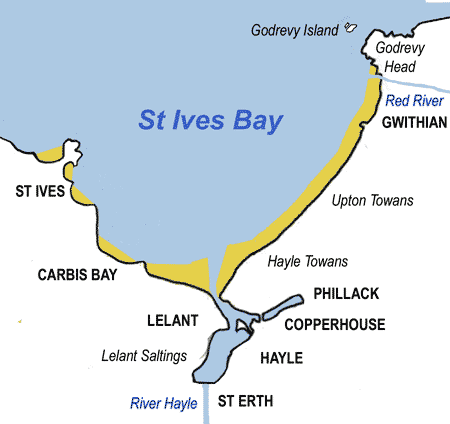
for example). However, The Towans usually refers to the three-mile (5 km) stretch of coastal dunes which extends north east from the estuary of the River Hayle
River Hayle
The River Hayle is a small river in west Cornwall, UK which issues into St Ives Bay at Hayle on Cornwall's Atlantic coast.The River Hayle is approx 12 miles long and it rises south-west of Crowan village. Its course is west for approx 5 miles...
(at 50.19256°N 5.43111°W) to Gwithian
Gwithian
beach2Gwithian is a coastal village in west Cornwall, United Kingdom. It is situated three miles northeast of Hayle and four miles east of St Ives, Cornwall across St Ives Bay....
beach (at 50.22991°N 5.39145°W) with a mid-point near Upton (at 50.21053°N 5.40768°W).
Although 'The Towans' refers to the whole stretch, individual areas of the dunes have their own identities. Those named by Ordnance Survey
Ordnance Survey
Ordnance Survey , an executive agency and non-ministerial government department of the Government of the United Kingdom, is the national mapping agency for Great Britain, producing maps of Great Britain , and one of the world's largest producers of maps.The name reflects its creation together with...
on its mapping are (from southwest to northeast) Hayle Towans, Riviere Towans, Mexico Towans, Common Towans, Phillack Towans, Upton Towans and Gwithian Towans.
The Towans are bounded to the southeast by Phillack
Phillack
Phillack is a village in west Cornwall, United Kingdom. It is situated approximately one mile northeast of Hayle and half-a-mile inland from St Ives Bay on Cornwall's Atlantic coast...
village and the B3301 Hayle
Hayle
Hayle is a small town, civil parish and cargo port in west Cornwall, United Kingdom. It is situated at the mouth of the Hayle River and is approximately seven miles northeast of Penzance...
to Portreath
Portreath
Portreath is a civil parish, village and fishing port on the north coast of Cornwall, United Kingdom. The village is situated approximately three miles northwest of Redruth....
road; to the northwest, the dunes face St Ives Bay
St Ives Bay
St Ives Bay is a bay on the Atlantic coast of north-west Cornwall in the United Kingdom. It is in the form of a shallow crescent, some 4 miles or 6 km across, between St Ives in the west and Godrevy Head in the east....
across an intertidal beach. Substantial areas of The Towans rise more than 50 metres (164 ft) above sea level, the highest point being 72 metres (236.2 ft) at Phillack Towans.
The southern half of The Towans is in Hayle civil parish
Civil parish
In England, a civil parish is a territorial designation and, where they are found, the lowest tier of local government below districts and counties...
and the northern half in Gwinear-Gwithian
Gwinear-Gwithian
Gwinear–Gwithian is a coastal civil parish in west Cornwall, United Kingdom. It includes the villages of Connor Downs, Gwinear, Gwithian, Reawla and Rosewarne...
civil parish. The southern half was in Phillack parish until 1935 when Hayle parish absorbed Phillack.
The Towans habitat of sand dune and grassland is suited to a variety of wildlife and plants including the pyramidal orchid
Pyramidal orchid
The Pyramidal Orchid, Anacamptis pyramidalis, is an herbaceous perennial plant belonging to the Genus Anacamptis of the family Orchidaceae...
, the glow worm, the silver-studded blue butterfly
Lycaenidae
The Lycaenidae are the second-largest family of butterflies, with about 6000 species worldwide, whose members are also called gossamer-winged butterflies...
, and the skylark
Skylark
The Skylark is a small passerine bird species. This lark breeds across most of Europe and Asia and in the mountains of north Africa. It is mainly resident in the west of its range, but eastern populations are more migratory, moving further south in winter. Even in the milder west of its range,...
. Much of the area is a Site of Special Scientific Interest
Site of Special Scientific Interest
A Site of Special Scientific Interest is a conservation designation denoting a protected area in the United Kingdom. SSSIs are the basic building block of site-based nature conservation legislation and most other legal nature/geological conservation designations in Great Britain are based upon...
.
Electricity transmission lines
In 1910, a coal-fired power stationFossil fuel power plant
A fossil-fuel power station is a power station that burns fossil fuels such as coal, natural gas or petroleum to produce electricity. Central station fossil-fuel power plants are designed on a large scale for continuous operation...
was built on the northern flank of Hayle Towans beside the mouth of the River Hayle. The station was in use from 1910 until it closed in 1973. The buildings were demolished soon after closure but the station's legacy can still be seen in the overhead transmission lines
Electric power transmission
Electric-power transmission is the bulk transfer of electrical energy, from generating power plants to Electrical substations located near demand centers...
which cross the dunes, particularly at the southern section of The Towans (see photo).
For more detailed information, see Hayle Power Station
Hayle Power Station
Hayle Power Station was a coal-fired power station situated at the mouth of the River Hayle, at Hayle in Cornwall, South West England.-History:...
.
National Explosives Works
Upton Towans was the site of an explosivesExplosive material
An explosive material, also called an explosive, is a reactive substance that contains a great amount of potential energy that can produce an explosion if released suddenly, usually accompanied by the production of light, heat, sound, and pressure...
factory and is occasionally referred to as Dynamite Towans. The National Explosives Works was established in 1888 to supply the needs of local mines. The company also manufactured explosives for the Royal Navy
Royal Navy
The Royal Navy is the naval warfare service branch of the British Armed Forces. Founded in the 16th century, it is the oldest service branch and is known as the Senior Service...
during World War I
World War I
World War I , which was predominantly called the World War or the Great War from its occurrence until 1939, and the First World War or World War I thereafter, was a major war centred in Europe that began on 28 July 1914 and lasted until 11 November 1918...
.
Manufacturing of explosives at Upton ended in 1919, but the site was used to store explosives until the 1960s. The earthworks on the site are overgrown with vegetation but are still clearly visible.