


The Quarrymen

Encyclopedia
The Quarrymen are a British skiffle
and rock and roll
group, initially formed in Liverpool
in 1956, that eventually evolved into The Beatles
in 1960. Originally consisting of John Lennon
and several schoolfriends, The Quarrymen took their name from a line in the school song of Quarry Bank High School
which Lennon and most of the other original group members attended. Lennon's mother, Julia Lennon
, taught her son to play the banjo
and then showed Lennon and Eric Griffiths
how to tune their guitars in a similar way to the banjo, and taught them simple chords and songs.
Lennon started a skiffle group that was very briefly called the Blackjacks, but changed the name before any public performances. Some accounts credit Lennon with choosing the new name. Other accounts credit his close friend Pete Shotton
with suggesting the name. The Quarrymen played at parties, school dances, cinemas and amateur skiffle contests before Paul McCartney
joined the band in October 1957. George Harrison
joined the band in early 1958 at McCartney's recommendation, though Lennon initially resisted because he felt Harrison (still only 14 when he was first introduced to Lennon) to be too young.
The group made an amateur recording of themselves in 1958, performing Buddy Holly
's "That'll Be the Day
" and "In Spite of All the Danger
" – a song written by McCartney and Harrison. In early 1960, the group started exploring various alternative names. After Lennon recruited his art school pal Stuart Sutcliffe
to the group, they tried the name the Silver Beetles and other variations, before finally settling on The Beatles
in August 1960 when they first performed in Hamburg. In 1997 the five surviving original members of the group (all except the deceased Lennon) reunited to perform at the 40th anniversary celebrations of the garden fete performance at which Lennon and McCartney met for the first time. The band decided to continue playing, and since 1998 have performed in many countries throughout the world. Griffiths died in 2005, and Shotton retired due to ill-health. As of 2011, three founding members are still actively performing as The Quarrymen.
musicians, with the most successful British proponent of the genre in the 1950s being Lonnie Donegan
. The Quarrymen's initial repertoire included several songs that Donegan had recorded. When Lennon wanted to try making music himself, he and fellow Quarry Bank school friend, Griffiths, took guitar lessons in Hunt's Cross, Liverpool, although Lennon gave up the lessons soon after, as they were based on theory and not actual playing.
As Griffiths already knew how to play the banjo, Lennon's mother showed them how to tune the top four strings of their guitars to the same notes as a banjo, taught them the chords of D, C, and D7
, and the Fats Domino
song, "Ain't That a Shame
". They practised at Lennon's aunt's house (called Mendips) at 251 Menlove Avenue
where Lennon lived, or at Griffiths' house in Halewood Drive. They learned how to play "Rock Island Line
", "Jump Down Turn Around (Pick a Bale of Cotton)", "Alabamy Bound
" and "Cumberland Gap
", and later learned how to play "That's All Right" and "Mean Woman Blues
".
Lennon started his own skiffle band (very briefly called The Blackjacks) with Griffiths in the summer of 1956, and recruited his best friend, Shotton, even though he could not play an instrument. Shotton elected to play the washboard, as it simply required percussive strumming and no lessons, so his mother supplied a washboard she found in the shed
, and two thimble
s from her sewing box. A week later Shotton asked Bill Smith, another school friend, to play a home-made "tea-Chest" bass, and Griffiths invited another school friend, Rod Davis (who had just purchased a banjo), to join the group.
After a few days the Blackjacks name was abandoned. Both Lennon and Shotton have been credited with coining the name Quarrymen after a line in their school's song: "Quarrymen, old before our birth. Straining each muscle and sinew". The choice of name was tongue-in-cheek as Lennon regarded the reference in the school song to "straining each muscle and sinew" as risible.
 The group first rehearsed in Shotton's house on Vale Road, but because of the noise his mother told them to use the corrugated
air-raid shelter in the back garden. Bill Smith performed at only two shows and rarely turned up for rehearsals, so Lennon decided that he should be replaced by his friend Len Garry. At the time of this decision, Smith had the group's tea-chest bass, so Lennon and Shotton decided to break into Smith's parents' garage and "liberate" the instrument. Another Lennon friend, Ivan Vaughan
, occasionally played at rehearsals when Garry was not available. Colin Hanton was an apprentice at Guy Rogers' upholstery
company in Speke
, and travelled to work on the same bus as Griffiths used to get to school. Hanton mentioned that he had a set of drums, but said that he was only an amateur. Griffiths went to Hanton's house to watch him play. Griffiths invited Hanton to join The Quarrymen, as having a drummer was a clear advantage for a group in Liverpool at the time, because they could then play rock 'n' roll songs as well as skiffle tunes.
Rehearsals were moved from the cold air-raid shelter to Hanton's or Griffiths' house—as Griffiths' father had died in WWII, and his mother worked all day. The band also often visited Lennon's mother at 1 Blomfield Road, listening to her collection of rock 'n' roll records by Elvis, Shirly and Lee
's "Let the Good Times Roll", and Gene Vincent
's "Be-Bop-A-Lula
" which they added to their repertoire. Another school friend, Nigel Walley, occasionally lent a hand playing tea-chest bass, but lost his instrument when he left it at a bus stop, so decided to become their manager. Although he did not secure the group many paid engagements, he sent flyers to local theatres and ballrooms, and put up posters designed by Lennon: "Country-and-western, rock n' roll, skiffle band — The Quarrymen — Open for Engagements — Please Call Nigel Walley, Tel.Gateacre 1715".
Walley did manage to secure two intermission
concerts at the Gaumont cinema (near Penny Lane
) on Saturday afternoons, and The Quarrymen performed at parties and skiffle contests in the Liverpool area.
Canadian impresario Carroll Levis
organised a skiffle contest, at which he instructed all eight acts to play for just three minutes each. The Quarrymen played "Worried Man Blues
", and were loudly applauded, but a group from Wales called the Sunnyside Skiffle Group "jumped all over the stage" and outshone the static Quarrymen, and were asked by Levis to fill in the last few minutes of the contest with a second song. Lennon argued heatedly with Levis backstage, saying the Sunnyside Skiffle Group had brought a bus full of supporters with them, and were given "the upper hand" advantage by Levis. After the competition, Levis used a clap-o-meter
(a machine to measure the decibels of the audience's reaction to the groups) as they were asked to walk back out onto the stage. The Quarrymen and the Sunnyside skiffle Group both tied by reaching ninety on the meter, but after a second test, The Quarrymen lost by a small margin.
-1458_lg.jpg) Whilst playing golf with Dr. Joseph Sytner, Walley—who had left school at 15 to become an apprentice golf professional at the Lee Park Golf Club—asked Dr. Sytner if his son, Alan, could book The Quarrymen at The Cavern, in Mathew Street
Whilst playing golf with Dr. Joseph Sytner, Walley—who had left school at 15 to become an apprentice golf professional at the Lee Park Golf Club—asked Dr. Sytner if his son, Alan, could book The Quarrymen at The Cavern, in Mathew Street
, which was one of three jazz clubs he managed. Sytner suggested that the band should play at the golf club first, so as to assess their talent. The band set up in the downstairs lounge of the golf club, and were surprised when nearly one hundred people filed in to listen. Just before the performance, the zip
on Davis' jeans broke, and he had to cover his crotch with his banjo. The performance was a success, a hat was later passed and almost £15 was collected, which was much more than any other groups were paid.
Alan Sytner phoned Walley a week later and offered the group an interlude spot playing skiffle between the performances of two jazz bands at the Cavern. Before the Cavern performance, The Quarrymen played (gratis) for St. Peter's Youth Club, in St. Barnabas Church hall, and were the main act at a Quarry Bank school dance. During this time Lennon heard Little Richard
singing "Long Tall Sally
" for the first time at classmate Michael Hill's house near Penny Lane, and thought Richard a better singer than Elvis. The group learned how to play numerous Elvis songs such as, "Don't Be Cruel
, "All Shook Up
", and "Heartbreak Hotel
", as well as songs by Eddie Cochran
, and Jerry Lee Lewis
.
Before the Cavern Club performance, the group argued amongst themselves about the set list, as rock 'n' roll songs were definitely not allowed at the club, but skiffle was tolerated as it was considered to be an off-shoot of jazz. After beginning with a skiffle song, Lennon called for the others to start playing "Don't Be Cruel
". Davis warned Lennon that the audience would "eat you alive", but Lennon ignored this and started playing the song himself, forcing the others to join in. Halfway through, Sytner pushed his way through the audience and handed Lennon a note which read, "Cut out the bloody rock 'n' roll".
After playing at an outdoor birthday party at Hanton's aunt's house, Shotton decided to leave the band, saying "I hate this, John--it's not for me". Lennon promptly picked up the washboard and smashed it over Shotton's head, leaving only the wooden frame hanging on Shotton's shoulders, and then said, "Well, that solves that then, doesn't it?" At Lennon's pleading, Shotton agreed to play a few more engagements (with his repaired washboard) before finally leaving. On Saturday 22 June 1957, The Quarrymen played a major performance;— two sets on a stationary flatbed truck
at an outdoor party in Rosebery Street, Liverpool, to celebrate the 750th anniversary of the granting of Liverpool’s charter by King John
.
. They first played on the back of a moving flatbed lorry, in a procession of floats
that carried the Rose Queen and retiring Rose Queen, Morris dancers, Boy Scout
s, Brownies, Girl Guides and Cubs, led by the Band of the Cheshire Yeomanry. At 4:15 they played on a permanent stage in the field behind the church, before a display by the City of Liverpool Police Dogs. They were playing "Come Go with Me
" when Paul McCartney arrived, and in the Scout hut after the set, Ivan Vaughan introduced McCartney to Lennon, who chatted for a few minutes before the band set up in the church hall for their performance at that evening's "Grand Dance". McCartney demonstrated how he tuned his guitar then sang Eddie Cochran's "Twenty Flight Rock
", Gene Vincent's "Be-Bop-A-Lula
", and a medley of Little Richard songs.
Vaughan and McCartney left before the evening show which started at 8 o'clock. During the performance there was an unexpected thunderstorm, which made the lights go out. Bob Molyneux, a young schoolmate from Quarry Bank, recorded part of the performance on his Grundig
TK8 portable reel-to-reel tape recorder
. The tape included versions of Lonnie Donnegan's "Puttin' on the Style" and Elvis' "Baby Let's Play House
". In 1963, Molyneux offered the tape to Lennon via Ringo Starr, but Lennon never responded, so Molyneux put the tape in a vault.
As they were walking home after the evening performance, Lennon and Shotton discussed the afternoon encounter with McCartney, and Lennon said that perhaps they should invite McCartney to join the band. Two weeks later Shotton encountered McCartney cycling through Woolton, and conveyed Lennon's casual invitation for him to join The Quarrymen, and Vaughan also invited McCartney to join. McCartney said he would join after Scout camp in Hathersage
, and a holiday with his family at Butlins
holiday camp in Filey
, Yorkshire. When McCartney returned from holiday he began rehearsing with The Quarrymen, playing songs such as, "Bye Bye Love" (The Everly Brothers) and "All Shook Up
", that Lennon and the group had been trying to learn, without success. During the summer, Davis was on holiday in Annecy
, France, and when he returned he discovered that McCartney had joined the group. With McCartney joining, rock 'n' roll songs were replacing much of the skiffle material in the group's repertoire. Davis felt that the banjo was ill-suited to the group's new direction and he withdrew from the group without rancour. In 1960, while studying at Cambridge University, Davis recorded the song "Running Shoes" with the Trad Grads, for Decca Records
(Decca, 45-F 11403) which he later mentioned to an envious Lennon.
McCartney made his debut with the band on Friday, 18 October 1957 at a Conservative Club
social held at the New Clubmoor Hall in the Norris Green
section of Liverpool. Lennon and McCartney wore cream-coloured sports jackets, which were paid for by the whole group—Walley collected half a crown per week from each member until they were paid for—and the others wore white shirts with tassels and black bootlace ties. To the irritation of the other group members, McCartney endlessly practised the lead guitar intro to "Raunchy
" (by saxophonist Bill Justis) and a solo from "Guitar Boogie Shuffle", for days before the engagement, but on the night (after being specially introduced by Lennon as a new member of the group) he missed his cue on "Raunchy", played all the wrong notes, and stepped back in embarrassment between Hanton and Garry. Everyone expected Lennon to say something sarcastic, but the sight of the always over-confident McCartney looking so crestfallen made Lennon laugh out loud so much that he "almost pissed himself". On Thursday, 7 November, Charlie McBain booked The Quarrymen to appear at the Wilson Hall Garston, Merseyside
. During 1957, McCartney played his first self-composed song, "I've Lost My Little Girl" to Lennon (written in 1956, after the death of McCartney's mother), who was shocked and impressed, according to Shotton's account.
's Morgue Skiffle Club, playing "Guitar Boogie Shuffle" (by Bert Weedon
) in March 1958. Lennon thought Harrison (at 14) was too young to join the band, so McCartney engineered another meeting on the upper deck of a Liverpool bus, where Harrison played "Raunchy" for Lennon. After McCartney's constant advocacy Lennon allowed the recently turned fifteen-year-old Harrison to join The Quarrymen as lead guitarist. The group then rehearsed at McCartney's house, but Griffiths was not told. When he coincidentally telephoned the McCartney house, Lennon, Harrison and McCartney sat in the back room, forcing Hanton to explain the situation. Griffiths left The Quarrymen soon after.
In March, Garry contracted tubercular meningitis
, and spent seven months in Fazakerley
hospital, and never played with the group again. The Quarrymen learned many of The Everly Brothers
songs, such as, "Cathy's Clown
, "All I Have to Do Is Dream
", "Wake Up Little Susie
", and even B-sides
of the records, which helped to refine Lennon and McCartney's own harmony singing.
Griffiths joined the Merchant Marine after leaving the group—visiting ports in South America and Canada—and upon his return to Liverpool he would either sell or swap records by Buddy Holly or Chuck Berry
with Lennon or McCartney. According to McCartney it was Holly who inspired Lennon and himself to write more songs, as Holly wrote his own instead of relying on a team of songwriters. Two of the songs Lennon and McCartney wrote at that time were later recorded: "One After 909
" (by The Beatles themselves and included on the Let It Be album) and "Like Dreamers Do
", which was a hit for The Applejacks in 1964. Lennon's first self-composed song "Hello Little Girl
" was also written in this period. John Duff Lowe (a schoolmate of McCartney's) played piano with the group occasionally in the summer of 1958, on the occasions when a piano was available at a venue.
at 38 Kensington, Liverpool, between the kitchen and a front room that served as an electrical goods shop . Actors from the Liverpool Playhouse often stayed in the room above the studio, and were asked by Phillips to record monologues and poems. Phillips had just turned 60 years old when Harrison heard about the studio from Storm's guitarist, Johnny Byrne, who had recorded a version of "Butterfly
" there on 22 June 1957.
The Quarrymen booked the studio on 12 July 1958, but when Lennon, McCartney, Harrison, Hanton and Lowe arrived they were surprised to see how small and technically basic it was, with one solitary microphone in the centre of the room. Phillips demanded that they pay for the recording before they set up the equipment, so each member paid 3 shillings and 6 pence, but Phillips then asked for a surcharge to cover the cost of transferring the tape recording to disc. As this was too expensive, Phillips said that for a cut-rate price they would not be taped first, but record directly to vinyl.
The group had decided to record "That'll Be the Day" as one of their two songs, but had not decided on the song for the other side of the disc. After recording "That'll Be the Day" (Lennon suggested that Hanton put a scarf over the snare drum to lower the volume) Phillips wanted them to immediately record the next song. They asked for some time to rehearse, but Phillips refused, saying, "For seventeen and six you're not here all day". McCartney suggested "In Spite of All the Danger" (a very early composition by McCartney with some assistance from Harrison) even though Lowe and Hanton had never heard it before. Lowe and Hanton busked through the song, and Phillips then handed the group a fragile 78rpm record, which was passed around the band for one week each, or lent out to friends. It was later lost until Lowe rediscovered it in 1981, and sold it to McCartney for an undisclosed amount. The recordings were released on Anthology 1
in 1995.
After two further performances (on 1 January, at a Speke Bus Depot social club party at Wilson Hall organised by Harrison’s father, and on 24 January, at a party at Woolton Village Club) they played at the Pavilion Theatre in Lodge Lane, where the management was looking for a regular group to play 30-minute sets between the bingo sessions. The first set at the Pavilion Theatre went well, but in the interval Lennon, McCartney and Hanton drank beer supplied by the management, and then moved onto "Poor Man's Black Velvets": a mix of two half-pints of Guinness
and cider
together. As Lennon, McCartney and Hanton were obviously drunk the second set was a shambles, and on the bus ride home a drunken McCartney fiercely criticised Hanton for not being good enough. Shotton (who had been at the theatre to watch) stepped between them to stop Hanton physically attacking McCartney, and helped Hanton off the bus with his drums. Hanton was never contacted again; only hearing something on TV three years later, when they were called The Beatles.
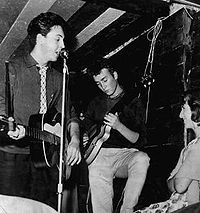 Lennon and McCartney continued to write songs together, but as no engagements were forthcoming, Harrison asked to join Storm's Tornados, but Storm's mother refused, saying Harrison was far too young. Harrison then joined the Les Stewart Quartet with Les Stewart, guitarist Ken Brown, and Geoff Skinner. Mona Best
opened The Casbah Coffee Club
on 29 August 1959, and Brown arranged for the quartet to be its resident band. When Brown missed rehearsals to help decorate the Casbah, Stewart refused to play. Brown and Harrison recruited Lennon and McCartney at short notice to help them fill the residency, and they reactivated The Quarrymen name for the occasion. They played a series of seven Saturday night engagements in the Casbah for 15 shillings each per night, starting on 29 August to October 1959, featuring Lennon, McCartney, Harrison and Brown as the "honorary Quarryman". They performed without a drummer, and with only one microphone
connected to the club's small PA
system. The opening night performance was attended by about 300 local teenagers, but as the cellar had no air-conditioning and people were dancing, the temperature rose until it became hard to breathe.
After the success of the first night, Mona gave The Quarrymen a residency, but as there was no amplification, Lennon persuaded Mona to hire a young amateur guitar player called Harry to play a short set before The Quarrymen, but this was only so they could use his 40-watt amplifier
. On 10 October, there was an argument between the band and Best over the group's fee for performing in the Casbah that night. Brown had showed up at the house, but was too ill to perform, so Best told him to rest upstairs in the Best's living room. She later insisted that Brown deserved to be paid for showing up, but, led by McCartney, the rest of the group insisted on being paid his share of the group's fee. After an argument The Quarrymen walked out of the Casbah and ended their residency.
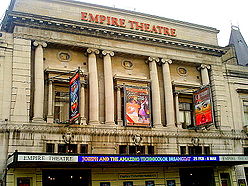 As the first prize was a TV appearance on Carrol Levis' Discoveries TV show, the group entered the Star Search competition as Johnny and the Moondogs, with only Lennon, McCartney, and Harrison. The first heat was held at the Liverpool Empire Theatre
on 18 October 1959, and after they passed the audition they were asked to play at the Manchester Hippodrome for the local finals, on Sunday 15 November 1959. This date has been disputed as being Monday 24 November 1958, as UK theatres were closed on Sundays in those days. According to Ray Ennis of the Swinging Bluegenes (later called The Swinging Blue Jeans
) the registration process in Manchester took all day, as there was a queue of musicians carrying amplifiers and instruments that stretched all the way around the building. Lennon (without a guitar), McCartney, and Harrison played Buddy Holly's "Think It Over", but the last train or bus left for Liverpool at 9:47, and at 9:20 there were still 12 acts to perform. As the trio only had £1 between them, it was impossible to stay any longer. As they were leaving, Lennon saw a cutaway electric guitar by the stage door, picked it up and walked off with it, later saying that the trip "wasn't a total loss."
During the school holidays of 1960, Lennon and McCartney performed together twice as the Nerk Twins, after hitchhiking to the Fox and Hounds pub in Caversham
, Reading
, which was managed by Mike Robbins and his wife Elizabeth (McCartney's cousin). Robbins had previously been in a group called the Jones Boys, and told stories to Lennon and McCartney about show business. Lennon and McCartney worked in the bar for the whole week for £5 each, performing on Saturday 23 April 1960, and again on Sunday, before returning to Liverpool.
, Stuart Sutcliffe
and Rod Murray, saw the poet Royston Ellis
at Liverpool University, and later met in a Liverpool pub, Ye Cracke
. Being disappointed with Ellis' performance, Harry proposed the idea that they should call the assembled quartet of friends the Dissenters, and make Liverpool famous: Lennon with his music, Sutcliffe and Murray with their paintings and Harry with his writing, but after talking to Sutcliffe one night at the Casbah Coffee Club, Lennon and McCartney persuaded Sutcliffe to buy a Höfner
500/5 bass—known in Europe as a President bass—with the money he had won in the John Moore art exhibition. By May 1960, Lennon, McCartney and Harrison were joined by Sutcliffe, who according to some sources suggested changing their name to the Beatals/Beetles. As the group always had to rely on the P.A. system
in the places they played, they realised they had to buy their own. Harry often heard Lennon, McCartney and Harrison rehearsing or playing in the Art College canteen in the basement, but after Sutcliffe joined The Quarrymen, Harry complained that Sutcliffe should be concentrating on art and not music, as he thought he was a competent, but not brilliant bassist.
As Harry and Sutcliffe were members of the Liverpool College of Art's Student Union committee, they put forward the idea that the college should buy its own P.A. system for college dances, which The Quarrymen often played at, although the equipment would later be appropriated by the group, and taken to Hamburg. As late as 7 March 1962, the Student’s Union sent Pete Mackey to ask Lennon to return the equipment, or pay for it, but Lennon told him it had been sold in Hamburg. The Beatles' manager, Brian Epstein
, contacted Fred O’ Brien from the Student’s Union and offered him the chance of a Liverpool Art College dance concert (featuring The Beatles for the minimal sum of £5 as recompense), but was turned down. Sutcliffe was later turned down when he returned from Hamburg to request he study for the ATD (Art Teachers Diploma) course at the college.
Brian Cass, of Cass and the Casanovas, heard the group rehearsing one night in the Jacaranda
club (managed by Allan Williams
) and promised Lennon that if they changed their name to Long John and the Silver Beetles (after Buddy Holly and The Crickets
) he would help them find a drummer. Lennon did not like the name, as he thought it made him sound like the fictional pirate Long John Silver
, but agreed to change the name to The Silver Beetles. In May 1960, they played a tour of Scotland under that name with Liverpool singer Johnny Gentle
. They finally changed the name of the group to The Beatles for their performances in Hamburg
.
and Colin Hanton
performed. Following this, the group continued to perform - undertaking tours of the UK, USA, Germany, Japan, Russia, Cuba and other countries. The group's repertoire focuses on the skiffle and early rock 'n' roll they played in their original incarnation with the added roots rock
historical perspective of illustrating how American roots music inspired the nascent Beatles.
In 2000, producer and The Beatles' historian Martin Lewis produced the group performing the Del-Vikings song Come Go with Me
(the first song McCartney recalled hearing Lennon sing on the first day they met) - for use on the soundtrack of the Michael Lindsay-Hogg
film Two Of Us - a film about the last day that Lennon and McCartney saw each other - in April 1976.
Eric Griffiths died in 2005, and Pete Shotton retired, owing to ill-health. As of 2010, the surviving three founder-members continue to perform around the world. They are occasionally augmented by honorary member Duff Lowe who played piano with the group briefly in the summer of 1958. In September and October 2010 the band undertook a US tour celebrating the 70th anniversary of their founder (Lennon). They appeared in a charity concert for Amnesty International honouring Lennon in New York City on Lennon's birthday, Saturday 9 October 2010.
Honorary members
Skiffle
Skiffle is a type of popular music with jazz, blues, folk, roots and country influences, usually using homemade or improvised instruments. Originating as a term in the United States in the first half of the twentieth century, it became popular again in the UK in the 1950s, where it was mainly...
and rock and roll
Rock and roll
Rock and roll is a genre of popular music that originated and evolved in the United States during the late 1940s and early 1950s, primarily from a combination of African American blues, country, jazz, and gospel music...
group, initially formed in Liverpool
Liverpool
Liverpool is a city and metropolitan borough of Merseyside, England, along the eastern side of the Mersey Estuary. It was founded as a borough in 1207 and was granted city status in 1880...
in 1956, that eventually evolved into The Beatles
The Beatles
The Beatles were an English rock band, active throughout the 1960s and one of the most commercially successful and critically acclaimed acts in the history of popular music. Formed in Liverpool, by 1962 the group consisted of John Lennon , Paul McCartney , George Harrison and Ringo Starr...
in 1960. Originally consisting of John Lennon
John Lennon
John Winston Lennon, MBE was an English musician and singer-songwriter who rose to worldwide fame as one of the founding members of The Beatles, one of the most commercially successful and critically acclaimed acts in the history of popular music...
and several schoolfriends, The Quarrymen took their name from a line in the school song of Quarry Bank High School
Calderstones School
Calderstones School is an English comprehensive school and specialist science college, located opposite Calderstones Park on Harthill Road in the Liverpool suburb of Allerton.The school's post code is L18 3HS...
which Lennon and most of the other original group members attended. Lennon's mother, Julia Lennon
Julia Lennon
Julia Lennon was the mother of English musician John Lennon, who was born during her marriage to Alfred Lennon. After complaints to Liverpool's Social Services by her eldest sister, Mimi Smith , she handed over the care of her son to her sister...
, taught her son to play the banjo
Banjo
In the 1830s Sweeney became the first white man to play the banjo on stage. His version of the instrument replaced the gourd with a drum-like sound box and included four full-length strings alongside a short fifth-string. There is no proof, however, that Sweeney invented either innovation. This new...
and then showed Lennon and Eric Griffiths
Eric Griffiths
Eric Ronald Griffiths was the guitarist in the original lineup of The Quarrymen until he left the group in the summer of 1958....
how to tune their guitars in a similar way to the banjo, and taught them simple chords and songs.
Lennon started a skiffle group that was very briefly called the Blackjacks, but changed the name before any public performances. Some accounts credit Lennon with choosing the new name. Other accounts credit his close friend Pete Shotton
Peter Shotton
Peter Shotton , commonly referred to as Pete Shotton, is an English businessman, best known for his long friendship with John Lennon of The Beatles. He was a close childhood friend of Lennon's, and attended Dovedale Infants School and Quarry Bank Grammar School at the same time as the future Beatle...
with suggesting the name. The Quarrymen played at parties, school dances, cinemas and amateur skiffle contests before Paul McCartney
Paul McCartney
Sir James Paul McCartney, MBE, Hon RAM, FRCM is an English musician, singer-songwriter and composer. Formerly of The Beatles and Wings , McCartney is listed in Guinness World Records as the "most successful musician and composer in popular music history", with 60 gold discs and sales of 100...
joined the band in October 1957. George Harrison
George Harrison
George Harrison, MBE was an English musician, guitarist, singer-songwriter, actor and film producer who achieved international fame as lead guitarist of The Beatles. Often referred to as "the quiet Beatle", Harrison became over time an admirer of Indian mysticism, and introduced it to the other...
joined the band in early 1958 at McCartney's recommendation, though Lennon initially resisted because he felt Harrison (still only 14 when he was first introduced to Lennon) to be too young.
The group made an amateur recording of themselves in 1958, performing Buddy Holly
Buddy Holly
Charles Hardin Holley , known professionally as Buddy Holly, was an American singer-songwriter and a pioneer of rock and roll...
's "That'll Be the Day
That'll Be the Day
"That'll Be the Day" is a song written by Buddy Holly and Jerry Allison and recorded by various artists including The Crickets and Linda Ronstadt. It was also the first song to be recorded by The Quarrymen, the skiffle group that subsequently became The Beatles...
" and "In Spite of All the Danger
In Spite of All the Danger
"In Spite of All the Danger" is one of the first songs recorded by The Quarrymen, then composed of John Lennon, Paul McCartney, George Harrison, pianist John Lowe and drummer Colin Hanton....
" – a song written by McCartney and Harrison. In early 1960, the group started exploring various alternative names. After Lennon recruited his art school pal Stuart Sutcliffe
Stuart Sutcliffe
Stuart Fergusson Victor Sutcliffe was a Scottish artist and musician, best known as the original bass player of The Beatles. Sutcliffe left the band to pursue a career as an artist, having previously attended the Liverpool College of Art...
to the group, they tried the name the Silver Beetles and other variations, before finally settling on The Beatles
The Beatles
The Beatles were an English rock band, active throughout the 1960s and one of the most commercially successful and critically acclaimed acts in the history of popular music. Formed in Liverpool, by 1962 the group consisted of John Lennon , Paul McCartney , George Harrison and Ringo Starr...
in August 1960 when they first performed in Hamburg. In 1997 the five surviving original members of the group (all except the deceased Lennon) reunited to perform at the 40th anniversary celebrations of the garden fete performance at which Lennon and McCartney met for the first time. The band decided to continue playing, and since 1998 have performed in many countries throughout the world. Griffiths died in 2005, and Shotton retired due to ill-health. As of 2011, three founding members are still actively performing as The Quarrymen.
Early years
In the mid-1950s, there was a revival in the UK of the musical form "skiffle" that had originated in the USA and had been popular in the US in the 1920s, '30s and '40s. In addition to its popularity among British teenagers as music to listen to, it also spawned a craze of teenage boys starting their own groups to perform the music. One of the primary attractions was that it did not require great musical skills or expensive instruments to be played. Early British skiffle was played by traditional jazzTrad jazz
Trad jazz - short for "traditional jazz" - refers to the Dixieland and Ragtime jazz styles of the early 20th century in contrast to any more modern style....
musicians, with the most successful British proponent of the genre in the 1950s being Lonnie Donegan
Lonnie Donegan
Anthony James "Lonnie" Donegan MBE was a skiffle musician, with more than 20 UK Top 30 hits to his name. He is known as the "King of Skiffle" and is often cited as a large influence on the generation of British musicians who became famous in the 1960s...
. The Quarrymen's initial repertoire included several songs that Donegan had recorded. When Lennon wanted to try making music himself, he and fellow Quarry Bank school friend, Griffiths, took guitar lessons in Hunt's Cross, Liverpool, although Lennon gave up the lessons soon after, as they were based on theory and not actual playing.
As Griffiths already knew how to play the banjo, Lennon's mother showed them how to tune the top four strings of their guitars to the same notes as a banjo, taught them the chords of D, C, and D7
Chord (music)
A chord in music is any harmonic set of two–three or more notes that is heard as if sounding simultaneously. These need not actually be played together: arpeggios and broken chords may for many practical and theoretical purposes be understood as chords...
, and the Fats Domino
Fats Domino
Antoine Dominique "Fats" Domino, Jr. is an American R&B and rock and roll pianist and singer-songwriter. He was born and raised in New Orleans, Louisiana, and Creole was his first language....
song, "Ain't That a Shame
Ain't That a Shame
"Ain't That a Shame" is a song recorded by Fats Domino and Dave Bartholomew, in New Orleans, Louisiana, for Imperial Records and released in 1955. It was previously recorded in 1901 by Silas Leachman. The recording was a hit for Domino, eventually selling a million copies. It reached #1 on the...
". They practised at Lennon's aunt's house (called Mendips) at 251 Menlove Avenue
251 Menlove Avenue
251 Menlove Avenue, named "Mendips", was the childhood home of John Lennon, singer and songwriter with the Beatles, and is now preserved by the National Trust....
where Lennon lived, or at Griffiths' house in Halewood Drive. They learned how to play "Rock Island Line
Rock Island Line (song)
"Rock Island Line" is an American blues/folk song first recorded by John Lomax in 1934 as sung by inmates in an Arkansas State Prison, and later popularized by Lead Belly. Many versions have been recorded by other artists, most significantly the world-wide hit version in the mid-1950s by Lonnie...
", "Jump Down Turn Around (Pick a Bale of Cotton)", "Alabamy Bound
Alabamy Bound
"Alabamy Bound" is a Tin Pan Alley tune written in 1924, with music by Ray Henderson and words by Buddy DeSylva and Bud Green. Written for the vaudeville stage it was made famous by Al Jolson. "Alabamy Bound" opens with:...
" and "Cumberland Gap
Cumberland Gap
Cumberland Gap is a pass through the Cumberland Mountains region of the Appalachian Mountains, also known as the Cumberland Water Gap, at the juncture of the U.S. states of Tennessee, Kentucky, and Virginia...
", and later learned how to play "That's All Right" and "Mean Woman Blues
Mean Woman Blues
"Mean Woman Blues" is a 12-bar blues song written by Claude Demetrius. It was recorded by Elvis Presley as part of the soundtrack for his 1957 motion picture, Loving You. Presley also released the song on Side 2 of a four-song EP record...
".
Lennon started his own skiffle band (very briefly called The Blackjacks) with Griffiths in the summer of 1956, and recruited his best friend, Shotton, even though he could not play an instrument. Shotton elected to play the washboard, as it simply required percussive strumming and no lessons, so his mother supplied a washboard she found in the shed
Shed
A shed is typically a simple, single-storey structure in a back garden or on an allotment that is used for storage, hobbies, or as a workshop....
, and two thimble
Thimble
A thimble is a small hard pitted cup worn for protection on the finger that pushes the needle in sewing.The earliest known thimble was Roman and was found at Pompeii. Made of bronze, its creation has been dated to the 1st century AD...
s from her sewing box. A week later Shotton asked Bill Smith, another school friend, to play a home-made "tea-Chest" bass, and Griffiths invited another school friend, Rod Davis (who had just purchased a banjo), to join the group.
After a few days the Blackjacks name was abandoned. Both Lennon and Shotton have been credited with coining the name Quarrymen after a line in their school's song: "Quarrymen, old before our birth. Straining each muscle and sinew". The choice of name was tongue-in-cheek as Lennon regarded the reference in the school song to "straining each muscle and sinew" as risible.
The Quarrymen
Corrugated galvanised iron
Corrugated galvanised iron is a building material composed of sheets of hot-dip galvanised mild steel, cold-rolled to produce a linear corrugated pattern in them...
air-raid shelter in the back garden. Bill Smith performed at only two shows and rarely turned up for rehearsals, so Lennon decided that he should be replaced by his friend Len Garry. At the time of this decision, Smith had the group's tea-chest bass, so Lennon and Shotton decided to break into Smith's parents' garage and "liberate" the instrument. Another Lennon friend, Ivan Vaughan
Ivan Vaughan
Ivan Vaughan was a boyhood friend of John Lennon, and later schoolmate of Paul McCartney at the Liverpool Institute, both commencing school there in Sept. 1953. He was born on the same day as Paul McCartney in Liverpool...
, occasionally played at rehearsals when Garry was not available. Colin Hanton was an apprentice at Guy Rogers' upholstery
Upholstery
Upholstery is the work of providing furniture, especially seats, with padding, springs, webbing, and fabric or leather covers. The word upholstery comes from the Middle English word upholder, which referred to a tradesman who held up his goods. The term is equally applicable to domestic,...
company in Speke
Speke
Speke is an area of Liverpool, Merseyside, England, close to the boundaries of the Metropolitan Borough of Knowsley. It is south east of the city centre and to the west of the town of Widnes....
, and travelled to work on the same bus as Griffiths used to get to school. Hanton mentioned that he had a set of drums, but said that he was only an amateur. Griffiths went to Hanton's house to watch him play. Griffiths invited Hanton to join The Quarrymen, as having a drummer was a clear advantage for a group in Liverpool at the time, because they could then play rock 'n' roll songs as well as skiffle tunes.
Rehearsals were moved from the cold air-raid shelter to Hanton's or Griffiths' house—as Griffiths' father had died in WWII, and his mother worked all day. The band also often visited Lennon's mother at 1 Blomfield Road, listening to her collection of rock 'n' roll records by Elvis, Shirly and Lee
Shirley Goodman
Shirley Goodman was an American R&B singer known best for "Shirley and Lee", a 1950s R&B duo. Later in her career, she had a resurgence with the disco hit, "Shame, Shame, Shame" in the 1970s...
's "Let the Good Times Roll", and Gene Vincent
Gene Vincent
Vincent Eugene Craddock , known as Gene Vincent, was an American musician who pioneered the styles of rock and roll and rockabilly. His 1956 top ten hit with his Blue Caps, "Be-Bop-A-Lula", is considered a significant early example of rockabilly...
's "Be-Bop-A-Lula
Be-Bop-A-Lula
"Be-Bop-A-Lula" is a rockabilly song first recorded in 1956 by Gene Vincent and His Blue Caps.-Origins of the song:The writing of the song is credited to Gene Vincent and his manager, Bill "Sheriff Tex" Davis. There is evidence that the song was started in 1955, when Vincent was recuperating from...
" which they added to their repertoire. Another school friend, Nigel Walley, occasionally lent a hand playing tea-chest bass, but lost his instrument when he left it at a bus stop, so decided to become their manager. Although he did not secure the group many paid engagements, he sent flyers to local theatres and ballrooms, and put up posters designed by Lennon: "Country-and-western, rock n' roll, skiffle band — The Quarrymen — Open for Engagements — Please Call Nigel Walley, Tel.Gateacre 1715".
Walley did manage to secure two intermission
Intermission
An intermission or interval is a recess between parts of a performance or production, such as for a theatrical play, opera, concert, or film screening....
concerts at the Gaumont cinema (near Penny Lane
Penny Lane
"Penny Lane" is a song by The Beatles, written by Paul McCartney. It was credited to Lennon–McCartney.Recorded during the Sgt. Pepper sessions, "Penny Lane" was released in February 1967 as one side of a double A-sided single, along with "Strawberry Fields Forever". Both songs were later included...
) on Saturday afternoons, and The Quarrymen performed at parties and skiffle contests in the Liverpool area.
Canadian impresario Carroll Levis
Carroll Levis
Carroll Richard Levis was a talent scout, impresario and television and radio personality. Born in Toronto, Ontario, Canada, he moved to England in 1935 and joined the BBC. In the 1950s he hosted a talent competition for young people called The Carroll Levis Discovery Show.-References:...
organised a skiffle contest, at which he instructed all eight acts to play for just three minutes each. The Quarrymen played "Worried Man Blues
Worried Man Blues
"Worried Man Blues" is a folk song in the roots music repertoire. Like many folks songs passed by oral tradition, the lyrics vary from version to version, but generally all contain the chorus "It takes a worried man to sing a worried song/It takes a worried man to sing a worried song/I'm worried...
", and were loudly applauded, but a group from Wales called the Sunnyside Skiffle Group "jumped all over the stage" and outshone the static Quarrymen, and were asked by Levis to fill in the last few minutes of the contest with a second song. Lennon argued heatedly with Levis backstage, saying the Sunnyside Skiffle Group had brought a bus full of supporters with them, and were given "the upper hand" advantage by Levis. After the competition, Levis used a clap-o-meter
Clap-o-meter
A clap-o-meter, clapometer or applause meter is a measurement instrument that purports to measure and display the volume of clapping or applause made by a studio audience or an audience at some other event. It is used to decide the result of competitions based on the popularity of the contestants,...
(a machine to measure the decibels of the audience's reaction to the groups) as they were asked to walk back out onto the stage. The Quarrymen and the Sunnyside skiffle Group both tied by reaching ninety on the meter, but after a second test, The Quarrymen lost by a small margin.
Mathew Street
Mathew Street is a street in Liverpool, England, best-known worldwide as the location of the Cavern Club, where The Beatles played on numerous occasions in their early career...
, which was one of three jazz clubs he managed. Sytner suggested that the band should play at the golf club first, so as to assess their talent. The band set up in the downstairs lounge of the golf club, and were surprised when nearly one hundred people filed in to listen. Just before the performance, the zip
Zipper
A zipper is a commonly used device for temporarily joining two edges of fabric...
on Davis' jeans broke, and he had to cover his crotch with his banjo. The performance was a success, a hat was later passed and almost £15 was collected, which was much more than any other groups were paid.
Alan Sytner phoned Walley a week later and offered the group an interlude spot playing skiffle between the performances of two jazz bands at the Cavern. Before the Cavern performance, The Quarrymen played (gratis) for St. Peter's Youth Club, in St. Barnabas Church hall, and were the main act at a Quarry Bank school dance. During this time Lennon heard Little Richard
Little Richard
Richard Wayne Penniman , known by the stage name Little Richard, is an American singer, songwriter, musician, recording artist, and actor, considered key in the transition from rhythm and blues to rock and roll in the 1950s. He was also the first artist to put the funk in the rock and roll beat and...
singing "Long Tall Sally
Long Tall Sally
"Long Tall Sally" is a rock and roll 12-bar blues song written by Robert "Bumps" Blackwell, Enotris Johnson and Richard Penniman , recorded by Little Richard and released March 1956 on the Specialty Records label....
" for the first time at classmate Michael Hill's house near Penny Lane, and thought Richard a better singer than Elvis. The group learned how to play numerous Elvis songs such as, "Don't Be Cruel
Don't Be Cruel
-Legacy:"Don't Be Cruel" went on to become Presley's biggest selling single recorded in 1956, with sales over six million by 1961. It became a regular feature of his live sets until his death in 1977, and was often coupled with "Jailhouse Rock" or "Teddy Bear" during performances from 1969.Many...
, "All Shook Up
All Shook Up
"All Shook Up" is a song recorded by Elvis Presley and published by Elvis Presley Music and composed by Otis Blackwell. Elvis Presley's single topped the U.S. Pop chart on April 13, 1957, staying there for eight weeks. It also topped the R&B chart for four weeks, becoming Presley's second single to...
", and "Heartbreak Hotel
Heartbreak Hotel
"Heartbreak Hotel" is a song recorded by American rock and roll musician Elvis Presley. It was released as a single on January 27, 1956, Presley's first on his new record label RCA Victor. His first number-one pop record, "Heartbreak Hotel" topped Billboards Top 100 chart, became his first...
", as well as songs by Eddie Cochran
Eddie Cochran
Eddie Cochran , was an American rock and roll pioneer who in his brief career had a small but lasting influence on rock music through his guitar playing. Cochran's rockabilly songs, such as "C'mon Everybody", "Somethin' Else", and "Summertime Blues", captured teenage frustration and desire in the...
, and Jerry Lee Lewis
Jerry Lee Lewis
Jerry Lee Lewis is an American rock and roll and country music singer-songwriter and pianist. An early pioneer of rock and roll music, Lewis's career faltered after he married his young cousin, and he afterwards made a career extension to country and western music. He is known by the nickname 'The...
.
Before the Cavern Club performance, the group argued amongst themselves about the set list, as rock 'n' roll songs were definitely not allowed at the club, but skiffle was tolerated as it was considered to be an off-shoot of jazz. After beginning with a skiffle song, Lennon called for the others to start playing "Don't Be Cruel
Don't Be Cruel
-Legacy:"Don't Be Cruel" went on to become Presley's biggest selling single recorded in 1956, with sales over six million by 1961. It became a regular feature of his live sets until his death in 1977, and was often coupled with "Jailhouse Rock" or "Teddy Bear" during performances from 1969.Many...
". Davis warned Lennon that the audience would "eat you alive", but Lennon ignored this and started playing the song himself, forcing the others to join in. Halfway through, Sytner pushed his way through the audience and handed Lennon a note which read, "Cut out the bloody rock 'n' roll".
After playing at an outdoor birthday party at Hanton's aunt's house, Shotton decided to leave the band, saying "I hate this, John--it's not for me". Lennon promptly picked up the washboard and smashed it over Shotton's head, leaving only the wooden frame hanging on Shotton's shoulders, and then said, "Well, that solves that then, doesn't it?" At Lennon's pleading, Shotton agreed to play a few more engagements (with his repaired washboard) before finally leaving. On Saturday 22 June 1957, The Quarrymen played a major performance;— two sets on a stationary flatbed truck
Flatbed truck
A flatbed truck is a type of truck which can be either articulated or rigid. As the name suggests, it has an entirely flat, level 'bed' body with no sides or roof...
at an outdoor party in Rosebery Street, Liverpool, to celebrate the 750th anniversary of the granting of Liverpool’s charter by King John
John of England
John , also known as John Lackland , was King of England from 6 April 1199 until his death...
.
Paul McCartney
On Saturday 6 July 1957, The Quarrymen played at St. Peter's Church Rose Queen garden fête in WooltonWoolton
Woolton is a suburb of Liverpool, Merseyside, England and a Liverpool City Council Ward. It is located at the south of the city, bordered by Gateacre, Hunts Cross, Allerton and Halewood. At the 2001 Census the population was recorded as 14,836.-History:...
. They first played on the back of a moving flatbed lorry, in a procession of floats
Float (parade)
A float is a decorated platform, either built on a vehicle or towed behind one, which is a component of many festive parades, such as those of Mardi Gras in New Orleans, the Carnival of Viareggio, the Maltese Carnival, the Macy's Thanksgiving Day Parade, the Key West Fantasy Fest parade, the...
that carried the Rose Queen and retiring Rose Queen, Morris dancers, Boy Scout
Boy Scout
A Scout is a boy or a girl, usually 11 to 18 years of age, participating in the worldwide Scouting movement. Because of the large age and development span, many Scouting associations have split this age group into a junior and a senior section...
s, Brownies, Girl Guides and Cubs, led by the Band of the Cheshire Yeomanry. At 4:15 they played on a permanent stage in the field behind the church, before a display by the City of Liverpool Police Dogs. They were playing "Come Go with Me
Come Go with Me
"Come Go with Me" is a song written by C. E. Quick , an original member of the American doo-wop vocal group The Del-Vikings. The song was originally recorded by The Del-Vikings in 1956 and was released on Fee Bee Records...
" when Paul McCartney arrived, and in the Scout hut after the set, Ivan Vaughan introduced McCartney to Lennon, who chatted for a few minutes before the band set up in the church hall for their performance at that evening's "Grand Dance". McCartney demonstrated how he tuned his guitar then sang Eddie Cochran's "Twenty Flight Rock
Twenty Flight Rock
"Twenty Flight Rock" is a song originally performed by Eddie Cochran in the 1956 film comedy The Girl Can't Help It, and released as a single in 1957. Cochran's biographer notes Cochran was granted a co-writer credit, but no royalties, a standard ego-salving arrangement between publishers and...
", Gene Vincent's "Be-Bop-A-Lula
Be-Bop-A-Lula
"Be-Bop-A-Lula" is a rockabilly song first recorded in 1956 by Gene Vincent and His Blue Caps.-Origins of the song:The writing of the song is credited to Gene Vincent and his manager, Bill "Sheriff Tex" Davis. There is evidence that the song was started in 1955, when Vincent was recuperating from...
", and a medley of Little Richard songs.
Vaughan and McCartney left before the evening show which started at 8 o'clock. During the performance there was an unexpected thunderstorm, which made the lights go out. Bob Molyneux, a young schoolmate from Quarry Bank, recorded part of the performance on his Grundig
Grundig
Grundig AG is a German manufacturer of consumer electronics for home entertainment which transferred to Turkish control in 2004-2007. Established in 1945 in Nuremberg by Max Grundig, the company changed hands several times before becoming part of the Turkish Koç Holding group...
TK8 portable reel-to-reel tape recorder
Tape recorder
An audio tape recorder, tape deck, reel-to-reel tape deck, cassette deck or tape machine is an audio storage device that records and plays back sounds, including articulated voices, usually using magnetic tape, either wound on a reel or in a cassette, for storage...
. The tape included versions of Lonnie Donnegan's "Puttin' on the Style" and Elvis' "Baby Let's Play House
Baby Let's Play House
"Baby, Let's Play House", is a song written by Arthur Gunter and recorded by him in 1954 on the Excello Records label, and covered by Elvis Presley the following year on Sun Records...
". In 1963, Molyneux offered the tape to Lennon via Ringo Starr, but Lennon never responded, so Molyneux put the tape in a vault.
As they were walking home after the evening performance, Lennon and Shotton discussed the afternoon encounter with McCartney, and Lennon said that perhaps they should invite McCartney to join the band. Two weeks later Shotton encountered McCartney cycling through Woolton, and conveyed Lennon's casual invitation for him to join The Quarrymen, and Vaughan also invited McCartney to join. McCartney said he would join after Scout camp in Hathersage
Hathersage
Hathersage is a village in the Derbyshire Peak District, in England. It lies on the north bank of the River Derwent, approximately 10 miles west of Sheffield...
, and a holiday with his family at Butlins
Butlins
Butlins is a chain of large holiday camps in the United Kingdom. Butlins was founded by Billy Butlin to provide affordable holidays for ordinary British families....
holiday camp in Filey
Filey
Filey is a small town and civil parish in North Yorkshire, England. It forms part of the borough of Scarborough and is located between Scarborough and Bridlington on the North Sea coast. Although it started out as a fishing village, it has a large beach and is a popular tourist resort...
, Yorkshire. When McCartney returned from holiday he began rehearsing with The Quarrymen, playing songs such as, "Bye Bye Love" (The Everly Brothers) and "All Shook Up
All Shook Up
"All Shook Up" is a song recorded by Elvis Presley and published by Elvis Presley Music and composed by Otis Blackwell. Elvis Presley's single topped the U.S. Pop chart on April 13, 1957, staying there for eight weeks. It also topped the R&B chart for four weeks, becoming Presley's second single to...
", that Lennon and the group had been trying to learn, without success. During the summer, Davis was on holiday in Annecy
Annecy
Annecy is a commune in the Haute-Savoie department in the Rhône-Alpes region in south-eastern France.It lies on the northern tip of Lake Annecy , 35 kilometres south of Geneva.-Administration:...
, France, and when he returned he discovered that McCartney had joined the group. With McCartney joining, rock 'n' roll songs were replacing much of the skiffle material in the group's repertoire. Davis felt that the banjo was ill-suited to the group's new direction and he withdrew from the group without rancour. In 1960, while studying at Cambridge University, Davis recorded the song "Running Shoes" with the Trad Grads, for Decca Records
Decca Records
Decca Records began as a British record label established in 1929 by Edward Lewis. Its U.S. label was established in late 1934; however, owing to World War II, the link with the British company was broken for several decades....
(Decca, 45-F 11403) which he later mentioned to an envious Lennon.
McCartney made his debut with the band on Friday, 18 October 1957 at a Conservative Club
Association of Conservative Clubs
The Association of Conservative Clubs is an organisation associated with theConservative Party in the United Kingdom. It represents and provides support to the largest association of political clubs in the country estimated at 1,100....
social held at the New Clubmoor Hall in the Norris Green
Norris Green
Norris Green is a large housing estate and council ward in Liverpool, Merseyside, England. At the 2001 Census it had a population of 17,784.-History:...
section of Liverpool. Lennon and McCartney wore cream-coloured sports jackets, which were paid for by the whole group—Walley collected half a crown per week from each member until they were paid for—and the others wore white shirts with tassels and black bootlace ties. To the irritation of the other group members, McCartney endlessly practised the lead guitar intro to "Raunchy
Raunchy (song)
"Raunchy" is the name of an American rock and roll instrumental hit from 1957. It was recorded by Bill Justis and his band in Memphis, Tennessee, and co-written by Justis and Sid Manker....
" (by saxophonist Bill Justis) and a solo from "Guitar Boogie Shuffle", for days before the engagement, but on the night (after being specially introduced by Lennon as a new member of the group) he missed his cue on "Raunchy", played all the wrong notes, and stepped back in embarrassment between Hanton and Garry. Everyone expected Lennon to say something sarcastic, but the sight of the always over-confident McCartney looking so crestfallen made Lennon laugh out loud so much that he "almost pissed himself". On Thursday, 7 November, Charlie McBain booked The Quarrymen to appear at the Wilson Hall Garston, Merseyside
Garston, Merseyside
Garston is a district of Liverpool, Merseyside, England. It is bordered by Aigburth, Allerton, and Speke.-History:Gaerstun, meaning 'grazing settlement' or 'grazing farm' in Old English, is one possible root of the name....
. During 1957, McCartney played his first self-composed song, "I've Lost My Little Girl" to Lennon (written in 1956, after the death of McCartney's mother), who was shocked and impressed, according to Shotton's account.
George Harrison
The Quarrymen played the New Clubmoor Hall on 10 January 1958 and at the Cavern on 24 January. McCartney's school friend, Harrison (from a year below at the Liverpool Institute, which they both attended) first saw the group perform on 6 February at Wilson Hall. Harrison then auditioned for The Quarrymen in Rory StormRory Storm
Rory Storm was an English singer and musician. Born Alan Caldwell in Liverpool, Storm was the singer and leader of Rory Storm and The Hurricanes, a Liverpudlian band who were contemporaries of The Beatles in the late 1950s, and early 1960s...
's Morgue Skiffle Club, playing "Guitar Boogie Shuffle" (by Bert Weedon
Bert Weedon
Herbert Maurice William 'Bert' Weedon OBE is an English guitarist and composer whose style of guitar playing was popular and influential during the 1950s and 1960s. He was born in Burges Road, East Ham, Essex, now Greater London....
) in March 1958. Lennon thought Harrison (at 14) was too young to join the band, so McCartney engineered another meeting on the upper deck of a Liverpool bus, where Harrison played "Raunchy" for Lennon. After McCartney's constant advocacy Lennon allowed the recently turned fifteen-year-old Harrison to join The Quarrymen as lead guitarist. The group then rehearsed at McCartney's house, but Griffiths was not told. When he coincidentally telephoned the McCartney house, Lennon, Harrison and McCartney sat in the back room, forcing Hanton to explain the situation. Griffiths left The Quarrymen soon after.
In March, Garry contracted tubercular meningitis
Tuberculous meningitis
Tuberculous meningitis is also known as TB meningitis or tubercular meningitis.Tuberculous meningitis is Mycobacterium tuberculosis infection of the meninges—the system of membranes which envelops the central nervous system. It is the most common form of CNS tuberculosis.-Clinical features:Fever...
, and spent seven months in Fazakerley
Fazakerley
Fazakerley is a suburb of north Liverpool, Merseyside, England, and a Liverpool City Council Ward. At the 2001 Census it had a population of 15,062...
hospital, and never played with the group again. The Quarrymen learned many of The Everly Brothers
The Everly Brothers
The Everly Brothers are country-influenced rock and roll performers, known for steel-string guitar playing and close harmony singing...
songs, such as, "Cathy's Clown
Cathy's Clown
"Cathy's Clown" is a popular song, written and recorded by The Everly Brothers, in which an unnamed narrator informs Cathy that he "don't want your love anymore." It was their first single for Warner Bros., after spending three years on Archie Bleyer's Cadence label. "Cathy's Clown" sold eight...
, "All I Have to Do Is Dream
All I Have to Do Is Dream
"All I Have to Do Is Dream" is a popular song made famous by the Everly Brothers, written by the husband and wife songwriting team Felice and Boudleaux Bryant, and published in 1958. The song is ranked No...
", "Wake Up Little Susie
Wake Up Little Susie
"Wake Up Little Susie" is a popular song written by Felice and Boudleaux Bryant and published in 1957.The song is best known in a recording by The Everly Brothers, issued by Cadence Records as catalog number 1337...
", and even B-sides
B-Sides
B-Sides is an iTunes-exclusive album from the Coventry Trio The Enemy, consisting of ten songs that were B-sides to the single releases from their debut album We'll Live and Die in These Towns.-Track list:#Fear Killed the Youth of Our Nation...
of the records, which helped to refine Lennon and McCartney's own harmony singing.
Griffiths joined the Merchant Marine after leaving the group—visiting ports in South America and Canada—and upon his return to Liverpool he would either sell or swap records by Buddy Holly or Chuck Berry
Chuck Berry
Charles Edward Anderson "Chuck" Berry is an American guitarist, singer, and songwriter, and one of the pioneers of rock and roll music. With songs such as "Maybellene" , "Roll Over Beethoven" , "Rock and Roll Music" and "Johnny B...
with Lennon or McCartney. According to McCartney it was Holly who inspired Lennon and himself to write more songs, as Holly wrote his own instead of relying on a team of songwriters. Two of the songs Lennon and McCartney wrote at that time were later recorded: "One After 909
One After 909
"One After 909" is a song by The Beatles, written by John Lennon, with input from Paul McCartney , and originally released in 1970 on the album Let It Be. The album version is the live performance from the rooftop concert which took place on 30 January 1969...
" (by The Beatles themselves and included on the Let It Be album) and "Like Dreamers Do
Like Dreamers Do
"Like Dreamers Do" is a song written by Paul McCartney in 1957. It was performed by the Beatles at their unsuccessful 1962 audition for Decca Records. In 1964 the track was recorded by The Applejacks. This was the first commercial release of the song. The single's music director was Mike Leander...
", which was a hit for The Applejacks in 1964. Lennon's first self-composed song "Hello Little Girl
Hello Little Girl
"Hello Little Girl" is the first song ever written by John Lennon. According to Lennon, he drew on an old "Thirties or Forties song" that his mother sang to him . Written in 1957, it was used as one of the songs at The Beatles unsuccessful Decca audition in 1962...
" was also written in this period. John Duff Lowe (a schoolmate of McCartney's) played piano with the group occasionally in the summer of 1958, on the occasions when a piano was available at a venue.
Recording
Percy Phillips' operated a studio called Phillips' Sound Recording ServicesPhillips' Sound Recording Services
Phillips' Sound Recording Services was a studio in the house of Percy Francis Phillips and his family at 38 Kensington, Kensington, Liverpool, England...
at 38 Kensington, Liverpool, between the kitchen and a front room that served as an electrical goods shop . Actors from the Liverpool Playhouse often stayed in the room above the studio, and were asked by Phillips to record monologues and poems. Phillips had just turned 60 years old when Harrison heard about the studio from Storm's guitarist, Johnny Byrne, who had recorded a version of "Butterfly
Butterfly (1957 song)
"Butterfly" is a popular song written by Bernie Lowe and Kal Mann and published in 1957. The song is credited to Anthony September as songwriter in some sources...
" there on 22 June 1957.
The Quarrymen booked the studio on 12 July 1958, but when Lennon, McCartney, Harrison, Hanton and Lowe arrived they were surprised to see how small and technically basic it was, with one solitary microphone in the centre of the room. Phillips demanded that they pay for the recording before they set up the equipment, so each member paid 3 shillings and 6 pence, but Phillips then asked for a surcharge to cover the cost of transferring the tape recording to disc. As this was too expensive, Phillips said that for a cut-rate price they would not be taped first, but record directly to vinyl.
The group had decided to record "That'll Be the Day" as one of their two songs, but had not decided on the song for the other side of the disc. After recording "That'll Be the Day" (Lennon suggested that Hanton put a scarf over the snare drum to lower the volume) Phillips wanted them to immediately record the next song. They asked for some time to rehearse, but Phillips refused, saying, "For seventeen and six you're not here all day". McCartney suggested "In Spite of All the Danger" (a very early composition by McCartney with some assistance from Harrison) even though Lowe and Hanton had never heard it before. Lowe and Hanton busked through the song, and Phillips then handed the group a fragile 78rpm record, which was passed around the band for one week each, or lent out to friends. It was later lost until Lowe rediscovered it in 1981, and sold it to McCartney for an undisclosed amount. The recordings were released on Anthology 1
Anthology 1
Anthology 1 is a compilation album by The Beatles, released by Apple Records in November 1995. It was released as the first part of the Anthology trilogy of albums with Anthology 2 and Anthology 3, all of which tie-in with the televised special The Beatles Anthology. It contains "Free as a Bird",...
in 1995.
The Quarrymen to The Beatles
Lennon's mother, Julia, was killed in a road accident on 15 July 1958, and Lennon lost interest in the group for months. Lowe gave up guesting with the group on piano as he lived too far away from where they rehearsed, and having to travel by bus meant he could only rehearse at weekends. The group continued to play, such as at the wedding reception of Harrison's brother, Harry, in Speke, on 20 December 1958, and at Art School dances every other Friday, where they were billed as "The College Band" (although the first two performances were without Hanton).After two further performances (on 1 January, at a Speke Bus Depot social club party at Wilson Hall organised by Harrison’s father, and on 24 January, at a party at Woolton Village Club) they played at the Pavilion Theatre in Lodge Lane, where the management was looking for a regular group to play 30-minute sets between the bingo sessions. The first set at the Pavilion Theatre went well, but in the interval Lennon, McCartney and Hanton drank beer supplied by the management, and then moved onto "Poor Man's Black Velvets": a mix of two half-pints of Guinness
Guinness
Guinness is a popular Irish dry stout that originated in the brewery of Arthur Guinness at St. James's Gate, Dublin. Guinness is directly descended from the porter style that originated in London in the early 18th century and is one of the most successful beer brands worldwide, brewed in almost...
and cider
Cider
Cider or cyder is a fermented alcoholic beverage made from apple juice. Cider varies in alcohol content from 2% abv to 8.5% abv or more in traditional English ciders. In some regions, such as Germany and America, cider may be termed "apple wine"...
together. As Lennon, McCartney and Hanton were obviously drunk the second set was a shambles, and on the bus ride home a drunken McCartney fiercely criticised Hanton for not being good enough. Shotton (who had been at the theatre to watch) stepped between them to stop Hanton physically attacking McCartney, and helped Hanton off the bus with his drums. Hanton was never contacted again; only hearing something on TV three years later, when they were called The Beatles.
Mona Best
Mona "Mo" Best was born in India and is best known as the mother of Pete Best , who was an early member of The Beatles. Mona also had two other sons, Rory and Vincent "Roag" Best...
opened The Casbah Coffee Club
The Casbah Coffee Club
The Casbah Coffee Club was a rock and roll music venue in West Derby, Liverpool, started by Mona Best in 1959 in the cellar of the family home. The Casbah, as it became widely known, was planned as a members-only club for Best's sons Pete, his younger brother, Rory, and their friends...
on 29 August 1959, and Brown arranged for the quartet to be its resident band. When Brown missed rehearsals to help decorate the Casbah, Stewart refused to play. Brown and Harrison recruited Lennon and McCartney at short notice to help them fill the residency, and they reactivated The Quarrymen name for the occasion. They played a series of seven Saturday night engagements in the Casbah for 15 shillings each per night, starting on 29 August to October 1959, featuring Lennon, McCartney, Harrison and Brown as the "honorary Quarryman". They performed without a drummer, and with only one microphone
Microphone
A microphone is an acoustic-to-electric transducer or sensor that converts sound into an electrical signal. In 1877, Emile Berliner invented the first microphone used as a telephone voice transmitter...
connected to the club's small PA
Public address
A public address system is an electronic amplification system with a mixer, amplifier and loudspeakers, used to reinforce a sound source, e.g., a person giving a speech, a DJ playing prerecorded music, and distributing the sound throughout a venue or building.Simple PA systems are often used in...
system. The opening night performance was attended by about 300 local teenagers, but as the cellar had no air-conditioning and people were dancing, the temperature rose until it became hard to breathe.
After the success of the first night, Mona gave The Quarrymen a residency, but as there was no amplification, Lennon persuaded Mona to hire a young amateur guitar player called Harry to play a short set before The Quarrymen, but this was only so they could use his 40-watt amplifier
Amplifier
Generally, an amplifier or simply amp, is a device for increasing the power of a signal.In popular use, the term usually describes an electronic amplifier, in which the input "signal" is usually a voltage or a current. In audio applications, amplifiers drive the loudspeakers used in PA systems to...
. On 10 October, there was an argument between the band and Best over the group's fee for performing in the Casbah that night. Brown had showed up at the house, but was too ill to perform, so Best told him to rest upstairs in the Best's living room. She later insisted that Brown deserved to be paid for showing up, but, led by McCartney, the rest of the group insisted on being paid his share of the group's fee. After an argument The Quarrymen walked out of the Casbah and ended their residency.
Liverpool Empire Theatre
Liverpool Empire Theatre is located on the corner of Lime Street and London Road in Liverpool, Merseyside, England. The theatre is the second to be built on the site, and was opened in 1925. It has the largest two-tier auditorium in Britain and can seat 2,350 people...
on 18 October 1959, and after they passed the audition they were asked to play at the Manchester Hippodrome for the local finals, on Sunday 15 November 1959. This date has been disputed as being Monday 24 November 1958, as UK theatres were closed on Sundays in those days. According to Ray Ennis of the Swinging Bluegenes (later called The Swinging Blue Jeans
The Swinging Blue Jeans
The Swinging Blue Jeans were a four piece 1960s British Merseybeat band, best known for their hit singles with the HMV label; "Hippy Hippy Shake", the follow-up, Little Richard's "Good Golly Miss Molly", and "You're No Good", a Clint Ballard song that provided a change of pace and furnished the...
) the registration process in Manchester took all day, as there was a queue of musicians carrying amplifiers and instruments that stretched all the way around the building. Lennon (without a guitar), McCartney, and Harrison played Buddy Holly's "Think It Over", but the last train or bus left for Liverpool at 9:47, and at 9:20 there were still 12 acts to perform. As the trio only had £1 between them, it was impossible to stay any longer. As they were leaving, Lennon saw a cutaway electric guitar by the stage door, picked it up and walked off with it, later saying that the trip "wasn't a total loss."
During the school holidays of 1960, Lennon and McCartney performed together twice as the Nerk Twins, after hitchhiking to the Fox and Hounds pub in Caversham
Caversham, Berkshire
Caversham is a suburb and former village in the unitary authority of Reading, England. It lies on the north bank of the River Thames, within the royal county of Berkshire, on the opposite bank from the rest of Reading...
, Reading
Reading, Berkshire
Reading is a large town and unitary authority area in England. It is located in the Thames Valley at the confluence of the River Thames and River Kennet, and on both the Great Western Main Line railway and the M4 motorway, some west of London....
, which was managed by Mike Robbins and his wife Elizabeth (McCartney's cousin). Robbins had previously been in a group called the Jones Boys, and told stories to Lennon and McCartney about show business. Lennon and McCartney worked in the bar for the whole week for £5 each, performing on Saturday 23 April 1960, and again on Sunday, before returning to Liverpool.
Stuart Sutcliffe
Lennon, along with fellow art students Bill HarryBill Harry
Bill Harry is the creator of Mersey Beat, an important newspaper of the early 1960s, which focused on the Liverpool music scene...
, Stuart Sutcliffe
Stuart Sutcliffe
Stuart Fergusson Victor Sutcliffe was a Scottish artist and musician, best known as the original bass player of The Beatles. Sutcliffe left the band to pursue a career as an artist, having previously attended the Liverpool College of Art...
and Rod Murray, saw the poet Royston Ellis
Royston Ellis
Royston Ellis is a British writer heavily influenced by the American Beat Generation.Ellis began his career with two poetry collections published during that era: "Jiving To Gyp" and "Rave" . In June 1960, he travelled to Liverpool, England to perform a poetry reading at Liverpool University...
at Liverpool University, and later met in a Liverpool pub, Ye Cracke
Ye Cracke
Ye Cracke is a pub in Rice Street off Hope Street, Liverpool, England. The 'Y' is a Thorn , thus the name is pronounced 'The Crack'. Despite the faux Old English name, Ye Cracke is in fact a 19th-century public house...
. Being disappointed with Ellis' performance, Harry proposed the idea that they should call the assembled quartet of friends the Dissenters, and make Liverpool famous: Lennon with his music, Sutcliffe and Murray with their paintings and Harry with his writing, but after talking to Sutcliffe one night at the Casbah Coffee Club, Lennon and McCartney persuaded Sutcliffe to buy a Höfner
Höfner
Karl Höfner GmbH & Co. KG is a German manufacturer of musical instruments, with one division that manufactures guitars and basses, and another that manufactures other string instruments....
500/5 bass—known in Europe as a President bass—with the money he had won in the John Moore art exhibition. By May 1960, Lennon, McCartney and Harrison were joined by Sutcliffe, who according to some sources suggested changing their name to the Beatals/Beetles. As the group always had to rely on the P.A. system
Public address
A public address system is an electronic amplification system with a mixer, amplifier and loudspeakers, used to reinforce a sound source, e.g., a person giving a speech, a DJ playing prerecorded music, and distributing the sound throughout a venue or building.Simple PA systems are often used in...
in the places they played, they realised they had to buy their own. Harry often heard Lennon, McCartney and Harrison rehearsing or playing in the Art College canteen in the basement, but after Sutcliffe joined The Quarrymen, Harry complained that Sutcliffe should be concentrating on art and not music, as he thought he was a competent, but not brilliant bassist.
As Harry and Sutcliffe were members of the Liverpool College of Art's Student Union committee, they put forward the idea that the college should buy its own P.A. system for college dances, which The Quarrymen often played at, although the equipment would later be appropriated by the group, and taken to Hamburg. As late as 7 March 1962, the Student’s Union sent Pete Mackey to ask Lennon to return the equipment, or pay for it, but Lennon told him it had been sold in Hamburg. The Beatles' manager, Brian Epstein
Brian Epstein
Brian Samuel Epstein , was an English music entrepreneur, and is best known for being the manager of The Beatles up until his death. He also managed several other musical artists such as Gerry & the Pacemakers, Billy J. Kramer and the Dakotas, Cilla Black, The Remo Four & The Cyrkle...
, contacted Fred O’ Brien from the Student’s Union and offered him the chance of a Liverpool Art College dance concert (featuring The Beatles for the minimal sum of £5 as recompense), but was turned down. Sutcliffe was later turned down when he returned from Hamburg to request he study for the ATD (Art Teachers Diploma) course at the college.
Brian Cass, of Cass and the Casanovas, heard the group rehearsing one night in the Jacaranda
Jacaranda
Jacaranda is a genus of 49 species of flowering plants in the family Bignoniaceae, native to tropical and subtropical regions of South America , Central America, Mexico, and the Caribbean. It is also found in Asia, especially in Nepal...
club (managed by Allan Williams
Allan Williams
Allan Williams is a former businessman and promoter of Welsh descent. He was the original booking agent of The Beatles...
) and promised Lennon that if they changed their name to Long John and the Silver Beetles (after Buddy Holly and The Crickets
The Crickets
The Crickets are a rock & roll band from Lubbock, Texas, formed by singer/songwriter Buddy Holly in the 1950s. Their first hit record was "That'll Be the Day", released in 1957....
) he would help them find a drummer. Lennon did not like the name, as he thought it made him sound like the fictional pirate Long John Silver
Long John Silver
Long John Silver is a fictional character and the primary antagonist of the novel Treasure Island, by Robert Louis Stevenson. Silver is also known by the nicknames "Barbecue" and the "Sea-Cook".- Profile :...
, but agreed to change the name to The Silver Beetles. In May 1960, they played a tour of Scotland under that name with Liverpool singer Johnny Gentle
Larry Parnes
Laurence Maurice "Larry" Parnes was an English pop manager and impresario. He has been described as "the first major British rock manager... Parnes' stable encompassed most of the most successful pre-Beatles British rock singers."...
. They finally changed the name of the group to The Beatles for their performances in Hamburg
Hamburg
-History:The first historic name for the city was, according to Claudius Ptolemy's reports, Treva.But the city takes its modern name, Hamburg, from the first permanent building on the site, a castle whose construction was ordered by the Emperor Charlemagne in AD 808...
.
1997 reunion to present
The surviving members of the original line-up of The Quarrymen reunited in 1997 for the 40th anniversary of their performance at the 1957 Woolton village fete - which was the occasion of the first meeting of Lennon and McCartney. All five surviving original members Pete Shotton, Rod Davis, Len Garry, Eric GriffithsEric Griffiths
Eric Ronald Griffiths was the guitarist in the original lineup of The Quarrymen until he left the group in the summer of 1958....
and Colin Hanton
Colin Hanton
Colin Leo Hanton was a drummer for The Quarrymen—the band which would later evolve into The Beatles....
performed. Following this, the group continued to perform - undertaking tours of the UK, USA, Germany, Japan, Russia, Cuba and other countries. The group's repertoire focuses on the skiffle and early rock 'n' roll they played in their original incarnation with the added roots rock
Roots rock
Roots rock is a term now used to describe rock music that looks back to rock's origins in folk, blues and country music. It is particularly associated with the creation of hybrid sub-genres from the later 1960s including country rock and Southern rock, which have been seen as responses to the...
historical perspective of illustrating how American roots music inspired the nascent Beatles.
In 2000, producer and The Beatles' historian Martin Lewis produced the group performing the Del-Vikings song Come Go with Me
Come Go with Me
"Come Go with Me" is a song written by C. E. Quick , an original member of the American doo-wop vocal group The Del-Vikings. The song was originally recorded by The Del-Vikings in 1956 and was released on Fee Bee Records...
(the first song McCartney recalled hearing Lennon sing on the first day they met) - for use on the soundtrack of the Michael Lindsay-Hogg
Michael Lindsay-Hogg
Sir Michael Edward Lindsay-Hogg, 5th Baronet is a British television and stage director and an occasional writer and actor.-Background and early work:...
film Two Of Us - a film about the last day that Lennon and McCartney saw each other - in April 1976.
Eric Griffiths died in 2005, and Pete Shotton retired, owing to ill-health. As of 2010, the surviving three founder-members continue to perform around the world. They are occasionally augmented by honorary member Duff Lowe who played piano with the group briefly in the summer of 1958. In September and October 2010 the band undertook a US tour celebrating the 70th anniversary of their founder (Lennon). They appeared in a charity concert for Amnesty International honouring Lennon in New York City on Lennon's birthday, Saturday 9 October 2010.
Members
During the years that the band performed as The Quarrymen in its first incarnation (1956–1960), a total of eight people passed through the ranks of the group as regular members, with a handful of others lending an occasional hand. They are listed in the sequence of their joining or their first contribution. The instrument listed is the instrument played during the 1956-1960 period.1956–1960
Regular members- John LennonJohn LennonJohn Winston Lennon, MBE was an English musician and singer-songwriter who rose to worldwide fame as one of the founding members of The Beatles, one of the most commercially successful and critically acclaimed acts in the history of popular music...
(1956–1960) – guitar and vocals - Pete ShottonPeter ShottonPeter Shotton , commonly referred to as Pete Shotton, is an English businessman, best known for his long friendship with John Lennon of The Beatles. He was a close childhood friend of Lennon's, and attended Dovedale Infants School and Quarry Bank Grammar School at the same time as the future Beatle...
(1956–1957) – washboard - Eric GriffithsEric GriffithsEric Ronald Griffiths was the guitarist in the original lineup of The Quarrymen until he left the group in the summer of 1958....
(1956–1958) – guitar - Rod DavisRod DavisRod Davis is a professional American and Canadian linebacker for the Edmonton Eskimos of the Canadian Football League. He was selected in the fifth round of the 2004 NFL Draft by the Minnesota Vikings...
(1956–1957) – banjo - Len Garry (1956–1958) – tea-chest bass
- Colin HantonColin HantonColin Leo Hanton was a drummer for The Quarrymen—the band which would later evolve into The Beatles....
(1956–1959) – drums - Paul McCartneyPaul McCartneySir James Paul McCartney, MBE, Hon RAM, FRCM is an English musician, singer-songwriter and composer. Formerly of The Beatles and Wings , McCartney is listed in Guinness World Records as the "most successful musician and composer in popular music history", with 60 gold discs and sales of 100...
(1957–1960) – guitar and vocals - George HarrisonGeorge HarrisonGeorge Harrison, MBE was an English musician, guitarist, singer-songwriter, actor and film producer who achieved international fame as lead guitarist of The Beatles. Often referred to as "the quiet Beatle", Harrison became over time an admirer of Indian mysticism, and introduced it to the other...
(1958–1960) – guitar and vocals
Honorary members
- Bill Smith (1956) – tea-chest bass (founder-member of the first unnamed line-up [called as The Blackjacks for a week] and played with The Quarrymen at a couple of early appearances before leaving the group)
- Ivan VaughanIvan VaughanIvan Vaughan was a boyhood friend of John Lennon, and later schoolmate of Paul McCartney at the Liverpool Institute, both commencing school there in Sept. 1953. He was born on the same day as Paul McCartney in Liverpool...
(1956–1958) – tea-chest bass (played at a few rehearsals and shows) (died 1993) - Nigel Walley (1956–1958) – tea-chest bass (played at a few rehearsals and shows, then became the group's "manager")
- John Duff Lowe (1958) – piano (played at a number of shows in 1958 and on the Percy Phillips' recordings in 1958)
- Ken Brown (1959) – guitar (played at a few shows in September/October 1959 as an "honorary" Quarryman) (died 2010)
- Stuart SutcliffeStuart SutcliffeStuart Fergusson Victor Sutcliffe was a Scottish artist and musician, best known as the original bass player of The Beatles. Sutcliffe left the band to pursue a career as an artist, having previously attended the Liverpool College of Art...
(1960) – electric bass (played at a few rehearsals in early 1960 before The Quarrymen name was dropped) (died 1962)
1997–present
They perform as "John Lennon's Original Quarrymen" and are known as "The Quarrymen - The Band That Became The Beatles- Rod Davis
- Len Garry
- Colin Hanton
- John Duff Lowe (he was occasionally augmented, but now plays as a full member)
- Pete Shotton (retired 2000)
- Eric Griffiths (died 2005)
Discography
- Open For EngagementsOpen For EngagementsOpen For Engagements is the first proper recording released by The Quarrymen after their reformation in the mid-90s.1. Dizzy Miss Lizzy2. History 3. Thumbin' A Ride4. Come Go With Me5. In the Right Place6. Twenty Flight Rock7. John Winston8. Shinto...
(1994) In the lineup, only Rod DavisRod DavisRod Davis is a professional American and Canadian linebacker for the Edmonton Eskimos of the Canadian Football League. He was selected in the fifth round of the 2004 NFL Draft by the Minnesota Vikings...
(guitar) an John Duff Lowe (piano) played for The Quarrymen in the 1950s - Get Back – Together (1997)
- Songs We RememberSongs We RememberSongs We Remember is an album by a re-incarnated version of The Quarrymen, which was the band that eventually evolved into The Beatles. The album was recorded at Liverpool's Parr Street Studios in April 2004 and was released on August 29, 2004 at the Liverpool Beatles Convention...
(2004)