

Tel Hai

Encyclopedia
Tel Hai is the modern name of a settlement in northern Israel, the site of an early battle in the Arab–Israeli conflict, and of a noted monument, tourist attraction, and a college. It is part of kibbutz
Kfar Giladi
.
The battle of 1 March 1920, which gave Tel Hai its long-enduring fame, was significant far beyond the small number of fighters involved on either side - mainly due to its influence on Zionist culture, both inspiring an enduring heroic story and profoundly influencing Zionist military and political strategies over several decades.
In retrospect, it can be regarded as the first military engagement between what was to become Israel
and what was to become Syria
, though at the time itself combatants on either side did not regard it in such terms.
. The area was subsequently subject to intermittent border adjustments among the British and the French. In 1919, the British relinquished the northern section of Upper Galilee
containing Tel Hai, Metula
, Hamrah, and Kfar Giladi
to the French
jurisdiction.
The Zionist movement was greatly displeased with this, since it would have left the sources of the Jordan River outside the borders of British Mandatory Palestine, where the Jewish National Home envisaged in the Balfour Declaration was to be established. Therefore, the few isolated settlements in this territory assumed a strategic value from the Zionist point of view. Still, there was a fierce debate among Zionist factions and leaders, some of whom advocated letting Tel Hai and the other outposts hang on at all costs, while others regarded their situation as untenable and advocated withdrawing them.
Arabs in this area at this time were not primarily involved in opposition to Zionism but in strongly opposing the imposition of the French Mandate of Syria
, which they regarded as betrayal of the promises made during the Arab Revolt
against Ottoman rule. By present-day definitions some of these villagers would be defined as Syrians, some as Lebanese and some as Palestinians. These definitions did not yet exist, however; the people concerned had been until shortly before part of a single political unit, the Ottoman Empire, and wanted to be part of the newly proclaimed Arab Kingdom of Syria
rather than live under French rule.
The Zionist pioneers in Tel Hai, headed by Joseph Trumpeldor
were in fact neutral in this conflict - they wanted the area to be neither Arab-ruled nor French-ruled, but restored to British rule which they hoped would eventually lead to its becoming part of the future Jewish state (which indeed ultimately happened). However, as being newcomers to the area recently arrived from Europe, they were evidently suspected by the local Arabs of being pro-French, which ultimately led to armed clash.
In skirmishes prior to the main battle, two members of the Tel Hai community were killed. They are commonly counted among the eight casualties of the Tel Hai battle.
On March 1, 1920, several hundred Shiites from Jabal Amil in southern Lebanon attacked Tel Hai. They demanded to search Tel Hai, and while the Jews attempted to maintain neutrality, they signalled for reinforcements from the kibbutz Kfar Giladi. Joseph Trumpeldor and ten men attempted to drive the Shiites and roving village militias away.
In mainstream Zionist historiography, the Arabs' demand to search Tel Hai on suspicion that there were French soldiers inside was generally regarded as a cynical ruse, with the prior intention of gaining possession and killing the Zionist pioneers or driving them away from the area. Whether or not premeditated on the Arab side, an armed confrontation did break out, in which six of the Tel-Hai defenders were killed and the survivors found their position intenable and had no choice but to withdraw - whereupon the place was burned.
The direct incident which started the confrontation is commonly mentioned as the Arabs grabbing a gun out of the hands of a woman member of the Tel-Hai community. The sight of an armed woman was clearly at odds with the cultural codes of the local villages, who might have found it insulting.
In the 1970s and 1980s, revisionist Israeli historians claimed that Trumpeldor's last words were in fact a pungent curse in Russian, his mother tongue. This led to a prolonged controversy, which was never definitely settled. In fact, as Trumpeldor lay dying for several hours, he had time enough to say both.
The words attributed to Trumpeldor are clearly a variant of the well known saying "Dulce et decorum est pro patria mori
" ("It is sweet and fitting to die for one's country"), derived from the Odes of the Roman
poet
Horace
- lines with which Trumpeldor, like other educated Europeans of the time, must have been familiar. However, in the curriculum of Hebrew-languague schools in Mandatory Palestine and later Israel, the Latin antecedanats were hardly ever mentioned and the saying attributed to Trumpeldor's original authoriship.
of Kfar Giladi
. Zionists felt vindicated, and the doctrine that creating "facts on the ground" would eventually determine the border became an enduring and influential part of Zionist thinking.
A national monument
in Upper Galilee
, Israel
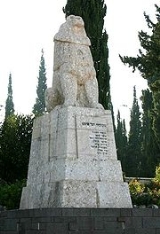
commemorates the deaths of eight Jews, six men and two women, among them the one-armed, Russian-Jewish independence fighter Joseph Trumpeldor
, in an engagement on 1 March 1920, with Bedouin
who had been attacking settlements in the area. The resolute actions of Trumpeldor and his colleagues against a much larger attacking force inspired the Jews of Jerusalem. The memorial is best known for an emblematic statue of a defiant lion representing Trumpeldor and his comrades. The city of Kiryat Shemona, literally Town of the Eight was named after them.
Kibbutz
A kibbutz is a collective community in Israel that was traditionally based on agriculture. Today, farming has been partly supplanted by other economic branches, including industrial plants and high-tech enterprises. Kibbutzim began as utopian communities, a combination of socialism and Zionism...
Kfar Giladi
Kfar Giladi
-External links:* * Jewish Agency for Israel*...
.
The battle of 1 March 1920, which gave Tel Hai its long-enduring fame, was significant far beyond the small number of fighters involved on either side - mainly due to its influence on Zionist culture, both inspiring an enduring heroic story and profoundly influencing Zionist military and political strategies over several decades.
In retrospect, it can be regarded as the first military engagement between what was to become Israel
Israel
The State of Israel is a parliamentary republic located in the Middle East, along the eastern shore of the Mediterranean Sea...
and what was to become Syria
Syria
Syria , officially the Syrian Arab Republic , is a country in Western Asia, bordering Lebanon and the Mediterranean Sea to the West, Turkey to the north, Iraq to the east, Jordan to the south, and Israel to the southwest....
, though at the time itself combatants on either side did not regard it in such terms.
Background
Tel Hai had been intermittently inhabited since 1905 and was permanently settled as a border outpost in 1918 following the defeat of the Ottoman EmpireOttoman Empire
The Ottoman EmpireIt was usually referred to as the "Ottoman Empire", the "Turkish Empire", the "Ottoman Caliphate" or more commonly "Turkey" by its contemporaries...
. The area was subsequently subject to intermittent border adjustments among the British and the French. In 1919, the British relinquished the northern section of Upper Galilee
Upper Galilee
The Upper Galilee is a geographical-political term in use since the end of the Second Temple period, originally referring to a mountainous area overlapping the present northern Israel and southern Lebanon, its borders being the Litani river in the north, the Mediterranean Sea in the west, the Beit...
containing Tel Hai, Metula
Metula
Metula is a town in the Northern District of Israel. Metula is located between the sites of the Biblical cities of Dan, Abel Bet Maacah, and Ijon, bordering Lebanon.-Early history:...
, Hamrah, and Kfar Giladi
Kfar Giladi
-External links:* * Jewish Agency for Israel*...
to the French
France
The French Republic , The French Republic , The French Republic , (commonly known as France , is a unitary semi-presidential republic in Western Europe with several overseas territories and islands located on other continents and in the Indian, Pacific, and Atlantic oceans. Metropolitan France...
jurisdiction.
The Zionist movement was greatly displeased with this, since it would have left the sources of the Jordan River outside the borders of British Mandatory Palestine, where the Jewish National Home envisaged in the Balfour Declaration was to be established. Therefore, the few isolated settlements in this territory assumed a strategic value from the Zionist point of view. Still, there was a fierce debate among Zionist factions and leaders, some of whom advocated letting Tel Hai and the other outposts hang on at all costs, while others regarded their situation as untenable and advocated withdrawing them.
Arabs in this area at this time were not primarily involved in opposition to Zionism but in strongly opposing the imposition of the French Mandate of Syria
French Mandate of Syria
Officially the French Mandate for Syria and the Lebanon was a League of Nations mandate founded after the First World War and the partitioning of the Ottoman Empire...
, which they regarded as betrayal of the promises made during the Arab Revolt
Arab Revolt
The Arab Revolt was initiated by the Sherif Hussein bin Ali with the aim of securing independence from the ruling Ottoman Turks and creating a single unified Arab state spanning from Aleppo in Syria to Aden in Yemen.- Background :...
against Ottoman rule. By present-day definitions some of these villagers would be defined as Syrians, some as Lebanese and some as Palestinians. These definitions did not yet exist, however; the people concerned had been until shortly before part of a single political unit, the Ottoman Empire, and wanted to be part of the newly proclaimed Arab Kingdom of Syria
Arab Kingdom of Syria
The Arab Kingdom of Syria is the first modern Arab state to come into existence, and although it officially lasted less than a year , its existence has had a lasting impact in the Arab world to this day. Throughout its existence it was led by Sharif Hussein bin Ali’s son Faisal bin Hussein...
rather than live under French rule.
The Zionist pioneers in Tel Hai, headed by Joseph Trumpeldor
Joseph Trumpeldor
Joseph Trumpeldor , was an early Zionist activist. He helped organize the Zion Mule Corps and bring Jewish immigrants to the Land of Israel. Trumpeldor died defending the settlement of Tel Hai in 1920 and subsequently became a Zionist national hero...
were in fact neutral in this conflict - they wanted the area to be neither Arab-ruled nor French-ruled, but restored to British rule which they hoped would eventually lead to its becoming part of the future Jewish state (which indeed ultimately happened). However, as being newcomers to the area recently arrived from Europe, they were evidently suspected by the local Arabs of being pro-French, which ultimately led to armed clash.
The battle
The one-armed Trumpedor had served as an officer in the Russian Army during the Russian-Japanese War of 1905 - one of the very few Russian Jews to gain a commission under the Tzar - and had a commanded a Jewish auxiliary unit fighting with the British Army in the Gallipoli Campaign of the First World War. As such, he was about the most experienced military man which the Zionist movement could send to command the threatened outpost.In skirmishes prior to the main battle, two members of the Tel Hai community were killed. They are commonly counted among the eight casualties of the Tel Hai battle.
On March 1, 1920, several hundred Shiites from Jabal Amil in southern Lebanon attacked Tel Hai. They demanded to search Tel Hai, and while the Jews attempted to maintain neutrality, they signalled for reinforcements from the kibbutz Kfar Giladi. Joseph Trumpeldor and ten men attempted to drive the Shiites and roving village militias away.
In mainstream Zionist historiography, the Arabs' demand to search Tel Hai on suspicion that there were French soldiers inside was generally regarded as a cynical ruse, with the prior intention of gaining possession and killing the Zionist pioneers or driving them away from the area. Whether or not premeditated on the Arab side, an armed confrontation did break out, in which six of the Tel-Hai defenders were killed and the survivors found their position intenable and had no choice but to withdraw - whereupon the place was burned.
The direct incident which started the confrontation is commonly mentioned as the Arabs grabbing a gun out of the hands of a woman member of the Tel-Hai community. The sight of an armed woman was clearly at odds with the cultural codes of the local villages, who might have found it insulting.
Trumpeldor's last words
Trumpeldor was severely wounded and died after several hours. He is credited with having said before dying "No matter, it is good to die for our country" ("אין דבר, טוב למות בעד ארצנו") words which in Zionist and Israeli collective memory remain closely associated with the names "Trumpeldor" and "Tel Hai".In the 1970s and 1980s, revisionist Israeli historians claimed that Trumpeldor's last words were in fact a pungent curse in Russian, his mother tongue. This led to a prolonged controversy, which was never definitely settled. In fact, as Trumpeldor lay dying for several hours, he had time enough to say both.
The words attributed to Trumpeldor are clearly a variant of the well known saying "Dulce et decorum est pro patria mori
Dulce et decorum est pro patria mori
Dulce et decorum est pro patria mori is a line from the Roman lyrical poet Horace's Odes . The line can be roughly translated into English as: "It is sweet and fitting to die for one's country."-Context:...
" ("It is sweet and fitting to die for one's country"), derived from the Odes of the Roman
Ancient Rome
Ancient Rome was a thriving civilization that grew on the Italian Peninsula as early as the 8th century BC. Located along the Mediterranean Sea and centered on the city of Rome, it expanded to one of the largest empires in the ancient world....
poet
Poet
A poet is a person who writes poetry. A poet's work can be literal, meaning that his work is derived from a specific event, or metaphorical, meaning that his work can take on many meanings and forms. Poets have existed since antiquity, in nearly all languages, and have produced works that vary...
Horace
Horace
Quintus Horatius Flaccus , known in the English-speaking world as Horace, was the leading Roman lyric poet during the time of Augustus.-Life:...
- lines with which Trumpeldor, like other educated Europeans of the time, must have been familiar. However, in the curriculum of Hebrew-languague schools in Mandatory Palestine and later Israel, the Latin antecedanats were hardly ever mentioned and the saying attributed to Trumpeldor's original authoriship.
Post-1920 history
The border finally agreed between the British and the French included in Mandatory Palestine a conpicuous "panhandle" or "finger" jutting northwards and including the whole course of the Jordan River. This addressed most of the Zionist aspirations, though not quite all of them, as two of the Jordan's tributaries - the Banias and Hatbani - remained in what would become Syria and Lebanon, (which would become part of the background for the Six Day war forty years later). It was thus possible for Tel Hai to be resettled in 1921, though it did not become a viable independent community and in 1926 it was absorbed into the kibbutzKibbutz
A kibbutz is a collective community in Israel that was traditionally based on agriculture. Today, farming has been partly supplanted by other economic branches, including industrial plants and high-tech enterprises. Kibbutzim began as utopian communities, a combination of socialism and Zionism...
of Kfar Giladi
Kfar Giladi
-External links:* * Jewish Agency for Israel*...
. Zionists felt vindicated, and the doctrine that creating "facts on the ground" would eventually determine the border became an enduring and influential part of Zionist thinking.
A national monument
National monument
A National monument is a monument constructed in order to commemorate something of national importance such as a war or the country's founding. The term may also refer to a specific monument status, such as a National Heritage Site, which most national monuments are by reason of their cultural...
in Upper Galilee
Upper Galilee
The Upper Galilee is a geographical-political term in use since the end of the Second Temple period, originally referring to a mountainous area overlapping the present northern Israel and southern Lebanon, its borders being the Litani river in the north, the Mediterranean Sea in the west, the Beit...
, Israel
Israel
The State of Israel is a parliamentary republic located in the Middle East, along the eastern shore of the Mediterranean Sea...
commemorates the deaths of eight Jews, six men and two women, among them the one-armed, Russian-Jewish independence fighter Joseph Trumpeldor
Joseph Trumpeldor
Joseph Trumpeldor , was an early Zionist activist. He helped organize the Zion Mule Corps and bring Jewish immigrants to the Land of Israel. Trumpeldor died defending the settlement of Tel Hai in 1920 and subsequently became a Zionist national hero...
, in an engagement on 1 March 1920, with Bedouin
Bedouin
The Bedouin are a part of a predominantly desert-dwelling Arab ethnic group traditionally divided into tribes or clans, known in Arabic as ..-Etymology:...
who had been attacking settlements in the area. The resolute actions of Trumpeldor and his colleagues against a much larger attacking force inspired the Jews of Jerusalem. The memorial is best known for an emblematic statue of a defiant lion representing Trumpeldor and his comrades. The city of Kiryat Shemona, literally Town of the Eight was named after them.
See also
- Riots in Palestine of 1920
- Sykes-Picot AgreementSykes-Picot AgreementThe Sykes–Picot Agreement of 1916 was a secret agreement between the governments of the United Kingdom and France, with the assent of Imperial Russia, defining their respective spheres of influence and control in Western Asia after the expected downfall of the Ottoman Empire during World War I...
- Tel-Hai Academic CollegeTel-Hai Academic CollegeTel-Hai Academic College is a college located in Tel Hai in northern Israel, near Kibbutz Kfar Giladi and north of Kiryat Shmona.The college offers academic and continuing education programs for approximately 4,500 students, 70 percent of whom come from outside the Galilee. Minorities comprise...