


Talbot-Lago

Encyclopedia
Talbot-Lago was a French automobile
manufacturer based in Suresnes
, Hauts de Seine, outside of Paris
.
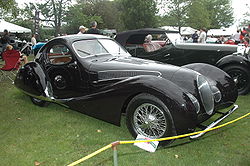
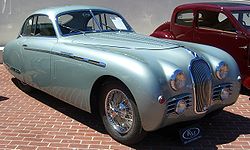
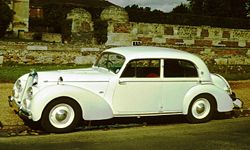 The Anglo-French STD (Sunbeam-Talbot-Darracq
) combine collapsed in 1935. The French Talbot
company was acquired and reorganised by a Venetian
born engineer called Anthony Lago (1893–1960) and after that, the Talbot-Lago name was used. On the home market the cars carried a Talbot badge.
At the same time, the British interests of Talbot were taken over by the Rootes Group and the parallel using of Talbot brand in France
and Britain
ended. Talbot-Lago cars sold in Britain were badged as Darracq.
Lago was an excellent engineer who developed the existing six-cylinder engine into a high-performance 4-litre one. The sporting six-cylinder models had a great racing history. The bodies—such as of T150 coupé—were made by excellent coachbuilder
s such as Figoni & Falaschi or Saoutchik
.
In 1946, the company began production of a new engine design, based on earlier units but with a new cylinder head featuring a twin overhead camshaft. This engine, designed under the leadership of Carlo Marchetti, was in many respects a new engine. A 4483 cc six cylinder in-line engine was developed for the Talbot Lago Record (1946–1952) and for the Talbot Grand Sport 26CV (1947–1954). These cars were priced against large luxurious cars from the likes of Delahaye
, Delage
, Hotchkiss
and Salmson
. Talbot would remain in the auto-making business for longer than any of these others, and the Talbot name had the further dubious distinction of a resurrection in the early 1980s.
of 26 CV and a claimed actual power output of 170 hp, delivered to the rear wheels via a four speed manual gear box, with the option at extra cost of a Wilson pre-selector
gear box, and supporting a claimed top speed of 170 km/h (105 mph). The car was commonly sold as a stylish four door sedan, but a two door cabriolet was also offered. There were also coachbuilt specials with bodywork by traditionalist firms such as Graber
.
with his son
to win the LeMans 24 Hour race
in 1950. The GS replaced the Lago-Record chassis which was named for its remarkable top speed. Having a 4.5 liter inline-6 aluminum cylinder head and triple carburetor from the T26 the Grand Prix cars, the GS was one of the world's most powerful production cars. Chassis details were similar to the Grand Prix cars, but it was longer and wider. It came it two wheelbase lengths -104 and 110 inches (2,794 mm).
Almost all the Talbots sold during the late 1940s came with Talbot bodies, constructed in the manufacturer's extensive workshops. The T26 Grand Sport (GS) was the exception, however, and cars were delivered only as bare chassis, requiring customers to choose bespoke bodywork from a specialist coachbuilder. The GS was a star turn in a dull world and coachbuilders such as Saoutchik, Franay and Figoni & Falaschi competed to trump Talbot's own designers with elaborately elegant bodies.
of 15 CV which was enough to attract the punitive levels of car tax applied by the French government to large cars. The power output was initially 110 bhp, which in 1949 was increased to 120 bhp. Although the postwar Baby sedan closely resembled the more powerful Record on a brief glance, the Baby's 2950 mm wheelbase was slightly shorter than the 3130 mm wheelbase of the Record, and the overall length was correspondingly 200 mm shorter, reflecting the shortened 4 cylinder engine block. Additionally the cheaper car sat on a simplified suspension set-up. Baby customers could specify as an option a Wilson pre-selector gear box.
body appeared for the Talbot Baby and Record. The wheelbases were carried over from the earlier models. Although in many ways strikingly modern, the new car featured a two piece front windscreen in place of the single flat screen of its predecessor, presumably reflecting the difficulties at the time of combining the strength of a windscreen with curved glass at an acceptable price and quality. The new car’s large rear window was itself replaced by a larger three-piece “panoramic” wrap around back window as part of the car’s first face-lift, which took place in time for the 1952 Paris Motor Show. The engine specification of the four cylinder unit was unchanged as was the claimed performance even though the new body was some 100 kg heavier than the old. A new development with the Ponton bodied cars body was the availability of the larger six cylinder unit from the Talbot Record in the top of the line Talbot Baby, which in this form was called the Talbot Baby/6 Luxe, and had the slightly longer wheel-base and overall length enforced by the greater length of the six cylinder engine.
engine.
engines or, for the last cars, less sophisticated and less powerful Simca
2351 cc ohc engines from the Vedette
.
Despite its high quality cars, Talbot-Lago struggled for postwar survival along with other prewar marques such as Hotchkiss and Delahaye
, and production ceased when Simca took over during 1959. (Simca was subsequently taken over by Chrysler
, who gained a controlling share in 1963, and rebranded the business as Chrysler France in 1970).
plant produced 155 cars in 1947 which had increased to 23 in 1948. 433 cars were produced in 1950, but this then fell to 80 in 1951 and to 34 in 1952. In 1953 it is thought that the company turned out just 13 of the 26CV Record model and 4 of the 15 CV Babys. During the rest of the decade volumes do not appear to have recovered significantly.
n.b. Prior to there was no Constructor's World Championship, hence constructors were not awarded points.
Automobile
An automobile, autocar, motor car or car is a wheeled motor vehicle used for transporting passengers, which also carries its own engine or motor...
manufacturer based in Suresnes
Suresnes
Suresnes is a commune in the western suburbs of Paris, France. It is located from the center of Paris. The nearest communes are Neuilly-sur-Seine, Puteaux, Rueil-Malmaison, Saint-Cloud and Boulogne-Billancourt...
, Hauts de Seine, outside of Paris
Paris
Paris is the capital and largest city in France, situated on the river Seine, in northern France, at the heart of the Île-de-France region...
.
Origins
Darracq
Automobiles Darracq S.A. was a French motor vehicle manufacturing company founded in 1896 by Alexandre Darracq.Using part of the substantial profit he had made from selling his Gladiator bicycle factory, Alexandre Darracq began operating from a plant in the Parisian suburb of Suresnes...
) combine collapsed in 1935. The French Talbot
Talbot
Talbot was an automobile marque that existed from 1903 to 1986, with a hiatus from 1960 to 1978, under a number of different owners, latterly under Peugeot...
company was acquired and reorganised by a Venetian
Venice
Venice is a city in northern Italy which is renowned for the beauty of its setting, its architecture and its artworks. It is the capital of the Veneto region...
born engineer called Anthony Lago (1893–1960) and after that, the Talbot-Lago name was used. On the home market the cars carried a Talbot badge.
At the same time, the British interests of Talbot were taken over by the Rootes Group and the parallel using of Talbot brand in France
France
The French Republic , The French Republic , The French Republic , (commonly known as France , is a unitary semi-presidential republic in Western Europe with several overseas territories and islands located on other continents and in the Indian, Pacific, and Atlantic oceans. Metropolitan France...
and Britain
United Kingdom
The United Kingdom of Great Britain and Northern IrelandIn the United Kingdom and Dependencies, other languages have been officially recognised as legitimate autochthonous languages under the European Charter for Regional or Minority Languages...
ended. Talbot-Lago cars sold in Britain were badged as Darracq.
Reorganisation under Tony Lago
For 1935, the existing range continued in production but from 1936 these were steadily replaced with cars designed by Walter Becchia featuring transverse leaf sprung independent suspension. These ranged from the two litre T11, the 3 litre T17, four litre T23 and sporting Spéciale and SS.Lago was an excellent engineer who developed the existing six-cylinder engine into a high-performance 4-litre one. The sporting six-cylinder models had a great racing history. The bodies—such as of T150 coupé—were made by excellent coachbuilder
Coachbuilder
A coachbuilder is a manufacturer of bodies for carriages or automobiles.The trade dates back several centuries. Rippon was active in the time of Queen Elizabeth I, Barker founded in 1710 by an officer in Queen Anne's Guards, Brewster a relative newcomer , formed in 1810. Others in Britain included...
s such as Figoni & Falaschi or Saoutchik
Saoutchik
Founded by cabinet maker Jacques Saoutchik , Saoutchik was a top-class French coachbuilding company founded in 1906. In the 1930s the company became famous for their high quality and often extravagant designs. After Jacques died in 1955, the company passed into the hands of his son Pierre...
.
After World War II
After the war, the company continued to be known both for successful high performance racing cars and for large luxurious passenger cars, with extensive sharing of chassis and engine components between the two. Nevertheless, the period was one of economic stagnation and financial stringency. The company had difficulty finding customers, and its finances were stretched.In 1946, the company began production of a new engine design, based on earlier units but with a new cylinder head featuring a twin overhead camshaft. This engine, designed under the leadership of Carlo Marchetti, was in many respects a new engine. A 4483 cc six cylinder in-line engine was developed for the Talbot Lago Record (1946–1952) and for the Talbot Grand Sport 26CV (1947–1954). These cars were priced against large luxurious cars from the likes of Delahaye
Delahaye
Delahaye automobile manufacturing company was started by Emile Delahaye in 1894, in Tours, France. His first cars were belt-driven, with single- or twin-cylinder engines. In 1900, Delahaye left the company.-History:...
, Delage
Delage
Delage was a French luxury automobile and racecar company founded in 1905 by Louis Delage in Levallois-Perret near Paris; it was acquired by Delahaye in 1935 and ceased operation in 1953.-History:...
, Hotchkiss
Hotchkiss et Cie
Société Anonyme des Anciens Etablissements Hotchkiss et Cie was a French arms and car company established by United States engineer Benjamin B. Hotchkiss, who was born in Watertown, Connecticut. He moved to France and set up a factory, first at Viviez near Rodez in 1867, then at Saint-Denis near...
and Salmson
Salmson
Salmson was a French engineering company, initially in the automobile and aeroplane manufacturing area,turning to pump manufacturing in the 1960s.-History:...
. Talbot would remain in the auto-making business for longer than any of these others, and the Talbot name had the further dubious distinction of a resurrection in the early 1980s.
Talbot Lago Record T26
The Talbot Lago Record T26 was a large car with a fiscal horse powerTax horsepower
The tax horsepower or taxable horsepower was an early system by which taxation rates for automobiles were reckoned in some European countries, such as Britain, Belgium, Germany, France, and Italy; some US states like Illinois charged license plate purchase and renewal fees for passenger...
of 26 CV and a claimed actual power output of 170 hp, delivered to the rear wheels via a four speed manual gear box, with the option at extra cost of a Wilson pre-selector
Preselector gearbox
A preselector or self-changing gearbox is a type of manual gearbox used on a variety of vehicles, most commonly in the 1930s...
gear box, and supporting a claimed top speed of 170 km/h (105 mph). The car was commonly sold as a stylish four door sedan, but a two door cabriolet was also offered. There were also coachbuilt specials with bodywork by traditionalist firms such as Graber
Graber
Graber was a coachbuilder based in Wichtrach in central Switzerland. Between 1927 and 1970 the firm supplied coach-built bodies for fitting on the chassis of various European and US auto-makers...
.
Talbot Lago Grand Sport T26
The T26 Grand Sport (GS) was first displayed in public in October 1947 as a shortened chassis, and only 12 were made during 1948 which was the models's first full year of production. The car was noted for its speed. The engine which produced 170 hp in the Lago Record was adapted to provide 190 bhp or, later, 195 bhp in the GS, and a top speed of around 200 km/h (124 mph) was claimed, depending on the body that was fitted. The car was built for either racing or luxury and benefited directly from Talbot's successful T26C Grand Prix car. As such it was expensive, rare and helped Louis RosierLouis Rosier
Louis Rosier was a racing driver from France.-Career highlights:...
with his son
Jean-Louis Rosier
Jean-Louis Rosier is the son of Louis Rosier. Together they won the 24 Hours of Le Mans in 1950. The Charade Circuit near Clermont-Ferrand is also named after them.-References:...
to win the LeMans 24 Hour race
24 Hours of Le Mans
The 24 Hours of Le Mans is the world's oldest sports car race in endurance racing, held annually since near the town of Le Mans, France. Commonly known as the Grand Prix of Endurance and Efficiency, race teams have to balance speed against the cars' ability to run for 24 hours without sustaining...
in 1950. The GS replaced the Lago-Record chassis which was named for its remarkable top speed. Having a 4.5 liter inline-6 aluminum cylinder head and triple carburetor from the T26 the Grand Prix cars, the GS was one of the world's most powerful production cars. Chassis details were similar to the Grand Prix cars, but it was longer and wider. It came it two wheelbase lengths -104 and 110 inches (2,794 mm).
Almost all the Talbots sold during the late 1940s came with Talbot bodies, constructed in the manufacturer's extensive workshops. The T26 Grand Sport (GS) was the exception, however, and cars were delivered only as bare chassis, requiring customers to choose bespoke bodywork from a specialist coachbuilder. The GS was a star turn in a dull world and coachbuilders such as Saoutchik, Franay and Figoni & Falaschi competed to trump Talbot's own designers with elaborately elegant bodies.
Talbot Lago Baby
The Talbot Lago Baby (1948–1951) marked the return of a pre-war Talbot model name and was the third model presented by the company during the 1940s. The car was commonly sold as a four door sedan, but a two door cabriolet was also offered. Its engine comprised only four cylinders, but the twin overhead camshaft with cylinder valves on both sides of the engine block was again featured: at 2690 cc the engine capacity equated to a fiscal horse powerTax horsepower
The tax horsepower or taxable horsepower was an early system by which taxation rates for automobiles were reckoned in some European countries, such as Britain, Belgium, Germany, France, and Italy; some US states like Illinois charged license plate purchase and renewal fees for passenger...
of 15 CV which was enough to attract the punitive levels of car tax applied by the French government to large cars. The power output was initially 110 bhp, which in 1949 was increased to 120 bhp. Although the postwar Baby sedan closely resembled the more powerful Record on a brief glance, the Baby's 2950 mm wheelbase was slightly shorter than the 3130 mm wheelbase of the Record, and the overall length was correspondingly 200 mm shorter, reflecting the shortened 4 cylinder engine block. Additionally the cheaper car sat on a simplified suspension set-up. Baby customers could specify as an option a Wilson pre-selector gear box.
New bodies for 1952
In 1951, as rumours of the company’s financial difficulties intensified, a new Ponton formatPonton (automobile)
Ponton or Pontoon styling refers to a 1930s-1960s design genre — ultimately the precursor of modern automotive styling. The trend emerged as distinct running boards and fully articulated fenders became less common and bodywork began to enclose the full width and uninterrupted length of a car...
body appeared for the Talbot Baby and Record. The wheelbases were carried over from the earlier models. Although in many ways strikingly modern, the new car featured a two piece front windscreen in place of the single flat screen of its predecessor, presumably reflecting the difficulties at the time of combining the strength of a windscreen with curved glass at an acceptable price and quality. The new car’s large rear window was itself replaced by a larger three-piece “panoramic” wrap around back window as part of the car’s first face-lift, which took place in time for the 1952 Paris Motor Show. The engine specification of the four cylinder unit was unchanged as was the claimed performance even though the new body was some 100 kg heavier than the old. A new development with the Ponton bodied cars body was the availability of the larger six cylinder unit from the Talbot Record in the top of the line Talbot Baby, which in this form was called the Talbot Baby/6 Luxe, and had the slightly longer wheel-base and overall length enforced by the greater length of the six cylinder engine.
Maserati engine
A later model, the Lago Sport (1954–1957), would used a MaseratiMaserati
Maserati is an Italian luxury car manufacturer established on December 1, 1914, in Bologna. The company's headquarters is now in Modena, and its emblem is a trident. It has been owned by the Italian car giant Fiat S.p.A. since 1993...
engine.
Lago America
The final Lago America models (1957–1959) used 2476 cc BMWBMW
Bayerische Motoren Werke AG is a German automobile, motorcycle and engine manufacturing company founded in 1916. It also owns and produces the Mini marque, and is the parent company of Rolls-Royce Motor Cars. BMW produces motorcycles under BMW Motorrad and Husqvarna brands...
engines or, for the last cars, less sophisticated and less powerful Simca
Simca
Simca was a French automaker, founded in November 1934 by Fiat. It was directed from July 1935 to May 1963 by the Italian Henri Théodore Pigozzi...
2351 cc ohc engines from the Vedette
Simca Vedette
The Simca Vedette is a large car, manufactured from 1954-1961 by the French automaker Simca, at their factory in Poissy, France. It was marketed with different model names according to trim and equipment levels...
.
Despite its high quality cars, Talbot-Lago struggled for postwar survival along with other prewar marques such as Hotchkiss and Delahaye
Delahaye
Delahaye automobile manufacturing company was started by Emile Delahaye in 1894, in Tours, France. His first cars were belt-driven, with single- or twin-cylinder engines. In 1900, Delahaye left the company.-History:...
, and production ceased when Simca took over during 1959. (Simca was subsequently taken over by Chrysler
Chrysler
Chrysler Group LLC is a multinational automaker headquartered in Auburn Hills, Michigan, USA. Chrysler was first organized as the Chrysler Corporation in 1925....
, who gained a controlling share in 1963, and rebranded the business as Chrysler France in 1970).
Commercial
Sales data by model was kept confidential, possibly in connection with the company’s financial difficulties, but the overall totals for the early 1950s tell a dire story. The SuresnesSuresnes
Suresnes is a commune in the western suburbs of Paris, France. It is located from the center of Paris. The nearest communes are Neuilly-sur-Seine, Puteaux, Rueil-Malmaison, Saint-Cloud and Boulogne-Billancourt...
plant produced 155 cars in 1947 which had increased to 23 in 1948. 433 cars were produced in 1950, but this then fell to 80 in 1951 and to 34 in 1952. In 1953 it is thought that the company turned out just 13 of the 26CV Record model and 4 of the 15 CV Babys. During the rest of the decade volumes do not appear to have recovered significantly.
Today
Talbot-Lagos have become a top-prized car at various auctions, fetching as much as $3.685 million at the 2005 Pebble Beach Auction for a 1938 T150-C Lago Speciale Teardrop Coupe. The same year, the top bidder at a Christie's auction was awarded a 1937 Talbot-Lago T150 C-SS Teardrop Coupe with coachwork by Figoni and Falaschi for his $3.535 million-dollar bid.Works team entries
| Year | Chassis | Engine | Driver | 1 | 2 | 3 | 4 | 5 | 6 | 7 |
|---|---|---|---|---|---|---|---|---|---|---|
| 1950 1950 Formula One season The 1950 Formula One season included the inaugural FIA Formula One World Championship season, which commenced on May 13, 1950, and ended on September 3 after 7 races... |
T26C-DA | Talbot Talbot Talbot was an automobile marque that existed from 1903 to 1986, with a hiatus from 1960 to 1978, under a number of different owners, latterly under Peugeot... L6 Straight-6 The straight-six engine or inline-six engine is a six-cylinder internal combustion engine with all six cylinders mounted in a straight line along the crankcase... |
GBR 1950 British Grand Prix The 1950 British Grand Prix was a Formula One motor race held on 13 May 1950 at the Silverstone Circuit, Silverstone, England. It was the fifth British Grand Prix, and the third to be held at Silverstone after motor racing resumed after World War II. It was the first round of the 1950 World... |
MON 1950 Monaco Grand Prix The 1950 Monaco Grand Prix was a Formula One motor race held on May 21, 1950 at Monaco. This race was the second round of 1950 World Drivers' Championship. The race, contested over 100 laps at an overall distance of 318.1 km was won by Juan Manuel Fangio for the Alfa Romeo team after starting from... |
500 1950 Indianapolis 500 The 1950 Indianapolis 500 was an automobile race which was held on Tuesday, May 30, 1950 at the Indianapolis Motor Speedway. The event was the third round of the 1950 World Drivers' Championship... |
SUI 1950 Swiss Grand Prix The 1950 Swiss Grand Prix was a Formula One motor race held on June 4, 1950 at Bremgarten. It was the fourth round of the 1950 World Drivers' Championship.-Report:... |
BEL 1950 Belgian Grand Prix The 1950 Belgian Grand Prix was a Formula One motor race held on June 18, 1950 at Spa-Francorchamps. It was the fifth round of the 1950 World Drivers' Championship.-Report:... |
FRA 1950 French Grand Prix The 1950 French Grand Prix was a Formula One motor race held on July 2, 1950 at Reims-Gueux. It was the sixth round of 1950 World Drivers' Championship.__FORCETOC__-Report:Fangio put in a stunning display with a 116 mph practice lap... |
ITA 1950 Italian Grand Prix The 1950 Italian Grand Prix was a Formula One motor race held on September 3, 1950 at Monza. It was the seventh and final event of the 1950 World Drivers' Championship... |
|
 Yves Giraud-Cabantous Yves Giraud-Cabantous |
4 | DNA | Ret | Ret | 8 | |||||
| Eugene Martin Eugène Martin Eugène Martin was a racing driver from France. He participated in two Formula One World Championship Grands Prix, debuting on May 13, 1950. He scored no championship points.... |
Ret | Ret | ||||||||
| Louis Rosier Louis Rosier Louis Rosier was a racing driver from France.-Career highlights:... |
3 | 3 | 6* | |||||||
| Philippe Étancelin Philippe Étancelin Philippe Étancelin was a French Grand Prix motor racing driver who joined the new Formula One circuit at its inception.-Biography:... |
Ret | |||||||||
| Raymond Sommer Raymond Sommer Raymond Sommer was a Grand Prix motor racing driver.... |
Ret |
* Indicates shared drive with Charles PozziCharles PozziCharles Pozzi was a French racing driver who participated in one World Championship Formula One race in 1950, the year of its inception....
in his privately entered T26C
n.b. Prior to there was no Constructor's World Championship, hence constructors were not awarded points.
Results of other Talbot-Lago cars
(Results in bold indicate pole position; results in italics indicate fastest lap.)| Year | Entrant | Chassis | Engine | Driver | 1 | 2 | 3 | 4 | 5 | 6 | 7 | 8 |
|---|---|---|---|---|---|---|---|---|---|---|---|---|
| 1950 1950 Formula One season The 1950 Formula One season included the inaugural FIA Formula One World Championship season, which commenced on May 13, 1950, and ended on September 3 after 7 races... |
Ecurie Rosier Louis Rosier Louis Rosier was a racing driver from France.-Career highlights:... |
T26C | Talbot Talbot Talbot was an automobile marque that existed from 1903 to 1986, with a hiatus from 1960 to 1978, under a number of different owners, latterly under Peugeot... L6 Straight-6 The straight-six engine or inline-six engine is a six-cylinder internal combustion engine with all six cylinders mounted in a straight line along the crankcase... |
GBR 1950 British Grand Prix The 1950 British Grand Prix was a Formula One motor race held on 13 May 1950 at the Silverstone Circuit, Silverstone, England. It was the fifth British Grand Prix, and the third to be held at Silverstone after motor racing resumed after World War II. It was the first round of the 1950 World... |
MON 1950 Monaco Grand Prix The 1950 Monaco Grand Prix was a Formula One motor race held on May 21, 1950 at Monaco. This race was the second round of 1950 World Drivers' Championship. The race, contested over 100 laps at an overall distance of 318.1 km was won by Juan Manuel Fangio for the Alfa Romeo team after starting from... |
500 1950 Indianapolis 500 The 1950 Indianapolis 500 was an automobile race which was held on Tuesday, May 30, 1950 at the Indianapolis Motor Speedway. The event was the third round of the 1950 World Drivers' Championship... |
SUI 1950 Swiss Grand Prix The 1950 Swiss Grand Prix was a Formula One motor race held on June 4, 1950 at Bremgarten. It was the fourth round of the 1950 World Drivers' Championship.-Report:... |
BEL 1950 Belgian Grand Prix The 1950 Belgian Grand Prix was a Formula One motor race held on June 18, 1950 at Spa-Francorchamps. It was the fifth round of the 1950 World Drivers' Championship.-Report:... |
FRA 1950 French Grand Prix The 1950 French Grand Prix was a Formula One motor race held on July 2, 1950 at Reims-Gueux. It was the sixth round of 1950 World Drivers' Championship.__FORCETOC__-Report:Fangio put in a stunning display with a 116 mph practice lap... |
ITA 1950 Italian Grand Prix The 1950 Italian Grand Prix was a Formula One motor race held on September 3, 1950 at Monza. It was the seventh and final event of the 1950 World Drivers' Championship... |
||
| Louis Rosier Louis Rosier Louis Rosier was a racing driver from France.-Career highlights:... |
5 | Ret | 4 | |||||||||
| Henri Louveau Henri Louveau Henri Louveau was a racing driver from France. He participated in two Formula One World Championship Grands Prix, debuting on September 3, 1950. He scored no championship points.... |
Ret | |||||||||||
| Charles Pozzi Charles Pozzi Charles Pozzi was a French racing driver who participated in one World Championship Formula One race in 1950, the year of its inception.... |
DNA | |||||||||||
| private | 6* | |||||||||||
| Raymond Sommer Raymond Sommer Raymond Sommer was a Grand Prix motor racing driver.... |
Ret | Ret | ||||||||||
| Pierre Levegh Pierre Levegh Pierre Eugène Alfred Bouillin was a French sportsman and racing driver. He took the racing name Pierre Levegh in memory of his uncle, a pioneering driver who died in 1904... |
DNA | 7 | Ret | Ret | ||||||||
| Guy Mairesse Guy Mairesse Guy Mairesse was a racing driver from France. He participated in 3 Formula One World Championship Grands Prix, debuting on September 3, 1950... |
Ret | |||||||||||
| Ecurie Belge Johnny Claes Octave John "Johnny" Claes was a racing driver from Belgium. Before his fame as a racing driver, Claes was also a jazz trumpeter and successful bandleader in Britain.-Early life and jazz career:... |
 Johnny Claes Johnny ClaesJohnny Claes Octave John "Johnny" Claes was a racing driver from Belgium. Before his fame as a racing driver, Claes was also a jazz trumpeter and successful bandleader in Britain.-Early life and jazz career:... |
11 | 7 | 10 | 8 | Ret | Ret | |||||
| Ecurie Bleue |  Harry Schell Harry SchellHarry Schell Harry O'Reilly Schell was an American Grand Prix motor racing driver.-Early life:... |
8 | ||||||||||
| Ecurie Leutitia | Eugene Chaboud Eugène Chaboud Marius Eugène Chaboud was a racing driver from France. He participated in three Formula One World Championship Grands Prix, scoring one championship point... |
Ret | ||||||||||
| Philippe Étancelin Philippe Étancelin Philippe Étancelin was a French Grand Prix motor racing driver who joined the new Formula One circuit at its inception.-Biography:... |
T26C T26C-DA |
Talbot Talbot Talbot was an automobile marque that existed from 1903 to 1986, with a hiatus from 1960 to 1978, under a number of different owners, latterly under Peugeot... L6 Straight-6 The straight-six engine or inline-six engine is a six-cylinder internal combustion engine with all six cylinders mounted in a straight line along the crankcase... |
5* | |||||||||
| Philippe Étancelin Philippe Étancelin Philippe Étancelin was a French Grand Prix motor racing driver who joined the new Formula One circuit at its inception.-Biography:... |
8 | Ret | Ret | 5* | 5 | |||||||
| 1951 1951 Formula One season The 1951 Formula One season was the second season of FIA Formula One motor racing. It featured the 1951 World Championship of Drivers, which commenced on May 27, 1951 and ended on October 28 after eight races... |
Ecurie Rosier Louis Rosier Louis Rosier was a racing driver from France.-Career highlights:... |
T26C T26C-DA T26C-GS |
Talbot Talbot Talbot was an automobile marque that existed from 1903 to 1986, with a hiatus from 1960 to 1978, under a number of different owners, latterly under Peugeot... L6 Straight-6 The straight-six engine or inline-six engine is a six-cylinder internal combustion engine with all six cylinders mounted in a straight line along the crankcase... |
SUI 1951 Swiss Grand Prix The 1951 Swiss Grand Prix was a Formula One motor race held at the Bremgarten on May 27, 1951. It was the first round of the 1951 World Drivers' Championship. The race saw the Formula One debut of British driver Stirling Moss.-Qualifying:-Race:... |
500 1951 Indianapolis 500 The 1951 Indianapolis 500 an automobile race which was held on Wednesday, May 30, 1951 at Indianapolis Motor Speedway. The event was the opening race of the 1951 AAA National Championship Trail and the second race of the 1951 World Championship of Drivers.... |
BEL 1951 Belgian Grand Prix The 1951 Belgian Grand Prix was a Formula One motor race held on June 17, 1951 at Circuit de Spa-Francorchamps. It was the third round of the 1951 World Drivers' Championship.- Race report :... |
FRA 1951 French Grand Prix The 1951 French Grand Prix was a Formula One motor race held at Reims-Gueux on 1 July 1951. It was the fourth round of the 1951 World Drivers' Championship and was won by Juan Manuel Fangio and Luigi Fagioli driving an Alfa Romeo... |
GBR 1951 British Grand Prix The 1951 British Grand Prix was a Formula One motor race held on 14 July 1951 at the Silverstone Circuit in Buckinghamshire, England. It was the fifth round of the 1951 World Drivers' Championship... |
GER 1951 German Grand Prix The 1951 German Grand Prix was a Formula One motor race held on July 29, 1951 at the Nürburgring Nordschleife. It was the sixth round of the 1951 World Drivers' Championship.-Qualifying:-Race:- Drivers' Championship standings after the race :... |
ITA 1951 Italian Grand Prix The 1951 Italian Grand Prix was a Formula One motor race held on September 16, 1951 at Monza. It was the seventh round of the 1951 World Drivers' Championship.-Qualifying:-Race:- Notes :* Pole position: Juan Manuel Fangio - 1:53.2... |
ESP 1951 Spanish Grand Prix The 1951 Spanish Grand Prix was a Formula One motor race held on October 28, 1951 at Pedralbes Circuit. It was the eighth and final round of the 1951 World Drivers' Championship.... |
|
| Louis Rosier Louis Rosier Louis Rosier was a racing driver from France.-Career highlights:... |
9 | 4 | Ret | 10 | 8 | 7 | 7 | |||||
| Henri Louveau Henri Louveau Henri Louveau was a racing driver from France. He participated in two Formula One World Championship Grands Prix, debuting on September 3, 1950. He scored no championship points.... |
Ret | |||||||||||
| Ecurie Belge Johnny Claes Octave John "Johnny" Claes was a racing driver from Belgium. Before his fame as a racing driver, Claes was also a jazz trumpeter and successful bandleader in Britain.-Early life and jazz career:... |
Johnny Claes Johnny Claes Octave John "Johnny" Claes was a racing driver from Belgium. Before his fame as a racing driver, Claes was also a jazz trumpeter and successful bandleader in Britain.-Early life and jazz career:... |
13 | 7 | Ret | 13 | 11 | Ret | Ret | ||||
| Ecurie Belgique | Guy Mairesse Guy Mairesse Guy Mairesse was a racing driver from France. He participated in 3 Formula One World Championship Grands Prix, debuting on September 3, 1950... |
NC | NC | |||||||||
| Jacques Swaters Jacques Swaters Jacques Swaters was a racing driver from Belgium and former team owner of Ecurie Francorchamps and Ecurie Nationale Belge.... |
10 | Ret | ||||||||||
| André Pilette André Pilette André Pilette , son of former Indy 500 participant Théodore Pilette, was a racing driver from Belgium. He participated in 14 Formula One World Championship Grands Prix, debuting on 17 June 1951. He scored 2 championship points... |
6 | |||||||||||
| private | Yves Giraud-Cabantous |
Ret | 5 | 7 | Ret | 8 | Ret | |||||
| Philippe Étancelin Philippe Étancelin Philippe Étancelin was a French Grand Prix motor racing driver who joined the new Formula One circuit at its inception.-Biography:... |
10 | Ret | Ret | Ret | 8 | |||||||
| Eugene Chaboud Eugène Chaboud Marius Eugène Chaboud was a racing driver from France. He participated in three Formula One World Championship Grands Prix, scoring one championship point... |
8 | |||||||||||
| Pierre Levegh Pierre Levegh Pierre Eugène Alfred Bouillin was a French sportsman and racing driver. He took the racing name Pierre Levegh in memory of his uncle, a pioneering driver who died in 1904... |
8 | 9 | Ret | |||||||||
| Duncan Hamilton | 12 | Ret | ||||||||||
 José Froilán González José Froilán GonzálezJosé Froilán González José Froilán González is an Argentine former racing driver, particularly notable for scoring Ferrari's first win in a Formula One World Championship race at the 1951 British Grand Prix. He made his Formula One debut for Scuderia Achille Varzi in the 1950 Monaco Grand Prix... |
Ret | |||||||||||
| Georges Grignard Georges Grignard Auguste Georges Paul Grignard was a racing driver from France. He raced in Formula One from 1947 to 1953, participating in one World Championship Grand Prix on 28 October 1951... |
Ret |
* Indicates shared drive
External links
- Talbot-Lago Flickr Group
- 1949 Talbot Lago T26 GS Coupé (by Barou)
- http://vea.qc.ca/vea/marques1/talbotfr.htm