

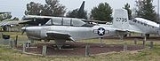
T-34 Mentor

Encyclopedia
The Beechcraft T-34 Mentor is a propeller-driven, single-engined, military trainer aircraft derived from the Beechcraft Model 35 Bonanza
. The earlier versions of the T-34, dating from around the late 1940s to the 1950s, were piston-engined. These were eventually succeeded by the upgraded T-34C Turbo-Mentor, powered by a turboprop
engine. The T-34 remains in service almost six decades after it was first designed.
, then in use by all services of the U.S. military.
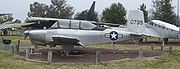
 Three initial design concepts were developed for the Model 45, including one with the Bonanza's signature V-tail
, but the final design that emerged in 1948 incorporated conventional tail control surfaces for the benefit of the more conservative military (featuring a relatively large unswept vertical fin that would find its way onto the Travel Air twin-engine civil aircraft almost ten years later). The Bonanza's fuselage with four-passenger cabin was replaced with a narrower fuselage incorporating a two-seater tandem cockpit and bubble canopy
, which provided greater visibility for the trainee pilot and flight instructor. Structurally, the Model 45 was much stronger than the Bonanza, being designed for +10g
and -4.5g, while the Continental E-185
engine of 185 horsepower
(hp) at takeoff (less than a third of the power of the T-6's engine) was the same as that fitted to contemporary Bonanzas.
Following the prototype were three Model A45T aircraft, the first two with the same engine as the prototype and the third with a Continental E-225
, which would prove to be close to the production version. Production did not begin until 1953, when Beechcraft began delivering T-34As to the United States Air Force
(USAF) and similar Model B45 aircraft for export. Production of the T-34B for the United States Navy
(USN) began in 1955, this version featuring a number of changes reflecting the different requirements of the two services. The T-34B had only differential braking for steering control on the ground instead of nosewheel steering, additional wing dihedral and, to cater for the different heights of pilots, adjustable rudder pedals instead of the moveable seats of the T-34A. T-34A production was completed in 1956, with T-34Bs being built until October 1957 and licensed B45 versions built in Canada
(125 manufactured by Canadian Car and Foundry
), Japan
(173 built by Fuji Heavy Industries
), and Argentina
(75 by FMA) until 1958. Beechcraft delivered the last Model B45s in 1959. Total production of the Continental-engined versions in the US and abroad was 1,904 aircraft.
s, supplying air to a single jet engine in the rear fuselage. The first flight of the Model 73, registered N134B, was on 18 December 1955. The Model 73 was evaluated by the USAF, which ordered the Cessna T-37, and the USN, which decided upon the Temco TT Pinto. The Model 73 was not put into production.
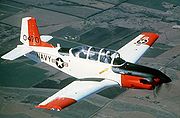 After a production hiatus of almost 15 years, the T-34C Turbo-Mentor powered by a Pratt & Whitney Canada PT6
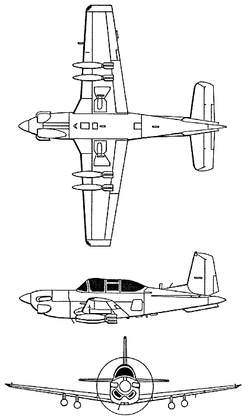
A-25 turboprop engine was developed in 1973. Development proceeded at the behest of the USN, which supplied two T-34Bs for conversion. After re-engining with the PT6, the two aircraft were redesignated as YT-34Cs, the first of these flying with turboprop power for the first time on 21 September 1973. Mentor production re-started in 1975 for deliveries of T-34Cs to the USN and of the T-34C-1 armed version for export customers in 1977, this version featuring four underwing hardpoint
s. The last Turbo-Mentor rolled off the production line in 1990.
From 1978, the T-34C Turbo-Mentor was the Argentine Naval Aviation
basic trainer used by the 1st Naval Aviation Force (Training), alongside 15 T-34C-1 light attack aircraft forming the Fourth Naval Air Attack Squadron. During the 1982 Falklands War
, four T-34C-1s were deployed to Port Stanley on 25 April 1982, primarily to be employed in a reconnaissance role. The main encounter with British forces occurred on 1 May 1982 when three Turbo-Mentors attacked a Royal Navy
Westland Sea King
helicopter in the area of Berkeley Sound but were intercepted by RN Sea Harriers flown by Lts Watson and Ward
, with one of the T-34Cs being damaged by cannon fire from Ward's aircraft. The four T-34C-1 Turbo-Mentors continued to operate, flying a few reconnaissance missions, but were redeployed to Borbon Station
where they were ultimately destroyed by the SAS Raid on Pebble Island
on 15 May 1982. Although all four hulks remained on the island for a considerable length of time, eventually, 0729/(1-A)411 was recovered on 10 June 1983 and stored for future display at the Fleet Air Arm Museum
.
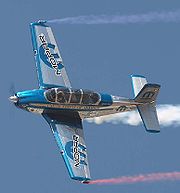 In 2004, due to a series of crashes involving in-flight structural failure during simulated combat flights, the entire US civilian fleet of T-34s was grounded by the Federal Aviation Administration
. The grounding has since been eased to a slate of restrictions on the permitted flight envelope. Via a series of Airworthiness Directives (ADs) established by or Alternate Methods of Compliance (AMOCs) negotiated with the FAA, including installation of certain, approved structural modifications to the wing spar and other repairs, the T-34 fleet in 2011 has been restored to full flight status by FAA at the Mentor's originally designed limitations, provided each individual example is compliant with those ADs and AMOCs.
The T-34C is still used as the primary training aircraft for United States Navy
and Marine Corps
pilots. The T-34C is currently being replaced by the T-6 Texan II
. NAS Pensacola has already completed the transition to the T-6 and one of three training squadrons at Whiting Field has also transitioned. The remaining two squadrons will be transitioned in 2011.
NASA
Dryden Flight Research Center
has operated two T-34C aircraft. The first was previously flown at the Glenn Research Center
in Cleveland, Ohio
, for propulsion experiments involving turboprop engines, and then came to Dryden as a chase aircraft in 1996. That aircraft was returned to the US Navy in 2002. Dryden obtained its second T-34C in early 2005 from the Navy's Air Warfare Center Aircraft Division at NAS Patuxent River, where it was due to be retired. At Dryden, the T-34C is primarily used for chasing remotely piloted unmanned air vehicles which fly slower than NASA's F-18's mission support aircraft can fly. It is also used for required pilot proficiency flying.
The United States Army
received six ex-US Navy T-34C, used as test platforms and chase plane
s at Edwards Air Force Base
and at Fort Bragg
.
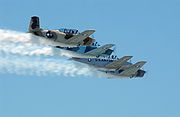
The Mentor is the aircraft used by the Lima Lima Flight Team and Dragon Flight, both civilian demonstration teams. It is also used by aerobatic pilot Julie Clark, who flies her T-34 "Free Spirit" (registration N134JC) at air shows.
T-34A
T-34B
YT-34C
T-34C Turbo-Mentor
T-34C-1
Turbo-Mentor 34C
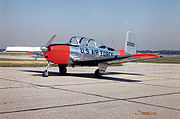
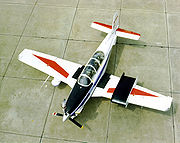
:
Beechcraft Bonanza
The Beechcraft Bonanza is an American general aviation aircraft introduced in 1947 by The Beech Aircraft Corporation of Wichita, Kansas. , it is still being produced by Hawker Beechcraft, and has been in continuous production longer than any other airplane in history...
. The earlier versions of the T-34, dating from around the late 1940s to the 1950s, were piston-engined. These were eventually succeeded by the upgraded T-34C Turbo-Mentor, powered by a turboprop
Turboprop
A turboprop engine is a type of turbine engine which drives an aircraft propeller using a reduction gear.The gas turbine is designed specifically for this application, with almost all of its output being used to drive the propeller...
engine. The T-34 remains in service almost six decades after it was first designed.
Design and development
The T-34 was the brainchild of Walter Beech, who developed it as the Beechcraft Model 45 private venture at a time when there was no defense budget for a new trainer model. Beech hoped to sell it as an economical alternative to the North American T-6/NJ TexanT-6 Texan
The North American Aviation T-6 Texan was a single-engine advanced trainer aircraft used to train pilots of the United States Army Air Forces, United States Navy, Royal Air Force and other air forces of the British Commonwealth during World War II and into the 1950s...
, then in use by all services of the U.S. military.
V-tail
In aircraft, a V-tail is an unconventional arrangement of the tail control surfaces that replaces the traditional fin and horizontal surfaces with two surfaces set in a V-shaped configuration when viewed from the front or rear of the aircraft...
, but the final design that emerged in 1948 incorporated conventional tail control surfaces for the benefit of the more conservative military (featuring a relatively large unswept vertical fin that would find its way onto the Travel Air twin-engine civil aircraft almost ten years later). The Bonanza's fuselage with four-passenger cabin was replaced with a narrower fuselage incorporating a two-seater tandem cockpit and bubble canopy
Bubble canopy
A bubble canopy is a canopy made like a soap bubble, which attempts to provide 360° vision to the pilot.-History:Bubble canopies have been in use since World War II. The British had already developed the "Malcolm hood", which was a bulged canopy, but the British Miles M.20 was one of the first...
, which provided greater visibility for the trainee pilot and flight instructor. Structurally, the Model 45 was much stronger than the Bonanza, being designed for +10g
G-force
The g-force associated with an object is its acceleration relative to free-fall. This acceleration experienced by an object is due to the vector sum of non-gravitational forces acting on an object free to move. The accelerations that are not produced by gravity are termed proper accelerations, and...
and -4.5g, while the Continental E-185
Continental Motors Company
Continental Motors Company was an American engine and automobile manufacturer. The company produced engines for various independent manufacturers of automobiles, tractors, and stationary equipment from the 1900s through the 1960s. Continental Motors also produced Continental-branded automobiles in...
engine of 185 horsepower
Horsepower
Horsepower is the name of several units of measurement of power. The most common definitions equal between 735.5 and 750 watts.Horsepower was originally defined to compare the output of steam engines with the power of draft horses in continuous operation. The unit was widely adopted to measure the...
(hp) at takeoff (less than a third of the power of the T-6's engine) was the same as that fitted to contemporary Bonanzas.
Following the prototype were three Model A45T aircraft, the first two with the same engine as the prototype and the third with a Continental E-225
Continental O-470
The Continental O-470 engine is a family of carbureted six-cylinder, horizontally opposed, air-cooled aircraft engines that was developed especially for use in light aircraft by Continental Motors. The family includes the E165, E185 and the E225 engines...
, which would prove to be close to the production version. Production did not begin until 1953, when Beechcraft began delivering T-34As to the United States Air Force
United States Air Force
The United States Air Force is the aerial warfare service branch of the United States Armed Forces and one of the American uniformed services. Initially part of the United States Army, the USAF was formed as a separate branch of the military on September 18, 1947 under the National Security Act of...
(USAF) and similar Model B45 aircraft for export. Production of the T-34B for the United States Navy
United States Navy
The United States Navy is the naval warfare service branch of the United States Armed Forces and one of the seven uniformed services of the United States. The U.S. Navy is the largest in the world; its battle fleet tonnage is greater than that of the next 13 largest navies combined. The U.S...
(USN) began in 1955, this version featuring a number of changes reflecting the different requirements of the two services. The T-34B had only differential braking for steering control on the ground instead of nosewheel steering, additional wing dihedral and, to cater for the different heights of pilots, adjustable rudder pedals instead of the moveable seats of the T-34A. T-34A production was completed in 1956, with T-34Bs being built until October 1957 and licensed B45 versions built in Canada
Canada
Canada is a North American country consisting of ten provinces and three territories. Located in the northern part of the continent, it extends from the Atlantic Ocean in the east to the Pacific Ocean in the west, and northward into the Arctic Ocean...
(125 manufactured by Canadian Car and Foundry
Canadian Car and Foundry
Canadian Car and Foundry also variously known as "Canadian Car & Foundry," or more familiarly as "Can Car," manufactured buses, railroad rolling stock and later aircraft for the Canadian market...
), Japan
Japan
Japan is an island nation in East Asia. Located in the Pacific Ocean, it lies to the east of the Sea of Japan, China, North Korea, South Korea and Russia, stretching from the Sea of Okhotsk in the north to the East China Sea and Taiwan in the south...
(173 built by Fuji Heavy Industries
Fuji Heavy Industries
, or FHI, is a Japanese transportation conglomerate most known for being the manufacturer of Subaru automobiles. It traces its roots to the Nakajima Aircraft Company, a leading supplier of airplanes to the Japanese government during World War II...
), and Argentina
Argentina
Argentina , officially the Argentine Republic , is the second largest country in South America by land area, after Brazil. It is constituted as a federation of 23 provinces and an autonomous city, Buenos Aires...
(75 by FMA) until 1958. Beechcraft delivered the last Model B45s in 1959. Total production of the Continental-engined versions in the US and abroad was 1,904 aircraft.
Model 73 Jet Mentor
In 1955 Beechcraft developed a jet-engined derivative, again as a private venture, and again in the hope of winning a contract from the US military. The Model 73 Jet Mentor shared many components with the piston-engined aircraft; major visual differences were the redesigned cockpit which was relocated further forward in the fuselage and the air intakes for the jet engine in the wing rootWing root
The wing root is the part of the wing on a fixed-wing aircraft that is closest to the fuselage. On a simple monoplane configuration, this is usually easy to identify...
s, supplying air to a single jet engine in the rear fuselage. The first flight of the Model 73, registered N134B, was on 18 December 1955. The Model 73 was evaluated by the USAF, which ordered the Cessna T-37, and the USN, which decided upon the Temco TT Pinto. The Model 73 was not put into production.
T-34C Turbo-Mentor
Pratt & Whitney Canada PT6
The Pratt & Whitney Canada PT6 is one of the most popular turboprop aircraft engines in history, and is produced by Pratt & Whitney Canada. The PT6 family is particularly well known for its extremely high reliability, with MTBO's on the order of 9000 hours in some models. In US military use, they...
A-25 turboprop engine was developed in 1973. Development proceeded at the behest of the USN, which supplied two T-34Bs for conversion. After re-engining with the PT6, the two aircraft were redesignated as YT-34Cs, the first of these flying with turboprop power for the first time on 21 September 1973. Mentor production re-started in 1975 for deliveries of T-34Cs to the USN and of the T-34C-1 armed version for export customers in 1977, this version featuring four underwing hardpoint
Hardpoint
A hardpoint, or weapon station, is any part of an airframe designed to carry an external load. This includes a point on the wing or fuselage of military aircraft where external ordnance, countermeasures, gun pods, targeting pods or drop tanks can be mounted.-Rail launchers:Large missiles and...
s. The last Turbo-Mentor rolled off the production line in 1990.
Operational history
The first flight of the Model 45 was on 2 December 1948, by Beechcraft test pilot Vern Carstens. In 1950 the USAF ordered three Model A45T test aircraft, which were given the military designation YT-34. A long competition followed to determine a new trainer, and in 1953 the Air Force put the Model 45 into service as the T-34A Mentor, while the USN followed in May 1955 with the T-34B. The US Air Force began to replace the T-34A at the beginning of the 1960s, while the U.S. Navy kept the T-34B operational until the early 1970s. As of 2007, Mentors are still used by several air forces and navies.From 1978, the T-34C Turbo-Mentor was the Argentine Naval Aviation
Argentine Naval Aviation
The Argentine Naval Aviation is the naval aviation branch of the Argentine Navy and one of its four operational commands...
basic trainer used by the 1st Naval Aviation Force (Training), alongside 15 T-34C-1 light attack aircraft forming the Fourth Naval Air Attack Squadron. During the 1982 Falklands War
Falklands War
The Falklands War , also called the Falklands Conflict or Falklands Crisis, was fought in 1982 between Argentina and the United Kingdom over the disputed Falkland Islands and South Georgia and the South Sandwich Islands...
, four T-34C-1s were deployed to Port Stanley on 25 April 1982, primarily to be employed in a reconnaissance role. The main encounter with British forces occurred on 1 May 1982 when three Turbo-Mentors attacked a Royal Navy
Royal Navy
The Royal Navy is the naval warfare service branch of the British Armed Forces. Founded in the 16th century, it is the oldest service branch and is known as the Senior Service...
Westland Sea King
Westland Sea King
The Westland WS-61 Sea King is a British licence-built version of the American Sikorsky S-61 helicopter of the same name, built by Westland Helicopters. The aircraft differs considerably from the American version, with Rolls-Royce Gnome engines , British made anti-submarine warfare systems and a...
helicopter in the area of Berkeley Sound but were intercepted by RN Sea Harriers flown by Lts Watson and Ward
Nigel Ward
Commander Nigel "Sharkey" Ward DSC, AFC, RN commanded 801 Naval Air Squadron from HMS Invincible during the Falklands War, of April to June 1982, and was the senior Sea Harrier adviser to the Command on the tactics, direction and progress of the air war....
, with one of the T-34Cs being damaged by cannon fire from Ward's aircraft. The four T-34C-1 Turbo-Mentors continued to operate, flying a few reconnaissance missions, but were redeployed to Borbon Station
Pebble Island
Pebble Island is one of the Falkland Islands, lying north of West Falkland.The island stretches about 19 miles from east to west and is about 4.3 miles at its widest point, with a total area of square miles .It has three high points: First Mountain , Middle Mountain and...
where they were ultimately destroyed by the SAS Raid on Pebble Island
Raid on Pebble Island
The Raid on Pebble Island took place on 14-15 May 1982 during the Falklands War. Pebble Island is part of the Falkland Islands.-Background:Immediately after the Argentines had seized the Falkland Islands they established a small airbase on Pebble Island using the local airstrip on which were based...
on 15 May 1982. Although all four hulks remained on the island for a considerable length of time, eventually, 0729/(1-A)411 was recovered on 10 June 1983 and stored for future display at the Fleet Air Arm Museum
Fleet Air Arm Museum
The Fleet Air Arm Museum is located north of Yeovil, and south of Bristol. It has an extensive collection of military and civilian aircraft, as well as models of Royal Navy ships, especially aircraft carriers. Some of the museum has interactive displays...
.
Federal Aviation Administration
The Federal Aviation Administration is the national aviation authority of the United States. An agency of the United States Department of Transportation, it has authority to regulate and oversee all aspects of civil aviation in the U.S...
. The grounding has since been eased to a slate of restrictions on the permitted flight envelope. Via a series of Airworthiness Directives (ADs) established by or Alternate Methods of Compliance (AMOCs) negotiated with the FAA, including installation of certain, approved structural modifications to the wing spar and other repairs, the T-34 fleet in 2011 has been restored to full flight status by FAA at the Mentor's originally designed limitations, provided each individual example is compliant with those ADs and AMOCs.
The T-34C is still used as the primary training aircraft for United States Navy
United States Navy
The United States Navy is the naval warfare service branch of the United States Armed Forces and one of the seven uniformed services of the United States. The U.S. Navy is the largest in the world; its battle fleet tonnage is greater than that of the next 13 largest navies combined. The U.S...
and Marine Corps
United States Marine Corps
The United States Marine Corps is a branch of the United States Armed Forces responsible for providing power projection from the sea, using the mobility of the United States Navy to deliver combined-arms task forces rapidly. It is one of seven uniformed services of the United States...
pilots. The T-34C is currently being replaced by the T-6 Texan II
T-6 Texan II
The Beechcraft T-6 Texan II is a single-engined turboprop aircraft built by the Raytheon Aircraft Company . Based on the Pilatus PC-9, the T-6 is used by the United States Air Force for basic pilot training and by the United States Navy for Primary and Intermediate Joint Naval Flight Officer and...
. NAS Pensacola has already completed the transition to the T-6 and one of three training squadrons at Whiting Field has also transitioned. The remaining two squadrons will be transitioned in 2011.
NASA
NASA
The National Aeronautics and Space Administration is the agency of the United States government that is responsible for the nation's civilian space program and for aeronautics and aerospace research...
Dryden Flight Research Center
Dryden Flight Research Center
The Dryden Flight Research Center , located inside Edwards Air Force Base, is an aeronautical research center operated by NASA. On March 26, 1976 it was named in honor of the late Hugh L. Dryden, a prominent aeronautical engineer who at the time of his death in 1965 was NASA's deputy administrator...
has operated two T-34C aircraft. The first was previously flown at the Glenn Research Center
Glenn Research Center
NASA John H. Glenn Research Center at Lewis Field is a NASA center, located within the cities of Brook Park, Cleveland and Fairview Park, Ohio between Cleveland Hopkins International Airport and the Cleveland Metroparks's Rocky River Reservation, and has other subsidiary facilities in Ohio...
in Cleveland, Ohio
Cleveland, Ohio
Cleveland is a city in the U.S. state of Ohio and is the county seat of Cuyahoga County, the most populous county in the state. The city is located in northeastern Ohio on the southern shore of Lake Erie, approximately west of the Pennsylvania border...
, for propulsion experiments involving turboprop engines, and then came to Dryden as a chase aircraft in 1996. That aircraft was returned to the US Navy in 2002. Dryden obtained its second T-34C in early 2005 from the Navy's Air Warfare Center Aircraft Division at NAS Patuxent River, where it was due to be retired. At Dryden, the T-34C is primarily used for chasing remotely piloted unmanned air vehicles which fly slower than NASA's F-18's mission support aircraft can fly. It is also used for required pilot proficiency flying.
The United States Army
United States Army
The United States Army is the main branch of the United States Armed Forces responsible for land-based military operations. It is the largest and oldest established branch of the U.S. military, and is one of seven U.S. uniformed services...
received six ex-US Navy T-34C, used as test platforms and chase plane
Chase plane
A chase plane is an aircraft that "chases" another aircraft, a spacecraft or a rocket during flight. Safety can be one function of a chase plane; others are to photo or video the target vehicle, or to collect engineering data from it...
s at Edwards Air Force Base
Edwards Air Force Base
Edwards Air Force Base is a United States Air Force base located on the border of Kern County, Los Angeles County, and San Bernardino County, California, in the Antelope Valley. It is southwest of the central business district of North Edwards, California and due east of Rosamond.It is named in...
and at Fort Bragg
Fort Bragg (North Carolina)
Fort Bragg is a major United States Army installation, in Cumberland and Hoke counties, North Carolina, U.S., mostly in Fayetteville but also partly in the town of Spring Lake. It was also a census-designated place in the 2010 census and had a population of 39,457. The fort is named for Confederate...
.
The Mentor is the aircraft used by the Lima Lima Flight Team and Dragon Flight, both civilian demonstration teams. It is also used by aerobatic pilot Julie Clark, who flies her T-34 "Free Spirit" (registration N134JC) at air shows.
Variants
YT-34- Prototype, three built.
T-34A
- US Air Force trainer. Replaced by the Cessna T-37Cessna T-37The Cessna T-37 Tweet is a small, economical twin-engine jet trainer-attack type aircraft which flew for decades as a primary trainer for the United States Air Force and in the air forces of several other nations...
around 1960 (450 built).
T-34B
- US Navy trainer. Used until early 70s when it was replaced by the T-34C (423 built by Beechcraft).
YT-34C
- Two T-34Bs were fitted with turboprop engines, and were used as T-34C prototypes.
T-34C Turbo-Mentor
- Two-seat primary trainer, fitted with a turboprop engine.
T-34C-1
- Equipped with hardpoints for training or light attack, able to carry 1200 lb (544.3 kg) of weapons on four underwing pylons. The armament could include flares, incendiary bombs, rocket or gun pods and antitank missiles. Widely exported.
Turbo-Mentor 34C
- Civilian version
Military operators
- Argentine Air ForceArgentine Air ForceThe Argentine Air Force is the national aviation branch of the Armed Forces of the Argentine Republic. , it had 14,606 military and 6,854 civilian staff.-History:...
- T-34B - Argentine Naval AviationArgentine Naval AviationThe Argentine Naval Aviation is the naval aviation branch of the Argentine Navy and one of its four operational commands...
- T-34C
- Royal Canadian Air ForceRoyal Canadian Air ForceThe history of the Royal Canadian Air Force begins in 1920, when the air force was created as the Canadian Air Force . In 1924 the CAF was renamed the Royal Canadian Air Force and granted royal sanction by King George V. The RCAF existed as an independent service until 1968...
- Chilean Air ForceChilean Air ForceThe Chilean Air Force is the air force of Chile, a branch of the Chilean military.-History:The first step towards the current FACh was taken by Teniente Coronel Pedro Pablo Dartnell, when he founded the Servicio de Aviación Militar de Chile on December 20, 1910, being trained as a pilot in France...
- Chilean NavyChilean Navy-Independence Wars of Chile and Peru :The Chilean Navy dates back to 1817. A year before, following the Battle of Chacabuco, General Bernardo O'Higgins prophetically declared "this victory and another hundred shall be of no significance if we do not gain control of the sea".This led to the...
- Ecuadorian Air ForceEcuadorian Air ForceThe Ecuadorian Air Force is the Air arm of the Military of Ecuador and responsible for the protection of the Ecuadorian airspace.-Mission:To develop the military air wing, in order to execute institutional objectives which guarantee sovereignty and contribute towards the nation's security and...
- Ecuadorian NavyEcuadorian NavyThe Ecuadorian Navy is responsible for the surveillance and protection of national maritime territory and has a personnel of 7,258 men to protect a coastline of 2,237 km which reaches far into the Pacific Ocean...
- Indonesian Air ForceIndonesian Air ForceThe Indonesian Air Force is the air force branch of the Indonesian National Armed Forces.The Indonesian Air Force has 34,930 personnel equipped with 110 combat aircraft including Su-27 and Su-30.-Before Indonesian independence :...
- Japan Air Self-Defense ForceJapan Air Self-Defense ForceThe , or JASDF, is the aviation branch of the Japan Self-Defense Forces responsible for the defense of Japanese airspace and other aerospace operations. The JASDF carries out combat air patrols around Japan, while also maintaining an extensive network of ground and air early warning radar systems...
- Japan Ground Self-Defense ForceJapan Ground Self-Defense ForceThe , or JGSDF, is the army of Japan. The largest of the three services of the Japan Self-Defense Forces, the Ground Self-Defense Force operates under the command of the chief of the ground staff, based in the city of Ichigaya, Tokyo. The present chief of ground staff is General Yoshifumi Hibako...
- Royal Moroccan Air ForceRoyal Moroccan Air ForceThe Royal Moroccan Air Force is the air force branch of the Moroccan Armed Forces.-History:...
- Peruvian Naval AviationPeruvian Naval AviationThe Peruvian Naval Aviation is the air branch of the Peruvian Navy. It was originally formed in 1919 as the Naval Aviators Corps but was merged in 1932 with the Peruvian Army Aviation. The service was recreated under its current name on July 3, 1963...
- Philippines Air Force
- United States Air ForceUnited States Air ForceThe United States Air Force is the aerial warfare service branch of the United States Armed Forces and one of the American uniformed services. Initially part of the United States Army, the USAF was formed as a separate branch of the military on September 18, 1947 under the National Security Act of...
- United States ArmyUnited States ArmyThe United States Army is the main branch of the United States Armed Forces responsible for land-based military operations. It is the largest and oldest established branch of the U.S. military, and is one of seven U.S. uniformed services...
- United States NavyUnited States NavyThe United States Navy is the naval warfare service branch of the United States Armed Forces and one of the seven uniformed services of the United States. The U.S. Navy is the largest in the world; its battle fleet tonnage is greater than that of the next 13 largest navies combined. The U.S...
- United States Marine CorpsUnited States Marine CorpsThe United States Marine Corps is a branch of the United States Armed Forces responsible for providing power projection from the sea, using the mobility of the United States Navy to deliver combined-arms task forces rapidly. It is one of seven uniformed services of the United States...
- United States Coast GuardUnited States Coast GuardThe United States Coast Guard is a branch of the United States Armed Forces and one of the seven U.S. uniformed services. The Coast Guard is a maritime, military, multi-mission service unique among the military branches for having a maritime law enforcement mission and a federal regulatory agency...
- Uruguayan Air ForceUruguayan Air ForceThe Uruguayan Air Force is one of the three main branches of the Armed Forces of Uruguay under the Uruguayan Ministry of Defense. The current head of the force is General of the Air Enrique A...
- Uruguayan Navy
Civil operators
- Club Aéreo de Santiago
- Turkish Aeronautical AssociationTurkish Aeronautical AssociationTurkish Aeronautical Association is a non-profit organization with an aim of increasing public awareness and participation in aviation related activities and the national body governing air sports in Turkey...
- Istanbul Havacilik Kulubu
:
- Dragon FlightDragon FlightDragon Flight is a civilian formation flight demonstration team sponsored by the March Field Aero Club. The team uses the T-34 Mentor.They make numerous appearances throughout the southwest United States each year. The team is based at March AFB in California....
- Lima Lima Flight TeamLima Lima Flight TeamThe Lima Lima Flight Team is a precision formation flying demonstration team based in Naperville, Illinois.The name derives from the FAA identifier of the field where the team originated. Naper Aero Club is located in the western suburbs of Chicago. It is a airport community, with 100 homes...
- NASANASAThe National Aeronautics and Space Administration is the agency of the United States government that is responsible for the nation's civilian space program and for aeronautics and aerospace research...
- The San Diego Salute
Specifications (T-34C)
See also
External links
- Manual: (1958) T.O. 1T-34A-1 Flight Handbook T-34A USAF Series
- US Navy Fact File: T-34C Turbo-Mentor on Navy.mil
- T-34 history page on Navy.mil
- Hawker Beechcraft T-34 page
- T-34 Mentor/T-34C Turbo-Mentor on GlobalSecurity.org
- FAS Military Analysis Network: T-34C Turbo-Mentor
- T-34 Association: Non-profit organization dedicated to "Keep 'em flyin."
- Corpus Christi 2006 accident