

Second Battle of the Atlantic

Encyclopedia
The Battle of the Atlantic was the longest continuous military campaign
in World War II
, running from 1939 to the defeat of Germany
in 1945. At its core was the Allied naval blockade of Germany, announced the day after the declaration of war, and Germany's subsequent counter-blockade. It was at its height from mid-1940 through to the end of 1943. The Battle of the Atlantic
pitted U-boat
s and other warships of the Kriegsmarine
(German Navy) and aircraft of the Luftwaffe (German Air Force) against Allied
merchant shipping. The convoy
s, coming mainly from North America
and mainly going to the United Kingdom
and the Soviet Union
, were protected for the most part by the British
and Canadian
navies and air forces. These forces were aided by ships and aircraft of the United States
from September 13, 1941. The Germans were joined by submarine
s of the Italian Royal Navy
(Regia Marina
) after their Axis
ally Italy
entered the war on June 10, 1940.
As an island nation, the United Kingdom was highly dependent on imported goods. Britain required more than a million tons of imported material per week in order to be able to survive and fight. In essence, the Battle of the Atlantic was a tonnage war
: the Allied struggle to supply Britain and the Axis attempt to stem the flow of merchant shipping which enabled Britain to keep fighting. From 1942 onwards, the Germans also sought to prevent the build-up of Allied supplies and equipment in the British Isles in preparation for the invasion of occupied Europe. The defeat of the U-boat threat was a pre-requisite for pushing back the Germans. Winston Churchill
was later to state:
The outcome of the battle was a strategic victory for the Allies—the German blockade failed—but at great cost: 3,500 merchant ships and 175 warships were sunk for the loss of 783 U-boats.
The name "Battle of the Atlantic", coined by Winston Churchill in 1941, covers a campaign that began on the first day of the European war and lasted for six years, involved thousands of ships and stretched over thousands of square miles of ocean in more than 100 convoy battles and perhaps 1,000 single-ship encounters. The situation swung back and forth over the six years as new weapons, tactics and counter-measures were developed by both sides. The Allies gradually gained the upper hand, driving the German surface raiders from the ocean by the end of 1942 and decisively defeating the U-boats by mid-1943. New German submarine types arrived in 1945, too late to affect the course of the war.
by Germany in the First World War
, countries tried to limit, even abolish, submarines. The effort failed. Instead, the London Naval Treaty
required submarines to abide by "cruiser rules", which demanded they surface, search and place ship crews in "a place of safety" (for which lifeboats did not qualify, except under particular circumstances) before sinking them, unless the ship in question showed "persistent refusal to stop...or active resistance to visit or search". These regulations did not prohibit arming merchantmen, but doing so, or having them report contact with submarines (or raider
s), made them de facto naval auxiliaries and removed the protection of the cruiser rules. This made restrictions on submarines effectively moot.
(Marine Nationale) for command of the sea. Instead, German naval strategy relied on commerce raiding
using capital ships, armed merchant cruisers, submarines and aircraft. Many German warships were already at sea when war was declared, including most of the available U-boats and the "pocket battleships" (Panzerschiffe) Deutschland
and Admiral Graf Spee which had sortied into the Atlantic in August. These ships immediately attacked British and French shipping. U-30 sank the liner SS Athenia
within hours of the declaration of war—in breach of her orders not to sink passenger ships. The U-boat fleet, which was to dominate so much of the Battle of the Atlantic, was small at the beginning of the war; many of the 57 available U-boats were the small and short-range Type IIs, useful primarily for minelaying
and operations in British coastal waters. Much of the early German anti-shipping activity involved minelaying by destroyer
s, aircraft and U-boats off British ports.
With the outbreak of war, the British and French immediately began a blockade
of Germany, although this had little immediate effect on German industry. The Royal Navy quickly introduced a convoy system for the protection of trade that gradually extended out from the British Isles, eventually reaching as far as Panama
, Bombay and Singapore
. Convoys allowed the Royal Navy to concentrate its escorts near the one place the U-boats were guaranteed to be found — the convoys. Each convoy consisted of between 30 and 70 mostly unarmed merchant ships.
Some British naval officials, particularly the First Lord of the Admiralty, Winston Churchill, sought a more 'offensive' strategy. The Royal Navy formed anti-submarine hunting groups based on aircraft carrier
s to patrol the shipping lanes in the Western Approaches
and hunt for German U-boats. This strategy was deeply flawed because a U-boat, with its tiny silhouette, was always likely to spot the surface warships and submerge long before it was sighted. The carrier aircraft were little help. Although they could spot submarines on the surface, at this stage of the war they had no adequate weapons to attack them. Any submarine found by an aircraft was long gone by the time surface warships arrived. The hunting group strategy proved a disaster within days. On September 14 1939, Britain's most modern carrier, HMS Ark Royal
, narrowly avoided being sunk when three torpedoes from U-39 exploded prematurely. U-39 was promptly forced to surface and scuttle by the escorting destroyers, becoming the first U-boat loss of the war. The British failed to learn the lesson: another carrier, HMS Courageous
, was sunk three days later by U-29
.
Escort destroyers hunting for U-boats continued to be a prominent, but misguided, feature of British anti-submarine strategy for the first year of the war. U-boats nearly always proved elusive, and the convoys, denuded of cover, were put at even greater risk.
German success in sinking Courageous was surpassed a month later when Günther Prien
in U-47 penetrated the British base at Scapa Flow
and sank the old battleship HMS Royal Oak
at anchor. Prien immediately became a hero in Germany.
In the South Atlantic, British forces were stretched by the cruise of Admiral Graf Spee, which sank nine merchant ships of 50,000 tons in the South Atlantic and Indian Oceans during the first three months of war. The British and French formed a series of hunting groups including three battlecruiser
s, three aircraft carriers, and 15 cruisers to seek the raider and her sister Deutschland, which was operating in the North Atlantic. These hunting groups had no success until Graf Spee was caught off the mouth of the River Plate
by an inferior British force. After suffering damage in the subsequent action, she took shelter in neutral Montevideo harbour and was scuttled
on 17 December 1939.
After this initial burst of activity, the Atlantic campaign quieted down. Admiral Karl Dönitz
, commander of the U-boat fleet, had planned a maximum submarine effort for the first month of the war, with almost all the available U-boats out on patrol in September. That level of deployment could not be sustained; the boats needed to return to harbour to refuel, re-arm, re-stock supplies, and refit. The harsh winter of 1939–40, which froze over many of the Baltic ports, seriously hampered the German offensive by trapping several new U-boats in the ice. Hitler
's plans to invade Norway
and Denmark
in the spring of 1940 led to the withdrawal of the fleet's surface warships and most of the ocean-going U-boats for fleet operations in Operation Weserübung
.
The resulting Norwegian campaign
revealed serious flaws in the magnetic influence pistol (firing mechanism) of the U-boats' principal weapon, the torpedo
. Although the narrow fjords gave U-boats little room for manoeuver, the concentration of British warships, troopships and supply ships provided countless opportunities for the U-boats to attack. Time and again, U-boat captains tracked British targets and fired, only to watch the ships sail on unharmed as the torpedoes exploded prematurely (due to the influence pistol), or hit and failed to explode (because of a faulty contact pistol), or ran beneath the target without exploding (due to the influence feature or depth control not working correctly). Not a single British warship was sunk by a U-boat in more than 20 attacks. As the news spread through the U-boat fleet, it began to undermine morale. The director in charge of torpedo development continued to claim it was the crews' fault. In early 1941, the problems were determined to be due to differences in magnetic fields at high latitudes and a slow leakage of high-pressure air from the submarine into the torpedo's depth regulation gear. Eventually those problems were solved by about March 1941, allowing the torpedos to become a formidable weapon.
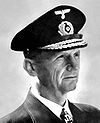 Early in the war, Dönitz submitted a memorandum to Grand Admiral Erich Raeder
, the German Navy's Commander-in-Chief, in which he estimated effective submarine warfare could bring Britain to her knees because of her dependence on overseas commerce. He advocated a system known as the Rudeltaktik (the so-called "wolf pack"), in which U-boats would spread out in a long line across the projected course of a convoy. Upon sighting a target, they would come together to attack en masse and overwhelm any escorting warships. While escorts chased individual submarines, the rest of the "pack" would be able to attack the merchant ships with impunity. Dönitz calculated 300 of the latest Atlantic Boats (the Type VII), would create enough havoc among Allied shipping that Britain would be knocked out of the war.
This was in stark contrast to the traditional view of submarine deployment up until then, in which the submarine was seen as a lone ambusher, waiting outside an enemy port to attack ships entering and leaving. This had been a very successful tactic used by British submarines in the Baltic and Bosporus
during World War I, but it could not be successful if port approaches were well patrolled. There had also been naval theorists who held submarines should be attached to a fleet and used like destroyers; this had been tried by the Germans at Jutland
with poor results, since underwater communications were in their infancy. (Interwar exercises had proven the idea faulty.) The Japanese
also adhered to the idea of a fleet submarine, following the doctrine
of Mahan
, and never used their submarines either for close blockade or convoy interdiction. The submarine was still looked upon by much of the naval world as "dishonourable", compared to the prestige attached to capital ships. This was true in Kriegsmarine as well; Raeder successfully lobbied for the money to be spent on capital ships instead.
The Royal Navy's main anti-submarine weapon before the war was the inshore patrol craft, which was fitted with hydrophones and armed with a small gun and depth charges. The Royal Navy, like most, had not considered anti-submarine warfare
as a tactical subject during the 1920s and 1930s. Unrestricted submarine warfare
had been outlawed by the London Naval Treaty
; anti-submarine warfare was seen as 'defensive' rather than dashing; many naval officers believed anti-submarine work was drudgery similar to mine sweeping; and ASDIC was believed to have rendered submarines impotent. Although destroyers also carried depth charges, it was expected these ships would be used in fleet actions rather than coastal patrol, so they were not extensively trained in their use. The British, however, ignored the fact that arming merchantmen, as Britain did from the start of the war, removed them from the protection of the "cruiser rules", and the fact anti-submarine trials with ASDIC had been conducted in ideal conditions.
The completion of Hitler's campaign in Western Europe meant U-boats withdrawn from the Atlantic for the Norwegian campaign now returned to the war on trade. So at the very time the number of U-boats on patrol in the Atlantic began to increase, the number of escorts available for the convoys was greatly reduced. The only consolation for the British was that the large merchant fleets of occupied countries like Norway and the Netherlands came under British control. After the German occupation of Denmark and Norway, Britain occupied Iceland
and the Faroe Islands, establishing bases there and preventing a German takeover.
It was in these circumstances that Winston Churchill, who had become Prime Minister on May 10, 1940, first wrote to President
Franklin Roosevelt to request the loan of 50 obsolete U.S. destroyers. This eventually led to the "Destroyers for Bases Agreement
" (effectively a sale but portrayed as a loan for political reasons), which operated in exchange for 99-year leases on certain British bases in Newfoundland
, Bermuda
and the West Indies, a financially advantageous bargain for the United States. A significant percentage of the U.S. population opposed entering the war, and some American politicians (including the U.S. Ambassador to Britain, Joseph P. Kennedy) considered Britain and her allies might actually lose. The first of these destroyers was only taken over by their British and Canadian crews in September and all needed to be rearmed and fitted with ASDIC. It was to be many months before these ships contributed to the campaign.
 The early U-boat operations, from the French bases were spectacularly successful. This was the heyday of the great U-boat aces like Günther Prien
of U-47, Otto Kretschmer
(U-99), Joachim Schepke
(U-100), Engelbert Endrass
(U-46), Victor Oehrn
(U-37) and Heinrich Bleichrodt
(U-48). U-boat crews became heroes in Germany. From June until October 1940, over 270 Allied ships were sunk: this period was referred to by U-boat crews as "the Happy Time" ("Die Glückliche Zeit"). Churchill would later write: "...the only thing that ever frightened me during the war was the U-boat peril".
The biggest challenge for the U-boats was to find the convoys in the vastness of the ocean. The Germans had a handful of very long-range Focke-Wulf Fw 200
Condor aircraft based at Bordeaux
and Stavanger
which were used for reconnaissance. The Condor being essentially a converted civilian airliner, this was a stop-gap solution for Fliegerführer Atlantik. Due to ongoing friction between the Luftwaffe and Kriegsmarine, the primary source of convoy sightings was the U-boats themselves. Since a submarine's bridge was very close to the water, their range of visual detection was quite limited. The best source proved to be the codebreakers of B-Dienst
.
In response, the British applied the techniques of operations research
to the problem and came up with series of counter-intuitive solutions to the problem of convoy engagements. It was realised the area of a convoy increased by the square of its perimeter, meaning the same number of ships, using the same number of escorts, were better protected in one convoy than in two. A large convoy was as difficult to locate as a small one. Moreover, reduced frequency (large convoys take longer to assemble) also reduced the chances of detection. Therefore, a few large convoys with an apparently weak escort were safer than many small convoys with a stronger escort.
Instead of attacking the Allied convoys singly, U-boats were directed to work in wolf packs (Rudeln) coordinated by radio. German codebreaking efforts at B-Dienst had succeeded in deciphering the British Naval Cypher No. 3, allowing the Germans to estimate where and when convoys could be expected. The boats spread out into a long patrol line that bisected the path of the Allied convoy routes. Once in position, the crew studied the horizon through binoculars
looking for masts or smoke, or used hydrophones to pick up propeller noises. When one boat sighted a convoy, it would report the sighting to U-boat headquarters
, shadowing and continuing to report as needed until other boats arrived, typically at night. Instead of being faced by single submarines, the convoy escorts then had to cope with groups of up to half a dozen U-boats attacking simultaneously. The most daring commanders, such as Kretschmer, penetrated the escort screen and attacked from within the columns of merchantmen. The escort vessels, which were too few in number and often lacking in endurance, had no answer to multiple submarines attacking on the surface at night as their ASDIC only worked well against underwater targets. Early British marine radar, working in the metric bands, lacked target discrimination and range. Moreover, corvettes were too slow to catch a surfaced U-boat.
Pack tactics were first used successfully in September and October 1940, to devastating effect in a series of convoy battles. On September 21, convoy HX 72
of 42 merchantmen was attacked by a pack of four U-boats, losing eleven ships sunk and two damaged over two nights. In October, the slow convoy SC 7, with an escort of two sloops and two corvettes, was overwhelmed, losing 59% of its ships. The battle for HX 79 in the following days was in many ways worse for the escorts than for SC 7. The loss of a quarter of the convoy without any loss to the U-boats, despite very strong escort (two destroyers, four corvettes, three trawlers, and a minesweeper), demonstrated the effectiveness of the German tactics against the inadequate British anti-submarine methods. On December 1, seven German and three Italian submarines caught HX 90
, sinking 10 ships and damaging three others. The success of pack tactics against these convoys encouraged Admiral Dönitz to adopt the wolf pack as his primary tactic.
Nor were the U-boats the only threat. Following some early experience in support of the war at sea during Operation Weserübung
, Fliegerführer Atlantik contributed small numbers of aircraft to the Battle of the Atlantic from 1940 onwards. These were primarily Fw 200s and (later) Junkers Ju 290
s, used for long-range reconnaissance. The Condors also bombed convoys beyond land-based fighter cover and thus defenceless. Initially, the Condors were very successful, claiming 365,000 tons of shipping in early 1941. These aircraft were few in number, however, and directly under Luftwaffe control; in addition, the pilots had little specialized training for anti-shipping warfare, limiting their effectiveness.
base in Bordeaux to attack Allied shipping in the Atlantic. The Italian submarines, designed for fleet operations in the Mediterranean, were not as well suited to Atlantic conditions as the German U-boats. Even so, the 32 Italian submarines that operated there sank 109 ships of 593,864 tons. The Italians were also successful with their use of 'human torpedo' chariots, disabling several British ships in Gibraltar.
Despite these successes, the Italian intervention was not favourably regarded by Dönitz, who characterised Italians as "inadequately disciplined" and "unable to remain calm in the face of the enemy". They were unable to cooperate in wolf pack tactics or even reliably report contacts or weather conditions and their area of operation was moved away from those of the Germans.
s and later Hedgehog
) to make an anti-submarine warfare system.
ASDIC produced an accurate range and bearing to the target, but could be fooled by thermocline
s, currents or eddies, and schools of fish, so it needed experienced operators to be effective. ASDIC was effective only at low speeds. Above 15 knots (29.4 km/h) or so, the noise of the ship going through the water drowned out the echoes.
The early wartime Royal Navy procedure was to sweep the ASDIC in an arc from one side of the escort's course to the other, stopping the transducer every few degrees to send out a signal. Several ships searching together would be used in a line, 1–1.5 mi (1.6–2.4 km) apart. If an echo was detected, and if the operator identified it as a submarine, the escort would be pointed towards the target and would close at a moderate speed, the submarine's range and bearing would be plotted over time to determine course and speed as the attacker closed to within 1000 yards (914.4 m). Once it was decided to attack, the escort would increase speed, using the target's course and speed data to adjust her own course. The intention was to pass over the submarine, rolling depth charges from chutes at the stern at even intervals, while throwers fired further charges some 40 yd (36.6 m) to either side. The intention was to lay a 'pattern' like an elongated diamond, hopefully with the submarine somewhere inside it. To effectively disable a submarine, a depth charge had to explode within about 20 ft (6.1 m). Since early ASDIC equipment was poor at determining depth, it was usual to vary the depth settings on part of the pattern.
There were disadvantages to the early versions of this system. Exercises in anti-submarine warfare had been restricted to one or two destroyers hunting a single submarine whose starting position was known, and working in daylight and calm weather. U-boats could dive far deeper than British or American submarines (over 700 feet (213.4 m)), well below the 350 feet (106.7 m)) maximum depth charge setting of British depth charges. More importantly, early ASDIC sets could not look directly down, so the operator lost contact on the U-boat during the final stages of the attack, a time when the submarine would certainly be manoeuvring rapidly. The explosion of a depth charge also disturbed the water so ASDIC contact was very difficult to regain if the first attack had failed. It enabled the U-boat to change position with impunity.
The belief ASDIC had solved the submarine problem, the acute budgetary pressures of the Great Depression
, and the pressing demands for many other types of rearmament meant little was spent on anti-submarine ships or weapons. Most British naval spending, and many of the best officers, went into the battlefleet. Critically, the British expected, as in the First World War, German submarines would be coastal craft and only threaten harbour approaches. As a result, the Royal Navy entered the Second World War in 1939 without enough long-range escorts to protect ocean-going shipping, and there were no officers with experience of long-range anti-submarine warfare. The situation in Royal Air Force
Coastal Command was even more dire: patrol aircraft lacked the range to cover the North Atlantic and could typically only machine-gun the spot where they saw a submarine dive.
 Despite their success, U-boats were still not recognized as the primary threat to the North Atlantic convoys. With the exception of men like Dönitz, most naval officers on both sides regarded surface warships as the ultimate commerce destroyers.
For the first half of 1940, there were no German surface raiders in the Atlantic because the German Fleet had been concentrated for the invasion of Norway. The sole pocket battleship raider, Admiral Graf Spee, had been stopped at the Battle of the River Plate by an inferior and outgunned British squadron. From the summer of 1940 a small but steady stream of warships and armed merchant raider
s set sail from Germany for the Atlantic.
The power of a raider against a convoy was demonstrated by the fate of convoy HX 84 which was found by the pocket battleship Admiral Scheer on November 5, 1940. Scheer quickly sank five ships and damaged several others as the convoy scattered. Only the sacrifice of the escorting Armed Merchant Cruiser HMS Jervis Bay and failing light allowed the other merchantmen to escape. The British now suspended North Atlantic convoys and the Home Fleet put to sea to try to intercept Scheer. The search failed and Scheer disappeared into the South Atlantic. She reappeared in the Indian Ocean the following month.
Other German surface raiders now began to make their presence felt. On Christmas Day 1940, the cruiser Admiral Hipper
attacked the troop convoy WS 5A, but was driven off by the escorting cruisers. Hipper had more success two months later, on February 12, 1941, when she found the unescorted convoy SLS 64 of 19 ships and sank seven of them. In January 1941, the formidable (and fast) battleships Scharnhorst
and Gneisenau
, which outgunned any Allied ship that could catch them, put to sea from Germany to raid the shipping lanes in Operation Berlin. With so many German raiders at large in the Atlantic, the British were forced to provide battleship escorts to as many convoys as possible. This twice saved convoys from slaughter by the German battleships. In February, the old battleship HMS Ramillies deterred an attack on HX 106. A month later, SL 67 was saved by the presence of HMS Malaya
.
In May, the Germans mounted the most ambitious raid of all: Operation Rheinübung
. The new battleship Bismarck
and the cruiser Prinz Eugen
put to sea to attack convoys. A British fleet intercepted the raiders off Iceland. In the Battle of the Denmark Strait
, the battlecruiser HMS Hood
was blown up and sunk, but Bismarck was damaged and had to run to France. Bismarck nearly reached her destination, but was disabled by an airstrike from the carrier Ark Royal
, and then sunk by the Home Fleet three days later. Her sinking marked the end of the warship raids. The advent of long-range search aircraft, notably the unglamorous but versatile PBY Catalina
, largely neutralized surface raiders.
In February 1942, Scharnhorst, Gneisenau, and Prinz Eugen moved from Brest back to Germany in the "Channel Dash". While this was an embarrassment for the British, it was the end of the German surface threat in the Atlantic. The loss of Bismarck, Arctic convoys, and the perceived invasion threat to Norway had persuaded Hitler to withdraw.
War had come too early for the German naval expansion project Plan Z
. Battleships powerful enough to destroy any convoy escort, with escorts able to annihilate the convoy, were never achieved. Although the number of ships the raiders sank was relatively small compared with the losses to U-boats, mines, and aircraft, their raids severely disrupted the Allied convoy system, reduced British imports, and strained the Home Fleet.
 The disastrous convoy battles of October 1940 forced a change in British tactics. The most important of these was the introduction of permanent escort groups to improve the co-ordination and effectiveness of ships and men in battle. British efforts were helped by a gradual increase in the number of escort vessels available as the old ex-American destroyers and the new British- and Canadian-built Flower class corvette
s were now coming into service in numbers. Many of these ships became part of the huge expansion of the Royal Canadian Navy
, which grew from a handful of destroyers at the outbreak of war to take an increasing share of convoy escort duty. Others of the new ships were manned by Free French, Norwegian and Dutch crews, but these were a tiny minority of the total number, and directly under British command. By 1941 American public opinion had begun to swing against Germany, but the war was still essentially Great Britain and the Empire against Germany.
Initially, the new escort groups consisted of two or three destroyers and half a dozen corvettes. Since two or three of the group would usually be in dock repairing weather or battle damage, the groups typically sailed with about six ships. The training of the escorts also improved as the realities of the battle became obvious. A new base was set up at Tobermory in the Hebrides
to prepare the new escort ships and their crews for the demands of battle under the strict regime of Vice-Admiral Gilbert O. Stephenson.
In February 1941, the Admiralty moved the headquarters of Western Approaches Command
from Plymouth
to Liverpool
, where much closer contact with, and control of, the Atlantic convoys was possible. Greater co-operation with supporting aircraft was also achieved. In April, the Admiralty took over operational control of Coastal Command aircraft. At a tactical level, new short-wave radar sets that could detect surfaced U-boats and were suitable for both small ships and aircraft began to arrive during 1941.
The impact of these changes first began to be felt in the battles during the spring of 1941. In early March, Prien in U-47 failed to return from patrol. Two weeks later, in the battle of Convoy HX 112, the newly formed 3rd Escort Group of five destroyers and two corvettes held off the U-boat pack. U-100 was detected by the primitive radar on the destroyer Vanoc, rammed and sunk. Shortly afterwards the U-99 was also caught and sunk, its crew captured. Dönitz had lost his three leading aces: Kretschmer, Prien, and Schepke.
Dönitz now moved his wolf packs further west, in order to catch the convoys before the anti-submarine escort joined. This new strategy was rewarded at the beginning of April when the pack found Convoy SC 26
before its anti-submarine escort had joined. Ten ships were sunk, but another U-boat was lost.
on May 23, to assume the responsibility for protecting convoys in the western zone and to establish the base for its escort force at St. John's
, Newfoundland
. On June 13, 1941 Commodore Leonard Murray
, Royal Canadian Navy
, assumed his post as Commodore Commanding Newfoundland Escort Force
, under the overall authority of the Commander-in-Chief, Western Approaches
, at Liverpool. Six Canadian destroyers and 17 corvettes, reinforced by seven destroyers, three sloops, and five corvettes of the Royal Navy, were assembled for duty in the force, which escorted the convoys from Canadian ports to Newfoundland and then on to a meeting point south of Iceland, where the British escort groups took over.
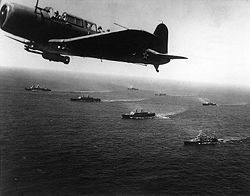 By 1941, the United States was taking an increasing part in the war, despite its nominal neutrality. In April 1941 President Roosevelt extended the Pan-American Security Zone
east almost as far as Iceland
. British forces occupied Iceland
when Denmark fell to the Germans in 1940; the U.S. was persuaded to provide forces to relieve British troops on the island. American warships began escorting Allied convoys in the western Atlantic as far as Iceland, and had several hostile encounters with U-boats. A Mid-Ocean Escort Force
of British, and Canadian, and American destroyers and corvettes was organized following the declaration of war by the United States.
In June 1941, the U.S. realized the tropical Atlantic had become dangerous for unescorted American as well as British ships. On May 21, the SS Robin Moor
, an American vessel carrying no military supplies, was stopped by U-69 750 miles (1,207 km) west of Freetown, Sierra Leone. After its passengers and crew were allowed thirty minutes to board lifeboats, U-69 torpedoed, shelled, and sank the ship. The survivors then drifted without rescue or detection for up to eighteen days. When news of the sinking reached the U.S., few shipping companies felt truly safe anywhere. As Time magazine noted in June 1941, "if such sinkings continue, U.S. ships bound for other places remote from fighting fronts, will be in danger. Henceforth the U.S. would either have to recall its ships from the ocean or enforce its right to the free use of the seas."
At the same time, the British were working on a number of technical developments which would address the German submarine superiority. Though these were British inventions, the critical technologies were provided freely to the U.S., which then re-named and manufactured them. In many cases this has resulted in the misconception these were American developments. Likewise, the U.S. provided the British with innovative technology, like Catalina flying boats and Liberator bombers, that were important contributions to the war effort.
s), equipped with a lone expendable Hurricane
fighter aircraft. When a German bomber approached, the fighter was fired off the end of the ramp with a large rocket to shoot down or drive off the German aircraft, the pilot then ditching in the water and (hopefully) being picked up by one of the escort ships if land was too far away. Nine combat launches were made, resulting in the destruction of eight Axis aircraft for the loss of one Allied pilot.
, which was gradually fitted to the larger escorts. HF/DF let an operator see the direction of a broadcast, even if the messages they were sending could not be read. Since the wolf pack relied on U-boats reporting convoy positions by radio, there was a steady stream of messages to intercept. A destroyer could then run in the direction of the signal and attack the U-boat, or at least force it to submerge (causing it to lose contact), which might prevent an attack on the convoy. When two ships fitted with HF/DF accompanied a convoy, a direction finding "fix" could be obtained. The British also made extensive use of shore HF/DF stations, so they could keep convoys updated with positions of U-boats.
The radio technology behind HF/DF was well understood by both sides, but the common technology before the war used a manually rotated aerial to fix the direction of the transmitter. This was delicate work, took quite a time to accomplish to any degree of accuracy and could easily fix the reciprocal of the signal 180 degrees in the wrong direction. Knowing this, the German U-boat radio operators considered themselves fairly safe if they confined themselves to short messages. The British, however, developed an oscilloscope-based indicator which instantly fixed the position of the shortest message. With this there was hardly any need to triangulate—the escort could just run down the precise bearing provided and use radar for final positioning. Many U-boat attacks were suppressed and submarines sunk in this way—a good example of the great difference minor aspects of technology could make to the battle.
to encipher its message traffic. They considered it unbreakable. Thus they felt safe in exchanging relatively large volumes of radio messages between U-boats and shore commands. This was essential to wolf pack operations, which required a lot of coordination.
In early 1941, the Royal Navy made a concerted effort to assist the codebreakers at Bletchley Park
in breaking German naval Enigma. This climaxed on May 9, when crew members of the destroyer HMS Bulldog
boarded U-110, and recovered all her code books and current Enigma keys. The captured material allowed the reading of all U-boat traffic for several weeks (until the keys ran out); then familiarity with the usual content of messages helped in breaking the new keys.
Throughout the summer and autumn of 1941, Enigma intercepts (combined with HF/DF) enabled the British to plot the positions of U-boat patrol lines and route convoys around them. Merchant ship losses dropped by over two-thirds in July 1941, and remained low until November.
This Allied advantage was offset by the growing numbers of U-boats now coming into service. The German Type VIIC submarine began reaching the Atlantic in large numbers in 1941; eventually 585 of them would be delivered. Although the Allies protected the convoys in late 1941, they were not sinking many U-boats. The "Flower'"-class corvette escorts could detect and defend, but they were not fast enough to go on the attack.
, reinforced by the first of the new escort carriers, HMS Audacity
and three destroyers from Gibraltar. The convoy was immediately intercepted by the waiting U-boat pack, resulting in a brutal battle. Walker was a tactical innovator, his ships' crews were highly trained and the presence of an escort carrier meant that the U-boats were frequently sighted and forced to dive before they could get close to the convoy. Over the next five days, five U-boats were sunk (four by Walker's group), despite the loss of the Audacity after two days. The British lost the Audacity, a destroyer and just two merchant ships. The battle was the first clear Allied convoy victory.
Through dogged effort, the Allies slowly gained the upper hand until the end of 1941. Although Allied warships failed to sink U-boats in large numbers, most convoys evaded attack completely. Shipping losses were high, but manageable.
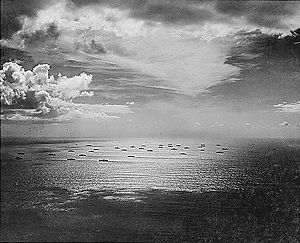
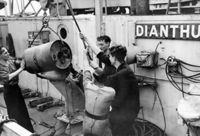

 The attack on Pearl Harbor
and the subsequent German declaration of war on the United States had an immediate effect on the campaign. Dönitz promptly planned to attack shipping off the American East Coast
. He had only 12 Type IX boats able to reach U.S. waters; half of them had been diverted by Hitler to the Mediterranean. One of the remainder was under repair, leaving only five boats for Operation Drumbeat
(Paukenschlag).
The U.S., having no direct experience of modern naval war on its own shores, did not employ a black-out. U-boats simply stood off shore at night and picked out ships silhouetted against city lights. Admiral Ernest King
, Commander-in-Chief United States Fleet (Cominch), who disliked the British, initially rejected Royal Navy calls for a coastal black-out or convoy system. King has been criticized for this decision, but his defenders argue the United States destroyer fleet was limited (partly because of the sale of 50 old destroyers to Britain earlier in the war), and King claimed it was far more important destroyers protect Allied troop transports than merchant shipping. His ships were also busy convoying Lend-Lease
material to the Soviet Union
, as well as fighting the Japanese in the Pacific. This does not explain the refusal to require coastal black-outs, or to respond to any advice the Royal Navy (or Royal Canadian Navy) provided. No troop transports were lost, but merchant ships sailing in U.S. waters were left exposed and suffered accordingly. Britain eventually had to build coastal escorts and provide them to the U.S. in a "reverse Lend Lease", since King was unable (or unwilling) to make any provision himself.
The first U-boats reached U.S. waters on 13 January 1942. By the time they withdrew on 6 February, they had sunk 156,939 tonnes of shipping without loss. The first batch of Type IXs was followed by more Type IXs and Type VIIs supported by Type XIV "Milch Cow" tankers which provided refuelling at sea. They sank 397 ships totalling over 2 million tons (as mentioned previously, not a single troop transport was lost). In 1943, the United States launched over 11 million tons of merchant shipping; that number declined in the later war years, as priorities moved elsewhere.
In May, King (by this time both Cominch and Chief of Naval Operations
{CNO}) finally scraped together enough ships to institute a convoy system. This quickly led to the loss of seven U-boats. The U.S. did not have enough ships to cover all the gaps; the U-boats continued to operate freely during the Battle of the Caribbean
and throughout the Gulf of Mexico
(where they effectively closed several U.S. ports) until July, when the British-loaned escorts began arriving. The institution of an interlocking convoy system on the American coast and in the Caribbean Sea
in mid-1942 resulted in an immediate drop in attacks in those areas. As a result of the increased coastal convoy escort system, the U-boats' attention was shifted back to the Atlantic convoys. For the Allies, the situation was serious but not critical throughout much of 1942.
Operation Drumbeat had one other effect. It was so successful Dönitz's policy of economic war was seen, even by Hitler, as the only effective use of the U-boat; he was given complete freedom to use them as he saw fit. Meanwhile, Raeder was dismissed after the embarrassing Battle of the Barents Sea
, in which two German heavy cruisers were beaten off by half a dozen British destroyers. Dönitz was eventually made Grand Admiral, and all building priorities turned to U-boats.
There were enough U-boats spread across the Atlantic to allow several wolf packs to attack many different convoy routes. Often as many as 10 to 15 boats would attack in one or two waves, following convoys like SC 104 and SC 107 by day and attacking at night. Losses quickly increased and in October 1942, 56 ships of over 258,000 tonnes were sunk in the "air gap" between Greenland
and Iceland.
U-boat losses also climbed. In the first six months of 1942, 21 were lost - less than one for every 40 merchant ships sunk. In August and September, 60 were sunk, one for every 10 merchant ships, almost as many as in the previous two years.
On November 19, 1942, Admiral Noble was replaced as Commander-in-Chief of Western Approaches Command
by Admiral Sir Max Horton
. Horton used the growing number of escorts becoming available to organize "support groups", to reinforce convoys that came under attack. Unlike the regular escort groups, support groups were not directly responsible for the safety of any particular convoy. This gave them much greater tactical flexibility, allowing them to detach ships to hunt submarines spotted by reconnaissance or picked up by HF/DF. Where regular escorts would have to break off and stay with their convoy, the support group ships could keep hunting a U-boat for many hours. One tactic introduced by Captain John Walker was the "hold-down", where a group of ships would patrol over a submerged U-boat until its air ran out and it was forced to the surface. This might require two or three days.
anti-submarine spigot mortar. Unlike depth charges, which exploded at certain set depths, disturbing the water and making it hard to track the target, Hedgehog charges only exploded on impact. This meant a U-boat could be continuously tracked and attacked until it was sunk.
was an improvement on 'Hedgehog' but was not introduced until late 1943. A three-barreled mortar, it projected 100 lb charges ahead or abeam; the charges' firing pistols were automatically set just prior to launch.
Ahead-throwing weapons including Hedgehog and Squid raised the percentage of kills by British surface ships (1943-45) from 85 kills in 5,174 attacks (1.6%) for depth charges, to 47 in 268 attacks (17.5%) for Hedgehog, the success rates rising with time.
in June 1942 was a significant factor in the North Atlantic struggle. It was a powerful searchlight that was automatically aligned with the airborne radar
to illuminate targets suddenly while in the final stages of an attack run. This let British aircraft attack U-boats recharging batteries on the surface at night, forcing German submarine skippers to switch to daytime recharges.
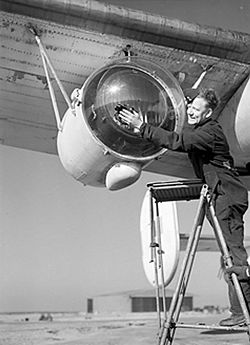
The U-boat commanders who survived reported a particular fear of this weapon system since the noise of an approaching aircraft was inaudible at night above the din made by the boat. The aircraft made contact with the submarine using centimetric radar, which was undetectable with typical U-boat equipment, then lined up on an attack run. When metric radar was used, the set would automatically lower the radar power during the approach so the submarine would not realize it was being tracked. With a mile or so to go the searchlight would automatically come on, immediately and accurately illuminating the target from the sky, which had about five seconds warning before it was hit with a stick of depth bombs. A drop in Allied shipping losses from 600,000 to 200,000 tons per month was attributed to this ingenious device.
after its French manufacturer, was capable of picking up the metric radar bands used by the early radars. This not only enabled U-boats to avoid detection by Canadian escorts, which were equipped with obsolete radar sets, but allowed them to track convoys where these sets were in use.
However, it also caused problems for the Germans, as it sometimes detected stray radar emissions from distant ships or planes, causing U-boats to submerge when they were not in actual danger, preventing them from recharging batteries or using their surfaced speed.
Then on 30 October, crewmen from HMS Petard
salvaged Enigma material from U-559 as it foundered off Port Said
. This material allowed the codebreakers to break TRITON - a feat credited to Alan Turing
. By December 1942, Enigma decrypts were again disclosing U-patrol positions, and shipping losses declined dramatically once more.
and ON 166 in February 1943, but in the spring, convoy battles started up again with the same ferocity. There were so many U-boats on patrol in the North Atlantic, it was difficult for convoys to evade detection, resulting in a succession of vicious battles.
Also, in March the Germans added a refinement to the U-boat Enigma key, which blinded the Allied codebreakers for 10 days. That month saw the battles of convoys UGS 6
, HX 228
, SC 121, SC 122 and HX 229. One hundred twenty ships were sunk worldwide, 82 ships of 476,000 tons in the Atlantic, while 12 U-boats were destroyed.
The supply situation in Britain was such there was talk of being unable to continue the war, with supplies of fuel being particularly low. It appeared Dönitz was winning. The situation was so bad, the British considered abandoning convoy entirely. The next two months saw a complete reversal of fortunes.
In April, losses of U-boats increased while their kills fell significantly. Only 39 ships of 235,000 tons were sunk in the Atlantic, and 15 U-boats were destroyed.
By May, wolf packs no longer had the advantage and that month became known as Black May
in the U-Boat Arm (U-Boot Waffe). The turning point was the battle centred around slow convoy ONS 5 (April–May 1943). Made up of 43 merchantmen escorted by 16 warships, it was attacked by a pack of 30 U-boats. Although 13 merchant ships were lost, six U-boats were sunk by the escorts or Allied aircraft. Despite a storm which scattered the convoy, the merchantmen reached the protection of land-based air cover, causing Dönitz to call off the attack. Two weeks later, SC 130 saw five U-boats destroyed for no losses. Faced with disaster, Dönitz called off operations in the North Atlantic, saying, "We had lost the Battle of the Atlantic".
In all, 43 U-boats were destroyed in May, 34 in the Atlantic. This was 25% of UbW's total operational strength. The Allies lost 58 ships in the same period, 34 of these (totalling 134,000 tons) in the Atlantic.
.jpg) The Battle of the Atlantic was won by the Allies in two months. There was no single reason for this, but what had changed was a sudden convergence of technologies, combined with an increase in Allied resources.
The Battle of the Atlantic was won by the Allies in two months. There was no single reason for this, but what had changed was a sudden convergence of technologies, combined with an increase in Allied resources.
The mid-Atlantic gap
that had been unreachable by aircraft was closed by long-range B-24 Liberator
s. At the May 1943 Trident conference, Admiral King requested General Henry H. Arnold
send a squadron of ASW-configured B-24s to Newfoundland to strengthen the air escort of North Atlantic convoys. General Arnold ordered his squadron commander to engage only in "offensive" search and attack missions and not in escort-of-convoys. In June, General Arnold suggested the Navy assume responsibility for ASW operations. Admiral King requested the Army's ASW-configured B-24s in exchange for an equal number of unmodified Navy B-24s. Agreement was reached in July and the exchange was completed in September 1943.
Further air cover was provided by the introduction of merchant aircraft carrier
s or MAC ships and later the growing numbers of American-built escort carrier
s. Flying primarily Grumman F4F/FM Wildcat
s and Grumman TBF/TBM Avenger
s, they sailed with the convoys and provided much needed air cover and patrols all the way across the Atlantic.
Larger numbers of escorts became available, both as a result of American building programmes and the release of escorts committed to the North African landings during November and December 1942. In particular, destroyer escort
s (similar British ships were known as frigate
s) were designed, which could be built more economically than expensive fleet destroyers and were more seaworthy than corvettes. There would not only be sufficient numbers of escorts to securely protect convoys, they could also form hunter-killer groups (often centred around escort carriers) to aggressively hunt U-boats.
By spring 1943, the British had developed an effective sea-scanning radar small enough to be carried in patrol aircraft armed with airborne depth charges. Centimetric radar greatly improved interception and was undetectable by Metox. Fitted with it, RAF Coastal Command
sank more U-Boats than any other Allied service in the last three years of the war. During 1943, U-boat losses amounted to 258 to all causes. Of this total, 90 were sunk by Coastal Command and 51 damaged.
Allied air forces developed tactics and technology to make the Bay of Biscay
, the main route for France-based U-boats, very dangerous. The Leigh Light enabled attacks on U-boats recharging their batteries on the surface at night. Fliegerführer Atlantik responded by providing fighter cover for U-boats moving into and returning from the Atlantic and for returning blockade runner
s. Nevertheless, with intelligence coming from resistance
personnel in the ports themselves, the last few miles to and from port proved hazardous to many U-Boats.
Dönitz's aim in this tonnage war was to sink Allied ships faster than they could be replaced; as losses fell and production rose, particularly in the United States, this became impossible.
and Elektroboot
types. Among these upgrades were improved anti-aircraft defences, radar detectors, better torpedoes, decoys, and Schnorchel
s (snorkels), which allowed U-boats to run underwater off their diesel engines.
The return to the offensive in September 1943, in the North Atlantic saw initial success, with an attack on ONS 18 and ON 202. A series of battles saw fewer victories and more losses for UbW. After four months, BdU again called off the offensive; eight ships of 56,000 tons and six warships had been sunk for the loss of 39 U-boats, a catastrophic loss ratio.
The Luftwaffe also introduced the long-range He 177
bomber and the Henschel Hs 293
guided glider bomb, which claimed a number of victims, but Allied air superiority prevented them being a major threat.
The Germans also introduced improved radar warning units, such as the Wanze
.
To fool Allied sonar, the Germans deployed Bold canisters (which the British called Submarine Bubble Target) to generate false echoes, as well as Sieglinde
self-propelled decoys.
The development of torpedoes also improved with the pattern-running FAT
(Flächen-Absuch-Torpedo), which ran a pre-programmed course criss-crossing the convoy path, and the acoustic torpedo
(known to the Allies as German Naval Acoustic Torpedo, or GNAT), which would home on the propeller noise of a target. This was initially very effective, but the Allies quickly developed counter-measures, both tactical ("Step-Aside") and technical ("Foxer
").
None of the German measures were truly effective and by 1943 Allied air power was so strong U-boats were being attacked in the Bay of Biscay
shortly after leaving port. The Germans had lost the technological race. Their actions were restricted to lone-wolf attacks in British coastal waters, and preparation to resist the expected invasion of France
.
Over the next two years, many U-boats were sunk, usually with all hands. With the battle won by the Allies, supplies poured into Britain and North Africa for the eventual liberation of Europe.
' series: the Type XXI and short range Type XXIII. The Type XXI could run submerged at 17 knots (33.3 km/h), faster than a Type VII at full speed surfaced, and faster than Allied corvettes. Designs were finalized in January 1943 but mass-production of the new types did not start until 1944. By 1945, just five Type XXIII and one Type XXI boats were operational. The Type XXIIIs made nine patrols, sinking five ships in the first five months of 1945; only one combat patrol was carried out by a Type XXI before the war ended, making no contact with the enemy.
As the Allied armies closed in on the U-boat bases in North Germany, over 200 boats were scuttled to avoid capture; those of most value attempted to flee to Norway. In the first week of May, twenty-three boats were sunk in the Baltic while attempting this journey.
The last actions in American waters
took place on 5/6 May 1945, which saw the sinking of SS Black Point and the destruction of U-853 and U-881
in separate incidents.
The last actions of the Battle of the Atlantic
were on 7/8 May. U-320 was the last U-boat sunk in action, by an RAF Catalina; while the Allied minesweeper NYMS 382 and the freighters Sneland and Avondale Park were torpedoed in separate incidents, just hours before the German surrender
.
The remaining U-boats, at sea or in port, were surrendered to the Allies, 174 in total. Most were destroyed in Operation Deadlight
after the war.
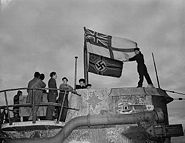 The Germans failed to stop the flow of strategic supplies to Britain. This failure resulted in the build-up of troops and supplies needed for the D-Day landings. The defeat of the U-boat was a necessary precursor for accumulation of Allied troops and supplies to ensure Germany's defeat.
Victory was achieved at a huge cost: between 1939 and 1945, 3,500 Allied merchant ships (totalling 14.5 million gross tons) and 175 Allied warships were sunk and some 72,200 Allied sailors and merchant seamen lost their lives. The Germans lost 783 U-boats and approximately 30,000 sailors killed, three-fourths of Germany's 40,000-man U-boat fleet.
Losses:
The British merchant fleet was made up of vessels from the many and varied private shipping lines, examples being the tankers of the British Tanker Company
and the freighters of Ellerman
and Silver Lines. The British government, via the Ministry of War Transport, also had new ships built during the course of the war, these being known as Empire ship
s.
s totalling 38.5 million tons, vastly exceeding the 14 million tons of shipping the German U-boats were able to sink during the war.
At the outbreak of the war, Canada possessed 38 ocean-going merchant vessels. By the end of hostilities, in excess of 400 cargo ships had been built in Canada.
The Battle of the Atlantic was the only battle of the Second World War to touch North American shores. U-boats disrupted coastal shipping from the Caribbean to Halifax, during the summer of 1942 they even entered the Gulf of St. Lawrence.
Canadian officers wore uniforms which were virtually identical in style to those of the British. The ordinary seamen were issued with an 'MN Canada' badge to wear on their lapel when on leave, to indicate their service.
At the end of the war, Rear Admiral Leonard Murray
, Commander-in-Chief Canadian North Atlantic, remarked, "...the Battle of the Atlantic was not won by any Navy or Air Force, it was won by the courage, fortitude and determination of the British and Allied Merchant Navy."
ordered all Norwegian ships to sail to German, Italian or neutral ports. He was ignored. All Norwegian ships decided to put their services at the disposal of the Allies. The vessels of the Norwegian Merchant Navy were placed under the control of the government run Nortraship
, with headquarters in London and New York.
Nortraship’s modern ships, especially its tankers, were extremely important to the Allies. Norwegian tankers carried nearly one-third of the oil transported to Britain during the war. Records show that 694 Norwegian ships were sunk during this period, representing 47% of the total fleet. At the end of the war in 1945, the Norwegian merchant fleet was estimated at 1,378 ships. More than 3,700 Norwegian merchant seamen lost their lives.
Biographies
General histories of the campaign
Military campaign
In the military sciences, the term military campaign applies to large scale, long duration, significant military strategy plan incorporating a series of inter-related military operations or battles forming a distinct part of a larger conflict often called a war...
in World War II
World War II
World War II, or the Second World War , was a global conflict lasting from 1939 to 1945, involving most of the world's nations—including all of the great powers—eventually forming two opposing military alliances: the Allies and the Axis...
, running from 1939 to the defeat of Germany
Nazi Germany
Nazi Germany , also known as the Third Reich , but officially called German Reich from 1933 to 1943 and Greater German Reich from 26 June 1943 onward, is the name commonly used to refer to the state of Germany from 1933 to 1945, when it was a totalitarian dictatorship ruled by...
in 1945. At its core was the Allied naval blockade of Germany, announced the day after the declaration of war, and Germany's subsequent counter-blockade. It was at its height from mid-1940 through to the end of 1943. The Battle of the Atlantic
Atlantic Ocean
The Atlantic Ocean is the second-largest of the world's oceanic divisions. With a total area of about , it covers approximately 20% of the Earth's surface and about 26% of its water surface area...
pitted U-boat
U-boat
U-boat is the anglicized version of the German word U-Boot , itself an abbreviation of Unterseeboot , and refers to military submarines operated by Germany, particularly in World War I and World War II...
s and other warships of the Kriegsmarine
Kriegsmarine
The Kriegsmarine was the name of the German Navy during the Nazi regime . It superseded the Kaiserliche Marine of World War I and the post-war Reichsmarine. The Kriegsmarine was one of three official branches of the Wehrmacht, the unified armed forces of Nazi Germany.The Kriegsmarine grew rapidly...
(German Navy) and aircraft of the Luftwaffe (German Air Force) against Allied
Allies of World War II
The Allies of World War II were the countries that opposed the Axis powers during the Second World War . Former Axis states contributing to the Allied victory are not considered Allied states...
merchant shipping. The convoy
Convoy
A convoy is a group of vehicles, typically motor vehicles or ships, traveling together for mutual support and protection. Often, a convoy is organized with armed defensive support, though it may also be used in a non-military sense, for example when driving through remote areas.-Age of Sail:Naval...
s, coming mainly from North America
North America
North America is a continent wholly within the Northern Hemisphere and almost wholly within the Western Hemisphere. It is also considered a northern subcontinent of the Americas...
and mainly going to the United Kingdom
United Kingdom
The United Kingdom of Great Britain and Northern IrelandIn the United Kingdom and Dependencies, other languages have been officially recognised as legitimate autochthonous languages under the European Charter for Regional or Minority Languages...
and the Soviet Union
Soviet Union
The Soviet Union , officially the Union of Soviet Socialist Republics , was a constitutionally socialist state that existed in Eurasia between 1922 and 1991....
, were protected for the most part by the British
Royal Navy
The Royal Navy is the naval warfare service branch of the British Armed Forces. Founded in the 16th century, it is the oldest service branch and is known as the Senior Service...
and Canadian
Royal Canadian Navy
The history of the Royal Canadian Navy goes back to 1910, when the naval force was created as the Naval Service of Canada and renamed a year later by King George V. The Royal Canadian Navy is one of the three environmental commands of the Canadian Forces...
navies and air forces. These forces were aided by ships and aircraft of the United States
United States Navy
The United States Navy is the naval warfare service branch of the United States Armed Forces and one of the seven uniformed services of the United States. The U.S. Navy is the largest in the world; its battle fleet tonnage is greater than that of the next 13 largest navies combined. The U.S...
from September 13, 1941. The Germans were joined by submarine
Submarine
A submarine is a watercraft capable of independent operation below the surface of the water. It differs from a submersible, which has more limited underwater capability...
s of the Italian Royal Navy
Regia Marina
The Regia Marina dates from the proclamation of the Kingdom of Italy in 1861 after Italian unification...
(Regia Marina
Regia Marina
The Regia Marina dates from the proclamation of the Kingdom of Italy in 1861 after Italian unification...
) after their Axis
Axis Powers
The Axis powers , also known as the Axis alliance, Axis nations, Axis countries, or just the Axis, was an alignment of great powers during the mid-20th century that fought World War II against the Allies. It began in 1936 with treaties of friendship between Germany and Italy and between Germany and...
ally Italy
Kingdom of Italy (1861–1946)
The Kingdom of Italy was a state forged in 1861 by the unification of Italy under the influence of the Kingdom of Sardinia, which was its legal predecessor state...
entered the war on June 10, 1940.
As an island nation, the United Kingdom was highly dependent on imported goods. Britain required more than a million tons of imported material per week in order to be able to survive and fight. In essence, the Battle of the Atlantic was a tonnage war
Tonnage war
A tonnage war is a military strategy aimed at merchant shipping. The premise is that an enemy has only a finite number of ships, and a finite capacity to build replacements for them. The concept was made famous by U-boat commander Karl Dönitz, who wrote: The shipping of the enemy powers is one...
: the Allied struggle to supply Britain and the Axis attempt to stem the flow of merchant shipping which enabled Britain to keep fighting. From 1942 onwards, the Germans also sought to prevent the build-up of Allied supplies and equipment in the British Isles in preparation for the invasion of occupied Europe. The defeat of the U-boat threat was a pre-requisite for pushing back the Germans. Winston Churchill
Winston Churchill
Sir Winston Leonard Spencer-Churchill, was a predominantly Conservative British politician and statesman known for his leadership of the United Kingdom during the Second World War. He is widely regarded as one of the greatest wartime leaders of the century and served as Prime Minister twice...
was later to state:
The Battle of the Atlantic was the dominating factor all through the war. Never for one moment could we forget that everything happening elsewhere, on land, at sea or in the air depended ultimately on its outcome.
The outcome of the battle was a strategic victory for the Allies—the German blockade failed—but at great cost: 3,500 merchant ships and 175 warships were sunk for the loss of 783 U-boats.
The name "Battle of the Atlantic", coined by Winston Churchill in 1941, covers a campaign that began on the first day of the European war and lasted for six years, involved thousands of ships and stretched over thousands of square miles of ocean in more than 100 convoy battles and perhaps 1,000 single-ship encounters. The situation swung back and forth over the six years as new weapons, tactics and counter-measures were developed by both sides. The Allies gradually gained the upper hand, driving the German surface raiders from the ocean by the end of 1942 and decisively defeating the U-boats by mid-1943. New German submarine types arrived in 1945, too late to affect the course of the war.
Background
Following the use of unrestricted submarine warfareUnrestricted submarine warfare
Unrestricted submarine warfare is a type of naval warfare in which submarines sink merchantmen without warning, as opposed to attacks per prize rules...
by Germany in the First World War
World War I
World War I , which was predominantly called the World War or the Great War from its occurrence until 1939, and the First World War or World War I thereafter, was a major war centred in Europe that began on 28 July 1914 and lasted until 11 November 1918...
, countries tried to limit, even abolish, submarines. The effort failed. Instead, the London Naval Treaty
London Naval Treaty
The London Naval Treaty was an agreement between the United Kingdom, the Empire of Japan, France, Italy and the United States, signed on April 22, 1930, which regulated submarine warfare and limited naval shipbuilding. Ratifications were exchanged in London on October 27, 1930, and the treaty went...
required submarines to abide by "cruiser rules", which demanded they surface, search and place ship crews in "a place of safety" (for which lifeboats did not qualify, except under particular circumstances) before sinking them, unless the ship in question showed "persistent refusal to stop...or active resistance to visit or search". These regulations did not prohibit arming merchantmen, but doing so, or having them report contact with submarines (or raider
Commerce raiding
Commerce raiding or guerre de course is a form of naval warfare used to destroy or disrupt the logistics of an enemy on the open sea by attacking its merchant shipping, rather than engaging the combatants themselves or enforcing a blockade against them.Commerce raiding was heavily criticised by...
s), made them de facto naval auxiliaries and removed the protection of the cruiser rules. This made restrictions on submarines effectively moot.
Early skirmishes (September 1939 – May 1940)
In 1939, the Kriegsmarine lacked the strength to challenge the combined British Royal Navy and French NavyFrench Navy
The French Navy, officially the Marine nationale and often called La Royale is the maritime arm of the French military. It includes a full range of fighting vessels, from patrol boats to a nuclear powered aircraft carrier and 10 nuclear-powered submarines, four of which are capable of launching...
(Marine Nationale) for command of the sea. Instead, German naval strategy relied on commerce raiding
Commerce raiding
Commerce raiding or guerre de course is a form of naval warfare used to destroy or disrupt the logistics of an enemy on the open sea by attacking its merchant shipping, rather than engaging the combatants themselves or enforcing a blockade against them.Commerce raiding was heavily criticised by...
using capital ships, armed merchant cruisers, submarines and aircraft. Many German warships were already at sea when war was declared, including most of the available U-boats and the "pocket battleships" (Panzerschiffe) Deutschland
German pocket battleship Deutschland
Deutschland was the lead ship of her class of heavy cruisers which served with the Kriegsmarine of Nazi Germany during World War II. Ordered by the Weimar government for the Reichsmarine, she was laid down at the Deutsche Werke shipyard in Kiel in February 1929 and completed by April 1933...
and Admiral Graf Spee which had sortied into the Atlantic in August. These ships immediately attacked British and French shipping. U-30 sank the liner SS Athenia
SS Athenia
The S.S. Athenia was the first British ship to be sunk by Nazi Germany in World War II.-Description:Athenia was built by the Fairfield Shipbuilding and Engineering Company, Ltd., and was launched at Govan, Scotland in 1923. She was built for Anchor-Donaldson Ltd.'s route between Britain and Canada...
within hours of the declaration of war—in breach of her orders not to sink passenger ships. The U-boat fleet, which was to dominate so much of the Battle of the Atlantic, was small at the beginning of the war; many of the 57 available U-boats were the small and short-range Type IIs, useful primarily for minelaying
Naval mine
A naval mine is a self-contained explosive device placed in water to destroy surface ships or submarines. Unlike depth charges, mines are deposited and left to wait until they are triggered by the approach of, or contact with, an enemy vessel...
and operations in British coastal waters. Much of the early German anti-shipping activity involved minelaying by destroyer
Destroyer
In naval terminology, a destroyer is a fast and maneuverable yet long-endurance warship intended to escort larger vessels in a fleet, convoy or battle group and defend them against smaller, powerful, short-range attackers. Destroyers, originally called torpedo-boat destroyers in 1892, evolved from...
s, aircraft and U-boats off British ports.
With the outbreak of war, the British and French immediately began a blockade
Blockade of Germany (1939 - 1945)
The Blockade of Germany also known as the Economic War, was carried out during the Second World War by Great Britain, France and later the United States in order to restrict the supplies of minerals, metals, food and textiles Germany needed to sustain its war effort...
of Germany, although this had little immediate effect on German industry. The Royal Navy quickly introduced a convoy system for the protection of trade that gradually extended out from the British Isles, eventually reaching as far as Panama
Panama
Panama , officially the Republic of Panama , is the southernmost country of Central America. Situated on the isthmus connecting North and South America, it is bordered by Costa Rica to the northwest, Colombia to the southeast, the Caribbean Sea to the north and the Pacific Ocean to the south. The...
, Bombay and Singapore
Singapore
Singapore , officially the Republic of Singapore, is a Southeast Asian city-state off the southern tip of the Malay Peninsula, north of the equator. An island country made up of 63 islands, it is separated from Malaysia by the Straits of Johor to its north and from Indonesia's Riau Islands by the...
. Convoys allowed the Royal Navy to concentrate its escorts near the one place the U-boats were guaranteed to be found — the convoys. Each convoy consisted of between 30 and 70 mostly unarmed merchant ships.
Some British naval officials, particularly the First Lord of the Admiralty, Winston Churchill, sought a more 'offensive' strategy. The Royal Navy formed anti-submarine hunting groups based on aircraft carrier
Aircraft carrier
An aircraft carrier is a warship designed with a primary mission of deploying and recovering aircraft, acting as a seagoing airbase. Aircraft carriers thus allow a naval force to project air power worldwide without having to depend on local bases for staging aircraft operations...
s to patrol the shipping lanes in the Western Approaches
Western Approaches
The Western Approaches is a rectangular area of the Atlantic ocean lying on the western coast of Great Britain. The rectangle is higher than it is wide, the north and south boundaries defined by the north and south ends of the British Isles, the eastern boundary lying on the western coast, and the...
and hunt for German U-boats. This strategy was deeply flawed because a U-boat, with its tiny silhouette, was always likely to spot the surface warships and submerge long before it was sighted. The carrier aircraft were little help. Although they could spot submarines on the surface, at this stage of the war they had no adequate weapons to attack them. Any submarine found by an aircraft was long gone by the time surface warships arrived. The hunting group strategy proved a disaster within days. On September 14 1939, Britain's most modern carrier, HMS Ark Royal
HMS Ark Royal (91)
HMS Ark Royal was an aircraft carrier of the Royal Navy that served during the Second World War.Designed in 1934 to fit the restrictions of the Washington Naval Treaty, Ark Royal was built by Cammell Laird and Company, Ltd. at Birkenhead, England, and completed in November 1938. Her design...
, narrowly avoided being sunk when three torpedoes from U-39 exploded prematurely. U-39 was promptly forced to surface and scuttle by the escorting destroyers, becoming the first U-boat loss of the war. The British failed to learn the lesson: another carrier, HMS Courageous
HMS Courageous (50)
HMS Courageous was the lead ship of the cruisers built for the Royal Navy during the First World War. Designed to support the Baltic Project championed by the First Sea Lord, John Fisher, the ship was very lightly armoured and armed with only a few heavy guns. Courageous was completed in late...
, was sunk three days later by U-29
German submarine U-29 (1936)
German submarine U-29 was a Type VIIA U-boat of the German Kriegsmarine during World War II.She was laid down on 2 January 1936 and commissioned on 10 November 1936. During her career U-29 was involved in seven war patrols under the command of Kapitänleutnant Otto Schuhart...
.
Escort destroyers hunting for U-boats continued to be a prominent, but misguided, feature of British anti-submarine strategy for the first year of the war. U-boats nearly always proved elusive, and the convoys, denuded of cover, were put at even greater risk.
German success in sinking Courageous was surpassed a month later when Günther Prien
Günther Prien
Lieutenant Commander Günther Prien was one of the outstanding German U-boat aces of the first part of the Second World War, and the first U-boat commander to win the Knight's Cross of the Iron Cross. Under Prien's command, the submarine sank over 30 Allied ships totaling about...
in U-47 penetrated the British base at Scapa Flow
Scapa Flow
right|thumb|Scapa Flow viewed from its eastern endScapa Flow is a body of water in the Orkney Islands, Scotland, United Kingdom, sheltered by the islands of Mainland, Graemsay, Burray, South Ronaldsay and Hoy. It is about...
and sank the old battleship HMS Royal Oak
HMS Royal Oak (1914)
HMS Royal Oak was a Revenge-class battleship of the British Royal Navy. Launched in 1914 and completed in 1916, Royal Oak first saw action at the Battle of Jutland. In peacetime, she served in the Atlantic, Home and Mediterranean fleets, more than once coming under accidental attack...
at anchor. Prien immediately became a hero in Germany.
In the South Atlantic, British forces were stretched by the cruise of Admiral Graf Spee, which sank nine merchant ships of 50,000 tons in the South Atlantic and Indian Oceans during the first three months of war. The British and French formed a series of hunting groups including three battlecruiser
Battlecruiser
Battlecruisers were large capital ships built in the first half of the 20th century. They were developed in the first decade of the century as the successor to the armoured cruiser, but their evolution was more closely linked to that of the dreadnought battleship...
s, three aircraft carriers, and 15 cruisers to seek the raider and her sister Deutschland, which was operating in the North Atlantic. These hunting groups had no success until Graf Spee was caught off the mouth of the River Plate
Battle of the River Plate
The Battle of the River Plate was the first naval battle in the Second World War. The German pocket battleship had been commerce raiding since the start of the war in September 1939...
by an inferior British force. After suffering damage in the subsequent action, she took shelter in neutral Montevideo harbour and was scuttled
Scuttling
Scuttling is the act of deliberately sinking a ship by allowing water to flow into the hull.This can be achieved in several ways—valves or hatches can be opened to the sea, or holes may be ripped into the hull with brute force or with explosives...
on 17 December 1939.
After this initial burst of activity, the Atlantic campaign quieted down. Admiral Karl Dönitz
Karl Dönitz
Karl Dönitz was a German naval commander during World War II. He started his career in the German Navy during World War I. In 1918, while he was in command of , the submarine was sunk by British forces and Dönitz was taken prisoner...
, commander of the U-boat fleet, had planned a maximum submarine effort for the first month of the war, with almost all the available U-boats out on patrol in September. That level of deployment could not be sustained; the boats needed to return to harbour to refuel, re-arm, re-stock supplies, and refit. The harsh winter of 1939–40, which froze over many of the Baltic ports, seriously hampered the German offensive by trapping several new U-boats in the ice. Hitler
Adolf Hitler
Adolf Hitler was an Austrian-born German politician and the leader of the National Socialist German Workers Party , commonly referred to as the Nazi Party). He was Chancellor of Germany from 1933 to 1945, and head of state from 1934 to 1945...
's plans to invade Norway
Norway
Norway , officially the Kingdom of Norway, is a Nordic unitary constitutional monarchy whose territory comprises the western portion of the Scandinavian Peninsula, Jan Mayen, and the Arctic archipelago of Svalbard and Bouvet Island. Norway has a total area of and a population of about 4.9 million...
and Denmark
Denmark
Denmark is a Scandinavian country in Northern Europe. The countries of Denmark and Greenland, as well as the Faroe Islands, constitute the Kingdom of Denmark . It is the southernmost of the Nordic countries, southwest of Sweden and south of Norway, and bordered to the south by Germany. Denmark...
in the spring of 1940 led to the withdrawal of the fleet's surface warships and most of the ocean-going U-boats for fleet operations in Operation Weserübung
Operation Weserübung
Operation Weserübung was the code name for Germany's assault on Denmark and Norway during the Second World War and the opening operation of the Norwegian Campaign...
.
The resulting Norwegian campaign
Norwegian Campaign
The Norwegian Campaign was a military campaign that was fought in Norway during the Second World War between the Allies and Germany, after the latter's invasion of the country. In April 1940, the United Kingdom and France came to Norway's aid with an expeditionary force...
revealed serious flaws in the magnetic influence pistol (firing mechanism) of the U-boats' principal weapon, the torpedo
Torpedo
The modern torpedo is a self-propelled missile weapon with an explosive warhead, launched above or below the water surface, propelled underwater towards a target, and designed to detonate either on contact with it or in proximity to it.The term torpedo was originally employed for...
. Although the narrow fjords gave U-boats little room for manoeuver, the concentration of British warships, troopships and supply ships provided countless opportunities for the U-boats to attack. Time and again, U-boat captains tracked British targets and fired, only to watch the ships sail on unharmed as the torpedoes exploded prematurely (due to the influence pistol), or hit and failed to explode (because of a faulty contact pistol), or ran beneath the target without exploding (due to the influence feature or depth control not working correctly). Not a single British warship was sunk by a U-boat in more than 20 attacks. As the news spread through the U-boat fleet, it began to undermine morale. The director in charge of torpedo development continued to claim it was the crews' fault. In early 1941, the problems were determined to be due to differences in magnetic fields at high latitudes and a slow leakage of high-pressure air from the submarine into the torpedo's depth regulation gear. Eventually those problems were solved by about March 1941, allowing the torpedos to become a formidable weapon.
Submarine warfare
Erich Raeder
Erich Johann Albert Raeder was a naval leader in Germany before and during World War II. Raeder attained the highest possible naval rank—that of Großadmiral — in 1939, becoming the first person to hold that rank since Alfred von Tirpitz...
, the German Navy's Commander-in-Chief, in which he estimated effective submarine warfare could bring Britain to her knees because of her dependence on overseas commerce. He advocated a system known as the Rudeltaktik (the so-called "wolf pack"), in which U-boats would spread out in a long line across the projected course of a convoy. Upon sighting a target, they would come together to attack en masse and overwhelm any escorting warships. While escorts chased individual submarines, the rest of the "pack" would be able to attack the merchant ships with impunity. Dönitz calculated 300 of the latest Atlantic Boats (the Type VII), would create enough havoc among Allied shipping that Britain would be knocked out of the war.
This was in stark contrast to the traditional view of submarine deployment up until then, in which the submarine was seen as a lone ambusher, waiting outside an enemy port to attack ships entering and leaving. This had been a very successful tactic used by British submarines in the Baltic and Bosporus
Bosporus
The Bosphorus or Bosporus , also known as the Istanbul Strait , is a strait that forms part of the boundary between Europe and Asia. It is one of the Turkish Straits, along with the Dardanelles...
during World War I, but it could not be successful if port approaches were well patrolled. There had also been naval theorists who held submarines should be attached to a fleet and used like destroyers; this had been tried by the Germans at Jutland
Battle of Jutland
The Battle of Jutland was a naval battle between the British Royal Navy's Grand Fleet and the Imperial German Navy's High Seas Fleet during the First World War. The battle was fought on 31 May and 1 June 1916 in the North Sea near Jutland, Denmark. It was the largest naval battle and the only...
with poor results, since underwater communications were in their infancy. (Interwar exercises had proven the idea faulty.) The Japanese
Empire of Japan
The Empire of Japan is the name of the state of Japan that existed from the Meiji Restoration on 3 January 1868 to the enactment of the post-World War II Constitution of...
also adhered to the idea of a fleet submarine, following the doctrine
Military doctrine
Military doctrine is the concise expression of how military forces contribute to campaigns, major operations, battles, and engagements.It is a guide to action, not hard and fast rules. Doctrine provides a common frame of reference across the military...
of Mahan
Alfred Thayer Mahan
Alfred Thayer Mahan was a United States Navy flag officer, geostrategist, and historian, who has been called "the most important American strategist of the nineteenth century." His concept of "sea power" was based on the idea that countries with greater naval power will have greater worldwide...
, and never used their submarines either for close blockade or convoy interdiction. The submarine was still looked upon by much of the naval world as "dishonourable", compared to the prestige attached to capital ships. This was true in Kriegsmarine as well; Raeder successfully lobbied for the money to be spent on capital ships instead.
The Royal Navy's main anti-submarine weapon before the war was the inshore patrol craft, which was fitted with hydrophones and armed with a small gun and depth charges. The Royal Navy, like most, had not considered anti-submarine warfare
Anti-submarine warfare
Anti-submarine warfare is a branch of naval warfare that uses surface warships, aircraft, or other submarines to find, track and deter, damage or destroy enemy submarines....
as a tactical subject during the 1920s and 1930s. Unrestricted submarine warfare
Unrestricted submarine warfare
Unrestricted submarine warfare is a type of naval warfare in which submarines sink merchantmen without warning, as opposed to attacks per prize rules...
had been outlawed by the London Naval Treaty
London Naval Treaty
The London Naval Treaty was an agreement between the United Kingdom, the Empire of Japan, France, Italy and the United States, signed on April 22, 1930, which regulated submarine warfare and limited naval shipbuilding. Ratifications were exchanged in London on October 27, 1930, and the treaty went...
; anti-submarine warfare was seen as 'defensive' rather than dashing; many naval officers believed anti-submarine work was drudgery similar to mine sweeping; and ASDIC was believed to have rendered submarines impotent. Although destroyers also carried depth charges, it was expected these ships would be used in fleet actions rather than coastal patrol, so they were not extensively trained in their use. The British, however, ignored the fact that arming merchantmen, as Britain did from the start of the war, removed them from the protection of the "cruiser rules", and the fact anti-submarine trials with ASDIC had been conducted in ideal conditions.
British situation
The German occupation of Norway in April 1940, the rapid conquest of the Low Countries and France in May and June and the Italian entry into the war on the Axis side in June transformed the war at sea in general and the Atlantic campaign in particular in three main ways:- Britain lost her biggest ally. In 1940, the French Navy was the fourth largest in the world. Only a handful of French ships joined the Free French ForcesFree French ForcesThe Free French Forces were French partisans in World War II who decided to continue fighting against the forces of the Axis powers after the surrender of France and subsequent German occupation and, in the case of Vichy France, collaboration with the Germans.-Definition:In many sources, Free...
and fought against Germany, though these were later joined by a few Canadian-built corvetteCorvetteA corvette is a small, maneuverable, lightly armed warship, originally smaller than a frigate and larger than a coastal patrol craft or fast attack craft , although many recent designs resemble frigates in size and role...
s. With the French fleet removed from the campaign, the Royal Navy was stretched even further. Italy's declaration of war meant that Britain also had to reinforce her Mediterranean FleetMediterranean Fleet (Royal Navy)The British Mediterranean Fleet was part of the Royal Navy. The Fleet was one of the most prestigious commands in the navy for the majority of its history, defending the vital sea link between the United Kingdom and the majority of the British Empire in the Eastern Hemisphere...
and establish a new group at GibraltarGibraltarGibraltar is a British overseas territory located on the southern end of the Iberian Peninsula at the entrance of the Mediterranean. A peninsula with an area of , it has a northern border with Andalusia, Spain. The Rock of Gibraltar is the major landmark of the region...
, known as Force HForce HForce H was a British naval formation during the Second World War. It was formed in 1940 to replace French naval power in the western Mediterranean that had been removed by the French armistice with Nazi Germany....
, to replace the French fleet in the Western Mediterranean. - The U-boats gained direct access to the Atlantic. Since the English ChannelEnglish ChannelThe English Channel , often referred to simply as the Channel, is an arm of the Atlantic Ocean that separates southern England from northern France, and joins the North Sea to the Atlantic. It is about long and varies in width from at its widest to in the Strait of Dover...
was relatively shallow, and was partially blocked with minefields by mid-1940, U-boats were ordered not to negotiate it and instead travel around the British Isles to reach the most profitable hunting grounds. The German bases in France, at BrestBrest, FranceBrest is a city in the Finistère department in Brittany in northwestern France. Located in a sheltered position not far from the western tip of the Breton peninsula, and the western extremity of metropolitan France, Brest is an important harbour and the second French military port after Toulon...
, LorientLorientLorient, or L'Orient, is a commune and a seaport in the Morbihan department in Brittany in north-western France.-History:At the beginning of the 17th century, merchants who were trading with India had established warehouses in Port-Louis...
, La Pallice, (near La RochelleLa RochelleLa Rochelle is a city in western France and a seaport on the Bay of Biscay, a part of the Atlantic Ocean. It is the capital of the Charente-Maritime department.The city is connected to the Île de Ré by a bridge completed on 19 May 1988...
), were about 450 miles (720 km) closer to the Atlantic than the bases on the North SeaNorth SeaIn the southwest, beyond the Straits of Dover, the North Sea becomes the English Channel connecting to the Atlantic Ocean. In the east, it connects to the Baltic Sea via the Skagerrak and Kattegat, narrow straits that separate Denmark from Norway and Sweden respectively...
. This greatly improved the situation for U-boats in the Atlantic, enabling them to attack convoys further west and letting them spend longer time on patrol, doubling the effective size of the U-boat force. The Germans later built huge fortified concrete submarine penSubmarine penA submarine pen is a bunker which is designed to protect submarines from air attack.The term is generally applied to submarine bases constructed during World War II, particularly in Germany and the occupied countries which were also known as U-boat pens .-Background:Amongst the first...
s for the U-boats in the French Atlantic bases, which were impervious to Allied bombing until the tallboy bombTallboy bombThe Tallboy or Bomb, Medium Capacity, 12,000 lb, was an earthquake bomb developed by the British aeronautical engineer Barnes Wallis and deployed by the RAF in 1944...
was developed. From early July, U-boats returned to the new French bases when they had completed their Atlantic patrols. - British destroyers were diverted from the Atlantic. The Norwegian CampaignNorwegian CampaignThe Norwegian Campaign was a military campaign that was fought in Norway during the Second World War between the Allies and Germany, after the latter's invasion of the country. In April 1940, the United Kingdom and France came to Norway's aid with an expeditionary force...
and the German invasion of the Low Countries and France imposed a heavy strain on the Royal Navy's destroyer flotillas. Many older destroyers were withdrawn from convoy routes to support the Norwegian campaign in April and May and then diverted to the English Channel to support the withdrawal from Dunkirk. By the summer of 1940 Britain faced a serious threat of invasion. Many destroyers were held in the Channel, ready to repel an German invasion. They suffered heavily under air attack by the Luftwaffes Fliegerführer AtlantikFliegerführer AtlantikFliegerführer Atlantik , was a Second World War Luftwaffe naval command Luftflotte . In February 1941, the Oberkommando der Luftwaffe was ordered by Adolf Hitler to form a naval air command to support to support the German Kriegsmarine’s U-Boat operations in the Battle of the Atlantic...
. Seven destroyers were lost in the Norwegian campaign, another six in the Battle of DunkirkBattle of DunkirkThe Battle of Dunkirk was a battle in the Second World War between the Allies and Germany. A part of the Battle of France on the Western Front, the Battle of Dunkirk was the defence and evacuation of British and allied forces in Europe from 26 May–4 June 1940.After the Phoney War, the Battle of...
and a further 10 in the Channel and North Sea between May and July, many to air attack because they lacked an adequate anti-aircraft armament. Dozens of others were damaged.
The completion of Hitler's campaign in Western Europe meant U-boats withdrawn from the Atlantic for the Norwegian campaign now returned to the war on trade. So at the very time the number of U-boats on patrol in the Atlantic began to increase, the number of escorts available for the convoys was greatly reduced. The only consolation for the British was that the large merchant fleets of occupied countries like Norway and the Netherlands came under British control. After the German occupation of Denmark and Norway, Britain occupied Iceland
Invasion of Iceland
The invasion of Iceland, codenamed Operation Fork, was a British military operation conducted by the Royal Navy, the Royal Marines and a small Canadian task force during World War II....
and the Faroe Islands, establishing bases there and preventing a German takeover.
It was in these circumstances that Winston Churchill, who had become Prime Minister on May 10, 1940, first wrote to President
President of the United States
The President of the United States of America is the head of state and head of government of the United States. The president leads the executive branch of the federal government and is the commander-in-chief of the United States Armed Forces....
Franklin Roosevelt to request the loan of 50 obsolete U.S. destroyers. This eventually led to the "Destroyers for Bases Agreement
Destroyers for Bases Agreement
The Destroyers for Bases Agreement between the United States and the United Kingdom, September 2, 1940, transferred fifty mothballed destroyers from the United States Navy in exchange for land rights on British possessions...
" (effectively a sale but portrayed as a loan for political reasons), which operated in exchange for 99-year leases on certain British bases in Newfoundland
Dominion of Newfoundland
The Dominion of Newfoundland was a British Dominion from 1907 to 1949 . The Dominion of Newfoundland was situated in northeastern North America along the Atlantic coast and comprised the island of Newfoundland and Labrador on the continental mainland...
, Bermuda
Bermuda
Bermuda is a British overseas territory in the North Atlantic Ocean. Located off the east coast of the United States, its nearest landmass is Cape Hatteras, North Carolina, about to the west-northwest. It is about south of Halifax, Nova Scotia, Canada, and northeast of Miami, Florida...
and the West Indies, a financially advantageous bargain for the United States. A significant percentage of the U.S. population opposed entering the war, and some American politicians (including the U.S. Ambassador to Britain, Joseph P. Kennedy) considered Britain and her allies might actually lose. The first of these destroyers was only taken over by their British and Canadian crews in September and all needed to be rearmed and fitted with ASDIC. It was to be many months before these ships contributed to the campaign.
'The Happy Time' (June 1940 – February 1941)
Günther Prien
Lieutenant Commander Günther Prien was one of the outstanding German U-boat aces of the first part of the Second World War, and the first U-boat commander to win the Knight's Cross of the Iron Cross. Under Prien's command, the submarine sank over 30 Allied ships totaling about...
of U-47, Otto Kretschmer
Otto Kretschmer
Flotilla Admiral Otto Kretschmer was a German U-boat commander in the Second World War and later an admiral in the Bundesmarine. From September 1939 until being captured in March 1941, he sank 47 ships, a total of 274,333 tons. For this he received the Knight's Cross of the Iron Cross with Oak...
(U-99), Joachim Schepke
Joachim Schepke
Lieutenant-Commander Joachim Schepke was a German U-boat commander during World War II. He was the seventh recipient of the Knight's Cross of the Iron Cross with Oak Leaves . The Knight's Cross of the Iron Cross and its higher grade Oak Leaves was awarded by the Third Reich to recognise extreme...
(U-100), Engelbert Endrass
Engelbert Endrass
Lieutenant Engelbert Endrass was a German U-boat commander in World War II. He commanded the Type VIIB U-boat and the Type VIIC , sinking twenty-two ships on ten patrols, for a total of 118,528 tons of Allied shipping, to become the 23rd highest scoring U-Boat ace of World War II...
(U-46), Victor Oehrn
Victor Oehrn
Victor Oehrn was a Fregattenkapitän with the Kriegsmarine during World War II. He commanded the U-boats and , sinking twenty-four ships on four patrols, for a total of 104,846 tons of Allied shipping, to stand 28th on the list of highest scoring U-Boat aces of World War II.-Career:Oehrn joined...
(U-37) and Heinrich Bleichrodt
Heinrich Bleichrodt
Lieutenant Commander Heinrich Bleichrodt was one of the most successful German U-boat commander of the Second World War. From October 1939 until retiring from front line service in December 1943, he sank 25 ships for a total of . For this he received the Knight's Cross with Oak Leaves, among other...
(U-48). U-boat crews became heroes in Germany. From June until October 1940, over 270 Allied ships were sunk: this period was referred to by U-boat crews as "the Happy Time" ("Die Glückliche Zeit"). Churchill would later write: "...the only thing that ever frightened me during the war was the U-boat peril".
The biggest challenge for the U-boats was to find the convoys in the vastness of the ocean. The Germans had a handful of very long-range Focke-Wulf Fw 200
Focke-Wulf Fw 200
The Focke-Wulf Fw 200 Condor, also known as Kurier to the Allies was a German all-metal four-engine monoplane originally developed by Focke-Wulf as a long-range airliner...
Condor aircraft based at Bordeaux
Bordeaux
Bordeaux is a port city on the Garonne River in the Gironde department in southwestern France.The Bordeaux-Arcachon-Libourne metropolitan area, has a population of 1,010,000 and constitutes the sixth-largest urban area in France. It is the capital of the Aquitaine region, as well as the prefecture...
and Stavanger
Stavanger
Stavanger is a city and municipality in the county of Rogaland, Norway.Stavanger municipality has a population of 126,469. There are 197,852 people living in the Stavanger conurbation, making Stavanger the fourth largest city, but the third largest urban area, in Norway...
which were used for reconnaissance. The Condor being essentially a converted civilian airliner, this was a stop-gap solution for Fliegerführer Atlantik. Due to ongoing friction between the Luftwaffe and Kriegsmarine, the primary source of convoy sightings was the U-boats themselves. Since a submarine's bridge was very close to the water, their range of visual detection was quite limited. The best source proved to be the codebreakers of B-Dienst
B-Dienst
The B-Dienst was a German naval codebreaking organisation. During World War II, B-Dienst solved British Naval Cypher No. 3, providing intelligence for the Battle of the Atlantic, until the British Admiralty introduced Naval Cypher No. 5 on 10 June 1943. B-Dienst also solved a number of merchant...
.
In response, the British applied the techniques of operations research
Operations research
Operations research is an interdisciplinary mathematical science that focuses on the effective use of technology by organizations...
to the problem and came up with series of counter-intuitive solutions to the problem of convoy engagements. It was realised the area of a convoy increased by the square of its perimeter, meaning the same number of ships, using the same number of escorts, were better protected in one convoy than in two. A large convoy was as difficult to locate as a small one. Moreover, reduced frequency (large convoys take longer to assemble) also reduced the chances of detection. Therefore, a few large convoys with an apparently weak escort were safer than many small convoys with a stronger escort.
Instead of attacking the Allied convoys singly, U-boats were directed to work in wolf packs (Rudeln) coordinated by radio. German codebreaking efforts at B-Dienst had succeeded in deciphering the British Naval Cypher No. 3, allowing the Germans to estimate where and when convoys could be expected. The boats spread out into a long patrol line that bisected the path of the Allied convoy routes. Once in position, the crew studied the horizon through binoculars
Binoculars
Binoculars, field glasses or binocular telescopes are a pair of identical or mirror-symmetrical telescopes mounted side-by-side and aligned to point accurately in the same direction, allowing the viewer to use both eyes when viewing distant objects...
looking for masts or smoke, or used hydrophones to pick up propeller noises. When one boat sighted a convoy, it would report the sighting to U-boat headquarters
Befehlshaber der U-Boote
Befehlshaber der U-Boote was the title of the supreme commander of the Kriegsmarines U-boat Arm during World War II. The term also referred to the Command HQ of the U-boat arm itself....
, shadowing and continuing to report as needed until other boats arrived, typically at night. Instead of being faced by single submarines, the convoy escorts then had to cope with groups of up to half a dozen U-boats attacking simultaneously. The most daring commanders, such as Kretschmer, penetrated the escort screen and attacked from within the columns of merchantmen. The escort vessels, which were too few in number and often lacking in endurance, had no answer to multiple submarines attacking on the surface at night as their ASDIC only worked well against underwater targets. Early British marine radar, working in the metric bands, lacked target discrimination and range. Moreover, corvettes were too slow to catch a surfaced U-boat.
Pack tactics were first used successfully in September and October 1940, to devastating effect in a series of convoy battles. On September 21, convoy HX 72
Convoy HX 72
HX 72 was a North Atlantic convoy of the HX series which ran during the battle of the Atlantic in World War II.-Background:HX 72 was an east-bound convoy of 43 ships which sailed from Halifax on 9 September 1940 bound for Liverpool and carrying war materials.The convoy, made up of contingents from...
of 42 merchantmen was attacked by a pack of four U-boats, losing eleven ships sunk and two damaged over two nights. In October, the slow convoy SC 7, with an escort of two sloops and two corvettes, was overwhelmed, losing 59% of its ships. The battle for HX 79 in the following days was in many ways worse for the escorts than for SC 7. The loss of a quarter of the convoy without any loss to the U-boats, despite very strong escort (two destroyers, four corvettes, three trawlers, and a minesweeper), demonstrated the effectiveness of the German tactics against the inadequate British anti-submarine methods. On December 1, seven German and three Italian submarines caught HX 90
Convoy HX 90
HX 90 was a North Atlantic convoy of the HX series which ran during the battle of the Atlantic in World War II.-Background:HX 90 was an east-bound convoy of 41 ships which sailed from Halifax on 21 November 1940 bound for Liverpool and carrying war materials.The convoy, made up of contingents from...
, sinking 10 ships and damaging three others. The success of pack tactics against these convoys encouraged Admiral Dönitz to adopt the wolf pack as his primary tactic.
Nor were the U-boats the only threat. Following some early experience in support of the war at sea during Operation Weserübung
Operation Weserübung
Operation Weserübung was the code name for Germany's assault on Denmark and Norway during the Second World War and the opening operation of the Norwegian Campaign...
, Fliegerführer Atlantik contributed small numbers of aircraft to the Battle of the Atlantic from 1940 onwards. These were primarily Fw 200s and (later) Junkers Ju 290
Junkers Ju 290
The Junkers Ju 290 was a long-range transport, maritime patrol aircraft and heavy bomber used by the Luftwaffe late in World War II.-Design and development:...
s, used for long-range reconnaissance. The Condors also bombed convoys beyond land-based fighter cover and thus defenceless. Initially, the Condors were very successful, claiming 365,000 tons of shipping in early 1941. These aircraft were few in number, however, and directly under Luftwaffe control; in addition, the pilots had little specialized training for anti-shipping warfare, limiting their effectiveness.
Italian submarines in the Atlantic
The Germans received help from their allies. From August 1940, a flotilla of 27 Italian submarines operated from the BETASOMBETASOM
BETASOM BETASOM BETASOM (an Italian language acronym of Bordeaux Sommergibile. was a submarine base established at Bordeaux by the Italian Regia Marina Italiana during World War II....
base in Bordeaux to attack Allied shipping in the Atlantic. The Italian submarines, designed for fleet operations in the Mediterranean, were not as well suited to Atlantic conditions as the German U-boats. Even so, the 32 Italian submarines that operated there sank 109 ships of 593,864 tons. The Italians were also successful with their use of 'human torpedo' chariots, disabling several British ships in Gibraltar.
Despite these successes, the Italian intervention was not favourably regarded by Dönitz, who characterised Italians as "inadequately disciplined" and "unable to remain calm in the face of the enemy". They were unable to cooperate in wolf pack tactics or even reliably report contacts or weather conditions and their area of operation was moved away from those of the Germans.
ASDIC
ASDIC was a central feature of the Battle of the Atlantic. One crucial development was the integration of ASDIC with a plotting table and weapons (depth chargeDepth charge
A depth charge is an anti-submarine warfare weapon intended to destroy or cripple a target submarine by the shock of exploding near it. Most use explosives and a fuze set to go off at a preselected depth in the ocean. Depth charges can be dropped by either surface ships, patrol aircraft, or from...
s and later Hedgehog
Hedgehog (weapon)
The Hedgehog was an anti-submarine weapon developed by the Royal Navy during World War II, that was deployed on convoy escort warships such as destroyers to supplement the depth charge. The weapon worked by firing a number of small spigot mortar bombs from spiked fittings...
) to make an anti-submarine warfare system.
ASDIC produced an accurate range and bearing to the target, but could be fooled by thermocline
Thermocline
A thermocline is a thin but distinct layer in a large body of fluid , in which temperature changes more rapidly with depth than it does in the layers above or below...
s, currents or eddies, and schools of fish, so it needed experienced operators to be effective. ASDIC was effective only at low speeds. Above 15 knots (29.4 km/h) or so, the noise of the ship going through the water drowned out the echoes.
The early wartime Royal Navy procedure was to sweep the ASDIC in an arc from one side of the escort's course to the other, stopping the transducer every few degrees to send out a signal. Several ships searching together would be used in a line, 1–1.5 mi (1.6–2.4 km) apart. If an echo was detected, and if the operator identified it as a submarine, the escort would be pointed towards the target and would close at a moderate speed, the submarine's range and bearing would be plotted over time to determine course and speed as the attacker closed to within 1000 yards (914.4 m). Once it was decided to attack, the escort would increase speed, using the target's course and speed data to adjust her own course. The intention was to pass over the submarine, rolling depth charges from chutes at the stern at even intervals, while throwers fired further charges some 40 yd (36.6 m) to either side. The intention was to lay a 'pattern' like an elongated diamond, hopefully with the submarine somewhere inside it. To effectively disable a submarine, a depth charge had to explode within about 20 ft (6.1 m). Since early ASDIC equipment was poor at determining depth, it was usual to vary the depth settings on part of the pattern.
There were disadvantages to the early versions of this system. Exercises in anti-submarine warfare had been restricted to one or two destroyers hunting a single submarine whose starting position was known, and working in daylight and calm weather. U-boats could dive far deeper than British or American submarines (over 700 feet (213.4 m)), well below the 350 feet (106.7 m)) maximum depth charge setting of British depth charges. More importantly, early ASDIC sets could not look directly down, so the operator lost contact on the U-boat during the final stages of the attack, a time when the submarine would certainly be manoeuvring rapidly. The explosion of a depth charge also disturbed the water so ASDIC contact was very difficult to regain if the first attack had failed. It enabled the U-boat to change position with impunity.
The belief ASDIC had solved the submarine problem, the acute budgetary pressures of the Great Depression
Great Depression
The Great Depression was a severe worldwide economic depression in the decade preceding World War II. The timing of the Great Depression varied across nations, but in most countries it started in about 1929 and lasted until the late 1930s or early 1940s...
, and the pressing demands for many other types of rearmament meant little was spent on anti-submarine ships or weapons. Most British naval spending, and many of the best officers, went into the battlefleet. Critically, the British expected, as in the First World War, German submarines would be coastal craft and only threaten harbour approaches. As a result, the Royal Navy entered the Second World War in 1939 without enough long-range escorts to protect ocean-going shipping, and there were no officers with experience of long-range anti-submarine warfare. The situation in Royal Air Force
Royal Air Force
The Royal Air Force is the aerial warfare service branch of the British Armed Forces. Formed on 1 April 1918, it is the oldest independent air force in the world...
Coastal Command was even more dire: patrol aircraft lacked the range to cover the North Atlantic and could typically only machine-gun the spot where they saw a submarine dive.
Great surface raiders
For the first half of 1940, there were no German surface raiders in the Atlantic because the German Fleet had been concentrated for the invasion of Norway. The sole pocket battleship raider, Admiral Graf Spee, had been stopped at the Battle of the River Plate by an inferior and outgunned British squadron. From the summer of 1940 a small but steady stream of warships and armed merchant raider
Merchant raider
Merchant raiders are ships which disguise themselves as non-combatant merchant vessels, whilst actually being armed and intending to attack enemy commerce. Germany used several merchant raiders early in World War I, and again early in World War II...
s set sail from Germany for the Atlantic.
The power of a raider against a convoy was demonstrated by the fate of convoy HX 84 which was found by the pocket battleship Admiral Scheer on November 5, 1940. Scheer quickly sank five ships and damaged several others as the convoy scattered. Only the sacrifice of the escorting Armed Merchant Cruiser HMS Jervis Bay and failing light allowed the other merchantmen to escape. The British now suspended North Atlantic convoys and the Home Fleet put to sea to try to intercept Scheer. The search failed and Scheer disappeared into the South Atlantic. She reappeared in the Indian Ocean the following month.
Other German surface raiders now began to make their presence felt. On Christmas Day 1940, the cruiser Admiral Hipper
German cruiser Admiral Hipper
Admiral Hipper, the first of five ships of her class, was the lead ship of the Admiral Hipper–class of heavy cruisers which served with the German Kriegsmarine during World War II. The ship was laid down at the Blohm & Voss shipyard in Hamburg in July 1935 and launched February 1937; Admiral Hipper...
attacked the troop convoy WS 5A, but was driven off by the escorting cruisers. Hipper had more success two months later, on February 12, 1941, when she found the unescorted convoy SLS 64 of 19 ships and sank seven of them. In January 1941, the formidable (and fast) battleships Scharnhorst
German battleship Scharnhorst
Scharnhorst was a German capital ship, alternatively described as a battleship and battlecruiser, of the German Kriegsmarine. She was the lead ship of her class, which included one other ship, Gneisenau. The ship was built at the Kriegsmarinewerft dockyard in Wilhelmshaven; she was laid down on 15...
and Gneisenau
German battleship Gneisenau
Gneisenau was a German capital ship, alternatively described as a battleship and battlecruiser, of the German Kriegsmarine. She was the second vessel of her class, which included one other ship, Scharnhorst. The ship was built at the Deutsche Werke dockyard in Kiel; she was laid down on 6 May 1935...
, which outgunned any Allied ship that could catch them, put to sea from Germany to raid the shipping lanes in Operation Berlin. With so many German raiders at large in the Atlantic, the British were forced to provide battleship escorts to as many convoys as possible. This twice saved convoys from slaughter by the German battleships. In February, the old battleship HMS Ramillies deterred an attack on HX 106. A month later, SL 67 was saved by the presence of HMS Malaya
HMS Malaya (1915)
HMS Malaya was a Queen Elizabeth class battleship of the British Royal Navy, built by Sir W. G. Armstrong Whitworth and Company at High Walker and launched in March 1915...
.
In May, the Germans mounted the most ambitious raid of all: Operation Rheinübung
Operation Rheinübung
Operation Rheinübung was the sortie into the Atlantic by the new German battleship Bismarck and heavy cruiser Prinz Eugen on 18–27 May 1941, during World War II...
. The new battleship Bismarck
German battleship Bismarck
Bismarck was the first of two s built for the German Kriegsmarine during World War II. Named after Chancellor Otto von Bismarck, the primary force behind the German unification in 1871, the ship was laid down at the Blohm & Voss shipyard in Hamburg in July 1936 and launched nearly three years later...
and the cruiser Prinz Eugen
German cruiser Prinz Eugen
Prinz Eugen was an Admiral Hipper-class heavy cruiser, the third member of the class of five vessels. She served with the German Kriegsmarine during World War II. The ship was laid down in April 1936 and launched August 1938; Prinz Eugen entered service after the outbreak of war, in August 1940...
put to sea to attack convoys. A British fleet intercepted the raiders off Iceland. In the Battle of the Denmark Strait
Battle of the Denmark Strait
The Battle of the Denmark Strait was a Second World War naval battle between ships of the Royal Navy and the German Kriegsmarine, fought on 24 May 1941...
, the battlecruiser HMS Hood
HMS Hood (51)
HMS Hood was the last battlecruiser built for the Royal Navy. One of four s ordered in mid-1916, her design—although drastically revised after the Battle of Jutland and improved while she was under construction—still had serious limitations. For this reason she was the only ship of her class to be...
was blown up and sunk, but Bismarck was damaged and had to run to France. Bismarck nearly reached her destination, but was disabled by an airstrike from the carrier Ark Royal
HMS Ark Royal (91)
HMS Ark Royal was an aircraft carrier of the Royal Navy that served during the Second World War.Designed in 1934 to fit the restrictions of the Washington Naval Treaty, Ark Royal was built by Cammell Laird and Company, Ltd. at Birkenhead, England, and completed in November 1938. Her design...
, and then sunk by the Home Fleet three days later. Her sinking marked the end of the warship raids. The advent of long-range search aircraft, notably the unglamorous but versatile PBY Catalina
PBY Catalina
The Consolidated PBY Catalina was an American flying boat of the 1930s and 1940s produced by Consolidated Aircraft. It was one of the most widely used multi-role aircraft of World War II. PBYs served with every branch of the United States Armed Forces and in the air forces and navies of many other...
, largely neutralized surface raiders.
In February 1942, Scharnhorst, Gneisenau, and Prinz Eugen moved from Brest back to Germany in the "Channel Dash". While this was an embarrassment for the British, it was the end of the German surface threat in the Atlantic. The loss of Bismarck, Arctic convoys, and the perceived invasion threat to Norway had persuaded Hitler to withdraw.
War had come too early for the German naval expansion project Plan Z
Plan Z
Plan Z was the name given to the planned re-equipment and expansion of the Nazi German Navy ordered by Adolf Hitler on January 27, 1939...
. Battleships powerful enough to destroy any convoy escort, with escorts able to annihilate the convoy, were never achieved. Although the number of ships the raiders sank was relatively small compared with the losses to U-boats, mines, and aircraft, their raids severely disrupted the Allied convoy system, reduced British imports, and strained the Home Fleet.
The escorts strike back (March – May 1941)
Flower class corvette
The Flower-class corvette was a class of 267 corvettes used during World War II, specifically with the Allied navies as anti-submarine convoy escorts during the Battle of the Atlantic...
s were now coming into service in numbers. Many of these ships became part of the huge expansion of the Royal Canadian Navy
Royal Canadian Navy
The history of the Royal Canadian Navy goes back to 1910, when the naval force was created as the Naval Service of Canada and renamed a year later by King George V. The Royal Canadian Navy is one of the three environmental commands of the Canadian Forces...
, which grew from a handful of destroyers at the outbreak of war to take an increasing share of convoy escort duty. Others of the new ships were manned by Free French, Norwegian and Dutch crews, but these were a tiny minority of the total number, and directly under British command. By 1941 American public opinion had begun to swing against Germany, but the war was still essentially Great Britain and the Empire against Germany.
Initially, the new escort groups consisted of two or three destroyers and half a dozen corvettes. Since two or three of the group would usually be in dock repairing weather or battle damage, the groups typically sailed with about six ships. The training of the escorts also improved as the realities of the battle became obvious. A new base was set up at Tobermory in the Hebrides
Hebrides
The Hebrides comprise a widespread and diverse archipelago off the west coast of Scotland. There are two main groups: the Inner and Outer Hebrides. These islands have a long history of occupation dating back to the Mesolithic and the culture of the residents has been affected by the successive...
to prepare the new escort ships and their crews for the demands of battle under the strict regime of Vice-Admiral Gilbert O. Stephenson.
In February 1941, the Admiralty moved the headquarters of Western Approaches Command
Western Approaches Command
Commander-in-Chief, Western Approaches was the commander of a major operational command of the Royal Navy during World War II. The admiral commanding, and his forces, sometimes informally known as 'Western Approaches Command,' were responsible for the safety of British shipping in the Western...
from Plymouth
Plymouth
Plymouth is a city and unitary authority area on the coast of Devon, England, about south-west of London. It is built between the mouths of the rivers Plym to the east and Tamar to the west, where they join Plymouth Sound...
to Liverpool
Liverpool
Liverpool is a city and metropolitan borough of Merseyside, England, along the eastern side of the Mersey Estuary. It was founded as a borough in 1207 and was granted city status in 1880...
, where much closer contact with, and control of, the Atlantic convoys was possible. Greater co-operation with supporting aircraft was also achieved. In April, the Admiralty took over operational control of Coastal Command aircraft. At a tactical level, new short-wave radar sets that could detect surfaced U-boats and were suitable for both small ships and aircraft began to arrive during 1941.
The impact of these changes first began to be felt in the battles during the spring of 1941. In early March, Prien in U-47 failed to return from patrol. Two weeks later, in the battle of Convoy HX 112, the newly formed 3rd Escort Group of five destroyers and two corvettes held off the U-boat pack. U-100 was detected by the primitive radar on the destroyer Vanoc, rammed and sunk. Shortly afterwards the U-99 was also caught and sunk, its crew captured. Dönitz had lost his three leading aces: Kretschmer, Prien, and Schepke.
Dönitz now moved his wolf packs further west, in order to catch the convoys before the anti-submarine escort joined. This new strategy was rewarded at the beginning of April when the pack found Convoy SC 26
Convoy SC 26
SC 26 was a North Atlantic convoy of the SC series which ran during the battle of the Atlantic in World War II.-Prelude:SC 26 was an east-bound convoy of 23 ships which sailed from Halifax on 20 March 1941 bound for Liverpool...
before its anti-submarine escort had joined. Ten ships were sunk, but another U-boat was lost.
Growing American activity
In June 1941, the British decided to provide convoy escort for the full length of the North Atlantic crossing. To this end, the Admiralty asked the Royal Canadian NavyRoyal Canadian Navy
The history of the Royal Canadian Navy goes back to 1910, when the naval force was created as the Naval Service of Canada and renamed a year later by King George V. The Royal Canadian Navy is one of the three environmental commands of the Canadian Forces...
on May 23, to assume the responsibility for protecting convoys in the western zone and to establish the base for its escort force at St. John's
St. John's, Newfoundland and Labrador
St. John's is the capital and largest city in Newfoundland and Labrador, and is the oldest English-founded city in North America. It is located on the eastern tip of the Avalon Peninsula on the island of Newfoundland. With a population of 192,326 as of July 1, 2010, the St...
, Newfoundland
Dominion of Newfoundland
The Dominion of Newfoundland was a British Dominion from 1907 to 1949 . The Dominion of Newfoundland was situated in northeastern North America along the Atlantic coast and comprised the island of Newfoundland and Labrador on the continental mainland...
. On June 13, 1941 Commodore Leonard Murray
Leonard W. Murray
Rear Admiral Leonard Warren Murray, CB, CBE was a officer of the Royal Canadian Navy who played a significant role in the Battle of the Atlantic. He commanded the Newfoundland Escort Force from 1941–1943, and from 1943 to the end of the war was Commander-in-Chief, Canadian Northwest Atlantic...
, Royal Canadian Navy
Royal Canadian Navy
The history of the Royal Canadian Navy goes back to 1910, when the naval force was created as the Naval Service of Canada and renamed a year later by King George V. The Royal Canadian Navy is one of the three environmental commands of the Canadian Forces...
, assumed his post as Commodore Commanding Newfoundland Escort Force
Newfoundland Escort Force
The Newfoundland Escort Force was an Allied formation of escort ships during the Battle of the Atlantic. Created in 1941, the force consisted of ships from the Royal Navy, Royal Canadian Navy and United States Navy under the command of Commodore Leonard W. Murray .In June 1941, the British decided...
, under the overall authority of the Commander-in-Chief, Western Approaches
Western Approaches Command
Commander-in-Chief, Western Approaches was the commander of a major operational command of the Royal Navy during World War II. The admiral commanding, and his forces, sometimes informally known as 'Western Approaches Command,' were responsible for the safety of British shipping in the Western...
, at Liverpool. Six Canadian destroyers and 17 corvettes, reinforced by seven destroyers, three sloops, and five corvettes of the Royal Navy, were assembled for duty in the force, which escorted the convoys from Canadian ports to Newfoundland and then on to a meeting point south of Iceland, where the British escort groups took over.
Pan-American Security Zone
During the early years of World War II before the United States became a formal belligerent, President Franklin D. Roosevelt declared a region of the Atlantic, adjacent to the Americas as the Pan-American Security Zone. Within this zone, United States naval ships escorted convoys bound for Europe...
east almost as far as Iceland
Iceland
Iceland , described as the Republic of Iceland, is a Nordic and European island country in the North Atlantic Ocean, on the Mid-Atlantic Ridge. Iceland also refers to the main island of the country, which contains almost all the population and almost all the land area. The country has a population...
. British forces occupied Iceland
Invasion of Iceland
The invasion of Iceland, codenamed Operation Fork, was a British military operation conducted by the Royal Navy, the Royal Marines and a small Canadian task force during World War II....
when Denmark fell to the Germans in 1940; the U.S. was persuaded to provide forces to relieve British troops on the island. American warships began escorting Allied convoys in the western Atlantic as far as Iceland, and had several hostile encounters with U-boats. A Mid-Ocean Escort Force
Mid-Ocean Escort Force
Mid-Ocean Escort Force referred to the organization of anti-submarine escorts for World War II trade convoys between Canada and the British Isles...
of British, and Canadian, and American destroyers and corvettes was organized following the declaration of war by the United States.
In June 1941, the U.S. realized the tropical Atlantic had become dangerous for unescorted American as well as British ships. On May 21, the SS Robin Moor
SS Robin Moor
SS Robin Moor was a Hog Islander steamship that sailed under the American flag from 1919 until being sunk by on 21 May 1941, before the United States had entered World War II, after allowing the passengers and crew to disembark...
, an American vessel carrying no military supplies, was stopped by U-69 750 miles (1,207 km) west of Freetown, Sierra Leone. After its passengers and crew were allowed thirty minutes to board lifeboats, U-69 torpedoed, shelled, and sank the ship. The survivors then drifted without rescue or detection for up to eighteen days. When news of the sinking reached the U.S., few shipping companies felt truly safe anywhere. As Time magazine noted in June 1941, "if such sinkings continue, U.S. ships bound for other places remote from fighting fronts, will be in danger. Henceforth the U.S. would either have to recall its ships from the ocean or enforce its right to the free use of the seas."
At the same time, the British were working on a number of technical developments which would address the German submarine superiority. Though these were British inventions, the critical technologies were provided freely to the U.S., which then re-named and manufactured them. In many cases this has resulted in the misconception these were American developments. Likewise, the U.S. provided the British with innovative technology, like Catalina flying boats and Liberator bombers, that were important contributions to the war effort.
Catapult Aircraft Merchantmen
Aircraft ranges were constantly improving, but the Atlantic was far too large to be covered completely by land-based types. A stop-gap measure was instituted by fitting ramps to the front of some of the cargo ships known as Catapult Aircraft Merchantmen (CAM shipCAM ship
CAM ships were World War II-era British merchant ships used in convoys as an emergency stop-gap until sufficient escort carriers became available. CAM is an acronym for catapult aircraft merchantman. A CAM ship was equipped with a rocket-propelled catapult launching a single Hawker Sea Hurricane,...
s), equipped with a lone expendable Hurricane
Hawker Hurricane
The Hawker Hurricane is a British single-seat fighter aircraft that was designed and predominantly built by Hawker Aircraft Ltd for the Royal Air Force...
fighter aircraft. When a German bomber approached, the fighter was fired off the end of the ramp with a large rocket to shoot down or drive off the German aircraft, the pilot then ditching in the water and (hopefully) being picked up by one of the escort ships if land was too far away. Nine combat launches were made, resulting in the destruction of eight Axis aircraft for the loss of one Allied pilot.
High-Frequency Direction-Finding
One of the more important developments was that of ship-borne direction-finding radio equipment, known as HF/DF (High-Frequency Direction-Finding) or Huff-DuffHuff-Duff
High-frequency direction finding, usually known by its abbreviation HF/DF is the common name for a type of radio direction finding employed especially during the two World Wars....
, which was gradually fitted to the larger escorts. HF/DF let an operator see the direction of a broadcast, even if the messages they were sending could not be read. Since the wolf pack relied on U-boats reporting convoy positions by radio, there was a steady stream of messages to intercept. A destroyer could then run in the direction of the signal and attack the U-boat, or at least force it to submerge (causing it to lose contact), which might prevent an attack on the convoy. When two ships fitted with HF/DF accompanied a convoy, a direction finding "fix" could be obtained. The British also made extensive use of shore HF/DF stations, so they could keep convoys updated with positions of U-boats.
The radio technology behind HF/DF was well understood by both sides, but the common technology before the war used a manually rotated aerial to fix the direction of the transmitter. This was delicate work, took quite a time to accomplish to any degree of accuracy and could easily fix the reciprocal of the signal 180 degrees in the wrong direction. Knowing this, the German U-boat radio operators considered themselves fairly safe if they confined themselves to short messages. The British, however, developed an oscilloscope-based indicator which instantly fixed the position of the shortest message. With this there was hardly any need to triangulate—the escort could just run down the precise bearing provided and use radar for final positioning. Many U-boat attacks were suppressed and submarines sunk in this way—a good example of the great difference minor aspects of technology could make to the battle.
Enigma cipher
The German navy relied on the Enigma machineEnigma machine
An Enigma machine is any of a family of related electro-mechanical rotor cipher machines used for the encryption and decryption of secret messages. Enigma was invented by German engineer Arthur Scherbius at the end of World War I...
to encipher its message traffic. They considered it unbreakable. Thus they felt safe in exchanging relatively large volumes of radio messages between U-boats and shore commands. This was essential to wolf pack operations, which required a lot of coordination.
In early 1941, the Royal Navy made a concerted effort to assist the codebreakers at Bletchley Park
Bletchley Park
Bletchley Park is an estate located in the town of Bletchley, in Buckinghamshire, England, which currently houses the National Museum of Computing...
in breaking German naval Enigma. This climaxed on May 9, when crew members of the destroyer HMS Bulldog
HMS Bulldog (1930)
HMS Bulldog was a of the British Royal Navy that saw service throughout World War II, seeing service on convoy duty in the Atlantic and Arctic...
boarded U-110, and recovered all her code books and current Enigma keys. The captured material allowed the reading of all U-boat traffic for several weeks (until the keys ran out); then familiarity with the usual content of messages helped in breaking the new keys.
Throughout the summer and autumn of 1941, Enigma intercepts (combined with HF/DF) enabled the British to plot the positions of U-boat patrol lines and route convoys around them. Merchant ship losses dropped by over two-thirds in July 1941, and remained low until November.
This Allied advantage was offset by the growing numbers of U-boats now coming into service. The German Type VIIC submarine began reaching the Atlantic in large numbers in 1941; eventually 585 of them would be delivered. Although the Allies protected the convoys in late 1941, they were not sinking many U-boats. The "Flower'"-class corvette escorts could detect and defend, but they were not fast enough to go on the attack.
Mediterranean diversion
In October 1941, Hitler ordered Dönitz to move U-boats into the Mediterranean to support German operations in that theatre. The resulting concentration near Gibraltar resulted in a series of battles around the Gibraltar and Sierra Leone convoys. In December 1941, Convoy HG 76 sailed, escorted by the 36th Escort Group of two sloops and six corvettes under Captain Frederic John WalkerFrederic John Walker
Captain Frederic John Walker, CB, DSO and three Bars, RN was a British Royal Navy officer noted for his exploits during World War II...
, reinforced by the first of the new escort carriers, HMS Audacity
HMS Audacity (D10)
|HMS Audacity was a British escort carrier of the Second World War and the first of her kind. She was originally the German merchant ship Hannover, captured by the Royal Navy in the West Indies in March 1940 and renamed Sinbad, then Empire Audacity. She was converted and commissioned as HMS Empire...
and three destroyers from Gibraltar. The convoy was immediately intercepted by the waiting U-boat pack, resulting in a brutal battle. Walker was a tactical innovator, his ships' crews were highly trained and the presence of an escort carrier meant that the U-boats were frequently sighted and forced to dive before they could get close to the convoy. Over the next five days, five U-boats were sunk (four by Walker's group), despite the loss of the Audacity after two days. The British lost the Audacity, a destroyer and just two merchant ships. The battle was the first clear Allied convoy victory.
Through dogged effort, the Allies slowly gained the upper hand until the end of 1941. Although Allied warships failed to sink U-boats in large numbers, most convoys evaded attack completely. Shipping losses were high, but manageable.
Operation Drumbeat (January – June 1942)
Attack on Pearl Harbor
The attack on Pearl Harbor was a surprise military strike conducted by the Imperial Japanese Navy against the United States naval base at Pearl Harbor, Hawaii, on the morning of December 7, 1941...
and the subsequent German declaration of war on the United States had an immediate effect on the campaign. Dönitz promptly planned to attack shipping off the American East Coast
East Coast of the United States
The East Coast of the United States, also known as the Eastern Seaboard, refers to the easternmost coastal states in the United States, which touch the Atlantic Ocean and stretch up to Canada. The term includes the U.S...
. He had only 12 Type IX boats able to reach U.S. waters; half of them had been diverted by Hitler to the Mediterranean. One of the remainder was under repair, leaving only five boats for Operation Drumbeat
Second happy time
The Second Happy Time , also known among German submarine commanders as the "American shooting season" was the informal name for a phase in the Second Battle of the Atlantic during which Axis submarines attacked merchant shipping along the east coast of North America...
(Paukenschlag).
The U.S., having no direct experience of modern naval war on its own shores, did not employ a black-out. U-boats simply stood off shore at night and picked out ships silhouetted against city lights. Admiral Ernest King
Ernest King
Fleet Admiral Ernest Joseph King was Commander in Chief, United States Fleet and Chief of Naval Operations during World War II. As COMINCH, he directed the United States Navy's operations, planning, and administration and was a member of the Joint Chiefs of Staff. He was the U.S...
, Commander-in-Chief United States Fleet (Cominch), who disliked the British, initially rejected Royal Navy calls for a coastal black-out or convoy system. King has been criticized for this decision, but his defenders argue the United States destroyer fleet was limited (partly because of the sale of 50 old destroyers to Britain earlier in the war), and King claimed it was far more important destroyers protect Allied troop transports than merchant shipping. His ships were also busy convoying Lend-Lease
Lend-Lease
Lend-Lease was the program under which the United States of America supplied the United Kingdom, the Soviet Union, China, Free France, and other Allied nations with materiel between 1941 and 1945. It was signed into law on March 11, 1941, a year and a half after the outbreak of war in Europe in...
material to the Soviet Union
Soviet Union
The Soviet Union , officially the Union of Soviet Socialist Republics , was a constitutionally socialist state that existed in Eurasia between 1922 and 1991....
, as well as fighting the Japanese in the Pacific. This does not explain the refusal to require coastal black-outs, or to respond to any advice the Royal Navy (or Royal Canadian Navy) provided. No troop transports were lost, but merchant ships sailing in U.S. waters were left exposed and suffered accordingly. Britain eventually had to build coastal escorts and provide them to the U.S. in a "reverse Lend Lease", since King was unable (or unwilling) to make any provision himself.
The first U-boats reached U.S. waters on 13 January 1942. By the time they withdrew on 6 February, they had sunk 156,939 tonnes of shipping without loss. The first batch of Type IXs was followed by more Type IXs and Type VIIs supported by Type XIV "Milch Cow" tankers which provided refuelling at sea. They sank 397 ships totalling over 2 million tons (as mentioned previously, not a single troop transport was lost). In 1943, the United States launched over 11 million tons of merchant shipping; that number declined in the later war years, as priorities moved elsewhere.
In May, King (by this time both Cominch and Chief of Naval Operations
Chief of Naval Operations
The Chief of Naval Operations is a statutory office held by a four-star admiral in the United States Navy, and is the most senior uniformed officer assigned to serve in the Department of the Navy. The office is a military adviser and deputy to the Secretary of the Navy...
{CNO}) finally scraped together enough ships to institute a convoy system. This quickly led to the loss of seven U-boats. The U.S. did not have enough ships to cover all the gaps; the U-boats continued to operate freely during the Battle of the Caribbean
Battle of the Caribbean
The Battle of the Caribbean refers to a naval campaign waged during World War II that was part of the Battle of the Atlantic, from 1941–1945. German U-boats and Italian submarines attempted to disrupt the Allied supply of oil and other material. They sank shipping in the Caribbean Sea and the Gulf...
and throughout the Gulf of Mexico
Gulf of Mexico
The Gulf of Mexico is a partially landlocked ocean basin largely surrounded by the North American continent and the island of Cuba. It is bounded on the northeast, north and northwest by the Gulf Coast of the United States, on the southwest and south by Mexico, and on the southeast by Cuba. In...
(where they effectively closed several U.S. ports) until July, when the British-loaned escorts began arriving. The institution of an interlocking convoy system on the American coast and in the Caribbean Sea
Caribbean Sea
The Caribbean Sea is a sea of the Atlantic Ocean located in the tropics of the Western hemisphere. It is bounded by Mexico and Central America to the west and southwest, to the north by the Greater Antilles, and to the east by the Lesser Antilles....
in mid-1942 resulted in an immediate drop in attacks in those areas. As a result of the increased coastal convoy escort system, the U-boats' attention was shifted back to the Atlantic convoys. For the Allies, the situation was serious but not critical throughout much of 1942.
Operation Drumbeat had one other effect. It was so successful Dönitz's policy of economic war was seen, even by Hitler, as the only effective use of the U-boat; he was given complete freedom to use them as he saw fit. Meanwhile, Raeder was dismissed after the embarrassing Battle of the Barents Sea
Battle of the Barents Sea
The Battle of the Barents Sea took place on 31 December 1942 between German surface raiders and British ships escorting convoy JW 51B to Kola Inlet in the USSR. The action took place in the Barents Sea north of North Cape, Norway...
, in which two German heavy cruisers were beaten off by half a dozen British destroyers. Dönitz was eventually made Grand Admiral, and all building priorities turned to U-boats.
Battle returns to the mid-Atlantic (July 1942 – February 1943)
With the U.S. finally arranging convoys, ship losses to the U-boats quickly dropped, Dönitz realized his U-boats were better used elsewhere. On 19 July 1942, he ordered the last boats to withdraw from the United States Atlantic coast; by the end of July 1942 he had shifted his attention back to the North Atlantic. Convoy SC 94 marked the return of the U-boats to the convoys from Canada to Britain.There were enough U-boats spread across the Atlantic to allow several wolf packs to attack many different convoy routes. Often as many as 10 to 15 boats would attack in one or two waves, following convoys like SC 104 and SC 107 by day and attacking at night. Losses quickly increased and in October 1942, 56 ships of over 258,000 tonnes were sunk in the "air gap" between Greenland
Greenland
Greenland is an autonomous country within the Kingdom of Denmark, located between the Arctic and Atlantic Oceans, east of the Canadian Arctic Archipelago. Though physiographically a part of the continent of North America, Greenland has been politically and culturally associated with Europe for...
and Iceland.
U-boat losses also climbed. In the first six months of 1942, 21 were lost - less than one for every 40 merchant ships sunk. In August and September, 60 were sunk, one for every 10 merchant ships, almost as many as in the previous two years.
On November 19, 1942, Admiral Noble was replaced as Commander-in-Chief of Western Approaches Command
Western Approaches Command
Commander-in-Chief, Western Approaches was the commander of a major operational command of the Royal Navy during World War II. The admiral commanding, and his forces, sometimes informally known as 'Western Approaches Command,' were responsible for the safety of British shipping in the Western...
by Admiral Sir Max Horton
Max Kennedy Horton
Admiral Sir Max Kennedy Horton, GCB, DSO and two bars was a British submariner in World War I and commander-in-chief of the Western Approaches in the latter half of World War II, responsible for British participation in the Second World War's Battle of the Atlantic.-First World War:Horton joined...
. Horton used the growing number of escorts becoming available to organize "support groups", to reinforce convoys that came under attack. Unlike the regular escort groups, support groups were not directly responsible for the safety of any particular convoy. This gave them much greater tactical flexibility, allowing them to detach ships to hunt submarines spotted by reconnaissance or picked up by HF/DF. Where regular escorts would have to break off and stay with their convoy, the support group ships could keep hunting a U-boat for many hours. One tactic introduced by Captain John Walker was the "hold-down", where a group of ships would patrol over a submerged U-boat until its air ran out and it was forced to the surface. This might require two or three days.
Ahead-throwing weapons
In response to the ineffectiveness of depth charges, the British developed ahead-throwing anti-submarine weapons, starting with Hedgehog.Hedgehog
By late 1942, warships started being fitted with the HedgehogHedgehog (weapon)
The Hedgehog was an anti-submarine weapon developed by the Royal Navy during World War II, that was deployed on convoy escort warships such as destroyers to supplement the depth charge. The weapon worked by firing a number of small spigot mortar bombs from spiked fittings...
anti-submarine spigot mortar. Unlike depth charges, which exploded at certain set depths, disturbing the water and making it hard to track the target, Hedgehog charges only exploded on impact. This meant a U-boat could be continuously tracked and attacked until it was sunk.
Squid
SquidSquid (weapon)
Squid was a British World War II ship-mounted anti-submarine weapon. It consisted of a three-barrelled mortar which launched depth charges. It replaced the Hedgehog system, and was in turn replaced by the Limbo system....
was an improvement on 'Hedgehog' but was not introduced until late 1943. A three-barreled mortar, it projected 100 lb charges ahead or abeam; the charges' firing pistols were automatically set just prior to launch.
Ahead-throwing weapons including Hedgehog and Squid raised the percentage of kills by British surface ships (1943-45) from 85 kills in 5,174 attacks (1.6%) for depth charges, to 47 in 268 attacks (17.5%) for Hedgehog, the success rates rising with time.
Leigh Light
Detection by radar-equipped aircraft could suppress U-boat activity over a wide area, but an aircraft attack would only be successful with good visibility. U-boats were quite safe from aircraft at night, since the deployment of an illuminating flare gave adequate warning of an attack. The introduction by the British of the Leigh LightLeigh light
The Leigh Light was a British World War II era anti-submarine device used in the Second Battle of the Atlantic.It was a powerful carbon arc searchlight of 24 inches diameter fitted to a number of the British Royal Air Force's Coastal Command patrol bombers to help them spot surfaced...
in June 1942 was a significant factor in the North Atlantic struggle. It was a powerful searchlight that was automatically aligned with the airborne radar
Radar
Radar is an object-detection system which uses radio waves to determine the range, altitude, direction, or speed of objects. It can be used to detect aircraft, ships, spacecraft, guided missiles, motor vehicles, weather formations, and terrain. The radar dish or antenna transmits pulses of radio...
to illuminate targets suddenly while in the final stages of an attack run. This let British aircraft attack U-boats recharging batteries on the surface at night, forcing German submarine skippers to switch to daytime recharges.
The U-boat commanders who survived reported a particular fear of this weapon system since the noise of an approaching aircraft was inaudible at night above the din made by the boat. The aircraft made contact with the submarine using centimetric radar, which was undetectable with typical U-boat equipment, then lined up on an attack run. When metric radar was used, the set would automatically lower the radar power during the approach so the submarine would not realize it was being tracked. With a mile or so to go the searchlight would automatically come on, immediately and accurately illuminating the target from the sky, which had about five seconds warning before it was hit with a stick of depth bombs. A drop in Allied shipping losses from 600,000 to 200,000 tons per month was attributed to this ingenious device.
Metox receiver
By August 1942, U-boats were being fitted with radar detectors to enable them to avoid the sudden ambushes which a radar-equipped aircraft or corvette might spring. The first such receiver, named MetoxMetox
The Metox, named after its manufacturer, was a pioneering high frequency very sensitive radar warning receiver manufactured by a small French company in occupied Paris, which could detect ASV transmissions from patrolling Allied aircraft. It is not clear whether the design was German or French or...
after its French manufacturer, was capable of picking up the metric radar bands used by the early radars. This not only enabled U-boats to avoid detection by Canadian escorts, which were equipped with obsolete radar sets, but allowed them to track convoys where these sets were in use.
However, it also caused problems for the Germans, as it sometimes detected stray radar emissions from distant ships or planes, causing U-boats to submerge when they were not in actual danger, preventing them from recharging batteries or using their surfaced speed.
Enigma in 1942
On 1 February 1942, the Kriegsmarine switched the U-boats to a completely new Enigma key (TRITON), which used special upgraded Enigma machines. This new key could not be read by codebreakers, the Allies no longer knew where the U-boat patrol lines were. This made it far more difficult to evade contact, and the wolf packs ravaged many convoys. This state persisted for ten months. The Allies had to "make do" with HF/DF results, and German navy Enigma from other keys. These included signals from coastal forces about U-boat arrivals and departures at their bases in France, and the reports of the U-boat training command. From these clues, Commander Rodger Winn's Admiralty Submarine Tracking Room supplied their "best estimate", but it was not enough.Then on 30 October, crewmen from HMS Petard
HMS Petard (G56)
HMS Petard was a "P"-class destroyer of the British Royal Navy that saw service during World War II. She was one of the three "P" class ships, out of the original eight, to survive the war in a serviceable condition....
salvaged Enigma material from U-559 as it foundered off Port Said
Port Said
Port Said is a city that lies in north east Egypt extending about 30 km along the coast of the Mediterranean Sea, north of the Suez Canal, with an approximate population of 603,787...
. This material allowed the codebreakers to break TRITON - a feat credited to Alan Turing
Alan Turing
Alan Mathison Turing, OBE, FRS , was an English mathematician, logician, cryptanalyst, and computer scientist. He was highly influential in the development of computer science, providing a formalisation of the concepts of "algorithm" and "computation" with the Turing machine, which played a...
. By December 1942, Enigma decrypts were again disclosing U-patrol positions, and shipping losses declined dramatically once more.
Climax of the campaign (March 1943 – May 1943, "Black May")
After Convoy ON 154, winter weather provided a brief respite from the fighting in January before convoys SC 118Convoy SC 118
Convoy SC-118 was the 118th of the numbered series of World War II Slow Convoys of merchant ships from Sydney, Cape Breton Island to Liverpool.-Prelude:...
and ON 166 in February 1943, but in the spring, convoy battles started up again with the same ferocity. There were so many U-boats on patrol in the North Atlantic, it was difficult for convoys to evade detection, resulting in a succession of vicious battles.
Also, in March the Germans added a refinement to the U-boat Enigma key, which blinded the Allied codebreakers for 10 days. That month saw the battles of convoys UGS 6
UG convoys
The UG convoys were a series of east-bound trans-Atlantic convoys from the United States to Gibraltar carrying food, ammunition, and military hardware to the United States Army in North Africa and southern Europe during World War II...
, HX 228
Convoy HX 228
HX 228 was a North Atlantic convoy of the HX series which ran during the battle of the Atlantic in World War II. It was one of 4 convoy battles that occurred during the crisis month of March 1943 and is notable for seeing the loss of the Escort Group leader Cdr AA "Harry" Tait.-Prelude:HX 228 was...
, SC 121, SC 122 and HX 229. One hundred twenty ships were sunk worldwide, 82 ships of 476,000 tons in the Atlantic, while 12 U-boats were destroyed.
The supply situation in Britain was such there was talk of being unable to continue the war, with supplies of fuel being particularly low. It appeared Dönitz was winning. The situation was so bad, the British considered abandoning convoy entirely. The next two months saw a complete reversal of fortunes.
In April, losses of U-boats increased while their kills fell significantly. Only 39 ships of 235,000 tons were sunk in the Atlantic, and 15 U-boats were destroyed.
By May, wolf packs no longer had the advantage and that month became known as Black May
Black May (1943)
‘Black May’ refers to a period in the Battle of the Atlantic campaign during World War II, when the German U-boat arm suffered high casualties with fewer Allied ships sunk; it is considered a turning point in the Battle of the Atlantic.-Background:After February battles around convoys SC 118, ON...
in the U-Boat Arm (U-Boot Waffe). The turning point was the battle centred around slow convoy ONS 5 (April–May 1943). Made up of 43 merchantmen escorted by 16 warships, it was attacked by a pack of 30 U-boats. Although 13 merchant ships were lost, six U-boats were sunk by the escorts or Allied aircraft. Despite a storm which scattered the convoy, the merchantmen reached the protection of land-based air cover, causing Dönitz to call off the attack. Two weeks later, SC 130 saw five U-boats destroyed for no losses. Faced with disaster, Dönitz called off operations in the North Atlantic, saying, "We had lost the Battle of the Atlantic".
In all, 43 U-boats were destroyed in May, 34 in the Atlantic. This was 25% of UbW's total operational strength. The Allies lost 58 ships in the same period, 34 of these (totalling 134,000 tons) in the Atlantic.
Convergence of technologies
The mid-Atlantic gap
Mid-Atlantic gap
The Mid-Atlantic Gap was the gap in coverage by land-based Coastal Command antisubmarine aircraft during the Battle of the Atlantic in the Second World War. It is frequently known as The Black Pit, as well as the Atlantic Gap, Air Gap, Greenland Gap, or just "the Gap". This resulted in heavy...
that had been unreachable by aircraft was closed by long-range B-24 Liberator
B-24 Liberator
The Consolidated B-24 Liberator was an American heavy bomber, designed by Consolidated Aircraft of San Diego, California. It was known within the company as the Model 32, and a small number of early models were sold under the name LB-30, for Land Bomber...
s. At the May 1943 Trident conference, Admiral King requested General Henry H. Arnold
Henry H. Arnold
Henry Harley "Hap" Arnold was an American general officer holding the grades of General of the Army and later General of the Air Force. Arnold was an aviation pioneer, Chief of the Air Corps , Commanding General of the U.S...
send a squadron of ASW-configured B-24s to Newfoundland to strengthen the air escort of North Atlantic convoys. General Arnold ordered his squadron commander to engage only in "offensive" search and attack missions and not in escort-of-convoys. In June, General Arnold suggested the Navy assume responsibility for ASW operations. Admiral King requested the Army's ASW-configured B-24s in exchange for an equal number of unmodified Navy B-24s. Agreement was reached in July and the exchange was completed in September 1943.
Further air cover was provided by the introduction of merchant aircraft carrier
Merchant aircraft carrier
Merchant aircraft carriers were bulk cargo ships with minimal aircraft handling facilities, used during World War II by Britain and the Netherlands as an interim measure to supplement British and United States-built escort carriers in providing an anti-submarine function for convoys...
s or MAC ships and later the growing numbers of American-built escort carrier
Escort aircraft carrier
The escort aircraft carrier or escort carrier, also called a "jeep carrier" or "baby flattop" in the USN or "Woolworth Carrier" by the Royal Navy, was a small and slow type of aircraft carrier used by the British Royal Navy , the Imperial Japanese Navy and Imperial Japanese Army Air Force, and the...
s. Flying primarily Grumman F4F/FM Wildcat
F4F Wildcat
The Grumman F4F Wildcat was an American carrier-based fighter aircraft that began service with both the United States Navy and the British Royal Navy in 1940...
s and Grumman TBF/TBM Avenger
TBF Avenger
The Grumman TBF Avenger was a torpedo bomber developed initially for the United States Navy and Marine Corps, and eventually used by several air or naval arms around the world....
s, they sailed with the convoys and provided much needed air cover and patrols all the way across the Atlantic.
Larger numbers of escorts became available, both as a result of American building programmes and the release of escorts committed to the North African landings during November and December 1942. In particular, destroyer escort
Destroyer escort
A destroyer escort is the classification for a smaller, lightly armed warship designed to be used to escort convoys of merchant marine ships, primarily of the United States Merchant Marine in World War II. It is employed primarily for anti-submarine warfare, but also provides some protection...
s (similar British ships were known as frigate
Frigate
A frigate is any of several types of warship, the term having been used for ships of various sizes and roles over the last few centuries.In the 17th century, the term was used for any warship built for speed and maneuverability, the description often used being "frigate-built"...
s) were designed, which could be built more economically than expensive fleet destroyers and were more seaworthy than corvettes. There would not only be sufficient numbers of escorts to securely protect convoys, they could also form hunter-killer groups (often centred around escort carriers) to aggressively hunt U-boats.
By spring 1943, the British had developed an effective sea-scanning radar small enough to be carried in patrol aircraft armed with airborne depth charges. Centimetric radar greatly improved interception and was undetectable by Metox. Fitted with it, RAF Coastal Command
RAF Coastal Command
RAF Coastal Command was a formation within the Royal Air Force . Founded in 1936, it was the RAF's premier maritime arm, after the Royal Navy's secondment of the Fleet Air Arm in 1937. Naval aviation was neglected in the inter-war period, 1919–1939, and as a consequence the service did not receive...
sank more U-Boats than any other Allied service in the last three years of the war. During 1943, U-boat losses amounted to 258 to all causes. Of this total, 90 were sunk by Coastal Command and 51 damaged.
Allied air forces developed tactics and technology to make the Bay of Biscay
Bay of Biscay
The Bay of Biscay is a gulf of the northeast Atlantic Ocean located south of the Celtic Sea. It lies along the western coast of France from Brest south to the Spanish border, and the northern coast of Spain west to Cape Ortegal, and is named in English after the province of Biscay, in the Spanish...
, the main route for France-based U-boats, very dangerous. The Leigh Light enabled attacks on U-boats recharging their batteries on the surface at night. Fliegerführer Atlantik responded by providing fighter cover for U-boats moving into and returning from the Atlantic and for returning blockade runner
Blockade runner
A blockade runner is usually a lighter weight ship used for evading a naval blockade of a port or strait, as opposed to confronting the blockaders to break the blockade. Very often blockade running is done in order to transport cargo, for example to bring food or arms to a blockaded city...
s. Nevertheless, with intelligence coming from resistance
French Resistance
The French Resistance is the name used to denote the collection of French resistance movements that fought against the Nazi German occupation of France and against the collaborationist Vichy régime during World War II...
personnel in the ports themselves, the last few miles to and from port proved hazardous to many U-Boats.
Dönitz's aim in this tonnage war was to sink Allied ships faster than they could be replaced; as losses fell and production rose, particularly in the United States, this became impossible.
Final years (June 1943 – May 1945)
Germany made several attempts to upgrade the U-boat force, while awaiting the next generation of U-boats: the WalterHellmuth Walter
Hellmuth Walter was a German engineer who pioneered research into rocket engines and gas turbines...
and Elektroboot
Elektroboot
An elektroboot was the first submarine designed to operate entirely submerged, rather than as submersibles that could submerge as a temporary means to escape detection or launch an attack.- History :...
types. Among these upgrades were improved anti-aircraft defences, radar detectors, better torpedoes, decoys, and Schnorchel
Submarine snorkel
A submarine snorkel is a device which allows a submarine to operate submerged while still taking in air from above the surface. Navy personnel often refer to it as the snort.-History:...
s (snorkels), which allowed U-boats to run underwater off their diesel engines.
The return to the offensive in September 1943, in the North Atlantic saw initial success, with an attack on ONS 18 and ON 202. A series of battles saw fewer victories and more losses for UbW. After four months, BdU again called off the offensive; eight ships of 56,000 tons and six warships had been sunk for the loss of 39 U-boats, a catastrophic loss ratio.
The Luftwaffe also introduced the long-range He 177
Heinkel He 177
The Heinkel He 177 Greif was the only operational long-range bomber to be operated by the Luftwaffe. Starting its existence as Germany's first purpose-built heavy bomber just before the war, and built in large numbers during World War II, it was also mistakenly tasked, right from its beginnings,...
bomber and the Henschel Hs 293
Henschel Hs 293
The Henschel Hs 293 was a World War II German anti-ship guided missile: a radio-controlled glide bomb with a rocket engine slung underneath it. It was designed by Herbert A. Wagner.- History :...
guided glider bomb, which claimed a number of victims, but Allied air superiority prevented them being a major threat.
Tactical and technical fixes
To counter Allied air power, UbW increased the anti-aircraft armament of the U-boats, and introduced specially equipped "flak boat"s; they were to stay surfaced and shoot it out with attacking planes, rather than dive and evade. These developments initially caught RAF pilots by surprise. However, a U-boat which remained surfaced increased the risk of its pressure hull being punctured, while attacking pilots often called in surface ships if they met too much resistance, while circling out of range of the U-boat's guns. Should the U-boat dive the aircraft would then attack. Immediate diving remained a U-boat's best chance of survival when encountering aircraft. According to German sources, only six aircraft were shot down by U-flaks in six missions (three by U-441, and one each by U-256, U-621 and U-953).The Germans also introduced improved radar warning units, such as the Wanze
Wanze
Wanze is a Walloon municipality of Belgium located in the province of Liège. It consists of the former municipalities of Wanze, Antheit, Bas-Oha, Huccorgne, Moha and Vinalmont....
.
To fool Allied sonar, the Germans deployed Bold canisters (which the British called Submarine Bubble Target) to generate false echoes, as well as Sieglinde
Sieglinde (decoy)
Sieglinde was a decoy used during the Second World War by German U-boats.Similar to the Bold device, except that it was powered by electric motors allowing to move at 6 knots as well as rise and fall. The effect was that it appeared like a moving U-boat on Sonar.This allowed the real U-boat to...
self-propelled decoys.
The development of torpedoes also improved with the pattern-running FAT
Fat
Fats consist of a wide group of compounds that are generally soluble in organic solvents and generally insoluble in water. Chemically, fats are triglycerides, triesters of glycerol and any of several fatty acids. Fats may be either solid or liquid at room temperature, depending on their structure...
(Flächen-Absuch-Torpedo), which ran a pre-programmed course criss-crossing the convoy path, and the acoustic torpedo
G7es torpedo
The G7es or Zaunkönig T-5 was a torpedo employed by German U-boats during World War II. It was known as the GNAT to the British.- Description :...
(known to the Allies as German Naval Acoustic Torpedo, or GNAT), which would home on the propeller noise of a target. This was initially very effective, but the Allies quickly developed counter-measures, both tactical ("Step-Aside") and technical ("Foxer
Foxer
Foxer, was the codename for a British built acoustic decoy, used to confuse German acoustic homing torpedoes like the G7es torpedo during the Second World War. A US version codenamed FXR was deployed in 1943. A Canadian version was also built called the CAT...
").
None of the German measures were truly effective and by 1943 Allied air power was so strong U-boats were being attacked in the Bay of Biscay
Bay of Biscay
The Bay of Biscay is a gulf of the northeast Atlantic Ocean located south of the Celtic Sea. It lies along the western coast of France from Brest south to the Spanish border, and the northern coast of Spain west to Cape Ortegal, and is named in English after the province of Biscay, in the Spanish...
shortly after leaving port. The Germans had lost the technological race. Their actions were restricted to lone-wolf attacks in British coastal waters, and preparation to resist the expected invasion of France
Operation Neptune
The Normandy landings, codenamed Operation Neptune, were the landing operations of the Allied invasion of Normandy, in Operation Overlord, during World War II. The landings commenced on Tuesday, 6 June 1944 , beginning at 6:30 AM British Double Summer Time...
.
Over the next two years, many U-boats were sunk, usually with all hands. With the battle won by the Allies, supplies poured into Britain and North Africa for the eventual liberation of Europe.
Last actions (May 1945)
Late in the war, the Germans introduced the 'ElektrobootElektroboot
An elektroboot was the first submarine designed to operate entirely submerged, rather than as submersibles that could submerge as a temporary means to escape detection or launch an attack.- History :...
' series: the Type XXI and short range Type XXIII. The Type XXI could run submerged at 17 knots (33.3 km/h), faster than a Type VII at full speed surfaced, and faster than Allied corvettes. Designs were finalized in January 1943 but mass-production of the new types did not start until 1944. By 1945, just five Type XXIII and one Type XXI boats were operational. The Type XXIIIs made nine patrols, sinking five ships in the first five months of 1945; only one combat patrol was carried out by a Type XXI before the war ended, making no contact with the enemy.
As the Allied armies closed in on the U-boat bases in North Germany, over 200 boats were scuttled to avoid capture; those of most value attempted to flee to Norway. In the first week of May, twenty-three boats were sunk in the Baltic while attempting this journey.
The last actions in American waters
Actions of 5/6 May 1945
The last actions of the Battle of the Atlantic in American waters took place on 5/6 May 1945.There were two such actions, against U-853 off the Rhode Island coast, and U 881, south of Cape Race, both sunk during the same period.-Background:...
took place on 5/6 May 1945, which saw the sinking of SS Black Point and the destruction of U-853 and U-881
German submarine U-881
German submarine U-881 was a Type IXC/40 U-boat built for and operated by the Kriegsmarine during World War II. The ship was ordered on 26 April 1942, laid down on 7 August 1943, and launched on 4 March 1944. She was commissioned into the Kriegsmarine under the command of Kplt. Dr. Karl-Heinz...
in separate incidents.
The last actions of the Battle of the Atlantic
Actions of 7/8 May 1945
The last actions in British coastal waters and the last actions of the Battle of the Atlantic took place on 7/8 May 1945.-Background:During the first five months of 1945, the U-boat Arm of the German Navy dispatched 125 U boat patrols to the Atlantic, operating principally in British coastal...
were on 7/8 May. U-320 was the last U-boat sunk in action, by an RAF Catalina; while the Allied minesweeper NYMS 382 and the freighters Sneland and Avondale Park were torpedoed in separate incidents, just hours before the German surrender
End of World War II in Europe
The final battles of the European Theatre of World War II as well as the German surrender to the Western Allies and the Soviet Union took place in late April and early May 1945.-Timeline of surrenders and deaths:...
.
The remaining U-boats, at sea or in port, were surrendered to the Allies, 174 in total. Most were destroyed in Operation Deadlight
Operation Deadlight
Operation Deadlight was the code name for the scuttling of U-boats surrendered to the Allies after the defeat of Germany near the end of World War II....
after the war.
Outcomes
Victory was achieved at a huge cost: between 1939 and 1945, 3,500 Allied merchant ships (totalling 14.5 million gross tons) and 175 Allied warships were sunk and some 72,200 Allied sailors and merchant seamen lost their lives. The Germans lost 783 U-boats and approximately 30,000 sailors killed, three-fourths of Germany's 40,000-man U-boat fleet.
Losses:
| Allies | Germans | 36,200 sailors | 30,000 sailors | 36,000 merchant seamen | 783 submarines | 3,500 merchant vessels | 175 warships |
|---|
Great Britain
During the Second World War nearly one third of the world's merchant shipping was British. Over 30,000 men from the British Merchant Navy lost their lives between 1939–1945. More than 2,400 British ships were sunk. The ships were crewed by sailors from all over the British Empire, including some 25% from India and China, and 5% from the West Indies, Middle East and Africa. The British officers wore uniforms very similar to those of the Royal Navy. The ordinary sailors, however, had no uniform and when on leave in Britain they sometimes suffered taunts and abuse from civilians who mistakenly thought the crewmen were shirking their patriotic duty to enlist in the armed forces. To counter this, the crewmen were issued with an 'MN' lapel badge to indicate they were serving in the Merchant Navy.The British merchant fleet was made up of vessels from the many and varied private shipping lines, examples being the tankers of the British Tanker Company
British Tanker Company
British Tanker Company Limited was the maritime transport arm of the Anglo-Persian Oil Company, the forerunner of BP. The British Tanker Company was formed in 1915 with an initial fleet of seven oil tankers...
and the freighters of Ellerman
Ellerman Lines
Ellerman Lines was a cargo and passenger shipping company that operated from the late nineteenth century and into the twentieth century. It was founded in the late nineteenth century, and continued to expand with the acquisition of smaller shipping lines until it became one of the largest shipping...
and Silver Lines. The British government, via the Ministry of War Transport, also had new ships built during the course of the war, these being known as Empire ship
Empire ship
The Empire ships were a series of ships in the service of the British Government. Their names were all prefixed with "Empire". Mostly they were used during World War II by the Ministry of War Transport , who owned the ships but contracted out their management to various shipping lines. Some ships...
s.
United States
In addition to its existing merchant fleet, United States shipyards built 2,710 Liberty shipLiberty ship
Liberty ships were cargo ships built in the United States during World War II. Though British in conception, they were adapted by the U.S. as they were cheap and quick to build, and came to symbolize U.S. wartime industrial output. Based on vessels ordered by Britain to replace ships torpedoed by...
s totalling 38.5 million tons, vastly exceeding the 14 million tons of shipping the German U-boats were able to sink during the war.
Canada
Canada's Merchant Navy was vital to the Allied cause during World War II. More than 70 Canadian merchant vessels were lost. 1,600 merchant sailors were killed, including eight women. Information obtained by British agents regarding German shipping movements led Canada to conscript all its merchant vessels two weeks before actually declaring war, with the Royal Canadian Navy taking control of all shipping 26 August 1939.At the outbreak of the war, Canada possessed 38 ocean-going merchant vessels. By the end of hostilities, in excess of 400 cargo ships had been built in Canada.
The Battle of the Atlantic was the only battle of the Second World War to touch North American shores. U-boats disrupted coastal shipping from the Caribbean to Halifax, during the summer of 1942 they even entered the Gulf of St. Lawrence.
Canadian officers wore uniforms which were virtually identical in style to those of the British. The ordinary seamen were issued with an 'MN Canada' badge to wear on their lapel when on leave, to indicate their service.
At the end of the war, Rear Admiral Leonard Murray
Leonard W. Murray
Rear Admiral Leonard Warren Murray, CB, CBE was a officer of the Royal Canadian Navy who played a significant role in the Battle of the Atlantic. He commanded the Newfoundland Escort Force from 1941–1943, and from 1943 to the end of the war was Commander-in-Chief, Canadian Northwest Atlantic...
, Commander-in-Chief Canadian North Atlantic, remarked, "...the Battle of the Atlantic was not won by any Navy or Air Force, it was won by the courage, fortitude and determination of the British and Allied Merchant Navy."
Norway
Before the war, Norway's Merchant Navy was the fourth largest in the world and its ships were the most modern. The Nazis and the Allies both recognised the great importance of Norway’s merchant fleet, and following Germany’s invasion of Norway in April 1940, both sides sought control of the ships. Nazi puppet Vidkun QuislingVidkun Quisling
Vidkun Abraham Lauritz Jonssøn Quisling was a Norwegian politician. On 9 April 1940, with the German invasion of Norway in progress, he seized power in a Nazi-backed coup d'etat that garnered him international infamy. From 1942 to 1945 he served as Minister-President, working with the occupying...
ordered all Norwegian ships to sail to German, Italian or neutral ports. He was ignored. All Norwegian ships decided to put their services at the disposal of the Allies. The vessels of the Norwegian Merchant Navy were placed under the control of the government run Nortraship
Nortraship
The Norwegian Shipping and Trade Mission was established in London in April 1940 to administer the Norwegian merchant fleet outside German-controlled areas. Nortraship operated some 1,000 vessels and was the largest shipping company in the world. It is credited for giving a major contribution to...
, with headquarters in London and New York.
Nortraship’s modern ships, especially its tankers, were extremely important to the Allies. Norwegian tankers carried nearly one-third of the oil transported to Britain during the war. Records show that 694 Norwegian ships were sunk during this period, representing 47% of the total fleet. At the end of the war in 1945, the Norwegian merchant fleet was estimated at 1,378 ships. More than 3,700 Norwegian merchant seamen lost their lives.
Brazil
When the war began, Brazil had a small fleet of merchant vessels, which actively participated on the allied side, especially in combat with U-boats in the South Atlantic. A total of 35 Brazilian ships were attacked by German U-boats, of which 33 were sunk, including warships and merchant and passenger ships. Nearly 700 Brazilian merchant sailors and civilians died.See also
- Allied submarines in the Pacific WarAllied submarines in the Pacific WarAllied submarines were used extensively during the Pacific War and were a key contributor to the defeat of the Empire of Japan. During the war, submarines of the United States Navy were responsible for 55% of Japan's merchant marine losses; other Allied navies added to the toll. The war against...
- Arctic convoys of World War IIArctic convoys of World War IIThe Arctic convoys of World War II travelled from the United Kingdom and North America to the northern ports of the Soviet Union—Arkhangelsk and Murmansk. There were 78 convoys between August 1941 and May 1945...
for the convoys to Russia - Attacks on North America during World War IIAttacks on North America during World War IIThe American Theater of World War II was a minor area of operations mainly due to the continent's geographical separation from the central theaters of conflict in Europe and Asia...
- BETASOMBETASOMBETASOM BETASOM BETASOM (an Italian language acronym of Bordeaux Sommergibile. was a submarine base established at Bordeaux by the Italian Regia Marina Italiana during World War II....
, the Italian submarine flotilla at Bordeaux - Black May (1943)Black May (1943)‘Black May’ refers to a period in the Battle of the Atlantic campaign during World War II, when the German U-boat arm suffered high casualties with fewer Allied ships sunk; it is considered a turning point in the Battle of the Atlantic.-Background:After February battles around convoys SC 118, ON...
a turning point in the Battle of the Atlantic (U-boats withdrawn) - Blockade of Germany (1939 - 1945)Blockade of Germany (1939 - 1945)The Blockade of Germany also known as the Economic War, was carried out during the Second World War by Great Britain, France and later the United States in order to restrict the supplies of minerals, metals, food and textiles Germany needed to sustain its war effort...
- Das BootDas BootDas Boot is a 1981 German epic war film written and directed by Wolfgang Petersen, produced by Günter Rohrbach, and starring Jürgen Prochnow, Herbert Grönemeyer, and Klaus Wennemann...
– Film about World War II submarine warfare - List of successful U-boat commanders
- Losses during the Battle of the Atlantic (1939-1945)
- The Norwegian Shipping and Trade Mission – NortrashipNortrashipThe Norwegian Shipping and Trade Mission was established in London in April 1940 to administer the Norwegian merchant fleet outside German-controlled areas. Nortraship operated some 1,000 vessels and was the largest shipping company in the world. It is credited for giving a major contribution to...
- Timeline of the Battle of the Atlantic (1939-1945)
- U-boat Campaign (World War I)U-boat Campaign (World War I)The U-boat Campaign from 1914 to 1918 was the World War I naval campaign fought by German U-boats against the trade routes of the Entente Powers...
for the First World War submarine campaign - US Naval Institute 2001 Author of the Year award: "Into the Gray Wolves Den," www.historyarticles.com
Further reading
Official histories- Behrens, C.B.A. Merchant Shipping and the Demands of War London: HMSO)
- Douglas, William A.B., Roger Sarty and Michael Whitby, No Higher Purpose: The Official Operational History of the Royal Canadian Navy in the Second World War, 1939–1943, Volume 2 Part 1, Vanwell Publishing 2002, ISBN 1-55125-061-6
- Douglas, William A.B., Roger Sarty and Michael Whitby, A Blue Water Navy: The Official Operational History of the Royal Canadian Navy in the Second World War, 1943–1945, Volume 2 Part 2, Vanwell Publishing 2007, ISBN 1-55125-069-1
- Morison, S.E. The Two Ocean War and History of United States Naval Operation in World War II in 15 Volumes. Volume I The Battle of the Atlantic and volume X The Atlantic Battle Won deal with the Battle of the Atlantic
- Schull, Joseph, Far Distant Ships: An Official Account of Canadian Naval Operations in World War II, King's Printer, Ottawa, 1952 - reprinted by Stoddart Publishing, Toronto, 1987, ISBN 0-7737-2160-6
- Aircraft against U-Boats (New Zealand official history)
Biographies
- Cremer, Peter. U-333
- Dönitz, Karl. Ten Years And Twenty Days
- Gretton, Peter. Convoy Escort Commander (London). Autobiography of a former escort group commander
- Macintyre, Donald. U-boat Killer (London). Autobiography of another former escort group commander (1956)
- Rayner, DenysDenys RaynerDenys Arthur Rayner DSC & Bar, VRD, RNVR fought throughout the Battle of the Atlantic. After intensive war service at sea, Rayner became a writer, a farmer, and a successful designer and builder of small sailing craft - his first being the Westcoaster; his most successful being the glass fibre...
, Escort: The Battle of the Atlantic (London: William Kimber 1955) - Robertson, Terence. The Golden Horseshoe (London). Biography of the top German U-boat ace, Otto KretschmerOtto KretschmerFlotilla Admiral Otto Kretschmer was a German U-boat commander in the Second World War and later an admiral in the Bundesmarine. From September 1939 until being captured in March 1941, he sank 47 ships, a total of 274,333 tons. For this he received the Knight's Cross of the Iron Cross with Oak...
- Robertson, Terence. Walker R.N. (London 1955). Biography of the leading British escort group commander, Frederick John Walker
- Werner, Herbert A. Iron Coffins: The account of a surviving U-boat captain with historical and technical details
General histories of the campaign
- Blair, Clay. Hitler's U-boat War. Two volumes. ISBN 0-304-35260-8 Comprehensive history of the campaign
- Fairbank, David. Bitter Ocean: The Battle of the Atlantic, 1939–1945
- Gannon, Michael. 1990. Operation Drumbeat: The Dramatic True Story of Germany's First U-Boat Attacks Along the American Coast in World War II. Harper and Row. ISBN 0-06-092088-2
- Gannon, Michael. 1998. Black May: The Epic Story of the Allies' Defeat of the German U-Boats in May 1943. Dell. ISBN 0-440-23564-2
- Keegan, John. Atlas of World War II (2006)
- Macintyre, Donald. The Battle of the Atlantic. (London 1961). Excellent single volume history by one of the British Escort Group commanders
- O'Connor, Jerome M, "FDR's Undeclared War", WWW.Historyarticles.com
- Rohwer, Dr. JürgenJürgen RohwerJürgen Rohwer is a German naval military historian and Professor of history at the University of Stuttgart. He is currently residing in Weinstadt, Germany...
. The Critical Convoy Battles of March 1943 (London: Ian Allan 1977). ISBN 0-7110-0749-7. A thorough and lucid analysis of the defeat of the U-boats - Sarty, Roger, The Battle of the Atlantic: The Royal Canadian Navy's Greatest Campaign, 1939-1945, CEF Books, Ottawa, 2001 ISBN 1-896979-44-0
- Terraine, John, Business in Great Waters, (London 1987) Wordsworth Military Library. The best single-volume study of the U-Boat Campaigns, 1917–1945
- van der Vat, Dan. The Atlantic Campaign, 1988 ISBN 0-340-37751-8
- Williams, Andrew, The Battle of the Atlantic: Hitler's Gray Wolves of the Sea and the Allies' Desperate Struggle to Defeat Them
- Woodman, Richard. The Real Cruel Sea; The Merchant Navy in the Battle of the Atlantic, 1939–1943 (London 2004) ISBN 0-7195-6403-4