

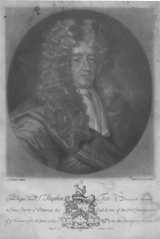
Stephen Fox

Encyclopedia
Sir Stephen Fox was an English
politician
.
, a yeoman
farmer
. At the age of fifteen he first obtained a post in the household of Algernon Percy, 10th Earl of Northumberland
; then he entered the service of Lord Percy, the earl's brother, and was present with the royalist army at the Battle of Worcester
as Lord Percy's deputy at the ordnance board. Accompanying Charles II
in his flight to the continent, he was appointed manager of the royal household, on the recommendation of Edward Hyde, 1st Earl of Clarendon
. Clarendon described him as "a young man bred under the severe discipline of Lord Percy ... very well qualified with languages, and all other parts of clerkship, honesty and discretion".
The skill with which Fox managed the finances of the exiled court earned him further confidence and promotion. He was employed on several important missions, and acted eventually as intermediary between the king and General Monck
. Honours and emolument were his reward after the Restoration; he was appointed to the lucrative offices of first Clerk of the Green Cloth
and Paymaster of the Forces
.
In November 1661, he became member of parliament
for Salisbury. In 1665 he was knighted; was returned as MP
for Westminster
on 27 February 1679, and succeeded the Earl of Rochester as a commissioner of the treasury, filling that office for twenty-three years and during three reigns. In 1680 he resigned the paymastership and was made first commissioner of horse. In 1684, he became sole commissioner of horse.
He was offered a peerage by James II
, on condition of turning Roman Catholic, but refused, in spite of which he was allowed to retain his commissionerships. In 1685 he was again M.P. for Salisbury, and opposed the bill for a standing army supported by the king. During the Revolution, he maintained an attitude of decent reserve, but on James's flight, submitted to William III
, who confirmed him in his offices. He was again elected for Westminster
in 1691 and 1695, for Cricklade
in 1698, and finally in 1713 once more for Salisbury.
It is his distinction to have founded Royal Hospital Chelsea
, to which he contributed £13,000. As a statesman he was second-rater, but as a public servant he creditably discharged all the duties with which he was entrusted. Unlike other statesmen of his day, he grew rich in the service of the nation without being suspected of corruption or forfeiting the esteem of his contemporaries.
(1704–1776), was created Lord Ilchester and Stavordale in 1747 and Earl of Ilchester
in 1756; in 1758 he took the additional name of Strangways, and his descendants, the family of Fox-Strangways, still hold the Earldom of Ilchester. The younger son, who followed his father into politics, was Henry Fox, 1st Baron Holland
. One of his daughters from first marriage was Elizabeth Fox (circa 1655 – Tunbridge Wells, 28 February 1681), married in Westminster Abbey
on 27 December 1673 to Charles Cornwallis, 3rd Baron Cornwallis
(1655 – 29 April 1698). They were the great-grandparents of General Lord Cornwallis. From the first marriage he was also the father of Jane Fox (died 10 June 1721), wife of George Compton, 4th Earl of Northampton
.
England
England is a country that is part of the United Kingdom. It shares land borders with Scotland to the north and Wales to the west; the Irish Sea is to the north west, the Celtic Sea to the south west, with the North Sea to the east and the English Channel to the south separating it from continental...
politician
Politician
A politician, political leader, or political figure is an individual who is involved in influencing public policy and decision making...
.
Life
Stephen Fox was the son of William Fox, of Farley, in WiltshireWiltshire
Wiltshire is a ceremonial county in South West England. It is landlocked and borders the counties of Dorset, Somerset, Hampshire, Gloucestershire, Oxfordshire and Berkshire. It contains the unitary authority of Swindon and covers...
, a yeoman
Yeoman
Yeoman refers chiefly to a free man owning his own farm, especially from the Elizabethan era to the 17th century. Work requiring a great deal of effort or labor, such as would be done by a yeoman farmer, came to be described as "yeoman's work"...
farmer
Farmer
A farmer is a person engaged in agriculture, who raises living organisms for food or raw materials, generally including livestock husbandry and growing crops, such as produce and grain...
. At the age of fifteen he first obtained a post in the household of Algernon Percy, 10th Earl of Northumberland
Algernon Percy, 10th Earl of Northumberland
Algernon Percy, 10th Earl of Northumberland, 4th Baron Percy, KG was an English military leader and a prominent supporter of constitutional monarchy.-Family background:...
; then he entered the service of Lord Percy, the earl's brother, and was present with the royalist army at the Battle of Worcester
Battle of Worcester
The Battle of Worcester took place on 3 September 1651 at Worcester, England and was the final battle of the English Civil War. Oliver Cromwell and the Parliamentarians defeated the Royalist, predominantly Scottish, forces of King Charles II...
as Lord Percy's deputy at the ordnance board. Accompanying Charles II
Charles II of England
Charles II was monarch of the three kingdoms of England, Scotland, and Ireland.Charles II's father, King Charles I, was executed at Whitehall on 30 January 1649, at the climax of the English Civil War...
in his flight to the continent, he was appointed manager of the royal household, on the recommendation of Edward Hyde, 1st Earl of Clarendon
Edward Hyde, 1st Earl of Clarendon
Edward Hyde, 1st Earl of Clarendon was an English historian and statesman, and grandfather of two English monarchs, Mary II and Queen Anne.-Early life:...
. Clarendon described him as "a young man bred under the severe discipline of Lord Percy ... very well qualified with languages, and all other parts of clerkship, honesty and discretion".
The skill with which Fox managed the finances of the exiled court earned him further confidence and promotion. He was employed on several important missions, and acted eventually as intermediary between the king and General Monck
George Monck, 1st Duke of Albemarle
George Monck, 1st Duke of Albemarle, KG was an English soldier and politician and a key figure in the restoration of Charles II.-Early life and career:...
. Honours and emolument were his reward after the Restoration; he was appointed to the lucrative offices of first Clerk of the Green Cloth
Clerk of the Green Cloth
The Clerk of the Green Cloth was a position in the British Royal Household. The clerk acted as secretary of the Board of Green Cloth, and was therefore responsible for organising royal journeys and assisting in the administration of the Royal Household. From the Restoration, there were four clerks...
and Paymaster of the Forces
Paymaster of the Forces
The Paymaster of the Forces was a position in the British government. The office, which was established 1661 after the Restoration, was responsible for part of the financing of the British Army. The first to hold the office was Sir Stephen Fox. Before his time it had been the custom to appoint...
.
In November 1661, he became member of parliament
Member of Parliament
A Member of Parliament is a representative of the voters to a :parliament. In many countries with bicameral parliaments, the term applies specifically to members of the lower house, as upper houses often have a different title, such as senate, and thus also have different titles for its members,...
for Salisbury. In 1665 he was knighted; was returned as MP
Member of Parliament
A Member of Parliament is a representative of the voters to a :parliament. In many countries with bicameral parliaments, the term applies specifically to members of the lower house, as upper houses often have a different title, such as senate, and thus also have different titles for its members,...
for Westminster
Westminster (UK Parliament constituency)
Westminster was a parliamentary constituency in the Parliament of England to 1707, the Parliament of Great Britain 1707-1800 and the Parliament of the United Kingdom from 1801. It returned two members to 1885 and one thereafter....
on 27 February 1679, and succeeded the Earl of Rochester as a commissioner of the treasury, filling that office for twenty-three years and during three reigns. In 1680 he resigned the paymastership and was made first commissioner of horse. In 1684, he became sole commissioner of horse.
He was offered a peerage by James II
James II of England
James II & VII was King of England and King of Ireland as James II and King of Scotland as James VII, from 6 February 1685. He was the last Catholic monarch to reign over the Kingdoms of England, Scotland, and Ireland...
, on condition of turning Roman Catholic, but refused, in spite of which he was allowed to retain his commissionerships. In 1685 he was again M.P. for Salisbury, and opposed the bill for a standing army supported by the king. During the Revolution, he maintained an attitude of decent reserve, but on James's flight, submitted to William III
William III of England
William III & II was a sovereign Prince of Orange of the House of Orange-Nassau by birth. From 1672 he governed as Stadtholder William III of Orange over Holland, Zeeland, Utrecht, Guelders, and Overijssel of the Dutch Republic. From 1689 he reigned as William III over England and Ireland...
, who confirmed him in his offices. He was again elected for Westminster
Westminster (UK Parliament constituency)
Westminster was a parliamentary constituency in the Parliament of England to 1707, the Parliament of Great Britain 1707-1800 and the Parliament of the United Kingdom from 1801. It returned two members to 1885 and one thereafter....
in 1691 and 1695, for Cricklade
Cricklade (UK Parliament constituency)
Cricklade was a parliamentary constituency named after the town of Cricklade in Wiltshire.From 1295 until 1885, Cricklade was a parliamentary borough, returning two Members of Parliament to the House of Commons of the Parliament of the United Kingdom, previously to the House of Commons of...
in 1698, and finally in 1713 once more for Salisbury.
It is his distinction to have founded Royal Hospital Chelsea
Royal Hospital Chelsea
The Royal Hospital Chelsea is a retirement home and nursing home for British soldiers who are unfit for further duty due to injury or old age, located in the Chelsea region of central London, now the Royal Borough of Kensington and Chelsea. It is a true hospital in the original sense of the word,...
, to which he contributed £13,000. As a statesman he was second-rater, but as a public servant he creditably discharged all the duties with which he was entrusted. Unlike other statesmen of his day, he grew rich in the service of the nation without being suspected of corruption or forfeiting the esteem of his contemporaries.
Family
He was married twice (1651 and 11 July 1703); by his first wife, Elizabeth Whittle (died August, 1696), daughter of William Whittle and wife, he had seven sons, all of whom predeceased him, and three daughters; by his second, Christiana Hope (died 17 February 1718), daughter of Rev. Francis Hope and wife Christian Palfreyman, he had two sons and two daughters. The elder son by the second marriage, StephenStephen Fox-Strangways, 1st Earl of Ilchester
Stephen Fox-Strangways, 1st Earl of Ilchester PC was a British peer and Member of Parliament.Ilchester was the son of Sir Stephen Fox and his second wife Christiana Hope. Henry Fox, 1st Baron Holland, was his younger brother and Charles James Fox his nephew...
(1704–1776), was created Lord Ilchester and Stavordale in 1747 and Earl of Ilchester
Earl of Ilchester
Earl of Ilchester, is a title in the Peerage of Great Britain. It was created in 1756 for Stephen Fox, 1st Baron Ilchester, who had previously represented Shaftesbury in Parliament. He had already been created Baron Ilchester, of Ilchester in the County of Somerset in 1741, and Baron Ilchester and...
in 1756; in 1758 he took the additional name of Strangways, and his descendants, the family of Fox-Strangways, still hold the Earldom of Ilchester. The younger son, who followed his father into politics, was Henry Fox, 1st Baron Holland
Henry Fox, 1st Baron Holland
Henry Fox, 1st Baron Holland, of Foxley, MP, PC was a leading British politician of the 18th century. He identified primarily with the Whig faction...
. One of his daughters from first marriage was Elizabeth Fox (circa 1655 – Tunbridge Wells, 28 February 1681), married in Westminster Abbey
Westminster Abbey
The Collegiate Church of St Peter at Westminster, popularly known as Westminster Abbey, is a large, mainly Gothic church, in the City of Westminster, London, United Kingdom, located just to the west of the Palace of Westminster. It is the traditional place of coronation and burial site for English,...
on 27 December 1673 to Charles Cornwallis, 3rd Baron Cornwallis
Charles Cornwallis, 3rd Baron Cornwallis
Charles Cornwallis, 3rd Baron Cornwallis PC was a British politician who served as First Lord of the Admiralty. He succeeded his father as Baron Cornwallis in 1673...
(1655 – 29 April 1698). They were the great-grandparents of General Lord Cornwallis. From the first marriage he was also the father of Jane Fox (died 10 June 1721), wife of George Compton, 4th Earl of Northampton
George Compton, 4th Earl of Northampton
George Compton, 4th Earl of Northampton, PC , styled Lord Compton from 1664 to 1681, was a British peer....
.