


Ascospore

Encyclopedia
Spore
In biology, a spore is a reproductive structure that is adapted for dispersal and surviving for extended periods of time in unfavorable conditions. Spores form part of the life cycles of many bacteria, plants, algae, fungi and some protozoa. According to scientist Dr...
contained in an ascus
Ascus
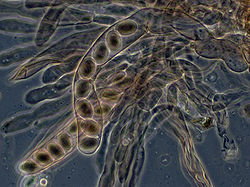
An ascus is the sexual spore-bearing cell produced in ascomycete fungi. On average, asci normally contain eight ascospores, produced by a meiotic cell division followed, in most species, by a mitotic cell division. However, asci in some genera or species can number one , two, four, or multiples...
or that was produced inside an ascus. This kind of spore is specific to fungi classified as ascomycetes (Ascomycota
Ascomycota
The Ascomycota are a Division/Phylum of the kingdom Fungi, and subkingdom Dikarya. Its members are commonly known as the Sac fungi. They are the largest phylum of Fungi, with over 64,000 species...
).
Typically, a single ascus will contain eight ascospores. The eight spores are produced by a combination of a meiotic division followed by a mitotic division. The meiosis division turns the original diploid zygote
Zygote
A zygote , or zygocyte, is the initial cell formed when two gamete cells are joined by means of sexual reproduction. In multicellular organisms, it is the earliest developmental stage of the embryo...
nucleus into four haploid ones. That is, the single original cell from which the whole process begins contains two complete sets of chromosome
Chromosome
A chromosome is an organized structure of DNA and protein found in cells. It is a single piece of coiled DNA containing many genes, regulatory elements and other nucleotide sequences. Chromosomes also contain DNA-bound proteins, which serve to package the DNA and control its functions.Chromosomes...
s. In preparation for meiosis, all the DNA
DNA
Deoxyribonucleic acid is a nucleic acid that contains the genetic instructions used in the development and functioning of all known living organisms . The DNA segments that carry this genetic information are called genes, but other DNA sequences have structural purposes, or are involved in...
of both sets is duplicated, to make a total of four sets. The nucleus that contains the four sets divides in two stages, separating into four new nuclei – each of which has one complete set of chromosomes. Following this process, each of the four new nuclei duplicates its DNA and undergoes a division by mitosis.
As a result, the ascus will contain four pairs of spores.
The Fungi Saccharomyces
Saccharomyces
Saccharomyces is a genus in the kingdom of fungi that includes many species of yeast. Saccharomyces is from Greek σάκχαρ and μύκης and means sugar fungus. Many members of this genus are considered very important in food production. One example is Saccharomyces cerevisiae, which is used in making...
produces ascospores when grown on V-8 medium, acetate ascospor agar, or Gorodkowa medium. These ascospores are globose and located in asci. Each ascus contains one to four ascospores. The asci do not rupture at maturity. Ascospores are stained with Kinyoun stain and ascospore stain. When stained with Gram stain, ascospores are gram-negative while vegetative cells are gram-positive.