


Ascus

Encyclopedia
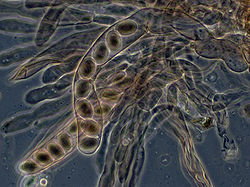
Ascomycota
The Ascomycota are a Division/Phylum of the kingdom Fungi, and subkingdom Dikarya. Its members are commonly known as the Sac fungi. They are the largest phylum of Fungi, with over 64,000 species...
fungi. On average, asci normally contain eight ascospore
Ascospore
An ascospore is a spore contained in an ascus or that was produced inside an ascus. This kind of spore is specific to fungi classified as ascomycetes ....
s, produced by a meiotic
Meiosis
Meiosis is a special type of cell division necessary for sexual reproduction. The cells produced by meiosis are gametes or spores. The animals' gametes are called sperm and egg cells....
cell division followed, in most species, by a mitotic
Mitosis
Mitosis is the process by which a eukaryotic cell separates the chromosomes in its cell nucleus into two identical sets, in two separate nuclei. It is generally followed immediately by cytokinesis, which divides the nuclei, cytoplasm, organelles and cell membrane into two cells containing roughly...
cell division. However, asci in some genera or species can number one (e.g. Monosporascus cannonballus
Monosporascus cannonballus
Monosporascus cannonballus is a plant pathogen.- External links :* *...
), two, four, or multiples of four. In a few cases, the ascospores can bud off conidia that may fill the asci (e.g. Tympanis
Tympanis
Tympanis is a genus of fungi in the family Helotiaceae. The genus contains 29 species.-External links:* at Index Fungorum...
) with hundreds of conidia, or the ascospores may fragment, e.g. some Cordyceps
Cordyceps
Cordyceps is a genus of ascomycete fungi that includes about 400 described species. All Cordyceps species are endoparasitoids, mainly on insects and other arthropods ; a few are parasitic on other fungi. The best known species of the genus is Cordyceps sinensis, first recorded as yartsa gunbu in...
, also filling the asci with smaller cells. Ascospores are nonmotile, usually single celled, but not infrequently may be coenocytic (lacking a septum
Septum
In anatomy, a septum is a wall, dividing a cavity or structure into smaller ones.-In human anatomy:...
), and in some cases coenocytic in multiple planes. Mitotic divisions within the developing spores populate each resulting cell in septate ascospores with nuclei.
In many cases the asci are formed in a regular layer, the hymenium
Hymenium
The hymenium is the tissue layer on the hymenophore of a fungal fruiting body where the cells develop into basidia or asci, which produce spores. In some species all of the cells of the hymenium develop into basidia or asci, while in others some cells develop into sterile cells called cystidia or...
, in a fruiting body which is visible to the naked eye, here called an ascocarp
Ascocarp
An ascocarp, or ascoma , is the fruiting body of an ascomycete fungus. It consists of very tightly interwoven hyphae and may contain millions of asci, each of which typically contains eight ascospores...
or ascoma. In other cases, such as single-celled yeasts, no such structures are found. In rare cases asci of some genera can regularly develop inside older discharged asci one after another, e.g. Dipodascus
Dipodascus
Dipodascus is a genus of fungi in the family Dipodascaceae.-External links:*...
.
Asci normally release their spores by bursting at the tip, but they may also digest themselves passively releasing the ascospores either in a liquid or as a dry powder. Typically, actively discharging asci have a specially differentiated tip, either a pore or an operculum. In some hymenium forming genera, when one ascus bursts, it can trigger the bursting of many other asci in the ascocarp resulting in a massive discharge visible as a cloud of spores – the phenomenon called "puffing". This is an example of positive feedback
Positive feedback
Positive feedback is a process in which the effects of a small disturbance on a system include an increase in the magnitude of the perturbation. That is, A produces more of B which in turn produces more of A. In contrast, a system that responds to a perturbation in a way that reduces its effect is...
. A faint hissing sound can also be heard for species of Peziza
Peziza
Peziza is a large genus of saprophytic cup fungi that grow on the ground, rotting wood, or dung. Most members of this genus are of unknown edibility and are difficult to identify as separate species without use of microscopy...
and other cup fungi.
Asci, notably those of Neurospora crassa
Neurospora crassa
Neurospora crassa is a type of red bread mold of the phylum Ascomycota. The genus name, meaning "nerve spore" refers to the characteristic striations on the spores. The first published account of this fungus was from an infestation of French bakeries in 1843. N...
, have been used in laboratories for studying the process of meiosis, because the four cell
Cell (biology)
The cell is the basic structural and functional unit of all known living organisms. It is the smallest unit of life that is classified as a living thing, and is often called the building block of life. The Alberts text discusses how the "cellular building blocks" move to shape developing embryos....
s produced by meiosis line up in regular order. By modifying a gene
Gene
A gene is a molecular unit of heredity of a living organism. It is a name given to some stretches of DNA and RNA that code for a type of protein or for an RNA chain that has a function in the organism. Living beings depend on genes, as they specify all proteins and functional RNA chains...
coding for spore color, the biologist can study crossing over
Chromosomal crossover
Chromosomal crossover is an exchange of genetic material between homologous chromosomes. It is one of the final phases of genetic recombination, which occurs during prophase I of meiosis in a process called synapsis. Synapsis begins before the synaptonemal complex develops, and is not completed...
and other phenomena.
Asci of most Pezizomycotina
Pezizomycotina
Pezizomycotina contains the filamentous ascomycetes and is a subphylum of the Ascomycota . It is more or less synonymous with the older taxon Euascomycota...
develop after the formation of croziers
Crozier (mycology)
A crozier is an anatomical feature of many fungi in the phylum Ascomycota that form at the base of asci and look like hook-topped shepherd’s staffs or stylized religious crosiers...
at their base. The croziers help maintain a brief dikaryon
Dikaryon
Dikaryon is from Greek, di meaning 2 and karyon meaning nut, referring to the cell nucleus.The dikaryon is a nuclear feature which is unique to some fungi, in which after plasmogamy the two compatible nuclei of two cells pair off and cohabit without karyogamy within the cells of the hyphae,...
. The compatible nuclei of the dikaryon merge forming a diploid nucleus that then undergoes meiosis
Meiosis
Meiosis is a special type of cell division necessary for sexual reproduction. The cells produced by meiosis are gametes or spores. The animals' gametes are called sperm and egg cells....
and ultimately internal ascospore formation. Members of the Taphrinomycotina
Taphrinomycotina
Taphrinomycotina is one of three subphyla constituting the Ascomycota and is more or less synonymous with the slightly older invalid name Archiascomycetes...
and Saccharomycotina
Saccharomycotina
Saccharomycotina is a subphylum of the phylum Ascomycota , and consists of yeasts - they form no ascocarps , their asci are naked, and they can reproduce asexually by budding....
do not form croziers.
Ascus classification

Ascomycota
The Ascomycota are a Division/Phylum of the kingdom Fungi, and subkingdom Dikarya. Its members are commonly known as the Sac fungi. They are the largest phylum of Fungi, with over 64,000 species...
. There are four basic types of ascus.
- A unitunicate-operculate ascus has a "lid", the OperculumOperculum (botany)An operculum, in botany, is a term generally used to describe a structure within a plant, moss, or fungus acting as a cap, flap, or lid. In plants, it may also be called a bud cap.Examples of structures identified as opercula include:...
, which breaks open when the spores ripen and in this way sets them free. Unitunicate-operculate asci only occur in those ascocarps which have apothecia, for instance the morelMorelMorchella, the true morels, is a genus of edible mushrooms closely related to anatomically simpler cup fungi. These distinctive mushrooms appear honeycomb-like in that the upper portion is composed of a network of ridges with pits between them....
s. 'Unitunicate' means 'single-walled'. - Instead of an operculum, a unitunicate-inoperculate ascus has an elastic ring that functions like a pressure valveRelief valveThe relief valve is a type of valve used to control or limit the pressure in a system or vessel which can build up by a process upset, instrument or equipment failure, or fire....
. On ripening it briefly expands and so lets the spores shoot out. This type appears both in apothecia and in perithecia; an example is the illustrated Hypomyces chrysospermus. - A bitunicate ascus is enclosed in a double wall. This consists of a thin, brittle outer shell and a thick elastic inner wall. When the spores are ripe, the shell splits open so that the inner wall can take up water. As a consequence this begins to extend with its spores until it protrudes above the rest of the ascocarp so that the spores can escape into free air without being obstructed by the bulk of the fruiting body. Bitunicate asci occur only in pseudothecia and are found only in the classes DothideomycetesDothideomycetesDothideomycetes is the largest and most diverse class of ascomycete fungi. It comprises 11 orders 90 families, 1300 genera and over 19,000 known species. Traditionally, most of its members were included in the loculoascomycetes, which is not part of the currently accepted classification...
and ChaetothyriomycetesChaetothyriomycetesChaetothyriomycetidae is a subclass of fungi within the Eurotiomycetes. They are collectively termed the Black Yeasts.-References:Geiser DM, Gueidan C, Miadlikowska J, Lutzoni F, Kauff F, Hofstetter V, Fraker E, Schoch CL, Tibell L, Untereiner WA, Aptroot A, 2006. Eurotiomycetes: Eurotiomycetidae...
(which were formerly united in the old class Loculoascomycetes). Examples: Venturia inaequalis (apple scabApple scabApple scab is a disease to Malus trees, such as apple trees, caused by the ascomycete fungus Venturia inaequalis. The disease manifests as dull black or grey-brown lesions on the surface of tree leaves, buds or fruits. Lesions may also appear less frequently on the woody tissues of the tree. Fruits...
) and Guignardia aesculi (Brown Leaf Mold of Horse Chestnut).
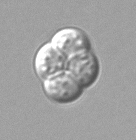
- Prototunicate asci are mostly spherical in shape and they have no active dispersal mechanism at all. The ripe ascus wall simply dissolves so that the spores can escape, or it is broken open by other influences such as animals. Asci of this type can be found both in perithecia and in cleistothecia, for instance with Dutch elm diseaseDutch elm diseaseDutch elm disease is a disease caused by a member of the sac fungi category, affecting elm trees which is spread by the elm bark beetle. Although believed to be originally native to Asia, the disease has been accidentally introduced into America and Europe, where it has devastated native...
(Ophiostoma). This is something of a catch-all term for cases which do not fit into the other three ascus types, and they probably belong to several independent groups which evolved separately from unitunicate asci.