


Spectrum disorder

Encyclopedia
A spectrum in psychiatry
is a range of linked conditions, such that there is "not a unitary disorder but rather a syndrome
composed of subgroups". The subgroups may be linked together by clinical appearance or by shared underlying causation. A spectrum may comprise relatively "severe" mental disorders as well as relatively "mild and nonclinical deficits".
and continuum
are related concepts in psychiatry. Some use them interchangeably while some argue the fine points of difference. The term continuum suggests a simple straight line with no significant discontinuities, while the term spectrum suggests that although there is a common denominator, a particular set of individuals may present with a particular pattern of symptoms (a syndrome
or subtype), reminiscent of the visible spectrum
of distinct colors after refraction of light by a prism.
Dimensions refers to different aspects of psychological functioning along which people vary, for example the dimension of personality, which is commonly further subdivided into five main dimensions (the Big Five personality traits
) each with two extremes that people fall between. An alternative approach sorts people into categories or "types", for example "personality types". In the classification of mental disorders
, dimensional approaches are generally also contrasted with categorical approaches. For example the former may involve a continuum of scores on personality trait measures, while the latter involves types of personality disorder
s defined by clusters of symptoms; the former may involve a continuum of psychotic experiences in the general population, while the latter involves types of psychotic disorders defined by clusters of symptoms.
A spectrum approach generally overlays or extends a categorical approach, which is most associated with the Diagnostic and Statistical Manual of Mental Disorders
and International Statistical Classification of Diseases and Related Health Problems
. A spectrum approach may start with the nuclear, classic DSM diagnostic criteria for a disorder or several disorders, and then include an additional broad range of issues such as temperaments or traits, lifestyle, behavioral patterns, and personality characteristics.
was originally used in physics to indicate an apparent qualitative distinction arising from a quantitative continuum (i.e. a series of colors formed when a beam of white light is dispersed by a prism so that their parts are arranged in the order of their wavelengths). Newton first used the word spectrum (Latin for "appearance" or "apparition") in print in 1671 in describing his experiments in optics
.
The term was first used by analogy
in psychiatry with a slightly different connotation, to identify a group of conditions that is qualitatively distinct in appearance but believed to be related from an underlying pathogenic point of view. It has been noted that for clinicians trained after the publication of DSM-III (1980), the spectrum concept in psychiatry may be relatively new, but that it has a long and distinguished history that dates back to Emil Kraepelin
and beyond. A dimensional concept was proposed by Ernst Kretschmer
in 1921 for schizophrenia (schizothymic – schizoid – schizophrenic) and for affective disorders (cyclothymic temperament – cycloid
'psychopathy
' – manic-depressive disorder) and by Eugen Bleuler
in 1922. The term "spectrum" was first used in psychiatry in 1968 in regard to a postulated schizophrenia spectrum, at that time meaning a linking of the then "schizoid personalities" in people diagnosed with schizophrenia and their genetic relatives (Seymour S. Kety
et al., 1968).
For different investigators, the hypothetical common pathogenic link has been of a different nature.
It has been argued that within the data used as the basis for developing the DSM system is a large literature leading to an alternative conclusion that a spectrum classification provides a better perspective on phenomenology of psychopathology
than a categorical classification system. However, the term has a varied history, meaning one thing when referring to a schizophrenia spectrum and another when referring to bipolar or obsessive–compulsive disorder spectrum, for example.
and International Classification of Diseases (Chapter V: Mental and behavioural disorders
) are generally limited to categorical diagnoses but do recognize some subsyndromal subtypes, such as schizotypal personality disorder
, dysthymia and cyclothymia
.
Spectrum concepts used in research or clinical practice include:
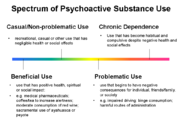 A spectrum of drug use
, drug abuse
and substance dependence
has been proposed, incorporating the role not just of the individual but of society, culture and availability. Rather than accepting loaded terms such as "use" vs. "abuse", the Health Officers Council of British Columbia
adopted in 2005 a model of psychoactive substance use that explicitly recognizes a spectrum of use ranging from beneficial to chronic dependence
(see diagram). A standardized questionnaire has been developed in psychiatry based on a spectrum concept of substance use.
Various higher-level
spectra have been proposed, that subsume conditions into fewer but broader overarching spectra. One psychological model based on factor analysis
, originating from developmental studies but also applied to adults, posits that many disorders fall on either an "internalizing" spectrum (characterized by negative affectivity
; subdivides into a "distress" subspectrum and a "fear" subspectrum) or an "externalizing" spectrum (characterized by negativity affectivity plus disinhibition). These spectra are hypothetically linked to underlying variation in some of the Big five personality traits
. Another theoretical model proposes that the dimensions of fear
and anger
, defined in a broad sense, underlie a broad spectrum of mood, behavioral and personality disorders. In this model, different combinations of excessive or deficient fear and anger correspond to different neuropsychological temperament
types hypothesized to underlie the spectrum of disorders.
Psychiatry
Psychiatry is the medical specialty devoted to the study and treatment of mental disorders. These mental disorders include various affective, behavioural, cognitive and perceptual abnormalities...
is a range of linked conditions, such that there is "not a unitary disorder but rather a syndrome
Syndrome
In medicine and psychology, a syndrome is the association of several clinically recognizable features, signs , symptoms , phenomena or characteristics that often occur together, so that the presence of one or more features alerts the physician to the possible presence of the others...
composed of subgroups". The subgroups may be linked together by clinical appearance or by shared underlying causation. A spectrum may comprise relatively "severe" mental disorders as well as relatively "mild and nonclinical deficits".
Definition
SpectrumSpectrum
A spectrum is a condition that is not limited to a specific set of values but can vary infinitely within a continuum. The word saw its first scientific use within the field of optics to describe the rainbow of colors in visible light when separated using a prism; it has since been applied by...
and continuum
Continuum (theory)
Continuum theories or models explain variation as involving a gradual quantitative transition without abrupt changes or discontinuities. It can be contrasted with 'categorical' models which propose qualitatively different states.-In physics:...
are related concepts in psychiatry. Some use them interchangeably while some argue the fine points of difference. The term continuum suggests a simple straight line with no significant discontinuities, while the term spectrum suggests that although there is a common denominator, a particular set of individuals may present with a particular pattern of symptoms (a syndrome
Syndrome
In medicine and psychology, a syndrome is the association of several clinically recognizable features, signs , symptoms , phenomena or characteristics that often occur together, so that the presence of one or more features alerts the physician to the possible presence of the others...
or subtype), reminiscent of the visible spectrum
Visible spectrum
The visible spectrum is the portion of the electromagnetic spectrum that is visible to the human eye. Electromagnetic radiation in this range of wavelengths is called visible light or simply light. A typical human eye will respond to wavelengths from about 390 to 750 nm. In terms of...
of distinct colors after refraction of light by a prism.
Dimensions refers to different aspects of psychological functioning along which people vary, for example the dimension of personality, which is commonly further subdivided into five main dimensions (the Big Five personality traits
Big Five personality traits
In contemporary psychology, the "Big Five" factors of personality are five broad domains or dimensions of personality which are used to describe human personality....
) each with two extremes that people fall between. An alternative approach sorts people into categories or "types", for example "personality types". In the classification of mental disorders
Classification of mental disorders
The classification of mental disorders, also known as psychiatric nosology or taxonomy, is a key aspect of psychiatry and other mental health professions and an important issue for consumers and providers of mental health services...
, dimensional approaches are generally also contrasted with categorical approaches. For example the former may involve a continuum of scores on personality trait measures, while the latter involves types of personality disorder
Personality disorder
Personality disorders, formerly referred to as character disorders, are a class of personality types and behaviors. Personality disorders are noted on Axis II of the Diagnostic and Statistical Manual of Mental Disorders or DSM-IV-TR of the American Psychiatric Association.Personality disorders are...
s defined by clusters of symptoms; the former may involve a continuum of psychotic experiences in the general population, while the latter involves types of psychotic disorders defined by clusters of symptoms.
A spectrum approach generally overlays or extends a categorical approach, which is most associated with the Diagnostic and Statistical Manual of Mental Disorders
Diagnostic and Statistical Manual of Mental Disorders
The Diagnostic and Statistical Manual of Mental Disorders is published by the American Psychiatric Association and provides a common language and standard criteria for the classification of mental disorders...
and International Statistical Classification of Diseases and Related Health Problems
ICD-10 Chapter V: Mental and behavioural disorders
- Organic, including symptomatic, mental disorders :* Dementia in Alzheimer's disease* Vascular dementia** Multi-infarct dementia* Dementia in other diseases classified elsewhere** Dementia in Pick's disease...
. A spectrum approach may start with the nuclear, classic DSM diagnostic criteria for a disorder or several disorders, and then include an additional broad range of issues such as temperaments or traits, lifestyle, behavioral patterns, and personality characteristics.
Origin
The term spectrumSpectrum
A spectrum is a condition that is not limited to a specific set of values but can vary infinitely within a continuum. The word saw its first scientific use within the field of optics to describe the rainbow of colors in visible light when separated using a prism; it has since been applied by...
was originally used in physics to indicate an apparent qualitative distinction arising from a quantitative continuum (i.e. a series of colors formed when a beam of white light is dispersed by a prism so that their parts are arranged in the order of their wavelengths). Newton first used the word spectrum (Latin for "appearance" or "apparition") in print in 1671 in describing his experiments in optics
Optics
Optics is the branch of physics which involves the behavior and properties of light, including its interactions with matter and the construction of instruments that use or detect it. Optics usually describes the behavior of visible, ultraviolet, and infrared light...
.
The term was first used by analogy
Analogy
Analogy is a cognitive process of transferring information or meaning from a particular subject to another particular subject , and a linguistic expression corresponding to such a process...
in psychiatry with a slightly different connotation, to identify a group of conditions that is qualitatively distinct in appearance but believed to be related from an underlying pathogenic point of view. It has been noted that for clinicians trained after the publication of DSM-III (1980), the spectrum concept in psychiatry may be relatively new, but that it has a long and distinguished history that dates back to Emil Kraepelin
Emil Kraepelin
Emil Kraepelin was a German psychiatrist. H.J. Eysenck's Encyclopedia of Psychology identifies him as the founder of modern scientific psychiatry, as well as of psychopharmacology and psychiatric genetics. Kraepelin believed the chief origin of psychiatric disease to be biological and genetic...
and beyond. A dimensional concept was proposed by Ernst Kretschmer
Ernst Kretschmer
Ernst Kretschmer Prof. Dr. med. Dr. phil. h.c., was a German psychiatrist who researched the human constitution and established a typology...
in 1921 for schizophrenia (schizothymic – schizoid – schizophrenic) and for affective disorders (cyclothymic temperament – cycloid
Cycloid
A cycloid is the curve traced by a point on the rim of a circular wheel as the wheel rolls along a straight line.It is an example of a roulette, a curve generated by a curve rolling on another curve....
'psychopathy
Psychopathy
Psychopathy is a mental disorder characterized primarily by a lack of empathy and remorse, shallow emotions, egocentricity, and deceptiveness. Psychopaths are highly prone to antisocial behavior and abusive treatment of others, and are very disproportionately responsible for violent crime...
' – manic-depressive disorder) and by Eugen Bleuler
Eugen Bleuler
Paul Eugen Bleuler was a Swiss psychiatrist most notable for his contributions to the understanding of mental illness and for coining the term "schizophrenia."-Biography:...
in 1922. The term "spectrum" was first used in psychiatry in 1968 in regard to a postulated schizophrenia spectrum, at that time meaning a linking of the then "schizoid personalities" in people diagnosed with schizophrenia and their genetic relatives (Seymour S. Kety
Seymour S. Kety
Seymour S. Kety was an American neuroscientist who was credited with making modern psychiatry a rigorous and heuristic branch of medicine by applying basic science to the study of human behavior in health and disease...
et al., 1968).
For different investigators, the hypothetical common pathogenic link has been of a different nature.
It has been argued that within the data used as the basis for developing the DSM system is a large literature leading to an alternative conclusion that a spectrum classification provides a better perspective on phenomenology of psychopathology
Psychopathology
Psychopathology is the study of mental illness, mental distress, and abnormal/maladaptive behavior. The term is most commonly used within psychiatry where pathology refers to disease processes...
than a categorical classification system. However, the term has a varied history, meaning one thing when referring to a schizophrenia spectrum and another when referring to bipolar or obsessive–compulsive disorder spectrum, for example.
Types of spectrum
The widely-used Diagnostic and Statistical Manual of Mental DisordersDiagnostic and Statistical Manual of Mental Disorders
The Diagnostic and Statistical Manual of Mental Disorders is published by the American Psychiatric Association and provides a common language and standard criteria for the classification of mental disorders...
and International Classification of Diseases (Chapter V: Mental and behavioural disorders
ICD-10 Chapter V: Mental and behavioural disorders
- Organic, including symptomatic, mental disorders :* Dementia in Alzheimer's disease* Vascular dementia** Multi-infarct dementia* Dementia in other diseases classified elsewhere** Dementia in Pick's disease...
) are generally limited to categorical diagnoses but do recognize some subsyndromal subtypes, such as schizotypal personality disorder
Schizotypal personality disorder
Schizotypal personality disorder, or simply schizotypal disorder, is a personality disorder that is characterized by a need for social isolation, anxiety in social situations, odd behavior and thinking, and often unconventional beliefs.-Genetic:...
, dysthymia and cyclothymia
Cyclothymia
Cyclothymia is a mood and mental disorder in the bipolar spectrum that causes both hypomanic and depressive episodes. It is defined medically within the bipolar spectrum and consists of recurrent disturbances between sudden hypomania and dysthymic episodes. The diagnosis of cyclothymic disorder is...
.
Spectrum concepts used in research or clinical practice include:
- autistic spectrum
- obsessive–compulsive spectrum (including eating disorderEating disorderEating disorders refer to a group of conditions defined by abnormal eating habits that may involve either insufficient or excessive food intake to the detriment of an individual's physical and mental health. Bulimia nervosa, anorexia nervosa, and binge eating disorder are the most common specific...
spectrum) - generalized anxiety spectrum
- social anxietySocial anxietySocial anxiety is anxiety about social situations, interactions with others, and being evaluated or scrutinized by other people...
spectrum - panicPanic disorderPanic disorder is an anxiety disorder characterized by recurring severe panic attacks. It may also include significant behavioral change lasting at least a month and of ongoing worry about the implications or concern about having other attacks. The latter are called anticipatory attacks...
-agoraphobiaAgoraphobiaAgoraphobia is an anxiety disorder defined as a morbid fear of having a panic attack or panic-like symptoms in a situation from which it is perceived to be difficult to escape. These situations can include, but are not limited to, wide-open spaces, crowds, or uncontrolled social conditions...
spectrum - post-traumatic stress spectrum or traumaPsychological traumaPsychological trauma is a type of damage to the psyche that occurs as a result of a traumatic event...
and lossGriefGrief is a multi-faceted response to loss, particularly to the loss of someone or something to which a bond was formed. Although conventionally focused on the emotional response to loss, it also has physical, cognitive, behavioral, social, and philosophical dimensions...
spectrum - schizophreniaSchizophreniaSchizophrenia is a mental disorder characterized by a disintegration of thought processes and of emotional responsiveness. It most commonly manifests itself as auditory hallucinations, paranoid or bizarre delusions, or disorganized speech and thinking, and it is accompanied by significant social...
spectrum or psychotic spectrum - schizoaffective spectrum
- mood disorderMood disorderMood disorder is the term designating a group of diagnoses in the Diagnostic and Statistical Manual of Mental Disorders classification system where a disturbance in the person's mood is hypothesized to be the main underlying feature...
(affective) spectrum or bipolar spectrumBipolar spectrumThe bipolar spectrum refers to a category of mood disorders that feature abnormally elevated or depressed mood. These disorders range from bipolar I disorder, featuring full-blown manic episodes, to cyclothymia, featuring less prominent hypomanic episodes, to "subsyndromal" conditions where only...
or depressive spectrum - depersonalizationDepersonalizationDepersonalization is an anomaly of the mechanism by which an individual has self-awareness. It is a feeling of watching oneself act, while having no control over a situation. Sufferers feel they have changed, and the world has become less real, vague, dreamlike, or lacking in significance...
-derealizationDerealizationDerealization is an alteration in the perception or experience of the external world so that it seems unreal. Other symptoms include feeling as though one's environment is lacking in spontaneity, emotional coloring and depth. It is a dissociative symptom of many conditions, such as psychiatric and...
spectrum
Recreational drug use
Recreational drug use is the use of a drug, usually psychoactive, with the intention of creating or enhancing recreational experience. Such use is controversial, however, often being considered to be also drug abuse, and it is often illegal...
, drug abuse
Drug abuse
Substance abuse, also known as drug abuse, refers to a maladaptive pattern of use of a substance that is not considered dependent. The term "drug abuse" does not exclude dependency, but is otherwise used in a similar manner in nonmedical contexts...
and substance dependence
Substance dependence
The section about substance dependence in the Diagnostic and Statistical Manual of Mental Disorders does not use the word addiction at all. It explains:...
has been proposed, incorporating the role not just of the individual but of society, culture and availability. Rather than accepting loaded terms such as "use" vs. "abuse", the Health Officers Council of British Columbia
British Columbia
British Columbia is the westernmost of Canada's provinces and is known for its natural beauty, as reflected in its Latin motto, Splendor sine occasu . Its name was chosen by Queen Victoria in 1858...
adopted in 2005 a model of psychoactive substance use that explicitly recognizes a spectrum of use ranging from beneficial to chronic dependence
Substance dependence
The section about substance dependence in the Diagnostic and Statistical Manual of Mental Disorders does not use the word addiction at all. It explains:...
(see diagram). A standardized questionnaire has been developed in psychiatry based on a spectrum concept of substance use.
Various higher-level
Hierarchy
A hierarchy is an arrangement of items in which the items are represented as being "above," "below," or "at the same level as" one another...
spectra have been proposed, that subsume conditions into fewer but broader overarching spectra. One psychological model based on factor analysis
Factor analysis
Factor analysis is a statistical method used to describe variability among observed, correlated variables in terms of a potentially lower number of unobserved, uncorrelated variables called factors. In other words, it is possible, for example, that variations in three or four observed variables...
, originating from developmental studies but also applied to adults, posits that many disorders fall on either an "internalizing" spectrum (characterized by negative affectivity
Negative affectivity
Negative Affect is a general dimension of subjective distress and unpleasurable engagement that subsumes a variety of aversive mood states, including anger, contempt, disgust, guilt, fear, and nervousness...
; subdivides into a "distress" subspectrum and a "fear" subspectrum) or an "externalizing" spectrum (characterized by negativity affectivity plus disinhibition). These spectra are hypothetically linked to underlying variation in some of the Big five personality traits
Big Five personality traits
In contemporary psychology, the "Big Five" factors of personality are five broad domains or dimensions of personality which are used to describe human personality....
. Another theoretical model proposes that the dimensions of fear
Fear
Fear is a distressing negative sensation induced by a perceived threat. It is a basic survival mechanism occurring in response to a specific stimulus, such as pain or the threat of danger...
and anger
Anger
Anger is an automatic response to ill treatment. It is the way a person indicates he or she will not tolerate certain types of behaviour. It is a feedback mechanism in which an unpleasant stimulus is met with an unpleasant response....
, defined in a broad sense, underlie a broad spectrum of mood, behavioral and personality disorders. In this model, different combinations of excessive or deficient fear and anger correspond to different neuropsychological temperament
Temperament
In psychology, temperament refers to those aspects of an individual's personality, such as introversion or extroversion, that are often regarded as innate rather than learned...
types hypothesized to underlie the spectrum of disorders.