


Sock monkey

Encyclopedia
Toy
A toy is any object that can be used for play. Toys are associated commonly with children and pets. Playing with toys is often thought to be an enjoyable means of training the young for life in human society. Different materials are used to make toys enjoyable and cuddly to both young and old...
made from socks
SOCKS
SOCKS is an Internet protocol that routes network packets between a client and server through a proxy server. SOCKS5 additionally provides authentication so only authorized users may access a server...
fashioned in the likeness of a monkey
Monkey
A monkey is a primate, either an Old World monkey or a New World monkey. There are about 260 known living species of monkey. Many are arboreal, although there are species that live primarily on the ground, such as baboons. Monkeys are generally considered to be intelligent. Unlike apes, monkeys...
. These stuffed animal
Stuffed animal
A stuffed toy is a toy sewn from cloth, plush, or other textiles, and stuffed with straw, beans, plastic pellets, cotton, synthetic fibres, or other similar materials. Stuffed toys are also known as plush toys A stuffed toy is a toy sewn from cloth, plush, or other textiles, and stuffed with straw,...
s are a mixture of folk art
Folk art
Folk art encompasses art produced from an indigenous culture or by peasants or other laboring tradespeople. In contrast to fine art, folk art is primarily utilitarian and decorative rather than purely aesthetic....
and kitsch
Kitsch
Kitsch is a form of art that is considered an inferior, tasteless copy of an extant style of art or a worthless imitation of art of recognized value. The concept is associated with the deliberate use of elements that may be thought of as cultural icons while making cheap mass-produced objects that...
in the culture of the United States
Culture of the United States
The Culture of the United States is a Western culture originally influenced by European cultures. It has been developing since long before the United States became a country with its own unique social and cultural characteristics such as dialect, music, arts, social habits, cuisine, and folklore...
and the culture of Canada
Culture of Canada
Canadian culture is a term that explains the artistic, musical, literary, culinary, political and social elements that are representative of Canada and Canadians, not only to its own population, but people all over the world. Canada's culture has historically been influenced by European culture and...
.
Origins
The sock monkey's most direct predecessors originated in the Victorian eraVictorian era
The Victorian era of British history was the period of Queen Victoria's reign from 20 June 1837 until her death on 22 January 1901. It was a long period of peace, prosperity, refined sensibilities and national self-confidence...
, when the craze for imitation stuffed animals swept from Europe
Europe
Europe is, by convention, one of the world's seven continents. Comprising the westernmost peninsula of Eurasia, Europe is generally 'divided' from Asia to its east by the watershed divides of the Ural and Caucasus Mountains, the Ural River, the Caspian and Black Seas, and the waterways connecting...
into North America
North America
North America is a continent wholly within the Northern Hemisphere and almost wholly within the Western Hemisphere. It is also considered a northern subcontinent of the Americas...
and met the burgeoning Arts and Crafts Movement
Arts and Crafts movement
Arts and Crafts was an international design philosophy that originated in England and flourished between 1860 and 1910 , continuing its influence until the 1930s...
. Craft makers began sewing stuffed animals as toys to comfort children, and, as tales of the Scramble for Africa
Scramble for Africa
The Scramble for Africa, also known as the Race for Africa or Partition of Africa was a process of invasion, occupation, colonization and annexation of African territory by European powers during the New Imperialism period, between 1881 and World War I in 1914...
increased the public's familiarity with exotic species, monkey toys soon became a fixture of American nurseries. However, these early stuffed monkeys were not necessarily made from socks, and also lacked the characteristic red lips of the sock monkeys popular today.
John Nelson, a Swedish
Sweden
Sweden , officially the Kingdom of Sweden , is a Nordic country on the Scandinavian Peninsula in Northern Europe. Sweden borders with Norway and Finland and is connected to Denmark by a bridge-tunnel across the Öresund....
immigrant to the United States
United States
The United States of America is a federal constitutional republic comprising fifty states and a federal district...
, patented the sock-knitting machine in 1869, and began manufacturing work socks in Rockford, Illinois
Rockford, Illinois
Rockford is a mid-sized city located on both banks of the Rock River in far northern Illinois. Often referred to as "The Forest City", Rockford is the county seat of Winnebago County, Illinois, USA. As reported in the 2010 U.S. census, the city was home to 152,871 people, the third most populated...
in 1890. The iconic sock monkeys made from red-heeled socks emerged at the earliest in 1932, the year the Nelson Knitting Company added the trademarked red heel to its product. In the early years, the red-heeled sock was marketed as "De-Tec-Tip". Nelson Knitting was an innovator in the mass market work sock field, creating a loom that enabled socks to be manufactured without seams in the heel. These seamless work socks were so popular that the market was soon flooded with imitators, and socks of this type were known under the generic term "Rockfords". Nelson Knitting added the red heel "de-tec-tip" to assure its customers that they were buying "original Rockfords". This red heel gave the monkeys their distinctive mouth. During the Great Depression
Great Depression
The Great Depression was a severe worldwide economic depression in the decade preceding World War II. The timing of the Great Depression varied across nations, but in most countries it started in about 1929 and lasted until the late 1930s or early 1940s...
, American crafters first made sock monkeys out of worn-out Rockford Red Heel Socks.
Developments
Around 1951, the Nelson Knitting company discovered that their socks were being used to make monkey dolls. This company became involved in a dispute over the design patent on the sock monkey pattern. They were awarded the patent in 1955, and began including the pattern with every pair of socks. The sock monkey doll was then used in promotional campaigns celebrating the widespread application of their product by inventive homemakers in the field of monkey manufacturing.In 1958, the "scrap-craft" magazine Pack-O-Fun published "How to Make Sock Toys", a guide to making different sock animals and dolls with red heeled socks. Frequently cited as being their most popular book ever, this pamphlet went through multiple printings and was produced in new editions up until the mid-1980s. In the late 1980s, a company called Marketing Tide of Willoughby Hills,Ohio,sold kits with the original socks and instructions in numerous craft and sewing magazines. Their kit was featured on the ABC-TV Network Home Show in 1992, which helped to put the Sock Monkey firmly back into American Culture.
The Nelson Knitting Company was acquired in 1992 by Fox River Mills
Fox River Mills
Fox River Mills, Inc. is a sock manufacturer based in Osage, Iowa.The company was founded in 1900. In 1992, they purchased the Nelson Knitting Company of Rockford, Illinois, and in the process acquired the trademark on the Red Heel socks used to make sock monkeys...
, and the original brown heather, Red Heel monkey sock is still in production by Fox River Mills. A distinctive change in the red-heeled sock design distinguishes monkeys made with Fox River Mills socks from Nelson Knitting Company socks. Fox River heels are more uniformly ovular, without the end points that gave Nelson Knitting-made sock monkeys their smiles or frowns.
In the 21st century, efforts by crafters, writers, photographers, and artists to immortalize the sock monkey doll beyond soft sculptured socks has intensified. Today, sock monkey images can be found adorning books, greeting cards, journals, calendars, book marks, paintings,playing cards,quilts,clothing,jewelery, and bakery goods like cakes and cookies to name but a few. Sock monkeys have also been immortalized in polymer clay, fiberglass, and in commercials. They have been themes for weddings, graduations, birthdays, and baby showers. They continue to make their way into our homes and hearts.
Sock monkeys today
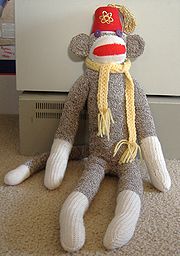
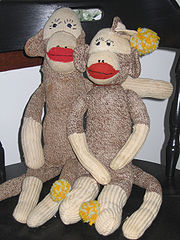
Sock monkeys remain a popular toy to this day. Most vintage red-heel sock monkeys found today are no older than the late 1950s, and many date from the 1970s. A number of methods for dating sock monkeys have been debated by collectors, including the shape of the red heel, the tightness of the weave, sock seams, the style of clothing worn, and other features. The term "vintage" red-heel sock monkeys is typically relegated to sock monkeys made from red-heel socks knitted by the Nelson Knitting Company and from similar socks knitted with red-heels by other companies in the same time period. The term "modern" red-heel sock monkeys is normally relegated to sock monkey dolls created after Fox River Mills, Inc. acquired Nelson Knitting Company in 1992. Home made red-heel sock monkey dolls usually have unique faces and body characteristics and are considered one-of-a-kind. Sock monkey dolls are also mass-manufactured in the marketplace. Sock monkey dolls mass-manufactured by a company normally all have the same face and body characteristics. Not all sock monkey dolls are created from red-heel socks. A new trend is growing to create sock monkey dolls from colorful striped or polka dot socks—even mismatched socks. The love of sock monkeys has led to other sock creatures being designed and made. These include the 'Sockodile', 'Sockosaurus' and 'Sock Bear' to name a few.Sock Monkey Festivals
The continued popularity of the sock monkey encouraged the city of Rockford, IllinoisRockford, Illinois
Rockford is a mid-sized city located on both banks of the Rock River in far northern Illinois. Often referred to as "The Forest City", Rockford is the county seat of Winnebago County, Illinois, USA. As reported in the 2010 U.S. census, the city was home to 152,871 people, the third most populated...
to embrace the doll as a part of its history. In 2005, Midway Village Center in Rockford held its first "Sock Monkey Madness Festival", while simultaneously opening an exhibit highlighting the industrial, legal, and creative history of the Nelson red heel sock and the sock monkey.
Other festivities have been held in other geographic areas, too, with sock monkeys as the event's main or supporting theme. Sock monkey novelty items are normally available for purchase in gift shops at such events, and also on the web.
External links
- Sock Monkey Craft Project Instructions – Step by step directions with photographs.
- Examples of Sock Monkeys from around the world. - Different designs and types of Sock Monkeys from around the world.