

.gif)
Sin (mythology)

Encyclopedia
Sumerian language
Sumerian is the language of ancient Sumer, which was spoken in southern Mesopotamia since at least the 4th millennium BC. During the 3rd millennium BC, there developed a very intimate cultural symbiosis between the Sumerians and the Akkadians, which included widespread bilingualism...
: ) was the god of the moon
Lunar deity
In mythology, a lunar deity is a god or goddess associated with or symbolizing the moon. These deities can have a variety of functions and traditions depending upon the culture, but they are often related to or an enemy of the solar deity. Even though they may be related, they are distinct from the...
in Mesopotamian mythology. Nanna is a Sumer
Sumer
Sumer was a civilization and historical region in southern Mesopotamia, modern Iraq during the Chalcolithic and Early Bronze Age....
ian deity, the son of Enlil
Enlil
Elizabeth Barrett Browning was one of the most prominent poets of the Victorian era. Her poetry was widely popular in both England and the United States during her lifetime. A collection of her last poems was published by her husband, Robert Browning, shortly after her death.-Early life:Members...
and Ninlil
Ninlil
In Sumerian religion, Ninlil , also called Sud, in Assyrian called Mullitu, is the consort goddess of Enlil. Her parentage is variously described. Most commonly she is called the daughter of Haia and Nunbarsegunu...
, and became identified with Semitic
Semitic
In linguistics and ethnology, Semitic was first used to refer to a language family of largely Middle Eastern origin, now called the Semitic languages...
Sin. The two chief seats of Nanna's/Sin's worship were Ur
Ur
Ur was an important city-state in ancient Sumer located at the site of modern Tell el-Muqayyar in Iraq's Dhi Qar Governorate...
in the south of Mesopotamia and Harran
Harran
Harran was a major ancient city in Upper Mesopotamia whose site is near the modern village of Altınbaşak, Turkey, 24 miles southeast of Şanlıurfa...
in the north.
Name
The original meaning of the name Nanna is unknown. The earliest spelling found in Ur and UrukUruk
Uruk was an ancient city of Sumer and later Babylonia, situated east of the present bed of the Euphrates river, on the ancient dry former channel of the Euphrates River, some 30 km east of modern As-Samawah, Al-Muthannā, Iraq.Uruk gave its name to the Uruk...
is D
Dingir
Dingir is a cuneiform sign, most commonly the determinative for "deity" although it has related meanings as well. As a determinative, it is not pronounced, and is conventionally transliterated as a superscript "D" as in e.g. DInanna...
LAK-32.NA (where NA is to be understood as a phonetic complement
Phonetic complement
A phonetic complement is a phonetic symbol used to disambiguate word characters that have multiple readings, in mixed logographic-phonetic scripts such as Egyptian hieroglyphs, Akkadian cuneiform, Japanese, and Mayan...
). The name of Ur, spelled LAK-32.UNUGKI=URIM2KI, is itself derived from the theonym, and means "the abode (UNUG) of Nanna (LAK-32)".
The pre-classical sign LAK-32 later collapses with ŠEŠ (the ideogram for "brother"), and the classical Sumerian spelling is DŠEŠ.KI, with the phonetic reading na-an-na. The technical term for the crescent moon could also refer to the deity, DU4.SAKAR. Later, the name is spelled logographically as DNANNA.
The Semitic moon god Su'en/Sin is in origin a separate deity from Sumerian Nanna, but from the Akkadian Empire period the two undergo syncretization and are identified. The occasional Assyria
Assyria
Assyria was a Semitic Akkadian kingdom, extant as a nation state from the mid–23rd century BC to 608 BC centred on the Upper Tigris river, in northern Mesopotamia , that came to rule regional empires a number of times through history. It was named for its original capital, the ancient city of Assur...
n spelling of DNANNA-ar DSu'en-e is due to association with Akkadian na-an-na-ru "illuminator, lamp", an epitheton of the moon god. The name of the Assyrian moon god Su'en/Sîn is usually spelled as DEN.ZU, or simply with the numeral 30
30 (number)
30 is the natural number following 29 and preceding 31.-In mathematics:30 is the sum of the first four squares, which makes it a square pyramidal number.It is a primorial and is the smallest Giuga number....
, DXXX.
Background
He is commonly designated as En-zu, which means "lord of wisdom". During the period (c.2600-2400 BCE) that Ur exercised a large measure of supremacy over the EuphratesEuphrates
The Euphrates is the longest and one of the most historically important rivers of Western Asia. Together with the Tigris, it is one of the two defining rivers of Mesopotamia...
valley, Sin was naturally regarded as the head of the pantheon
Pantheon (gods)
A pantheon is a set of all the gods of a particular polytheistic religion or mythology.Max Weber's 1922 opus, Economy and Society discusses the link between a...
. It is to this period that we must trace such designations of Sin as "father of the gods", "chief of the gods", "creator of all things", and the like. The "wisdom" personified by the moon-god is likewise an expression of the science of astronomy or the practice of astrology
Astrology
Astrology consists of a number of belief systems which hold that there is a relationship between astronomical phenomena and events in the human world...
, in which the observation of the moon's phases is an important factor.
His wife was Ningal
Ningal
Ningal was a goddess of reeds in the Sumerian mythology, daughter of Enki and Ningikurga and the consort of the moon god Nanna by whom she bore Utu the sun god, Inanna, and in some texts, Ishkur...
("Great Lady"), who bore him Utu
Utu
Utu is the Sun god in Sumerian mythology, the son of the moon god Nanna and the goddess Ningal. His brother and sisters are Ishkur and Inanna and Erishkigal....
/Shamash
Shamash
Shamash was a native Mesopotamian deity and the sun god in the Akkadian, Assyrian and Babylonian pantheons. Shamash was the god of justice in Babylonia and Assyria, corresponding to Sumerian Utu...
("Sun") and Inanna
Inanna
Inanna, also spelled Inana is the Sumerian goddess of sexual love, fertility, and warfare....
/Ishtar
Ishtar
Ishtar is the Assyrian and Babylonian goddess of fertility, love, war, and sex. She is the counterpart to the Sumerian Inanna and to the cognate north-west Semitic goddess Astarte.-Characteristics:...
(the goddess of the planet Venus
Venus
Venus is the second planet from the Sun, orbiting it every 224.7 Earth days. The planet is named after Venus, the Roman goddess of love and beauty. After the Moon, it is the brightest natural object in the night sky, reaching an apparent magnitude of −4.6, bright enough to cast shadows...
). The tendency to centralize the powers of the universe leads to the establishment of the doctrine of a triad consisting of Sin/Nanna and his children.
Sin had a beard made of lapis lazuli
Lapis lazuli
Lapis lazuli is a relatively rare semi-precious stone that has been prized since antiquity for its intense blue color....
and rode on a winged bull
Bull
Bull usually refers to an uncastrated adult male bovine.Bull may also refer to:-Entertainment:* Bull , an original show on the TNT Network* "Bull" , an episode of television series CSI: Crime Scene Investigation...
. The bull was one of his symbols, through his father, Enlil
Enlil
Elizabeth Barrett Browning was one of the most prominent poets of the Victorian era. Her poetry was widely popular in both England and the United States during her lifetime. A collection of her last poems was published by her husband, Robert Browning, shortly after her death.-Early life:Members...
, "Bull of Heaven", along with the crescent and the tripod (which may be a lamp-stand). On cylinder seal
Cylinder seal
A cylinder seal is a cylinder engraved with a 'picture story', used in ancient times to roll an impression onto a two-dimensional surface, generally wet clay. Cylinder seals were invented around 3500 BC in the Near East, at the contemporary site of Susa in south-western Iran and at the early site...
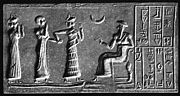
s, he is represented as an old man with a flowing beard
Beard
A beard is the collection of hair that grows on the chin, cheeks and neck of human beings. Usually, only pubescent or adult males are able to grow beards. However, women with hirsutism may develop a beard...
and the crescent symbol. In the astral-theological system he is represented by the number 30 and the moon. This number probably refers to the average number of days (correctly around 29.53) in a lunar month
Lunation
Lunation is the mean time for one lunar phase cycle . It is on average 29.530589 days, or 29 days 12 hours 44 minutes and 3 seconds...
, as measured between successive new moon
New moon
In astronomical terminology, the new moon is the lunar phase that occurs when the Moon, in its monthly orbital motion around Earth, lies between Earth and the Sun, and is therefore in conjunction with the Sun as seen from Earth...
s.
An important Sumerian text ("Enlil and Ninlil") tells of the descent of Enlil and Ninlil, pregnant with Nanna/Suen, into the underworld
Underworld
The Underworld is a region which is thought to be under the surface of the earth in some religions and in mythologies. It could be a place where the souls of the recently departed go, and in some traditions it is identified with Hell or the realm of death...
. There, three "substitutions" are given to allow the ascent of Nanna/Suen. The story shows some similarities to the text known as "The Descent of Inanna".
Seats of worship
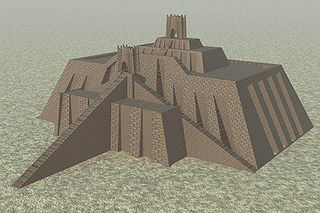
Nanna's chief sanctuary at Ur was named E-gish-shir-gal ("houseÉ (temple)
É is the Sumerian word or symbol for house or temple, written ideographically with the cuneiform sign .The Sumerian term É.GAL denoted a city's main building....
of the great light"). It was at Ur that the role of the En
EN (cuneiform)
EN is the Sumerian cuneiform for "lord" or "priest". Originally, it seems to have been used to designate a high priest or priestess of a Sumerian city-state's patron-deity - a position that entailed political power as well. It may also have been the original title of the ruler of Uruk...
Priestess developed. This was an extremely powerful role held by a princess, most notably Enheduanna
Enheduanna
Enheduanna , also transliterated as Enheduana, En-hedu-ana or EnHeduAnna , was an Akkadian princess as well as High Priestess of the Moon god Nanna in the Sumerian city-state of Ur...
, daughter of King Sargon of Akkad
Sargon of Akkad
Sargon of Akkad, also known as Sargon the Great "the Great King" , was an Akkadian emperor famous for his conquest of the Sumerian city-states in the 23rd and 22nd centuries BC. The founder of the Dynasty of Akkad, Sargon reigned in the last quarter of the third millennium BC...
, and was the primary cult role associated with the cult of Nanna/Sin.
Sin also had a sanctuary at Harran
Harran
Harran was a major ancient city in Upper Mesopotamia whose site is near the modern village of Altınbaşak, Turkey, 24 miles southeast of Şanlıurfa...
, named E-khul-khul ("house of joys"). The cult of the moon-god spread to other centers, so that temples to him are found in all the large cities of Babylonia
Babylonia
Babylonia was an ancient cultural region in central-southern Mesopotamia , with Babylon as its capital. Babylonia emerged as a major power when Hammurabi Babylonia was an ancient cultural region in central-southern Mesopotamia (present-day Iraq), with Babylon as its capital. Babylonia emerged as...
and Assyria
Assyria
Assyria was a Semitic Akkadian kingdom, extant as a nation state from the mid–23rd century BC to 608 BC centred on the Upper Tigris river, in northern Mesopotamia , that came to rule regional empires a number of times through history. It was named for its original capital, the ancient city of Assur...
. A sanctuary for Sin with Syriac
Syriac language
Syriac is a dialect of Middle Aramaic that was once spoken across much of the Fertile Crescent. Having first appeared as a script in the 1st century AD after being spoken as an unwritten language for five centuries, Classical Syriac became a major literary language throughout the Middle East from...
inscriptions invoking his name dating to the 2nd and 3rd centuries CE was found at Sumatar Harabesi
Sumatar Harabesi
Sumatar Harabesi was an ancient watering place for semi-nomadic peoples located in the Tektek Mountains, southeast of Urfa and northeast of Harran, in modern day Turkey...
in the Tektek mountains, not far from Harran and Edessa
Edessa, Mesopotamia
Edessa is the Greek name of an Aramaic town in northern Mesopotamia, as refounded by Seleucus I Nicator. For the modern history of the city, see Şanlıurfa.-Names:...
.
External links
- Tamara M. Green, The City of the Moon God: Religious Traditions of Harran. E.J. Brill, Leiden, 1992, 232 pages. ISBN 9004095136
- The Ur and Harran Latitudes, and Göbekli Tepe