

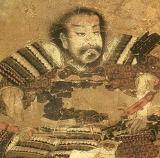
Shibata Katsuie

Encyclopedia
or was a Japan
ese military commander during the Sengoku Period
who served Oda Nobunaga
.
, a branch of the Shiba clan
(who descended from the Ashikaga clan
, and were the former suzerains of the Oda clan
). Note the differences between , , and the .
Katsuie was the retainer of Oda Nobukatsu (Oda Nobuyuki
). When control of the Oda clan
was contested, Katsuie initially supported his lord, Nobukatsu, against his elder brother Oda Nobunaga
. In 1556, Katsuie launched a coup d'etat
against Nobunaga. He was defeated at the Battle of Inō
, and in the aftermath Nobunaga had his brother executed, but impressed with the retainer's loyalty and bravery, decided to spare the life of Katusie. Katusie pledged his services to Nobunaga, earning his praise until eventually Nobunaga would offer Katusie the hand of his younger sister, Oichi
, in marriage. In 1570, while a joint Oda
-Tokugawa
coalition fought the battle of Anegawa, Katsuie was under siege at Chokoji Castle by 4000 soldiers of the Rokkaku clan
. Katsuie eventually won via an all-out attack, forcing the Rokkaku to retreat. This action, along with a series of brilliant victories, gained him renown as "Oni Shibata".
In 1575, after gaining control of Echizen
, he took command of Kitanosho Castle
(Hokujō) and was ordered to conquer the Hokuriku region
. After controlling Kaga
and Noto
, he began a campaign against Etchu Province
in 1581. In 1582, Nobunaga was betrayed
at Honnō-ji
by Akechi Mitsuhide
and although Katsuie wanted to join the hunt for Akechi, he was unable to return south as he was heavily invested with the Siege of Matsukura and the army of Uesugi Kenshin
.
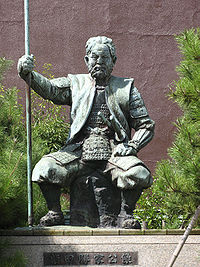 In a meeting in Kiyosu
to determine the successor to Nobunaga, he supported Oda Nobutaka
, the third son, for whom Katsuie had performed the genpuku
ritual. He allied with Oda Nobutaka and Takigawa Kazumasu
to battle Hideyoshi
. However, his domain was sealed off in the winter by snowfalls and this limited his ability. Both of his allies were defeated while Katsuie battled snowfalls and Uesugi. His forces, under the leadership of Sakuma Morimasa
, besieged Nakagawa Kiyohide
at Shizugatake in a move to turn the tide launching the battle of Shizugatake
. Sakuma ignored Shibata's orders to merely test the enemy's defence and was destroyed by returning Toyotomi Hideyoshi
's forces. He retreated to Kitanoshō castle but with the army destroyed, Katsuie had no option but to surrender. Katsuie committed seppuku
and set the fire to the castle. He implored Oichi to take their daughters and leave, but she decided to follow his death, while letting her daughters escape. Ironically, Katsuie had not so much as lifted a spear personally during the battle.
His death poem was:
Japan
Japan is an island nation in East Asia. Located in the Pacific Ocean, it lies to the east of the Sea of Japan, China, North Korea, South Korea and Russia, stretching from the Sea of Okhotsk in the north to the East China Sea and Taiwan in the south...
ese military commander during the Sengoku Period
Sengoku period
The or Warring States period in Japanese history was a time of social upheaval, political intrigue, and nearly constant military conflict that lasted roughly from the middle of the 15th century to the beginning of the 17th century. The name "Sengoku" was adopted by Japanese historians in reference...
who served Oda Nobunaga
Oda Nobunaga
was the initiator of the unification of Japan under the shogunate in the late 16th century, which ruled Japan until the Meiji Restoration in 1868. He was also a major daimyo during the Sengoku period of Japanese history. His opus was continued, completed and finalized by his successors Toyotomi...
.
Biography
Katsuie was born in the Shibata familyShibata clan
The Shibata clan a Japanese clan that had originated during the Heian period of Japan. The Shibata clan of Echigo province were notably related to that of the Shibata clan of Owari province. The Shibata clan of Echigo were descended from Sasaki Moritsuna, a supporter of Minamoto no Yoritomo and a...
, a branch of the Shiba clan
Shiba clan
The was a Japanese clan claiming descent from the Minamoto clan of the Heian era that held influence and territory in the provinces of Echizen province and Owari province to which they were governors during the Sengoku era. However, they were unable to make a transition to Sengoku-daimyo and lost...
(who descended from the Ashikaga clan
Ashikaga clan
The ' was a prominent Japanese samurai clan which established the Muromachi shogunate and ruled Japan from roughly 1336 to 1573.The Ashikaga were descended from a branch of the Minamoto clan, deriving originally from the town of Ashikaga in Shimotsuke province .For about a century the clan was...
, and were the former suzerains of the Oda clan
Oda clan
The was a family of Japanese daimyo who were to become an important political force in the unification of Japan in the mid-16th century. Though they had the climax of their fame under Oda Nobunaga and fell from the spotlight soon after, several branches of the family would continue on as daimyo...
). Note the differences between , , and the .
Katsuie was the retainer of Oda Nobukatsu (Oda Nobuyuki
Oda Nobuyuki
was the son of Oda Nobuhide, and younger brother of Oda Nobunaga in the earlier years of the Sengoku period of the 16th century of Japan.Nobuyuki conspired against his brother Nobunaga with the Hayashi and Shibata families. Nobuyuki's Suemori Castle was reduced by Ikeda Nobuteru. Though Hayashi and...
). When control of the Oda clan
Oda clan
The was a family of Japanese daimyo who were to become an important political force in the unification of Japan in the mid-16th century. Though they had the climax of their fame under Oda Nobunaga and fell from the spotlight soon after, several branches of the family would continue on as daimyo...
was contested, Katsuie initially supported his lord, Nobukatsu, against his elder brother Oda Nobunaga
Oda Nobunaga
was the initiator of the unification of Japan under the shogunate in the late 16th century, which ruled Japan until the Meiji Restoration in 1868. He was also a major daimyo during the Sengoku period of Japanese history. His opus was continued, completed and finalized by his successors Toyotomi...
. In 1556, Katsuie launched a coup d'etat
Coup d'état
A coup d'état state, literally: strike/blow of state)—also known as a coup, putsch, and overthrow—is the sudden, extrajudicial deposition of a government, usually by a small group of the existing state establishment—typically the military—to replace the deposed government with another body; either...
against Nobunaga. He was defeated at the Battle of Inō
Battle of Inō
The Battle of Inō was a battle fought during the Sengoku period of Japan. The battle was fought between two forces of the Oda clan, the head of the clan Oda Nobunaga and his brother Oda Nobuyuki, who with the support of Shibata Katsuie and Hayashi Hidesada, rebelled against Nobunaga...
, and in the aftermath Nobunaga had his brother executed, but impressed with the retainer's loyalty and bravery, decided to spare the life of Katusie. Katusie pledged his services to Nobunaga, earning his praise until eventually Nobunaga would offer Katusie the hand of his younger sister, Oichi
Oichi
or a female historical figure in the late Sengoku period. She is known primarily as the mother of three daughters who married well -- Yodo-dono, Ohatsu and Oeyo....
, in marriage. In 1570, while a joint Oda
ODA
*ODA or Oda may refer to:*Oda , a typical Albanian room*Oda , is a room within harem especially in the Ottoman Empire- Computing :* Open Data Center Alliance - Data Center and Cloud Infrastructure Standards...
-Tokugawa
Tokugawa clan
The was a powerful daimyo family of Japan. They nominally descended from Emperor Seiwa and were a branch of the Minamoto clan by the Nitta clan. However, the early history of this clan remains a mystery.-History:...
coalition fought the battle of Anegawa, Katsuie was under siege at Chokoji Castle by 4000 soldiers of the Rokkaku clan
Rokkaku clan
The was a Japanese samurai clan which wielded considerable power in the Muromachi period under the Ashikaga shogunate.-Rise and Fall:Founded by Sasaki Yasutsuna of Ōmi province in the 13th century, the name Rokkaku was taken from their residence within Kyoto; however, many members of this family...
. Katsuie eventually won via an all-out attack, forcing the Rokkaku to retreat. This action, along with a series of brilliant victories, gained him renown as "Oni Shibata".
In 1575, after gaining control of Echizen
Echizen Province
was an old province of Japan, which is today the northern part of Fukui Prefecture. It was sometimes called , with Etchū and Echigo Provinces.Echizen is famous for washi . A text dated AD 774 mentions the washi made in this area. Echizen-produced Washi is still the most commonly sold traditional...
, he took command of Kitanosho Castle
Kitanosho Castle
was a hirashiro . Its remains are located in current-day Fukui, Fukui Prefecture, Japan. As the castle lasted merely eight years, few records survive about it. It is known, though that it was built by Shibata Katsuie in 1575...
(Hokujō) and was ordered to conquer the Hokuriku region
Hokuriku region
The is located in the northwestern part of Honshū, the main island of Japan. It lies along the Sea of Japan within the Chūbu region. It is almost equivalent to Koshi Province and Hokurikudō area in pre-modern Japan....
. After controlling Kaga
Kaga Province
was an old province in the area that is today the southern part of Ishikawa Prefecture. It was sometimes called .Ruled by the Maeda clan, the capital of Kaga was Kanazawa. Kaga bordered on Echizen, Etchū, Hida, and Noto Provinces...
and Noto
Noto Province
was an old province in the area that is today the northern part of Ishikawa Prefecture in Japan, including the Noto Peninsula which is surrounded by the Sea of Japan. It was sometimes called . Noto bordered on Etchū and Kaga provinces....
, he began a campaign against Etchu Province
Etchu Province
was an old province in central Honshū, on the Sea of Japan side. It was sometimes called , with Echizen and Echigo Provinces. It bordered Echigo, Shinano, Hida, Kaga, and Noto provinces...
in 1581. In 1582, Nobunaga was betrayed
Incident at Honnoji
The ' refers to the forced suicide on June 21, 1582 of Japanese daimyo Oda Nobunaga at the hands of his samurai general Akechi Mitsuhide. This occurred in Honnō-ji, a temple in Kyoto, ending Nobunaga's quest to consolidate centralized power in Japan under his authority.-Context:Oda Nobunaga was at...
at Honnō-ji
Honno-ji
is a temple of the Nichiren branch of Buddhism located in Kyoto, Japan. Its honzon is mandara-honzon from Nam Myoho Renge Kyo.-History:...
by Akechi Mitsuhide
Akechi Mitsuhide
, nicknamed Jūbei or called from his clan name and title, was a samurai who lived during the Sengoku period of Feudal Japan.Mitsuhide was a general under daimyo Oda Nobunaga, although he became infamous for his betrayal in 1582, which led to Nobunaga's death at Honno-ji...
and although Katsuie wanted to join the hunt for Akechi, he was unable to return south as he was heavily invested with the Siege of Matsukura and the army of Uesugi Kenshin
Uesugi Kenshin
was a daimyo who ruled Echigo province in the Sengoku period of Japan.He was one of the most powerful lords of the Sengoku period. While chiefly remembered for his prowess on the battlefield, Kenshin is also regarded as an extremely skillful administrator who fostered the growth of local industries...
.
Kiyosu, Aichi
was a town located in Nishikasugai District, Aichi, Japan., the town had an estimated population of 19,409 and a density of 3,696.95 persons per km²...
to determine the successor to Nobunaga, he supported Oda Nobutaka
Oda Nobutaka
was a samurai and member of Oda clan. He was adopted as the head of Kanbe clan that ruled the middle region of Ise Province and was also called Kanbe Nobutaka ....
, the third son, for whom Katsuie had performed the genpuku
Genpuku
or genbuku was an historical Japanese coming-of-age ceremony. The etymology is atypical; in this case means "head" and means "wearing". The ceremony is also known as , , , , and ....
ritual. He allied with Oda Nobutaka and Takigawa Kazumasu
Takigawa Kazumasu
, also known as Sakonshōgen , was a samurai retainer to Oda Nobunaga, and later Toyotomi Hideyoshi, during Japan's Sengoku period. His biological son, Toshimasu, was adopted by Maeda Toshihisa and later served Nobunaga alongside Kazumasu and Toshimasu's adopted uncle, Maeda Toshiie.Originally from...
to battle Hideyoshi
Toyotomi Hideyoshi
was a daimyo warrior, general and politician of the Sengoku period. He unified the political factions of Japan. He succeeded his former liege lord, Oda Nobunaga, and brought an end to the Sengoku period. The period of his rule is often called the Momoyama period, named after Hideyoshi's castle...
. However, his domain was sealed off in the winter by snowfalls and this limited his ability. Both of his allies were defeated while Katsuie battled snowfalls and Uesugi. His forces, under the leadership of Sakuma Morimasa
Sakuma Morimasa
was the son of Sakuma Moritsugu, cousin of Sakuma Nobumori, a prominent Oda retainer to Oda Nobuhide and Oda Nobunaga. He was a retainer of Shibata Katsuie and one of his top generals in many of his campaigns...
, besieged Nakagawa Kiyohide
Nakagawa Kiyohide
Nakagawa Kiyohide was a daimyo in Azuchi-Momoyama period.His childhood name was Nakagawa Toranosuke...
at Shizugatake in a move to turn the tide launching the battle of Shizugatake
Battle of Shizugatake
The was a battle in Sengoku period Japan between supporters of Toyotomi Hideyoshi and Oda Nobutaka.In May, 1583, a former general of Nobunaga's named Shibata Katsuie coordinated a number of simultaneous attacks on Shizugatake, a series of forts held by Hideyoshi's generals among whom was Nakagawa...
. Sakuma ignored Shibata's orders to merely test the enemy's defence and was destroyed by returning Toyotomi Hideyoshi
Toyotomi Hideyoshi
was a daimyo warrior, general and politician of the Sengoku period. He unified the political factions of Japan. He succeeded his former liege lord, Oda Nobunaga, and brought an end to the Sengoku period. The period of his rule is often called the Momoyama period, named after Hideyoshi's castle...
's forces. He retreated to Kitanoshō castle but with the army destroyed, Katsuie had no option but to surrender. Katsuie committed seppuku
Seppuku
is a form of Japanese ritual suicide by disembowelment. Seppuku was originally reserved only for samurai. Part of the samurai bushido honor code, seppuku was either used voluntarily by samurai to die with honor rather than fall into the hands of their enemies , or as a form of capital punishment...
and set the fire to the castle. He implored Oichi to take their daughters and leave, but she decided to follow his death, while letting her daughters escape. Ironically, Katsuie had not so much as lifted a spear personally during the battle.
His death poem was:
- Natsu no yo no
- yumeji hakanaki
- ato no na wo
- kumoi ni ageyo
- yamahototogisu
- "Fleeting dream paths, in the summer night! O bird of the mountain, carry my name beyond the clouds."