


Lean manufacturing

Encyclopedia
Lean manufacturing, lean enterprise, or lean production, often simply, "Lean," is a production practice that considers the expenditure of resources for any goal other than the creation of value for the end customer to be wasteful, and thus a target for elimination. Working from the perspective of the customer who consumes a product or service, "value" is defined as any action or process that a customer would be willing to pay for.
Essentially, lean is centered on preserving value with less work. Lean manufacturing is a management philosophy derived mostly from the Toyota Production System
(TPS) (hence the term Toyotism is also prevalent) and identified as "Lean" only in the 1990s. TPS is renowned for its focus on reduction of the original Toyota seven wastes to improve overall customer value, but there are varying perspectives on how this is best achieved. The steady growth of Toyota, from a small company to the world's largest automaker,
has focused attention on how it has achieved this.
Lean manufacturing is a variation on the theme of efficiency based on optimizing flow; it is a present-day instance of the recurring theme in human history toward increasing efficiency, decreasing waste, and using empirical methods to decide what matters, rather than uncritically accepting pre-existing ideas. As such, it is a chapter in the larger narrative that also includes such ideas as the folk wisdom of thrift, time and motion study
, Taylorism, the Efficiency Movement
, and Fordism
. Lean manufacturing is often seen as a more refined version of earlier efficiency efforts, building upon the work of earlier leaders such as Taylor
or Ford
, and learning from their mistakes.
However, the modern view takes a more holistic approach where the definition of waste is far more generic. Irregular production with ups and downs in production levels would be considered waste. The goal of Lean then becomes the creation and maintenance of a production system which runs repetitively, day after day, week after week in a manner identical to the previous time period.
. Krafcik had been a quality engineer in the Toyota-GM NUMMI joint venture in California before coming to MIT for MBA studies. Krafcik's research was continued by the International Motor Vehicle Program
(IMVP) at MIT, which produced the international best-seller book co-authored by Jim Womack, Daniel Jones, and Daniel Roos called The Machine That Changed the World. A complete historical account of the IMVP and how the term "lean" was coined is given by Holweg (2007).
For many, Lean is the set of "tools" that assist in the identification and steady elimination of waste (muda). As waste is eliminated quality improves while production time and cost are reduced. Examples of such "tools" are Value Stream Mapping
, Five S, Kanban
(pull systems), and poka-yoke
(error-proofing).
There is a second approach to Lean Manufacturing, which is promoted by Toyota, in which the focus is upon improving the "flow" or smoothness of work, thereby steadily eliminating mura
("unevenness") through the system and not upon 'waste reduction' per se. Techniques to improve flow include production leveling
, "pull" production (by means of kanban
) and the Heijunka box
. This is a fundamentally different approach from most improvement methodologies, which may partially account for its lack of popularity.
The difference between these two approaches is not the goal itself, but rather the prime approach to achieving it. The implementation of smooth flow exposes quality problems that already existed, and thus waste reduction naturally happens as a consequence. The advantage claimed for this approach is that it naturally takes a system-wide perspective, whereas a waste focus sometimes wrongly assumes this perspective.
Both Lean and TPS can be seen as a loosely connected set of potentially competing principles whose goal is cost reduction by the elimination of waste. These principles include: Pull processing, Perfect first-time quality, Waste minimization, Continuous improvement, Flexibility, Building and maintaining a long term relationship with suppliers, Autonomation
, Load leveling and Production flow and Visual control. The disconnected nature of some of these principles perhaps springs from the fact that the TPS has grown pragmatically since 1948 as it responded to the problems it saw within its own production facilities. Thus what one sees today is the result of a 'need' driven learning to improve where each step has built on previous ideas and not something based upon a theoretical framework.
Toyota's view is that the main method of Lean is not the tools, but the reduction of three types of waste: muda ("non-value-adding work"), muri
("overburden"), and mura
("unevenness"), to expose problems systematically and to use the tools where the ideal cannot be achieved. From this perspective, the tools are workaround
s adapted to different situations, which explains any apparent incoherence of the principles above.
" (smart automation). Adherents of the Toyota approach would say that the smooth flowing delivery of value achieves all the other improvements as side-effects. If production flows perfectly then there is no inventory; if customer valued features are the only ones produced, then product design is simplified and effort is only expended on features the customer values. The other of the two TPS pillars is the very human aspect of autonomation, whereby automation is achieved with a human touch. The "human touch" here meaning to automate so that the machines/systems are designed to aid humans in focusing on what the humans do best. This aims, for example, to give the machines enough intelligence to recognize when they are working abnormally and flag this for human attention. Thus, in this case, humans would not have to monitor normal production and only have to focus on abnormal, or fault, conditions.
Lean implementation is therefore focused on getting the right things to the right place at the right time in the right quantity to achieve perfect work flow, while minimizing waste and being flexible and able to change. These concepts of flexibility and change are principally required to allow production leveling, using tools like SMED, but have their analogues in other processes such as research and development
(R&D). The flexibility and ability to change are within bounds and not open-ended, and therefore often not expensive capability requirements. More importantly, all of these concepts have to be understood, appreciated, and embraced by the actual employees who build the products and therefore own the processes that deliver the value. The cultural and managerial aspects of Lean are possibly more important than the actual tools or methodologies of production itself. There are many examples of Lean tool implementation without sustained benefit, and these are often blamed on weak understanding of Lean throughout the whole organization.
Lean aims to make the work simple enough to understand, do and manage. To achieve these three goals at once there is a belief held by some that Toyota's mentoring process,(loosely called Senpai
and Kohai, which is Japanese for senior and junior), is one of the best ways to foster Lean Thinking up and down the organizational structure. This is the process undertaken by Toyota as it helps its suppliers improve their own production. The closest equivalent to Toyota's mentoring process is the concept of "Lean Sensei," which encourages companies, organizations, and teams to seek outside, third-party experts, who can provide unbiased advice and coaching, (see Womack et al., Lean Thinking, 1998).
There have been recent attempts to link Lean to Service Management, perhaps one of the most recent and spectacular of which was London Heathrow Airport's Terminal 5. This particular case provides a graphic example of how care should be taken in translating successful practices from one context (production) to another (services), expecting the same results. In this case the public perception is more of a spectacular failure, than a spectacular success, resulting in potentially an unfair tainting of the lean manufacturing philosophies.
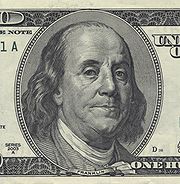 Most of the basic goals of lean manufacturing are common sense, and documented examples can be seen as early as Benjamin Franklin
. Poor Richard's Almanac
says of wasted time, "He that idly loses 5s.
worth of time, loses 5s., and might as prudently throw 5s. into the river." He added that avoiding unnecessary costs could be more profitable than increasing sales: "A penny saved is two pence clear. A pin a-day is a groat
a-year. Save and have."
Again Franklin's The Way to Wealth
says the following about carrying unnecessary inventory. "You call them goods; but, if you do not take care, they will prove evils to some of you. You expect they will be sold cheap, and, perhaps, they may [be bought] for less than they cost; but, if you have no occasion for them, they must be dear to you. Remember what Poor Richard says, 'Buy what thou hast no need of, and ere long thou shalt sell thy necessaries.' In another place he says, 'Many have been ruined by buying good penny worths'." Henry Ford
cited Franklin as a major influence on his own business practices, which included Just-in-time manufacturing.
The concept of waste being built into jobs and then taken for granted was noticed by motion efficiency expert Frank Gilbreth, who saw that masons bent over to pick up bricks from the ground. The bricklayer was therefore lowering and raising his entire upper body to pick up a 2.3 kg (5 lb.) brick, and this inefficiency had been built into the job through long practice. Introduction of a non-stooping scaffold, which delivered the bricks at waist level, allowed masons to work about three times as quickly, and with less effort.
, the father of scientific management
, introduced what are now called standardization and best practice deployment. In his Principles of Scientific Management, (1911), Taylor said: "And whenever a workman proposes an improvement, it should be the policy of the management to make a careful analysis of the new method, and if necessary conduct a series of experiments to determine accurately the relative merit of the new suggestion and of the old standard. And whenever the new method is found to be markedly superior to the old, it should be adopted as the standard for the whole establishment."
Taylor also warned explicitly against cutting piece rates (or, by implication, cutting wages or discharging workers) when efficiency improvements reduce the need for raw labor: "…after a workman has had the price per piece of the work he is doing lowered two or three times as a result of his having worked harder and increased his output, he is likely entirely to lose sight of his employer's side of the case and become imbued with a grim determination to have no more cuts if soldiering [marking time, just doing what he is told] can prevent it."
Shigeo Shingo
, the best-known exponent of single minute exchange of die (SMED) and error-proofing or poka-yoke, cites Principles of Scientific Management as his inspiration.
American industrialists recognized the threat of cheap offshore labor to American workers during the 1910s, and explicitly stated the goal of what is now called lean manufacturing as a countermeasure. Henry Towne, past President of the American Society of Mechanical Engineers
, wrote in the Foreword to Frederick Winslow Taylor's Shop Management (1911), "We are justly proud of the high wage rates which prevail throughout our country, and jealous of any interference with them by the products of the cheaper labor of other countries. To maintain this condition, to strengthen our control of home markets, and, above all, to broaden our opportunities in foreign markets where we must compete with the products of other industrial nations, we should welcome and encourage every influence tending to increase the efficiency of our productive processes."
Ford, in My Life and Work (1922), provided a single-paragraph description that encompasses the entire concept of waste:
Poor arrangement of the workplace—a major focus of the modern kaizen—and doing a job inefficiently out of habit—are major forms of waste even in modern workplaces.
Ford also pointed out how easy it was to overlook material waste. A former employee, Harry Bennett, wrote:
In other words, Ford saw the rust and realized that the steel plant was not recovering all of the iron.
Ford's early success, however, was not sustainable. As James P. Womack
and Daniel Jones pointed out in "Lean Thinking", what Ford accomplished represented the "special case" rather than a robust lean solution.
The major challenge that Ford faced was that his methods were built for a steady-state environment, rather than for the dynamic conditions firms increasingly face today. Although his rigid, top-down controls made it possible to hold variation in work activities down to very low levels, his approach did not respond well to uncertain, dynamic business conditions; they responded particularly badly to the need for new product innovation. This was made clear by Ford's precipitous decline when the company was forced to finally introduce a follow-on to the Model T (see Lean Dynamics
).
Design for Manufacture (DFM) also is a Ford concept. Ford said in My Life and Work (the same reference describes just in time manufacturing very explicitly):
This standardization
of parts was central to Ford's concept of mass production, and the manufacturing "tolerances", or upper and lower dimensional limits that ensured interchangeability of parts
became widely applied across manufacturing. Decades later, the renowned Japanese quality guru, Genichi Taguchi
, demonstrated that this "goal post" method of measuring was inadequate. He showed that "loss
" in capabilities did not begin only after exceeding these tolerances, but increased as described by the Taguchi Loss Function
at any condition exceeding the nominal condition. This became an important part of W. Edwards Deming
's quality movement of the 1980s, later helping to develop improved understanding of key areas of focus such as cycle time variation
in improving manufacturing quality and efficiencies in aerospace and other industries.
While Ford is renowned for his production line it is often not recognized how much effort he put into removing the fitters' work to make the production line possible. Until Ford, a car's components always had to be fitted or reshaped by a skilled engineer at the point of use, so that they would connect properly. By enforcing very strict specification and quality criteria on component manufacture, he eliminated this work almost entirely, reducing manufacturing effort by between 60-90%. However, Ford's mass production system failed to incorporate the notion of "pull production" and thus often suffered from over-production.
, in a textile factory with looms that stopped themselves when a thread broke, this became the seed of autonomation and Jidoka. Toyota's journey with JIT may have started back in 1934 when it moved from textiles to produce its first car. Kiichiro Toyoda
, founder of Toyota, directed the engine casting work and discovered many problems in their manufacture. He decided he must stop the repairing of poor quality by intense study of each stage of the process. In 1936, when Toyota won its first truck contract with the Japanese government, his processes hit new problems and he developed the "Kaizen
" improvement teams.
Levels of demand in the Post War economy of Japan were low and the focus of mass production on lowest cost per item via economies of scale therefore had little application. Having visited and seen supermarkets in the USA, Taiichi Ohno recognised the scheduling of work should not be driven by sales or production targets but by actual sales. Given the financial situation during this period, over-production had to be avoided and thus the notion of Pull (build to order rather than target driven Push) came to underpin production scheduling.
It was with Taiichi Ohno
at Toyota that these themes came together. He built on the already existing internal schools of thought and spread their breadth and use into what has now become the Toyota Production System
(TPS). It is principally from the TPS, but now including many other sources, that Lean production is developing. Norman Bodek wrote the following in his foreword to a reprint of Ford's Today and Tomorrow:
and mura
; it should be noted that for many Lean implementations this list shrinks to the first waste type only with corresponding benefits decrease.
To illustrate the state of this thinking Shigeo Shingo
observed that only the last turn of a bolt tightens it—the rest is just movement. This ever finer clarification of waste is key to establishing distinctions between value-adding activity, waste and non-value-adding work. Non-value adding work is waste that must be done under the present work conditions. One key is to measure, or estimate, the size of these wastes, to demonstrate the effect of the changes achieved and therefore the movement toward the goal.
The "flow" (or smoothness) based approach aims to achieve JIT, by removing the variation caused by work scheduling and thereby provide a driver, rationale or target and priorities for implementation, using a variety of techniques. The effort to achieve JIT exposes many quality problems that are hidden by buffer stocks; by forcing smooth flow of only value-adding steps, these problems become visible and must be dealt with explicitly.
Muri is all the unreasonable work that management imposes on workers and machines because of poor organization, such as carrying heavy weights, moving things around, dangerous tasks, even working significantly faster than usual. It is pushing a person or a machine beyond its natural limits. This may simply be asking a greater level of performance from a process than it can handle without taking shortcuts and informally modifying decision criteria. Unreasonable work is almost always a cause of multiple variations.
To link these three concepts is simple in TPS and thus Lean. Firstly, muri focuses on the preparation and planning of the process, or what work can be avoided proactively by design. Next, mura then focuses on how the work design is implemented and the elimination of fluctuation at the scheduling or operations level, such as quality and volume. Muda is then discovered after the process is in place and is dealt with reactively. It is seen through variation in output. It is the role of management to examine the muda, in the processes and eliminate the deeper causes by considering the connections to the muri and mura of the system. The muda and mura inconsistencies must be fed back to the muri, or planning, stage for the next project.
A typical example of the interplay of these wastes is the corporate behaviour of "making the numbers" as the end of a reporting period approaches. Demand is raised to 'make plan,' increasing (mura), when the "numbers" are low, which causes production to try to squeeze extra capacity from the process, which causes routines and standards to be modified or stretched. This stretch and improvisation leads to muri-style waste, which leads to downtime, mistakes and back flows, and waiting, thus the muda of waiting, correction and movement.
The original seven muda are:
Later an eighth waste was defined by Womack et al. (2003); it was described as manufacturing goods or services that do not meet customer demand or specifications. Many others have added the "waste of unused human talent" to the original seven wastes. These wastes were not originally a part of the seven deadly wastes defined by Taiichi Ohno in TPS, but were found to be useful additions in practice. For a complete listing of the "old" and "new" wastes see Bicheno and Holweg (2009)
Some of these definitions may seem rather idealistic, but this tough definition is seen as important and they drove the success of TPS. The clear identification of non-value-adding work, as distinct from wasted work, is critical to identifying the assumptions behind the current work process and to challenging them in due course. Breakthroughs in SMED and other process changing techniques rely upon clear identification of where untapped opportunities may lie if the processing assumptions are challenged.
Lean is about more than just cutting costs in the factory. One crucial insight is that most costs are assigned when a product is designed, (see Genichi Taguchi). Often an engineer will specify familiar, safe materials and processes rather than inexpensive, efficient ones. This reduces project risk, that is, the cost to the engineer, while increasing financial risks, and decreasing profits. Good organizations develop and review checklists to review product designs.
Companies must often look beyond the shop-floor to find opportunities for improving overall company cost and performance. At the system engineering level, requirements are reviewed with marketing and customer representative
s to eliminate those requirements that are costly. Shared modules may be developed, such as multipurpose power supplies or shared mechanical components or fasteners. Requirements are assigned to the cheapest discipline. For example, adjustments may be moved into software, and measurements away from a mechanical solution to an electronic solution. Another approach is to choose connection or power-transport methods that are cheap or that used standardized components that become available in a competitive market.
, Kohai, and Sensei
, because they strongly feel that transferring of Toyota culture down and across Toyota can only happen when more experienced Toyota Sensei continuously coach and guide the less experienced lean champions. Unfortunately, most lean practitioners in North America focus on the tools and methodologies of lean, versus the philosophy and culture of lean. Some exceptions include Shingijitsu Consulting out of Japan, which is made up of ex-Toyota managers, and Lean Sensei International based in North America, which coaches lean through Toyota-style cultural experience.
One of the dislocative effects of Lean is in the area of key performance indicators
(KPI). The KPIs by which a plant/facility are judged will often be driving behaviour, because the KPIs themselves assume a particular approach to the work being done. This can be an issue where, for example a truly Lean, Fixed Repeating Schedule
(FRS) and JIT approach is adopted, because these KPIs will no longer reflect performance, as the assumptions on which they are based become invalid. It is a key leadership challenge to manage the impact of this KPI chaos within the organization.
Similarly, commonly used accounting systems developed to support mass production
are no longer appropriate for companies pursuing Lean. Lean Accounting
provides truly Lean approaches to business management and financial reporting.
After formulating the guiding principles of its lean manufacturing approach in the Toyota Production System (TPS), Toyota formalized in 2001 the basis of its lean management: the key managerial values and attitudes needed to sustain continuous improvement in the long run. These core management principles are articulated around the twin pillars of Continuous Improvement (relentless elimination of waste) and Respect for People (engagement in long term relationships based on continuous improvement and mutual trust).
This formalization stems from problem solving. As Toyota expanded beyond its home base for the past 20 years, it hit the same problems in getting TPS properly applied that other western companies have had in copying TPS. Like any other problem, it has been working on trying a series of countermeasures to solve this particular concern. These countermeasures have focused on culture: how people behave, which is the most difficult challenge of all. Without the proper behavioral principles and values, TPS can be totally misapplied and fail to deliver results. As with TPS, the values had originally been passed down in a master-disciple manner, from boss to subordinate, without any written statement on the way. Just as with TPS, it was internally argued that formalizing the values would stifle them and lead to further misunderstanding. However, as Toyota veterans eventually wrote down the basic principles of TPS, Toyota set to put the Toyota Way into writing to educate new joiners.
Continuous Improvement breaks down into three basic principles:
Respect For People is less known outside of Toyota, and essentially involves two defining principles:
into other industries and contexts there are some acknowledged differences that seem to have developed in implementation.
Lean principles have been successfully applied to call center services to improve live agent call handling. By combining Agent-assisted Automation
and Lean's waste reduction practices, a company reduced handle time, reduced between agent variability, reduced accent barriers, and attained near perfect process adherence.
Lean principles have also found application in software application development and maintenance and other areas of information technology
(IT). More generally, the use of Lean in IT has become known as Lean IT
.
A study conducted on behalf of the Scottish Executive, by Warwick University, in 2005/06 found that Lean methods were applicable to the public sector, but that most results had been achieved using a much more restricted range of techniques than Lean provides.
A study completed in 2010 identified that Lean was beginning to embed in Higher Education in the UK (see Lean Higher Education
).
The challenge in moving Lean to services is the lack of widely available reference implementations to allow people to see how directly applying lean manufacturing tools and practices can work and the impact it does have. This makes it more difficult to build the level of belief seen as necessary for strong implementation. However, some research does relate widely recognized examples of success in retail and even airlines to the underlying principles of lean. Despite this, it remains the case that the direct manufacturing examples of 'techniques' or 'tools' need to be better 'translated' into a service context to support the more prominent approaches of implementation, which has not yet received the level of work or publicity that would give starting points for implementors. The upshot of this is that each implementation often 'feels its way' along as must the early industrial engineers of Toyota. This places huge importance upon sponsorship to encourage and protect these experimental developments.
Some commonly mentioned goals are:
Taking the first letter of each waste, the acronym "TIM WOOD" is formed. This is a common way to remember the wastes. The other alternative name that can used to remember is "DOT WIMP".
The strategic elements of Lean can be quite complex, and comprise multiple elements. Four different notions of Lean have been identified:
Stephen Shortell (Professor of Health Services Management and Organisational Behaviour – Berkeley University, California) states:-
"For improvement to flourish it must be carefully cultivated in a rich soil bed (a receptive organisation), given constant attention (sustained leadership), assured the right amounts of light (training and support) and water (measurement and data) and protected from damaging."
(OEE) is a set of performance metrics that fit well in a Lean environment.
Essentially, lean is centered on preserving value with less work. Lean manufacturing is a management philosophy derived mostly from the Toyota Production System
Toyota Production System
The Toyota Production System is an integrated socio-technical system, developed by Toyota, that comprises its management philosophy and practices. The TPS organizes manufacturing and logistics for the automobile manufacturer, including interaction with suppliers and customers...
(TPS) (hence the term Toyotism is also prevalent) and identified as "Lean" only in the 1990s. TPS is renowned for its focus on reduction of the original Toyota seven wastes to improve overall customer value, but there are varying perspectives on how this is best achieved. The steady growth of Toyota, from a small company to the world's largest automaker,
has focused attention on how it has achieved this.
Lean manufacturing is a variation on the theme of efficiency based on optimizing flow; it is a present-day instance of the recurring theme in human history toward increasing efficiency, decreasing waste, and using empirical methods to decide what matters, rather than uncritically accepting pre-existing ideas. As such, it is a chapter in the larger narrative that also includes such ideas as the folk wisdom of thrift, time and motion study
Time and motion study
A time and motion study is a business efficiency technique combining the Time Study work of Frederick Winslow Taylor with the Motion Study work of Frank and Lillian Gilbreth . It is a major part of scientific management...
, Taylorism, the Efficiency Movement
Efficiency Movement
The Efficiency Movement was a major movement in the United States, Britain and other industrial nations in the early 20th century that sought to identify and eliminate waste in all areas of the economy and society, and to develop and implement best practices. The concept covered mechanical,...
, and Fordism
Fordism
Fordism, named after Henry Ford, is a modern economic and social system based on industrial mass production. The concept is used in various social theories about production and related socio-economic phenomena. It has varying but related meanings in different fields, as well as for Marxist and...
. Lean manufacturing is often seen as a more refined version of earlier efficiency efforts, building upon the work of earlier leaders such as Taylor
Frederick Winslow Taylor
Frederick Winslow Taylor was an American mechanical engineer who sought to improve industrial efficiency. He is regarded as the father of scientific management and was one of the first management consultants...
or Ford
Henry Ford
Henry Ford was an American industrialist, the founder of the Ford Motor Company, and sponsor of the development of the assembly line technique of mass production. His introduction of the Model T automobile revolutionized transportation and American industry...
, and learning from their mistakes.
However, the modern view takes a more holistic approach where the definition of waste is far more generic. Irregular production with ups and downs in production levels would be considered waste. The goal of Lean then becomes the creation and maintenance of a production system which runs repetitively, day after day, week after week in a manner identical to the previous time period.
Overview
Lean principles come from the Japanese manufacturing industry. The term was first coined by John Krafcik in a Fall 1988 article, "Triumph of the Lean Production System," published in the Sloan Management Review and based on his master's thesis at the MIT Sloan School of ManagementMIT Sloan School of Management
The MIT Sloan School of Management is the business school of the Massachusetts Institute of Technology, in Cambridge, Massachusetts....
. Krafcik had been a quality engineer in the Toyota-GM NUMMI joint venture in California before coming to MIT for MBA studies. Krafcik's research was continued by the International Motor Vehicle Program
International Motor Vehicle Program
The International Motor Vehicle Program is the oldest and largest international research consortium aimed at understanding the challenges facing the global automotive industry....
(IMVP) at MIT, which produced the international best-seller book co-authored by Jim Womack, Daniel Jones, and Daniel Roos called The Machine That Changed the World. A complete historical account of the IMVP and how the term "lean" was coined is given by Holweg (2007).
For many, Lean is the set of "tools" that assist in the identification and steady elimination of waste (muda). As waste is eliminated quality improves while production time and cost are reduced. Examples of such "tools" are Value Stream Mapping
Value Stream Mapping
Value stream mapping is a lean manufacturing technique used to analyze and design the flow of materials and information required to bring a product or service to a consumer. At Toyota, where the technique originated, it is known as "material and information flow mapping"...
, Five S, Kanban
Kanban
, also spelled kamban, and literally meaning "signboard" or "billboard", is a concept related to lean and just-in-time production. According to Taiichi Ohno, the man credited with developing Just-in-time, kanban is one means through which JIT is achieved.Kanban is not an inventory control system...
(pull systems), and poka-yoke
Poka-yoke
' is a Japanese term that means "fail-safing" or "mistake-proofing". A poka-yoke is any mechanism in a lean manufacturing process that helps an equipment operator avoid mistakes . Its purpose is to eliminate product defects by preventing, correcting, or drawing attention to human errors as they...
(error-proofing).
There is a second approach to Lean Manufacturing, which is promoted by Toyota, in which the focus is upon improving the "flow" or smoothness of work, thereby steadily eliminating mura
Mura (Japanese term)
Mura is traditional general Japanese term for unevenness, irregularity or inconsistency in physical matter or human spiritual condition. It is also a key concept in performance improvement systems such as the Toyota Production System. Mura is one of the three types of waste . Waste reduction is an...
("unevenness") through the system and not upon 'waste reduction' per se. Techniques to improve flow include production leveling
Production leveling
Production leveling, also known as production smoothing or – by its Japanese original term – , is a technique for reducing the muda waste and vital to the development of production efficiency in the Toyota Production System and Lean Manufacturing...
, "pull" production (by means of kanban
Kanban
, also spelled kamban, and literally meaning "signboard" or "billboard", is a concept related to lean and just-in-time production. According to Taiichi Ohno, the man credited with developing Just-in-time, kanban is one means through which JIT is achieved.Kanban is not an inventory control system...
) and the Heijunka box
Heijunka box
A heijunka box is a visual scheduling tool used in heijunka, a concept created by Toyota for achieving a smoother production flow originally. Whilst heijunka refers to the concept of achieving production smoothing, the heijunka box is the name of a specific tool used in achieving the aims of...
. This is a fundamentally different approach from most improvement methodologies, which may partially account for its lack of popularity.
The difference between these two approaches is not the goal itself, but rather the prime approach to achieving it. The implementation of smooth flow exposes quality problems that already existed, and thus waste reduction naturally happens as a consequence. The advantage claimed for this approach is that it naturally takes a system-wide perspective, whereas a waste focus sometimes wrongly assumes this perspective.
Both Lean and TPS can be seen as a loosely connected set of potentially competing principles whose goal is cost reduction by the elimination of waste. These principles include: Pull processing, Perfect first-time quality, Waste minimization, Continuous improvement, Flexibility, Building and maintaining a long term relationship with suppliers, Autonomation
Autonomation
Autonomation describes a feature of machine design to effect the principle of used in the Toyota Production System and Lean manufacturing. It may be described as "intelligent automation" or "automation with a human touch." This type of automation implements some supervisory functions rather than...
, Load leveling and Production flow and Visual control. The disconnected nature of some of these principles perhaps springs from the fact that the TPS has grown pragmatically since 1948 as it responded to the problems it saw within its own production facilities. Thus what one sees today is the result of a 'need' driven learning to improve where each step has built on previous ideas and not something based upon a theoretical framework.
Toyota's view is that the main method of Lean is not the tools, but the reduction of three types of waste: muda ("non-value-adding work"), muri
Muri (Japanese term)
Muri is a Japanese term for overburden, unreasonableness or absurdity, which has become popularized in the West by its use as a key concept in the Toyota Production System.-Avoidance of muri in Toyota manufacturing:...
("overburden"), and mura
Mura (Japanese term)
Mura is traditional general Japanese term for unevenness, irregularity or inconsistency in physical matter or human spiritual condition. It is also a key concept in performance improvement systems such as the Toyota Production System. Mura is one of the three types of waste . Waste reduction is an...
("unevenness"), to expose problems systematically and to use the tools where the ideal cannot be achieved. From this perspective, the tools are workaround
Workaround
A workaround is a bypass of a recognized problem in a system. A workaround is typically a temporary fix that implies that a genuine solution to the problem is needed...
s adapted to different situations, which explains any apparent incoherence of the principles above.
Origins
Also known as the flexible mass production, the TPS has two pillar concepts: Just-in-time (JIT) or "flow", and "autonomationAutonomation
Autonomation describes a feature of machine design to effect the principle of used in the Toyota Production System and Lean manufacturing. It may be described as "intelligent automation" or "automation with a human touch." This type of automation implements some supervisory functions rather than...
" (smart automation). Adherents of the Toyota approach would say that the smooth flowing delivery of value achieves all the other improvements as side-effects. If production flows perfectly then there is no inventory; if customer valued features are the only ones produced, then product design is simplified and effort is only expended on features the customer values. The other of the two TPS pillars is the very human aspect of autonomation, whereby automation is achieved with a human touch. The "human touch" here meaning to automate so that the machines/systems are designed to aid humans in focusing on what the humans do best. This aims, for example, to give the machines enough intelligence to recognize when they are working abnormally and flag this for human attention. Thus, in this case, humans would not have to monitor normal production and only have to focus on abnormal, or fault, conditions.
Lean implementation is therefore focused on getting the right things to the right place at the right time in the right quantity to achieve perfect work flow, while minimizing waste and being flexible and able to change. These concepts of flexibility and change are principally required to allow production leveling, using tools like SMED, but have their analogues in other processes such as research and development
Research and development
The phrase research and development , according to the Organization for Economic Co-operation and Development, refers to "creative work undertaken on a systematic basis in order to increase the stock of knowledge, including knowledge of man, culture and society, and the use of this stock of...
(R&D). The flexibility and ability to change are within bounds and not open-ended, and therefore often not expensive capability requirements. More importantly, all of these concepts have to be understood, appreciated, and embraced by the actual employees who build the products and therefore own the processes that deliver the value. The cultural and managerial aspects of Lean are possibly more important than the actual tools or methodologies of production itself. There are many examples of Lean tool implementation without sustained benefit, and these are often blamed on weak understanding of Lean throughout the whole organization.
Lean aims to make the work simple enough to understand, do and manage. To achieve these three goals at once there is a belief held by some that Toyota's mentoring process,(loosely called Senpai
Senpai
and are an essential element of Japanese seniority-based status relationships, similar to the way that family and other relationships are decided based on age, with even twins being divided into elder and younger sibling...
and Kohai, which is Japanese for senior and junior), is one of the best ways to foster Lean Thinking up and down the organizational structure. This is the process undertaken by Toyota as it helps its suppliers improve their own production. The closest equivalent to Toyota's mentoring process is the concept of "Lean Sensei," which encourages companies, organizations, and teams to seek outside, third-party experts, who can provide unbiased advice and coaching, (see Womack et al., Lean Thinking, 1998).
There have been recent attempts to link Lean to Service Management, perhaps one of the most recent and spectacular of which was London Heathrow Airport's Terminal 5. This particular case provides a graphic example of how care should be taken in translating successful practices from one context (production) to another (services), expecting the same results. In this case the public perception is more of a spectacular failure, than a spectacular success, resulting in potentially an unfair tainting of the lean manufacturing philosophies.
A brief history of waste reduction thinking
The avoidance and then lateral removal of waste has a long history, and as such this history forms much of the basis of the philosophy now known as "Lean". In fact many of the concepts now seen as key to lean have been discovered and rediscovered over the years by others in their search to reduce waste.Pre-20th century
Benjamin Franklin
Dr. Benjamin Franklin was one of the Founding Fathers of the United States. A noted polymath, Franklin was a leading author, printer, political theorist, politician, postmaster, scientist, musician, inventor, satirist, civic activist, statesman, and diplomat...
. Poor Richard's Almanac
Poor Richard's Almanac
Poor Richard's Almanack was a yearly almanac published by Benjamin Franklin, who adopted the pseudonym of "Poor Richard" or "Richard Saunders" for this purpose. The publication appeared continually from 1732 to 1758...
says of wasted time, "He that idly loses 5s.
Shilling
The shilling is a unit of currency used in some current and former British Commonwealth countries. The word shilling comes from scilling, an accounting term that dates back to Anglo-Saxon times where it was deemed to be the value of a cow in Kent or a sheep elsewhere. The word is thought to derive...
worth of time, loses 5s., and might as prudently throw 5s. into the river." He added that avoiding unnecessary costs could be more profitable than increasing sales: "A penny saved is two pence clear. A pin a-day is a groat
Groat
Groat or Fuppence is the traditional name of an English silver coin worth four English pence, and also a Scottish coin originally worth fourpence, with later issues being valued at eightpence and one shilling.-Name:...
a-year. Save and have."
Again Franklin's The Way to Wealth
The Way to Wealth
"The Way to Wealth" is an essay written by Benjamin Franklin in 1758. It is a collection of adages and advice presented in Poor Richard's Almanac during its first 25 years of publication, organized into a speech given by "Father Abraham" to a group of people. Many of the phrases Father Abraham...
says the following about carrying unnecessary inventory. "You call them goods; but, if you do not take care, they will prove evils to some of you. You expect they will be sold cheap, and, perhaps, they may [be bought] for less than they cost; but, if you have no occasion for them, they must be dear to you. Remember what Poor Richard says, 'Buy what thou hast no need of, and ere long thou shalt sell thy necessaries.' In another place he says, 'Many have been ruined by buying good penny worths'." Henry Ford
Henry Ford
Henry Ford was an American industrialist, the founder of the Ford Motor Company, and sponsor of the development of the assembly line technique of mass production. His introduction of the Model T automobile revolutionized transportation and American industry...
cited Franklin as a major influence on his own business practices, which included Just-in-time manufacturing.
The concept of waste being built into jobs and then taken for granted was noticed by motion efficiency expert Frank Gilbreth, who saw that masons bent over to pick up bricks from the ground. The bricklayer was therefore lowering and raising his entire upper body to pick up a 2.3 kg (5 lb.) brick, and this inefficiency had been built into the job through long practice. Introduction of a non-stooping scaffold, which delivered the bricks at waist level, allowed masons to work about three times as quickly, and with less effort.
20th century
Frederick Winslow TaylorFrederick Winslow Taylor
Frederick Winslow Taylor was an American mechanical engineer who sought to improve industrial efficiency. He is regarded as the father of scientific management and was one of the first management consultants...
, the father of scientific management
Scientific management
Scientific management, also called Taylorism, was a theory of management that analyzed and synthesized workflows. Its main objective was improving economic efficiency, especially labor productivity. It was one of the earliest attempts to apply science to the engineering of processes and to management...
, introduced what are now called standardization and best practice deployment. In his Principles of Scientific Management, (1911), Taylor said: "And whenever a workman proposes an improvement, it should be the policy of the management to make a careful analysis of the new method, and if necessary conduct a series of experiments to determine accurately the relative merit of the new suggestion and of the old standard. And whenever the new method is found to be markedly superior to the old, it should be adopted as the standard for the whole establishment."
Taylor also warned explicitly against cutting piece rates (or, by implication, cutting wages or discharging workers) when efficiency improvements reduce the need for raw labor: "…after a workman has had the price per piece of the work he is doing lowered two or three times as a result of his having worked harder and increased his output, he is likely entirely to lose sight of his employer's side of the case and become imbued with a grim determination to have no more cuts if soldiering [marking time, just doing what he is told] can prevent it."
Shigeo Shingo
Shigeo Shingo
, born in Saga City, Japan, was a Japanese industrial engineer who distinguished himself as one of the world’s leading experts on manufacturing practices and the Toyota Production System. Shingo is known far more in the West than in Japan, as a result of his meeting Norman Bodek, an American...
, the best-known exponent of single minute exchange of die (SMED) and error-proofing or poka-yoke, cites Principles of Scientific Management as his inspiration.
American industrialists recognized the threat of cheap offshore labor to American workers during the 1910s, and explicitly stated the goal of what is now called lean manufacturing as a countermeasure. Henry Towne, past President of the American Society of Mechanical Engineers
American Society of Mechanical Engineers
The American Society of Mechanical Engineers is a professional body, specifically an engineering society, focused on mechanical engineering....
, wrote in the Foreword to Frederick Winslow Taylor's Shop Management (1911), "We are justly proud of the high wage rates which prevail throughout our country, and jealous of any interference with them by the products of the cheaper labor of other countries. To maintain this condition, to strengthen our control of home markets, and, above all, to broaden our opportunities in foreign markets where we must compete with the products of other industrial nations, we should welcome and encourage every influence tending to increase the efficiency of our productive processes."
Ford starts the ball rolling
Henry Ford continued this focus on waste while developing his mass assembly manufacturing system. Charles Buxton Going wrote in 1915:- Ford's success has startled the country, almost the world, financially, industrially, mechanically. It exhibits in higher degree than most persons would have thought possible the seemingly contradictory requirements of true efficiency, which are: constant increase of quality, great increase of pay to the workers, repeated reduction in cost to the consumer. And with these appears, as at once cause and effect, an absolutely incredible enlargement of output reaching something like one hundredfold in less than ten years, and an enormous profit to the manufacturer.
Ford, in My Life and Work (1922), provided a single-paragraph description that encompasses the entire concept of waste:
- I believe that the average farmer puts to a really useful purpose only about 5%. of the energy he expends.... Not only is everything done by hand, but seldom is a thought given to a logical arrangement. A farmer doing his chores will walk up and down a rickety ladder a dozen times. He will carry water for years instead of putting in a few lengths of pipe. His whole idea, when there is extra work to do, is to hire extra men. He thinks of putting money into improvements as an expense.... It is waste motion— waste effort— that makes farm prices high and profits low.
Poor arrangement of the workplace—a major focus of the modern kaizen—and doing a job inefficiently out of habit—are major forms of waste even in modern workplaces.
Ford also pointed out how easy it was to overlook material waste. A former employee, Harry Bennett, wrote:
- One day when Mr. Ford and I were together he spotted some rust in the slag that ballasted the right of way of the D. T. & I [railroad]. This slag had been dumped there from our own furnaces. 'You know,' Mr. Ford said to me, 'there's iron in that slag. You make the crane crews who put it out there sort it over, and take it back to the plant.'
In other words, Ford saw the rust and realized that the steel plant was not recovering all of the iron.
Ford's early success, however, was not sustainable. As James P. Womack
James P. Womack
James P. Womack was the research director of the International Motor Vehicle Program at the Massachusetts Institute of Technology in Cambridge, Massachusetts and is the founder and chairman of the Lean Enterprise Institute, a nonprofit institution for the dissemination and exploration of the Lean...
and Daniel Jones pointed out in "Lean Thinking", what Ford accomplished represented the "special case" rather than a robust lean solution.
The major challenge that Ford faced was that his methods were built for a steady-state environment, rather than for the dynamic conditions firms increasingly face today. Although his rigid, top-down controls made it possible to hold variation in work activities down to very low levels, his approach did not respond well to uncertain, dynamic business conditions; they responded particularly badly to the need for new product innovation. This was made clear by Ford's precipitous decline when the company was forced to finally introduce a follow-on to the Model T (see Lean Dynamics
Lean dynamics
Lean dynamics is a business management practice that emphasizes the same primary outcome as lean manufacturing or lean production of eliminating wasteful expenditure of resources...
).
Design for Manufacture (DFM) also is a Ford concept. Ford said in My Life and Work (the same reference describes just in time manufacturing very explicitly):
- ...entirely useless parts [may be]—a shoe, a dress, a house, a piece of machinery, a railroad, a steamship, an airplane. As we cut out useless parts and simplify necessary ones, we also cut down the cost of making. ... But also it is to be remembered that all the parts are designed so that they can be most easily made.
This standardization
Standardization
Standardization is the process of developing and implementing technical standards.The goals of standardization can be to help with independence of single suppliers , compatibility, interoperability, safety, repeatability, or quality....
of parts was central to Ford's concept of mass production, and the manufacturing "tolerances", or upper and lower dimensional limits that ensured interchangeability of parts
Interchangeable parts
Interchangeable parts are parts that are, for practical purposes, identical. They are made to specifications that ensure that they are so nearly identical that they will fit into any device of the same type. One such part can freely replace another, without any custom fitting...
became widely applied across manufacturing. Decades later, the renowned Japanese quality guru, Genichi Taguchi
Genichi Taguchi
is an engineer and statistician. From the 1950s onwards, Taguchi developed a methodology for applying statistics to improve the quality of manufactured goods...
, demonstrated that this "goal post" method of measuring was inadequate. He showed that "loss
Loss
Loss may refer to:*A negative difference between retail price and cost of production**Loss leader a deliberate commercial loss made in the expectation of recouping it by profitable sales of other lines...
" in capabilities did not begin only after exceeding these tolerances, but increased as described by the Taguchi Loss Function
Taguchi loss function
The Taguchi Loss Function is a graphical depiction of loss developed by the Japanese business statistician Genichi Taguchi to describe a phenomenon affecting the value of products produced by a company. Praised by Dr. W...
at any condition exceeding the nominal condition. This became an important part of W. Edwards Deming
W. Edwards Deming
William Edwards Deming was an American statistician, professor, author, lecturer and consultant. He is perhaps best known for his work in Japan...
's quality movement of the 1980s, later helping to develop improved understanding of key areas of focus such as cycle time variation
Cycle time variation
Cycle time variation is a proven metric and philosophy for continuous improvement with the aim of driving down the deviations in the time it takes to produce successive units on a production line. It supports organizations' application of lean manufacturing or lean production by eliminating...
in improving manufacturing quality and efficiencies in aerospace and other industries.
While Ford is renowned for his production line it is often not recognized how much effort he put into removing the fitters' work to make the production line possible. Until Ford, a car's components always had to be fitted or reshaped by a skilled engineer at the point of use, so that they would connect properly. By enforcing very strict specification and quality criteria on component manufacture, he eliminated this work almost entirely, reducing manufacturing effort by between 60-90%. However, Ford's mass production system failed to incorporate the notion of "pull production" and thus often suffered from over-production.
Toyota develops TPS
Toyota's development of ideas that later became Lean may have started at the turn of the 20th century with Sakichi ToyodaSakichi Toyoda
was a Japanese inventor and industrialist. He was born in Kosai, Shizuoka. The son of a poor carpenter, Toyoda is referred to as the "King of Japanese Inventors".- Career :...
, in a textile factory with looms that stopped themselves when a thread broke, this became the seed of autonomation and Jidoka. Toyota's journey with JIT may have started back in 1934 when it moved from textiles to produce its first car. Kiichiro Toyoda
Kiichiro Toyoda
was a Japanese entrepreneur and the son of Toyoda Loom Works founder Sakichi Toyoda. His decision to take Toyoda Loom Works into automobile manufacturing would create what would eventually become Toyota Motor Corporation, the world's largest automobile manufacturer....
, founder of Toyota, directed the engine casting work and discovered many problems in their manufacture. He decided he must stop the repairing of poor quality by intense study of each stage of the process. In 1936, when Toyota won its first truck contract with the Japanese government, his processes hit new problems and he developed the "Kaizen
Kaizen
, Japanese for "improvement", or "change for the better" refers to philosophy or practices that focus upon continuous improvement of processes in manufacturing, engineering, game development, and business management. It has been applied in healthcare, psychotherapy, life-coaching, government,...
" improvement teams.
Levels of demand in the Post War economy of Japan were low and the focus of mass production on lowest cost per item via economies of scale therefore had little application. Having visited and seen supermarkets in the USA, Taiichi Ohno recognised the scheduling of work should not be driven by sales or production targets but by actual sales. Given the financial situation during this period, over-production had to be avoided and thus the notion of Pull (build to order rather than target driven Push) came to underpin production scheduling.
It was with Taiichi Ohno
Taiichi Ohno
was a prominent Japanese businessman. He is considered to be the father of the Toyota Production System, which became Lean Manufacturing in the U.S. He devised the seven wastes as part of this system. He wrote several books about the system, including Toyota Production System: Beyond Large-Scale...
at Toyota that these themes came together. He built on the already existing internal schools of thought and spread their breadth and use into what has now become the Toyota Production System
Toyota Production System
The Toyota Production System is an integrated socio-technical system, developed by Toyota, that comprises its management philosophy and practices. The TPS organizes manufacturing and logistics for the automobile manufacturer, including interaction with suppliers and customers...
(TPS). It is principally from the TPS, but now including many other sources, that Lean production is developing. Norman Bodek wrote the following in his foreword to a reprint of Ford's Today and Tomorrow:
- I was first introduced to the concepts of just-in-time (JIT) and the Toyota production system in 1980. Subsequently I had the opportunity to witness its actual application at Toyota on one of our numerous Japanese study missions. There I met Mr. Taiichi Ohno, the system's creator. When bombarded with questions from our group on what inspired his thinking, he just laughed and said he learned it all from Henry Ford's book." The scale, rigor and continuous learning aspects of TPS have made it a core concept of Lean.
Types of waste
While the elimination of waste may seem like a simple and clear subject it is noticeable that waste is often very conservatively identified. This then hugely reduces the potential of such an aim. The elimination of waste is the goal of Lean, and Toyota defined three broad types of waste: muda, muriMuri (Japanese term)
Muri is a Japanese term for overburden, unreasonableness or absurdity, which has become popularized in the West by its use as a key concept in the Toyota Production System.-Avoidance of muri in Toyota manufacturing:...
and mura
Mura (Japanese term)
Mura is traditional general Japanese term for unevenness, irregularity or inconsistency in physical matter or human spiritual condition. It is also a key concept in performance improvement systems such as the Toyota Production System. Mura is one of the three types of waste . Waste reduction is an...
; it should be noted that for many Lean implementations this list shrinks to the first waste type only with corresponding benefits decrease.
To illustrate the state of this thinking Shigeo Shingo
Shigeo Shingo
, born in Saga City, Japan, was a Japanese industrial engineer who distinguished himself as one of the world’s leading experts on manufacturing practices and the Toyota Production System. Shingo is known far more in the West than in Japan, as a result of his meeting Norman Bodek, an American...
observed that only the last turn of a bolt tightens it—the rest is just movement. This ever finer clarification of waste is key to establishing distinctions between value-adding activity, waste and non-value-adding work. Non-value adding work is waste that must be done under the present work conditions. One key is to measure, or estimate, the size of these wastes, to demonstrate the effect of the changes achieved and therefore the movement toward the goal.
The "flow" (or smoothness) based approach aims to achieve JIT, by removing the variation caused by work scheduling and thereby provide a driver, rationale or target and priorities for implementation, using a variety of techniques. The effort to achieve JIT exposes many quality problems that are hidden by buffer stocks; by forcing smooth flow of only value-adding steps, these problems become visible and must be dealt with explicitly.
Muri is all the unreasonable work that management imposes on workers and machines because of poor organization, such as carrying heavy weights, moving things around, dangerous tasks, even working significantly faster than usual. It is pushing a person or a machine beyond its natural limits. This may simply be asking a greater level of performance from a process than it can handle without taking shortcuts and informally modifying decision criteria. Unreasonable work is almost always a cause of multiple variations.
To link these three concepts is simple in TPS and thus Lean. Firstly, muri focuses on the preparation and planning of the process, or what work can be avoided proactively by design. Next, mura then focuses on how the work design is implemented and the elimination of fluctuation at the scheduling or operations level, such as quality and volume. Muda is then discovered after the process is in place and is dealt with reactively. It is seen through variation in output. It is the role of management to examine the muda, in the processes and eliminate the deeper causes by considering the connections to the muri and mura of the system. The muda and mura inconsistencies must be fed back to the muri, or planning, stage for the next project.
A typical example of the interplay of these wastes is the corporate behaviour of "making the numbers" as the end of a reporting period approaches. Demand is raised to 'make plan,' increasing (mura), when the "numbers" are low, which causes production to try to squeeze extra capacity from the process, which causes routines and standards to be modified or stretched. This stretch and improvisation leads to muri-style waste, which leads to downtime, mistakes and back flows, and waiting, thus the muda of waiting, correction and movement.
The original seven muda are:
- Transport (moving products that are not actually required to perform the processing)
- Inventory (all components, work in processWork in processWork in process or in-process inventory includes the set at large of unfinished items for products in a production process. These items are not yet completed but either just being fabricated or waiting in a queue for further processing or in a buffer storage...
and finished product not being processed) - Motion (people or equipment moving or walking more than is required to perform the processing)
- Waiting (waiting for the next production step)
- Overproduction (production ahead of demand)
- Over Processing (resulting from poor tool or product design creating activity)
- Defects (the effort involved in inspecting for and fixing defects)
Later an eighth waste was defined by Womack et al. (2003); it was described as manufacturing goods or services that do not meet customer demand or specifications. Many others have added the "waste of unused human talent" to the original seven wastes. These wastes were not originally a part of the seven deadly wastes defined by Taiichi Ohno in TPS, but were found to be useful additions in practice. For a complete listing of the "old" and "new" wastes see Bicheno and Holweg (2009)
Some of these definitions may seem rather idealistic, but this tough definition is seen as important and they drove the success of TPS. The clear identification of non-value-adding work, as distinct from wasted work, is critical to identifying the assumptions behind the current work process and to challenging them in due course. Breakthroughs in SMED and other process changing techniques rely upon clear identification of where untapped opportunities may lie if the processing assumptions are challenged.
Lean implementation develops from TPS
The discipline required to implement Lean and the disciplines it seems to require are so often counter-cultural that they have made successful implementation of Lean a major challenge. Some would say that it was a major challenge in its manufacturing 'heartland' as well. Implementations under the Lean label are numerous and whether they are Lean and whether any success or failure can be laid at Lean's door is often debatable. Individual examples of success and failure exist in almost all spheres of business and activity and therefore cannot be taken as indications of whether Lean is particularly applicable to a specific sector of activity. It seems clear from the "successes" that no sector is immune from beneficial possibility.Lean is about more than just cutting costs in the factory. One crucial insight is that most costs are assigned when a product is designed, (see Genichi Taguchi). Often an engineer will specify familiar, safe materials and processes rather than inexpensive, efficient ones. This reduces project risk, that is, the cost to the engineer, while increasing financial risks, and decreasing profits. Good organizations develop and review checklists to review product designs.
Companies must often look beyond the shop-floor to find opportunities for improving overall company cost and performance. At the system engineering level, requirements are reviewed with marketing and customer representative
Customer representative
A customer representative is an individual who represents a community that intends to purchase a product. The term is most often applied to a representative of a company who works closely with a producer or developer to clarify specifications for a product or service. The term is used in software...
s to eliminate those requirements that are costly. Shared modules may be developed, such as multipurpose power supplies or shared mechanical components or fasteners. Requirements are assigned to the cheapest discipline. For example, adjustments may be moved into software, and measurements away from a mechanical solution to an electronic solution. Another approach is to choose connection or power-transport methods that are cheap or that used standardized components that become available in a competitive market.
An example program
In summary, an example of a lean implementation program could be: With a tools-based approach
|
With a muri or flow based approach (as used in the TPS with suppliers).
Workcell A workcell is an arrangement of resources in a manufacturing environment to improve the quality, speed and cost of the process. Workcells are designed to improve these by improving process flow and eliminating waste... s and market locations Manufacturing supermarket A manufacturing supermarket is, for a factory process, what a retail supermarket is for the customer. The customers draw products from the 'shelves' as needed and this can be detected by the supplier who then initiates a replenishment of that item... where necessary and avoiding variations in the operators work cycle Kanban , also spelled kamban, and literally meaning "signboard" or "billboard", is a concept related to lean and just-in-time production. According to Taiichi Ohno, the man credited with developing Just-in-time, kanban is one means through which JIT is achieved.Kanban is not an inventory control system... cards |
Lean leadership
The role of the leaders within the organization is the fundamental element of sustaining the progress of lean thinking. Experienced kaizen members at Toyota, for example, often bring up the concepts of SenpaiSenpai
and are an essential element of Japanese seniority-based status relationships, similar to the way that family and other relationships are decided based on age, with even twins being divided into elder and younger sibling...
, Kohai, and Sensei
Sensei
' is a Japanese word that basically means "person born before another." In general usage, it means "master" or "teacher," and the word is used as a title to refer to or address teachers, professors, professionals such as lawyers, CPA and doctors, politicians, clergymen, and other figures of authority...
, because they strongly feel that transferring of Toyota culture down and across Toyota can only happen when more experienced Toyota Sensei continuously coach and guide the less experienced lean champions. Unfortunately, most lean practitioners in North America focus on the tools and methodologies of lean, versus the philosophy and culture of lean. Some exceptions include Shingijitsu Consulting out of Japan, which is made up of ex-Toyota managers, and Lean Sensei International based in North America, which coaches lean through Toyota-style cultural experience.
One of the dislocative effects of Lean is in the area of key performance indicators
Key performance indicators
A performance indicator or key performance indicator is an industry jargon for a type of performance measurement.. KPIs are commonly used by an organization to evaluate its success or the success of a particular activity in which it is engaged...
(KPI). The KPIs by which a plant/facility are judged will often be driving behaviour, because the KPIs themselves assume a particular approach to the work being done. This can be an issue where, for example a truly Lean, Fixed Repeating Schedule
Fixed Repeating Schedule
Fixed Repeating Schedule is a key element of the Toyota Production System and Lean Manufacturing. As its name suggests it is a production schedule which is 'unchanging' and repeated perhaps daily or over a longer period such as a two weeks or month...
(FRS) and JIT approach is adopted, because these KPIs will no longer reflect performance, as the assumptions on which they are based become invalid. It is a key leadership challenge to manage the impact of this KPI chaos within the organization.
Similarly, commonly used accounting systems developed to support mass production
Mass production
Mass production is the production of large amounts of standardized products, including and especially on assembly lines...
are no longer appropriate for companies pursuing Lean. Lean Accounting
Lean accounting
The purpose of Lean Accounting is to support the lean enterprise as a business strategy. It seeks to move from traditional accounting methods to a system that measures and motivates excellent business practices in the lean enterprise.- Introduction :...
provides truly Lean approaches to business management and financial reporting.
After formulating the guiding principles of its lean manufacturing approach in the Toyota Production System (TPS), Toyota formalized in 2001 the basis of its lean management: the key managerial values and attitudes needed to sustain continuous improvement in the long run. These core management principles are articulated around the twin pillars of Continuous Improvement (relentless elimination of waste) and Respect for People (engagement in long term relationships based on continuous improvement and mutual trust).
This formalization stems from problem solving. As Toyota expanded beyond its home base for the past 20 years, it hit the same problems in getting TPS properly applied that other western companies have had in copying TPS. Like any other problem, it has been working on trying a series of countermeasures to solve this particular concern. These countermeasures have focused on culture: how people behave, which is the most difficult challenge of all. Without the proper behavioral principles and values, TPS can be totally misapplied and fail to deliver results. As with TPS, the values had originally been passed down in a master-disciple manner, from boss to subordinate, without any written statement on the way. Just as with TPS, it was internally argued that formalizing the values would stifle them and lead to further misunderstanding. However, as Toyota veterans eventually wrote down the basic principles of TPS, Toyota set to put the Toyota Way into writing to educate new joiners.
Continuous Improvement breaks down into three basic principles:
- Challenge: Having a long term vision of the challenges one needs to face to realize one's ambition (what we need to learn rather than what we want to do and then having the spirit to face that challenge). To do so, we have to challenge ourselves every day to see if we are achieving our goals.
- Kaizen: Good enough never is, no process can ever be thought perfect, so operations must be improved continuously, striving for innovation and evolution.
- Genchi Genbutsu: Going to the source to see the facts for oneself and make the right decisions, create consensus, and make sure goals are attained at the best possible speed.
Respect For People is less known outside of Toyota, and essentially involves two defining principles:
- Respect: Taking every stakeholders' problems seriously, and making every effort to build mutual trust. Taking responsibility for other people reaching their objectives.
- Teamwork: This is about developing individuals through team problem-solving. The idea is to develop and engage people through their contribution to team performance. Shop floor teams, the whole site as team, and team Toyota at the outset.
Differences from TPS
Whilst Lean is seen by many as a generalization of the Toyota Production SystemToyota Production System
The Toyota Production System is an integrated socio-technical system, developed by Toyota, that comprises its management philosophy and practices. The TPS organizes manufacturing and logistics for the automobile manufacturer, including interaction with suppliers and customers...
into other industries and contexts there are some acknowledged differences that seem to have developed in implementation.
- Seeking profit is a relentless focus for Toyota exemplified by the profit maximization principle (Price – Cost = Profit) and the need, therefore, to practice systematic cost reduction (through TPS or otherwise) to realize benefit. Lean implementations can tend to de-emphasise this key measure and thus become fixated with the implementation of improvement concepts of "flow" or "pull". However, the emergence of the "value curve analysis" promises to directly tie lean improvements to bottom-line performance measuments.20
- Tool orientation is a tendency in many programs to elevate mere tools (standardized work, value stream mapping, visual control, etc.) to an unhealthy status beyond their pragmatic intent. The tools are just different ways to work around certain types of problems but they do not solve them for you or always highlight the underlying cause of many types of problems. The tools employed at Toyota are often used to expose particular problems that are then dealt with, as each tool's limitations or blindspots are perhaps better understood. So, for example, Value Stream MappingValue Stream MappingValue stream mapping is a lean manufacturing technique used to analyze and design the flow of materials and information required to bring a product or service to a consumer. At Toyota, where the technique originated, it is known as "material and information flow mapping"...
focuses upon material and information flow problems (a title built into the Toyota title for this activity) but is not strong on Metrics, Man or Method. Internally they well know the limits of the tool and understood that it was never intended as the best way to see and analyze every waste or every problem related to quality, downtime, personnel development, cross training related issues, capacity bottlenecks, or anything to do with profits, safety, metrics or morale, etc. No one tool can do all of that. For surfacing these issues other tools are much more widely and effectively used. - Management technique rather than change agents has been a principle in Toyota from the early 1950s when they started emphasizing the development of the production manager's and supervisors' skills set in guiding natural work teams and did not rely upon staff-level change agents to drive improvements. This can manifest itself as a "Push" implementation of Lean rather than "Pull" by the team itself. This area of skills development is not that of the change agent specialist, but that of the natural operations work team leader. Although less prestigious than the TPS specialists, development of work team supervisors in Toyota is considered an equally, if not more important, topic merely because there are tens of thousands of these individuals. Specifically, it is these manufacturing leaders that are the main focus of training efforts in Toyota since they lead the daily work areas, and they directly and dramatically affect quality, cost, productivity, safety, and morale of the team environment. In many companies implementing Lean the reverse set of priorities is true. Emphasis is put on developing the specialist, while the supervisor skill level is expected to somehow develop over time on its own.
Lean services
Lean, as a concept or brand, has captured the imagination of many in different spheres of activity. Examples of these from many sectors are listed below.Lean principles have been successfully applied to call center services to improve live agent call handling. By combining Agent-assisted Automation
Agent-assisted automation
Agent-assisted automation is a type of call center technology that automates elements of 1) what the call center agent does with their desktop tools and/or 2) says to customers during the call...
and Lean's waste reduction practices, a company reduced handle time, reduced between agent variability, reduced accent barriers, and attained near perfect process adherence.
Lean principles have also found application in software application development and maintenance and other areas of information technology
Information technology
Information technology is the acquisition, processing, storage and dissemination of vocal, pictorial, textual and numerical information by a microelectronics-based combination of computing and telecommunications...
(IT). More generally, the use of Lean in IT has become known as Lean IT
Lean IT
Lean IT is the extension of lean manufacturing and lean services principles to the development and management of information technology products and services...
.
A study conducted on behalf of the Scottish Executive, by Warwick University, in 2005/06 found that Lean methods were applicable to the public sector, but that most results had been achieved using a much more restricted range of techniques than Lean provides.
A study completed in 2010 identified that Lean was beginning to embed in Higher Education in the UK (see Lean Higher Education
Lean Higher Education
Lean Higher Education is the application of the Lean management to Higher Education both in administration and academic activities . Today, the application of Lean management in higher education is most prevalent in administrative activities...
).
The challenge in moving Lean to services is the lack of widely available reference implementations to allow people to see how directly applying lean manufacturing tools and practices can work and the impact it does have. This makes it more difficult to build the level of belief seen as necessary for strong implementation. However, some research does relate widely recognized examples of success in retail and even airlines to the underlying principles of lean. Despite this, it remains the case that the direct manufacturing examples of 'techniques' or 'tools' need to be better 'translated' into a service context to support the more prominent approaches of implementation, which has not yet received the level of work or publicity that would give starting points for implementors. The upshot of this is that each implementation often 'feels its way' along as must the early industrial engineers of Toyota. This places huge importance upon sponsorship to encourage and protect these experimental developments.
Lean goals and strategy
The espoused goals of Lean manufacturing systems differ between various authors. While some maintain an internal focus, e.g. to increase profit for the organization, others claim that improvements should be done for the sake of the customerSome commonly mentioned goals are:
- Improve quality: To stay competitive in today's marketplace, a company must understand its customers' wants and needs and design processes to meet their expectations and requirements.
- Eliminate waste: Waste is any activity that consumes time, resources, or space but does not add any value to the product or service. See Types of wasteLean manufacturingLean manufacturing, lean enterprise, or lean production, often simply, "Lean," is a production practice that considers the expenditure of resources for any goal other than the creation of value for the end customer to be wasteful, and thus a target for elimination...
, above.
Taking the first letter of each waste, the acronym "TIM WOOD" is formed. This is a common way to remember the wastes. The other alternative name that can used to remember is "DOT WIMP".
- Reduce time: Reducing the time it takes to finish an activity from start to finish is one of the most effective ways to eliminate waste and lower costs.
- Reduce total costs: To minimize cost, a company must produce only to customer demand. Overproduction increases a company’s inventory costs because of storage needs.
The strategic elements of Lean can be quite complex, and comprise multiple elements. Four different notions of Lean have been identified:
- Lean as a fixed state or goal (Being Lean)
- Lean as a continuous change process (Becoming Lean)
- Lean as a set of tools or methods (Doing Lean/Toolbox Lean)
- Lean as a philosophy (Lean thinking)
Steps to achieve lean systems
The following steps should be implemented to create the ideal lean manufacturing system::- Design a simple manufacturing system
- Recognize that there is always room for improvement
- Continuously improve the lean manufacturing system design
Design a simple manufacturing system
A fundamental principle of lean manufacturing is demand-based flow manufacturing. In this type of production setting, inventory is only pulled through each production center when it is needed to meet a customer's order. The benefits of this goal include:- decreased cycle time
- less inventory
- increased productivity
- increased capital equipment utilization
There is always room for improvement
The core of lean is founded on the concept of continuous product and process improvement and the elimination of non-value added activities. "The Value adding activities are simply only those things the customer is willing to pay for, everything else is waste, and should be eliminated, simplified, reduced, or integrated" (Rizzardo, 2003). Improving the flow of material through new ideal system layouts at the customer's required rate would reduce waste in material movement and inventory.Continuously improve
A continuous improvement mindset is essential to reach a company's goals. The term "continuous improvement" means incremental improvement of products, processes, or services over time, with the goal of reducing waste to improve workplace functionality, customer service, or product performance (Suzaki, 1987).Stephen Shortell (Professor of Health Services Management and Organisational Behaviour – Berkeley University, California) states:-
"For improvement to flourish it must be carefully cultivated in a rich soil bed (a receptive organisation), given constant attention (sustained leadership), assured the right amounts of light (training and support) and water (measurement and data) and protected from damaging."
Measure
Overall equipment effectivenessOverall equipment effectiveness
Overall equipment effectiveness is a hierarchy of metrics which evaluates and indicates how effectively a manufacturing operation is utilized. The results are stated in a generic form which allows comparison between manufacturing units in differing industries...
(OEE) is a set of performance metrics that fit well in a Lean environment.