
Home      Discussion      Topics      Dictionary      Almanac
Signup       Login
Structural steel

Structural steel

Overview
Structural steel is steel
Steel
Steel is an alloy that consists mostly of iron and has a carbon content between 0.2% and 2.1% by weight, depending on the grade. Carbon is the most common alloying material for iron, but various other alloying elements are used, such as manganese, chromium, vanadium, and tungsten...

 construction material
Material
Material is anything made of matter, constituted of one or more substances. Wood, cement, hydrogen, air and water are all examples of materials. Sometimes the term "material" is used more narrowly to refer to substances or components with certain physical properties that are used as inputs to...

, a profile
Profile (engineering)
In standardization, a profile consists of an agreed-upon subset and interpretation of a specification. Many complex technical specifications have many optional features, such that two conforming implementations may not inter-operate due to choosing different sets of optional features to support...

, formed with a specific shape
Shape
The shape of an object located in some space is a geometrical description of the part of that space occupied by the object, as determined by its external boundary – abstracting from location and orientation in space, size, and other properties such as colour, content, and material...

 or cross section
Cross section (geometry)
In geometry, a cross-section is the intersection of a figure in 2-dimensional space with a line, or of a body in 3-dimensional space with a plane, etc...

 and certain standards of chemical composition
Chemistry
Chemistry is the science of matter, especially its chemical reactions, but also its composition, structure and properties. Chemistry is concerned with atoms and their interactions with other atoms, and particularly with the properties of chemical bonds....

 and mechanical properties. Structural steel shape, size, composition, strength, storage, etc., is regulated in most industrialized countries.
Discussion
Ask a question about 'Structural steel'
Start a new discussion about 'Structural steel'
Answer questions from other users
Full Discussion Forum
 
Unanswered Questions
Encyclopedia
Structural steel is steel
Steel
Steel is an alloy that consists mostly of iron and has a carbon content between 0.2% and 2.1% by weight, depending on the grade. Carbon is the most common alloying material for iron, but various other alloying elements are used, such as manganese, chromium, vanadium, and tungsten...

 construction material
Material
Material is anything made of matter, constituted of one or more substances. Wood, cement, hydrogen, air and water are all examples of materials. Sometimes the term "material" is used more narrowly to refer to substances or components with certain physical properties that are used as inputs to...

, a profile
Profile (engineering)
In standardization, a profile consists of an agreed-upon subset and interpretation of a specification. Many complex technical specifications have many optional features, such that two conforming implementations may not inter-operate due to choosing different sets of optional features to support...

, formed with a specific shape
Shape
The shape of an object located in some space is a geometrical description of the part of that space occupied by the object, as determined by its external boundary – abstracting from location and orientation in space, size, and other properties such as colour, content, and material...

 or cross section
Cross section (geometry)
In geometry, a cross-section is the intersection of a figure in 2-dimensional space with a line, or of a body in 3-dimensional space with a plane, etc...

 and certain standards of chemical composition
Chemistry
Chemistry is the science of matter, especially its chemical reactions, but also its composition, structure and properties. Chemistry is concerned with atoms and their interactions with other atoms, and particularly with the properties of chemical bonds....

 and mechanical properties. Structural steel shape, size, composition, strength, storage, etc., is regulated in most industrialized countries.

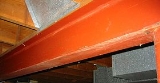
Structural steel members, such as -beams
I-beam
-beams, also known as H-beams, W-beams , rolled steel joist , or double-T are beams with an - or H-shaped cross-section. The horizontal elements of the "" are flanges, while the vertical element is the web...

, have high second moments of area
Second moment of area
The second moment of area, also known as the area moment of inertia, moment of inertia of plane area, or second moment of inertia is a property of a cross section that can be used to predict the resistance of beams to bending and deflection, around an axis that lies in the cross-sectional plane...

, which allow them to be very stiff in respect to their cross-sectional area.

Common structural shapes


In most developed countries
Developed country
A developed country is a country that has a high level of development according to some criteria. Which criteria, and which countries are classified as being developed, is a contentious issue...

, the shapes available are set out in published standards, although a number of specialist and proprietary cross sections are also available.

  • -beam
    I-beam
    -beams, also known as H-beams, W-beams , rolled steel joist , or double-T are beams with an - or H-shaped cross-section. The horizontal elements of the "" are flanges, while the vertical element is the web...

     (-shaped cross-section - in Britain these include Universal Beams (UB) and Universal Columns (UC); in Europe it includes the IPE, HE, HL, HD and other sections; in the US it includes Wide Flange (WF) and H sections)
  • Z-Shape (half a flange in opposite directions)
  • HSS-Shape (Hollow structural section
    Hollow structural section
    A hollow structural section is a type of metal profile with a hollow tubular cross section. In some countries they are referred to instead as a structural hollow section ....

     also known as SHS (structural hollow section) and including square
    Square (geometry)
    In geometry, a square is a regular quadrilateral. This means that it has four equal sides and four equal angles...

    , rectangular
    Rectangle
    In Euclidean plane geometry, a rectangle is any quadrilateral with four right angles. The term "oblong" is occasionally used to refer to a non-square rectangle...

    , circular
    Circular
    Circular is a basic geometric shape such as a Circle.Circular may also refer to:-Documents:*Circular note, a document request by a bank to its foreign correspondents to pay a specified sum of money to a named person...

     (pipe
    Pipe (material)
    A pipe is a tubular section or hollow cylinder, usually but not necessarily of circular cross-section, used mainly to convey substances which can flow — liquids and gases , slurries, powders, masses of small solids...

    ) and elliptical
    Ellipse
    In geometry, an ellipse is a plane curve that results from the intersection of a cone by a plane in a way that produces a closed curve. Circles are special cases of ellipses, obtained when the cutting plane is orthogonal to the cone's axis...

     cross sections)
  • Angle (L-shaped cross-section)
  • Channel ( [-shaped cross-section)
  • Tee (T-shaped cross-section)
  • Rail profile
    Rail profile
    The rail profile is the cross sectional shape of a railway rail, perpendicular to the length of the rail.In all but very early cast iron rails, a rail is hot rolled steel of a specific cross sectional profile designed for use as the fundamental component of railway track.Unlike some other uses of...

     (asymmetrical -beam)
    • Railway rail
    • Vignoles rail
    • Flanged T rail
    • Grooved rail
  • Bar, a piece of metal
    Metal
    A metal , is an element, compound, or alloy that is a good conductor of both electricity and heat. Metals are usually malleable and shiny, that is they reflect most of incident light...

    , rectangular cross sectioned (flat) and long, but not so wide so as to be called a sheet
    Sheet metal
    Sheet metal is simply metal formed into thin and flat pieces. It is one of the fundamental forms used in metalworking, and can be cut and bent into a variety of different shapes. Countless everyday objects are constructed of the material...

    .
  • Rod, a round
    Circle
    A circle is a simple shape of Euclidean geometry consisting of those points in a plane that are a given distance from a given point, the centre. The distance between any of the points and the centre is called the radius....

     or square and long piece of metal or wood
    Wood
    Wood is a hard, fibrous tissue found in many trees. It has been used for hundreds of thousands of years for both fuel and as a construction material. It is an organic material, a natural composite of cellulose fibers embedded in a matrix of lignin which resists compression...

    , see also rebar
    Rebar
    A rebar , also known as reinforcing steel, reinforcement steel, rerod, or a deformed bar, is a common steel bar, and is commonly used as a tensioning device in reinforced concrete and reinforced masonry structures holding the concrete in compression...

     and dowel
    Dowel
    A dowel is a solid cylindrical rod, usually made of wood, plastic or metal. In its original manufactured form, dowel is called dowel rod.Dowel rod is employed in numerous, diverse applications. It is used to form axles in toys, as detents on gymnastics grips, as knitting needles, as structural...

    .
  • Plate, metal sheets thicker than 6 mm or  in.
  • Open web steel joist
    Joist
    A joist, in architecture and engineering, is one of the horizontal supporting members that run from wall to wall, wall to beam, or beam to beam to support a ceiling, roof, or floor. It may be made of wood, steel, or concrete. Typically, a beam is bigger than, and is thus distinguished from, a joist...


While many sections are made by hot or cold rolling
Rolling (metalworking)
In metalworking, rolling is a metal forming process in which metal stock is passed through a pair of rolls. Rolling is classified according to the temperature of the metal rolled. If the temperature of the metal is above its recrystallization temperature, then the process is termed as hot rolling...

, others are made by weld
Weld
Weld most commonly refers to a joint formed by welding.Weld may also refer to:-People:* Weld family, an extended family of New England** Theodore Dwight Weld** Tuesday Weld* Weld-Blundell family* Cecil Weld-Forester, 1st Baron Forester...

ing together flat or bent plates (for example, the largest circular hollow sections are made from flat plate bent into a circle and seam-welded).

Standard structural steels (Europe)


Most steels used throughout Europe are specified to comply with the European standard
European Committee for Standardization
The European Committee for Standardization or Comité Européen de Normalisation , is a non-profit organisation whose mission is to foster the European economy in global trading, the welfare of European citizens and the environment by providing an efficient infrastructure to interested parties for...

 EN 10025
EN 10025
EN 10025 - Hot rolled products of structural steels refers to a set of european standards which specify the technical delivery conditions for hot rolled products of structural steels...

. However, many national standards also remain in force.

Typical grades are described as 'S275J2' or 'S355K2W'. In these examples, 'S' denotes structural rather than engineering steel; 275 or 355 denotes the yield strength in newtons per square millimetre or the equivalent megapascals; J2 or K2 denotes the materials toughness
Toughness
In materials science and metallurgy, toughness is the ability of a material to absorb energy and plastically deform without fracturing; Material toughness is defined as the amount of energy per volume that a material can absorb before rupturing...

 by reference to Charpy impact test
Charpy impact test
The Charpy impact test, also known as the Charpy v-notch test, is a standardized high strain-rate test which determines the amount of energy absorbed by a material during fracture. This absorbed energy is a measure of a given material's toughness and acts as a tool to study temperature-dependent...

 values; and the 'W' denotes weathering steel
Cor-ten
Weathering steel, best-known under the trademark COR-TEN steel and sometimes written without the hyphen as "Corten steel", is a group of steel alloys which were developed to eliminate the need for painting, and form a stable rust-like appearance if exposed to the weather for several years.United...

. Further letters can be used to designate fine grain steel ('N' or 'NL'); quenched and tempered
Quench
In materials science, quenching is the rapid cooling of a workpiece to obtain certain material properties. It prevents low-temperature processes, such as phase transformations, from occurring by only providing a narrow window of time in which the reaction is both thermodynamically favorable and...

 steel ('Q' or 'QL'); and thermomechanically rolled steel ('M' or 'ML').

The normal yield strength grades available are 195, 235, 275, 355, 420, and 460, although some grades are more commonly used than others e.g. in the UK, almost all structural steel is grades S275 and S355. Higher grades are available in quenched and tempered material (500, 550, 620, 690, 890 and 960 - although grades above 690 receive little if any use in construction at present).

Standard structural steels (USA)


Steels used for building construction in the US use standard alloys identified and specified by ASTM International
ASTM International
ASTM International, known until 2001 as the American Society for Testing and Materials , is an international standards organization that develops and publishes voluntary consensus technical standards for a wide range of materials, products, systems, and services...

. These steels have an alloy identification beginning with A and then two, three, or four numbers. The four-number AISI steel grades
AISI steel grades
The Society of Automotive Engineers designates SAE steel grades. These are four digit numbers which represent chemical composition standards for steel specifications. The American Iron and Steel Institute originally started a very similar system...

 commonly used for mechanical engineering, machines, and vehicles are a completely different specification series.

The standard commonly used structural steels are:

Carbon steels

  • A36
    A36 steel
    A36 steel is a standard steel alloy which is a common structural steel used in the United States.The A36 standard was established by the standards organization ASTM International.- Properties :...

     - structural shapes and plate
  • A53
    A53 steel
    ASTM A53 is a carbon steel alloy, used for structural steel pipe. The alloy specifications are set by ASTM International, in specification ASTM A53/A53M...

     - structural pipe and tubing
  • A500
    A500 steel
    ASTM A500 is a standard specification published by the ASTM for cold-formed welded and seamless carbon steel structural tubing in round, square, and rectangular shapes. It is commonly specified in the USA for hollow structural sections, but the more stringent CSA G40.21 is preferred in Canada....

     - structural pipe and tubing
  • A501 - structural pipe and tubing
  • A529 - structural shapes and plate

High strength low alloy steels

  • A441 - structural shapes and plates
  • A572 - structural shapes and plates
  • A618 - structural pipe and tubing
  • A992 - W shapes beams only
  • A270 - structural shapes and plates

Corrosion resistant high strength low alloy steels

  • A242 - structural shapes and plates
  • A588 - structural shapes and plates

Quenched and tempered alloy steels

  • A514 - structural shapes and plates
  • A517 - boilers and pressure vessels

CE Marking


The concept of CE Marking for all construction products and steel products is introduced by the Construction Products Directive (CPD)
Construction Products Directive
Construction Products Directive ' is a now repealed European Union Directive with the aim to remove technical barriers to trade in construction products between Member States in the European Union....

. The CPD is a European Directive that ensures the free movement of all construction products within the European Union.

Because steel components are “safety critical”, CE Marking is not allowed unless the Factory Production Control (FPC) system under which they are produced has been assessed by a suitable certification body that has been approved to the European Commission.

In the case of steel
Steel
Steel is an alloy that consists mostly of iron and has a carbon content between 0.2% and 2.1% by weight, depending on the grade. Carbon is the most common alloying material for iron, but various other alloying elements are used, such as manganese, chromium, vanadium, and tungsten...

 products such as sections, bolts and fabricated steelwork the CE Marking demonstrates that the product complies with the relevant harmonized standard.

For steel structures the main harmonized standards are:
  • Steel sections and plate - EN 10025-1
  • Hollow sections - EN 10219-1 and EN 10210-1
  • Pre-loadable bolts - EN 14399-1
  • Non-preloadable bolts - EN 15048-1
  • Fabricated steel - EN EN 1090
    EN 1090
    The EN 1090 standards are European standards that regulate the fabrication and assembly of steel and aluminum structures and are recognized by the Construction Products Directive...

     -1


The standard that covers CE Marking of structural steelwork is EN 1090
EN 1090
The EN 1090 standards are European standards that regulate the fabrication and assembly of steel and aluminum structures and are recognized by the Construction Products Directive...

-1. The standard has come in to force in late 2010. After a transition period of two years, CE Marking will become mandatory in most European Countries sometime early in 2012. The official end date of the transition period is July 1st 2012.

Steel vs. concrete


As raw material prices fluctuate, often so does building design. During times of lower steel prices, more steel and less concrete is used, and vice versa. Each set of vendors and users typically maintain national industry associations that advocate the use of its materials versus the other. However, both materials are typically used together. Concrete without steel reinforcement (usually ribbed round bars called rebar) crumbles under tensile loads. Steel on its own, without composite or reinforced concrete floors, is likewise not a preferred building method.

While rebar is almost always steel, it is not considered a structural steel and is described separately in the reinforcement bar and reinforced concrete
Reinforced concrete
Reinforced concrete is concrete in which reinforcement bars , reinforcement grids, plates or fibers have been incorporated to strengthen the concrete in tension. It was invented by French gardener Joseph Monier in 1849 and patented in 1867. The term Ferro Concrete refers only to concrete that is...

 articles.

While both steel structures and reinforced concrete cement (R.C.C) structures have their pros and cons, the steel structures have better strength-to-weight ratios than RCC and can be easily dismantled. Steel structures, which have bolted connections, can also be reused to some extent after dismantling.

Thermal properties


The properties of steel vary widely, depending on its alloying elements.

The austenizing temperature, the temperature where a steel transforms to an austenite
Austenite
Austenite, also known as gamma phase iron, is a metallic non-magnetic allotrope of iron or a solid solution of iron, with an alloying element. In plain-carbon steel, austenite exists above the critical eutectoid temperature of ; other alloys of steel have different eutectoid temperatures...

 crystal structure, for steel starts at 900°C for pure iron, then, as more carbon is added, the temperature falls to a minimum 724°C for eutectic steel (steel with only .83% by weight of carbon in it). As 2.1% carbon (by mass
Mass
Mass can be defined as a quantitive measure of the resistance an object has to change in its velocity.In physics, mass commonly refers to any of the following three properties of matter, which have been shown experimentally to be equivalent:...

) is approached, the austenizing temperature climbs back up, to 1130°C. Similarly, the melting point of steel changes based on the alloy.

The lowest temperature at which a plain carbon steel can begin to melt, its solidus
Solidus
Solidus may refer to:*Solidus , the "⁄" grammatical punctuation character, also used in mathematics*Slash a sign, "/" used as a punctuation mark and for various other purposes...

, is 1130 °C. Steel never turns into a liquid below this temperature. Pure Iron ('Steel' with 0% Carbon) starts to melt at 1492 °C (2720 °F), and is completely liquid upon reaching 1539 °C (2802 °F). Steel with 2.1% Carbon by weight begins melting at 1130 °C (2066 °F), and is completely molten upon reaching 1315 °C (2400 °F). 'Steel' with more than 2.1% Carbon is no longer Steel, but is known as Cast iron
Cast iron
Cast iron is derived from pig iron, and while it usually refers to gray iron, it also identifies a large group of ferrous alloys which solidify with a eutectic. The color of a fractured surface can be used to identify an alloy. White cast iron is named after its white surface when fractured, due...

.

Fire resistance


Steel loses strength when heated sufficiently. The critical temperature of a steel member is the temperature at which it cannot safely support its load. Building codes and structural engineering standard practice defines different critical temperatures depending on the structural element type, configuration, orientation, and loading characteristics. The critical temperature is often considered the temperature at which its yield stress has been reduced to 60% of the room temperature yield stress. In order to determine the fire resistance rating of a steel member, accepted calculations practice can be used, or a fire test
Fire test
A fire test is a means of determining whether or not fire protection products meet minimum performance criteria as set out in a building code or other applicable legislation. Successful tests in laboratories holding national accreditation for testing and certification result in the issuance of a...

 can be performed, the critical temperature of which is set by the standard accepted to the Authority Having Jurisdiction, such as a building code. In Japan
Japan
Japan is an island nation in East Asia. Located in the Pacific Ocean, it lies to the east of the Sea of Japan, China, North Korea, South Korea and Russia, stretching from the Sea of Okhotsk in the north to the East China Sea and Taiwan in the south...

, this is below 400°C. In China
China
Chinese civilization may refer to:* China for more general discussion of the country.* Chinese culture* Greater China, the transnational community of ethnic Chinese.* History of China* Sinosphere, the area historically affected by Chinese culture...

, Europe
Europe
Europe is, by convention, one of the world's seven continents. Comprising the westernmost peninsula of Eurasia, Europe is generally 'divided' from Asia to its east by the watershed divides of the Ural and Caucasus Mountains, the Ural River, the Caspian and Black Seas, and the waterways connecting...

 and North America
North America
North America is a continent wholly within the Northern Hemisphere and almost wholly within the Western Hemisphere. It is also considered a northern subcontinent of the Americas...

 (e.g., ASTM E-119), this is approximately 1000–1300F (530-810C). The time it takes for the steel element that is being tested to reach the temperature set by the test standard determines the duration of the fire-resistance rating
Fire-resistance rating
A fire-resistance rating typically means the duration for which a passive fire protection system can withstand a standard fire resistance test. This can be quantified simply as a measure of time, or it may entail a host of other criteria, involving other evidence of functionality or fitness for...

.
Heat transfer to the steel can be slowed by the use of fireproofing materials, thus limiting steel temperature. Common fireproofing methods for structural steel include intumescent
Intumescent
An intumescent is a substance which swells as a result of heat exposure, thus increasing in volume, and decreasing in density. Intumescents are typically used in passive fire protection and, in America, require listing and approval use and compliance in their installed configurations in order to...

, endothermic and plaster coatings as well as drywall, calcium silicate cladding, and mineral or high temperature insulation mineral wool blanket.

Concrete building structures often meet code required fire-resistance ratings, as the concrete thickness over the steel rebar provides sufficient fire resistance. However, concrete can be subject to spalling, particularly if it has an elevated moisture content. Although additional fireproofing is not often applied to concrete building structures, it is sometimes used in traffic tunnels and locations where a hydrocarbon
Hydrocarbon
In organic chemistry, a hydrocarbon is an organic compound consisting entirely of hydrogen and carbon. Hydrocarbons from which one hydrogen atom has been removed are functional groups, called hydrocarbyls....

 fuel fire is more likely, as flammable liquid fires provides more heat to the structural element as compared to a fire involving ordinary combustibles during the same fire period. Structural steel fireproofing materials include intumescent, endothermic
Endothermic
In thermodynamics, the word endothermic describes a process or reaction in which the system absorbs energy from the surroundings in the form of heat. Its etymology stems from the prefix endo- and the Greek word thermasi,...

 and plaster coatings as well as drywall
Drywall
Drywall, also known as plasterboard, wallboard or gypsum board is a panel made of gypsum plaster pressed between two thick sheets of paper...

, calcium silicate
Calcium silicate
Calcium silicate is the chemical compound Ca2SiO4, also known as calcium orthosilicate and sometimes formulated 2CaO.SiO2. It is one of group of compounds obtained by reacting calcium oxide and silica in various ratios e.g. 3CaO.SiO2, Ca3SiO5; 2CaO.SiO2, Ca2SiO4; 3CaO.2SiO2, Ca3Si2O7 and...

 cladding, and mineral or high temperature insulation wool blankets. Attention is given to connections, as the thermal expansion
Thermal expansion
Thermal expansion is the tendency of matter to change in volume in response to a change in temperature.When a substance is heated, its particles begin moving more and thus usually maintain a greater average separation. Materials which contract with increasing temperature are rare; this effect is...

 of structural elements can compromise fire-resistance rated assemblies.

Manufacturing


Cutting workpieces to length is usually done with a bandsaw.

A beam drill line (drill line) has long been considered an indispensable way to drill holes and mill slots into beams, channels and HSS elements. CNC beam drill lines are typically equipped with feed conveyors and position sensors to move the element into position for drilling, plus probing capability to determine the precise location where the hole or slot is to be cut.

For cutting irregular openings or non-uniform ends on dimensional (non-plate) elements, a cutting torch is typically used. Oxy-fuel
Oxy-fuel
Oxy-fuel refers to technology that burns oxygen with gaseous fuel. As compared to air, which contains 20.95% oxygen, higher temperatures can be reached using pure oxygen. Approximately the same total energy is produced when burning a fuel with oxygen as compared to with air; the difference is the...

 torches are the most common technology and range from simple hand-held torches to automated CNC coping machines that move the torch head around the structural element in accordance with cutting instructions programmed into the machine.

Fabricating flat plate is performed on a plate processing center where the plate is laid flat on a stationary 'table' and different cutting heads traverse the plate from a gantry-style arm or "bridge." The cutting heads can include a punch, drill or torch.

See also


  • Diamond plate
    Diamond plate
    Diamond plate, also known as checker plate, tread plate and Durbar floor plate, is a type of lightweight metal stock with a regular pattern of raised diamonds or lines on one side, with the reverse side being featureless. Diamond plate is usually steel, stainless steel or aluminum...

  • Dowel
  • Flame cleaning
    Flame cleaning
    Flame cleaning, also known as flame gouging, is the process of cleaning a structural steel surface by passing an intensely hot acetylene-oxygen flame over it...

  • Open web steel joist
    Open web steel joist
    In structural engineering, the Open Web Steel Joist is a lightweight steel truss consisting, in the standard form, of parallel chords and a triangulated web system, proportioned to span between bearing points....

  • Railway rail
  • Structural engineering
    Structural engineering
    Structural engineering is a field of engineering dealing with the analysis and design of structures that support or resist loads. Structural engineering is usually considered a specialty within civil engineering, but it can also be studied in its own right....

  • Structural shape rolling
    Structural shape rolling
    Structural shape rolling, also known as shape rolling and profile rolling, is a metal forming process where structural shapes are passed through rollers to bend or deform the workpiece to a desired shape while maintaining a constant cross-section...


External links