

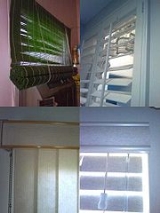
Window blind

Encyclopedia
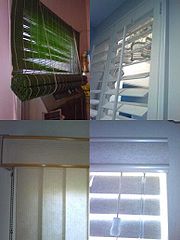
The term window blinds is also sometimes used to describe window coverings generically—in this context window blinds include almost every type of window covering, i.e. shutters, roller blinds, roman blinds and of course, standard vertical and horizontal blinds. In the United Kingdom
United Kingdom
The United Kingdom of Great Britain and Northern IrelandIn the United Kingdom and Dependencies, other languages have been officially recognised as legitimate autochthonous languages under the European Charter for Regional or Minority Languages...
awnings are also considered blinds.
Overview of different blind types
Many window blinds are made with slats of fabric, wood, plastic or metal that adjust by rotating from an open position to a closed position by allowing slats to overlap. A roller blind does not have slats but comprises a single piece of material. Metal window blinds are often used outside of the house or business to protect against theft, temperature, vision, bad weather and fire (in fire-prone areas). Often these blinds are machine-operated, rather than hand operated.The horizontal version uses a thin woven "ladder" system to suspend the slats and enable slats to be closed via a rotating drum to which each upper end of the woven ladder is wrapped and attached. A lift cord allows the blind to be pulled up and stack tightly to top of window when desired.
The vertical version uses a generally wider slat and has the added feature of being able to pull a cord to stack the slats together either to one side or to separate in the centre and stack on each end. This vertical blind allows rotation of slats by a rotating shaft in the upper head rail housing which runs through independent geared carriers that will convert twisting of tilt rail to a rotation of each individual slat in synchrony. The original vertical blinds were invented in Kansas City
Kansas City, Missouri
Kansas City, Missouri is the largest city in the U.S. state of Missouri and is the anchor city of the Kansas City Metropolitan Area, the second largest metropolitan area in Missouri. It encompasses in parts of Jackson, Clay, Cass, and Platte counties...
, Missouri, by Edward Bopp and Fredrick Bopp who held the original patent. The company name at the time was Sun Vertical. In the 1960s the patent and company was sold.
The term window blinds is also sometimes used, somewhat inaccurately, to describe window coverings generically—in this context window blinds include almost every type of window covering, e.g. shutters, roller blinds, roman blinds and of course, vertical and horizontal blinds.
In Britain awnings are also considered blinds. A blind limits observation and thus “blinds” the observer to the view. The main types are slat blinds which can be opened in two ways and solid blinds.
Solid blinds can only be raised or lowered and are sometimes called shades. There are types of blinds, such as Holland blinds and woven-wood blinds, where there are small spaces between the slats. In others such as pleated shades there are no spaces because the slats are sewn inside fabric.
Window blinds reduce the heat from sunlight. Ancient Egyptian pharaohs had blinds made of reeds. The most inexpensive blinds in the 19th century were home-made roller blinds, made of cloth.
Window blinds can be manually drawn using a cord, or automated through motorization. Controls for motorized blinds can be from a wall switch or keypad, remote control, or a personal computer, eliminating the need for cords and allowing control of otherwise inaccessible windows. A number of homes are integrating blind control with central CBUS solutions. This control provides ease of use, but is also effective to control blind operation to reduce heat loss during winter or heat effects during summer.
Persian, or slat
Metal
A metal , is an element, compound, or alloy that is a good conductor of both electricity and heat. Metals are usually malleable and shiny, that is they reflect most of incident light...
or vinyl
Vinyl
A vinyl compound is any organic compound that contains a vinyl group ,which are derivatives of ethene, CH2=CH2, with one hydrogen atom replaced with some other group...
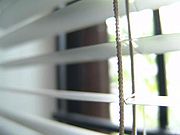
, connected with string in a way that they can be rotated to allow light to pass between the slats, rotated up to about 170 degrees to hide the light, or pulled up so that the entire window is clear. Vertical blinds consist of slats of stiffened fabric, plastic, or metal hanging by one end from a track; like the horizontal versions, the slats can be rotated 90 degrees to allow light to pass through or to fold up on one side of a door or window. Vertical blinds are very good at controlling how much natural or exterior light comes into a room, due to the ability of the slats to close tightly.
Venetian
A Venetian blind has horizontal slats, one above another. Venetian blinds are basic slatted blinds made of metal or plastic; wooden slats are sometimes used but in the US these are now usually referred to as wood blinds or bamboo blinds. They are suspended by strips of cloth called tapes, or by cords, by which all slats in unison can be rotated through nearly 180 degrees. The slats can be rotated such that they overlap with one side facing inward and then in the opposite direction such that they overlap with the other side facing inward. Between those extremes, various degrees of separation may be effected between the slats by varying the rotation. There are also lift cords passing through slots in each slat. When these cords are pulled, the bottom of the blind moves upward causing the lowest slats to press the underside of the next highest slat as the blind is raised. A modern variation of the lift cords combines them with the rotational cords in slots on the two edges of each slat. This avoids the slots otherwise required to allow a slat to rotate despite a lift cord passing through it, thus decreasing the amount of light passing through a closed blind. Slat width can be between 16–120 mm, with 25 mm being a common width.Related patents were taken out in England by Gowin Knight
Gowin Knight
Gowin Knight FRS was an English physicist who, in 1745, discovered a process for creating strongly magnetized steel. He also served as the first principal librarian of the British Museum.-Biography:...
in 1760 and Edward Beran on 11 December 1769, but Venetian blinds were known to the French long before then, the French name for Venetian blinds being persiennes. In 1761 St. Peter's Church, Philadelphia
St. Peter's Church, Philadelphia
St. Peter's Church is a historic church located on the corner of Third and Pine Streets in Philadelphia, Pennsylvania. It opened for worship on September 4, 1761 and served as a place of worship for many of the United States Founding Fathers during the period of the Continental Congresses. The...
had such blinds.
In the late 19th and early 20th centuries, Venetian blinds were widely adopted in office buildings to regulate light and air. A large modern complex in the US that adopted Venetian blinds was Rockefeller Center’s RCA Building (better known as the Radio City building) in New York City
New York City
New York is the most populous city in the United States and the center of the New York Metropolitan Area, one of the most populous metropolitan areas in the world. New York exerts a significant impact upon global commerce, finance, media, art, fashion, research, technology, education, and...
, completed in the 1930s. One of the largest orders for Venetian blinds ever placed was to the Burlington Venetian Blind Co., of Burlington, Vt., which supplied blinds for the windows of the Empire State Building in New York City
New York City
New York is the most populous city in the United States and the center of the New York Metropolitan Area, one of the most populous metropolitan areas in the world. New York exerts a significant impact upon global commerce, finance, media, art, fashion, research, technology, education, and...
.
Vertical
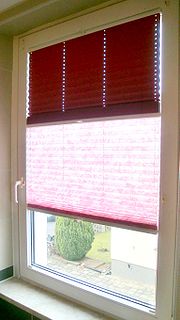
Stationary vertical blinds are hung in the doorways of some homes and businesses which generally leave the door open. Movement of the blind may signal a change in air flow, or someone entering the doorway. More commonly however, these vertical blinds are made of thick plastic. In the cold rooms of food businesses, this slows the heat leakage into the cold room. In warmer climates, vertical blinds discourage flies and some other insects from entering the building.
Others
Other variety of window blinds include mini blindMini blind
A mini blind is a type of non-vertical window blind made of long, narrow slats held together by string and located inside the window. Its slats are not as wide as venetian blind slats. A mini blind has more slats than a regular Venetian blind because its slats are narrow...
s (Venetian blinds with very narrow slats 1"(usually 25 mm wide), micro blinds 1/2"(usually 12 mm wide), louver
Louver
A louver or louvre , from the French l'ouvert; "the open one") is a window, blind or shutter with horizontal slats that are angled to admit light and air, but to keep out rain, direct sunshine, and noise...
s, jalousie
Jalousie
A jalousie window or louvre window is a window which consists of parallel glass, acrylic, or wooden louvers set in a frame. The louvers are locked together onto a track, so that they may be tilted open and shut in unison, to control airflow through the window...
s, brise soleil
Brise soleil
Brise soleil, sometimes brise-soleil , from French, "sun breaker"), in architecture refers to a variety of permanent sun-shading techniques, ranging from the simple patterned concrete walls popularized by Le Corbusier to the elaborate wing-like mechanism devised by Santiago Calatrava for the...
, Holland blinds, pleated blinds, Roman shade
Roman shade
.Roman shades are a type of window covering used to block out the sun to create a shaded area. Roman shades are different from standard shades in that they stack up evenly when being opened, however when they are they are visibly smooth, not bumpy or ribbed like typical vertical shades of blinds...
s, and roller shades.
Materials
A window blind is a means of screening a window, achieving similar results to those obtained by fitting curtains. Blinds are typically the same width and height as the window itself or slightly wider and taller - depending on whether they are fixed inside or outside the window's reveal (i.e. the wall recess within which the window itself is fixed).Window blinds have varying thermal effects: they can block unwanted heat of the summer sun and they can keep in heat in cold weather. But in both of these applications, they also reduce light to varying degrees, depending on the design. Many kinds of blinds attempt varying balances of privacy and shade. Blinds can be made of a number of different materials and manufactured in a number of different ways. This usually determines the name by which the blind is commonly known.
Fabric
Blinds made of fabric can either rolled up thanks to a thin cord and small horizontal slats (Roman blind), folding blinds with no horizontal slats create a less structured look (Austrian blinds). To create the blinds are used mainly silk and organza. A silk cloth can be present or embroidery stitch, which will give tissue varied terrain. If you combine silk and cotton, it is possible to achieve a two-layered fabric, similar to the skin of the animal.Wood
Pinoleum blinds are made up of small wooden twigs laid horizontally which are joined together by vertical threading. The resulting weave is, as a result, only flexible vertically and can be drawn upwards once manufactured as a roller blind or in a similar fashion to a Venetian blind. Conservatory blinds are often made with Pinoleum. Drawings in ancient Egyptian tombs of reed blinds have been reported and a common window blind during the 19th century is said to have been the home-made roller shade, a shade that has been underestimated.
Faux wood
Faux wood blinds are an alternative to real wood blinds. Made of a composite of man-made materials and natural wood particles, faux wood is also a less expensive choice than natural wood. These blinds have become more popular as the products have matured, becoming cheaper and more versatile at the same time offering more of a natural wood look. Current faux wood blinds are more warp resistant than ever before, have UV ratings as high as 500 and come in many colors that would be hard to find in natural wood blinds.Because of their resistance to warping, faux wood window blinds are a great choice for areas of extreme temperature swings. They are also the ideal choice for places with high moisture, such as bathrooms and kitchens, since they do not warp as easily as natural wood
Other materials
Venetian blinds, both horizontal and vertical, are available in a number of man-made materials (either resembling wood or metal or simply plastic). These are better suited to areas where moisture or direct contact with water is likely to cause a problem, such as bathrooms and kitchens. These blinds are often available with micro slats (as small as 16 mm or less). The result of smaller slats is that more have to be used to obscure the window completely. Conservatory blinds (i.e. ceiling fixed via a number of horizontal pulleys) are often made of man-made materials.Automobile blinds

Retrofit
Retrofitting refers to the addition of new technology or features to older systems.* power plant retrofit, improving power plant efficiency / increasing output / reducing emissions...
ted with sun blinds for rear and rear side windows. See also car glass
Car glass
Car glass includes windscreens, side and rear windows, and glass panel roofs on a vehicle. Side windows can be either fixed or be raised and lowered by depressing a button or switch or using a hand-turned crank. The power moonroof, a transparent, retractable sunroof, may be considered as an...
. These blinds are used to protect the vehicle and the passengers from direct sunlight.
Car shades are another common way to protect the vehicle. The shades for the rear and front windows are designed to be unfolded and sit against the window. They can be made of plastic or cardboard. The shades that go on the side windows of a vehicle are usually attached using suction cups or using static cling.
Solid fabric and slat car blinds have given way to cheaper and more flexible, folding wire-framed "dark-stocking" synthetic blinds. These are used where the car owner has not dark-tinted the glass of the car windows enough. or during the day, wishing to have more privacy.
See also
- CurtainCurtainA curtain is a piece of cloth intended to block or obscure light, or drafts, or water in the case of a shower curtain. Curtains hung over a doorway are known as portières...
- Domotics
- Mini blindMini blindA mini blind is a type of non-vertical window blind made of long, narrow slats held together by string and located inside the window. Its slats are not as wide as venetian blind slats. A mini blind has more slats than a regular Venetian blind because its slats are narrow...
- Solar screenSolar screenThe term solar screen generally refers to fixed framed panels of dense mesh which are mounted to the exterior of a commercial or residential window. These may also be installed over skylights, doors, and other fenestrations of a building. In some cases, a solar screen might install in the normal...
- SudareSudareare screens or blinds. They are sometimes called as well, particularly if they have a green fabric hem. Sudare are made of horizontal slats of decorative wood, bamboo, or other natural material woven together with simple string, colored yarn, or other decorative material to make nearly solid...
- Window shutterWindow shutterA window shutter is a solid and stable window covering usually consisting of a frame of vertical stiles and horizontal rails...