

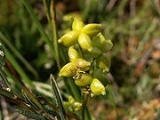
Scheuchzeriaceae

Encyclopedia
Scheuchzeria palustris (Rannoch-rush, pod grass, or Scheuchzeria), is a flowering plant
, the only species in the genus Scheuchzeria, itself the only genus in the family
Scheuchzeriaceae. In the APG II system
this is placed in the order Alismatales
of the monocots.
perennial plant
, native to cool temperate regions of the Northern Hemisphere
, where it grows in wet Sphagnum
peat bogs. It grows to 10–40 cm tall, with narrow linear leaves
alternating up the stem, with a basal sheath. The leaves can be up to 20 cm. The leaf tips are blunt with a conspicuous pore.
It has a creeping rhizome
clothed in papery, straw coloured remains of old leaf bases.
The flower
s are greenish-yellow, 4–6 mm diameter, with six tepal
s. They have an inflated sheathing base, 6 stamens and 3 carpels. It flowers from June until August
There are two subspecies
, not considered distinct by all authorities:
, a Swiss
naturalist, and his brother, Johann Kaspar Scheuchzer. The species name is from the Latin for a swamp
.
The English name refers to its occurrence on Rannoch Moor
in central Scotland
, the first site in Great Britain
the species was known from, and only one where it currently occurs; it is extinct
at a few other wetland sites further south in Britain, being found in pools and west hollows of ancient undisturbed Sphagnum
bogs.
Flowering plant
The flowering plants , also known as Angiospermae or Magnoliophyta, are the most diverse group of land plants. Angiosperms are seed-producing plants like the gymnosperms and can be distinguished from the gymnosperms by a series of synapomorphies...
, the only species in the genus Scheuchzeria, itself the only genus in the family
Family (biology)
In biological classification, family is* a taxonomic rank. Other well-known ranks are life, domain, kingdom, phylum, class, order, genus, and species, with family fitting between order and genus. As for the other well-known ranks, there is the option of an immediately lower rank, indicated by the...
Scheuchzeriaceae. In the APG II system
Angiosperm Phylogeny Group
The Angiosperm Phylogeny Group, or APG, refers to an informal international group of systematic botanists who came together to try to establish a consensus on the taxonomy of flowering plants that would reflect new knowledge about plant relationships discovered through phylogenetic studies., three...
this is placed in the order Alismatales
Alismatales
Alismatales is an order of flowering plants including about 2500 species. Pleants assigned to this order are mostly tropical or aquatic.-Description:...
of the monocots.
Description
It is a herbaceousHerbaceous
A herbaceous plant is a plant that has leaves and stems that die down at the end of the growing season to the soil level. They have no persistent woody stem above ground...
perennial plant
Perennial plant
A perennial plant or simply perennial is a plant that lives for more than two years. The term is often used to differentiate a plant from shorter lived annuals and biennials. The term is sometimes misused by commercial gardeners or horticulturalists to describe only herbaceous perennials...
, native to cool temperate regions of the Northern Hemisphere
Northern Hemisphere
The Northern Hemisphere is the half of a planet that is north of its equator—the word hemisphere literally means “half sphere”. It is also that half of the celestial sphere north of the celestial equator...
, where it grows in wet Sphagnum
Sphagnum
Sphagnum is a genus of between 151 and 350 species of mosses commonly called peat moss, due to its prevalence in peat bogs and mires. A distinction is made between sphagnum moss, the live moss growing on top of a peat bog on one hand, and sphagnum peat moss or sphagnum peat on the other, the...
peat bogs. It grows to 10–40 cm tall, with narrow linear leaves
Leaf
A leaf is an organ of a vascular plant, as defined in botanical terms, and in particular in plant morphology. Foliage is a mass noun that refers to leaves as a feature of plants....
alternating up the stem, with a basal sheath. The leaves can be up to 20 cm. The leaf tips are blunt with a conspicuous pore.
It has a creeping rhizome
Rhizome
In botany and dendrology, a rhizome is a characteristically horizontal stem of a plant that is usually found underground, often sending out roots and shoots from its nodes...
clothed in papery, straw coloured remains of old leaf bases.
The flower
Flower
A flower, sometimes known as a bloom or blossom, is the reproductive structure found in flowering plants . The biological function of a flower is to effect reproduction, usually by providing a mechanism for the union of sperm with eggs...
s are greenish-yellow, 4–6 mm diameter, with six tepal
Tepal
Tepals are elements of the perianth, or outer part of a flower, which include the petals or sepals. The term tepal is more often applied specifically when all segments of the perianth are of similar shape and color, or undifferentiated, which is called perigone...
s. They have an inflated sheathing base, 6 stamens and 3 carpels. It flowers from June until August
There are two subspecies
Subspecies
Subspecies in biological classification, is either a taxonomic rank subordinate to species, ora taxonomic unit in that rank . A subspecies cannot be recognized in isolation: a species will either be recognized as having no subspecies at all or two or more, never just one...
, not considered distinct by all authorities:
- Scheuchzeria palustris subsp. palustris. Northern and eastern EuropeEuropeEurope is, by convention, one of the world's seven continents. Comprising the westernmost peninsula of Eurasia, Europe is generally 'divided' from Asia to its east by the watershed divides of the Ural and Caucasus Mountains, the Ural River, the Caspian and Black Seas, and the waterways connecting...
, northern AsiaAsiaAsia is the world's largest and most populous continent, located primarily in the eastern and northern hemispheres. It covers 8.7% of the Earth's total surface area and with approximately 3.879 billion people, it hosts 60% of the world's current human population...
. - Scheuchzeria palustris subsp. americana (Fernald) Hultén. Northern North AmericaNorth AmericaNorth America is a continent wholly within the Northern Hemisphere and almost wholly within the Western Hemisphere. It is also considered a northern subcontinent of the Americas...
.
Etymology
The genus is named after Johann Jakob ScheuchzerJohann Jakob Scheuchzer
Johann Jakob Scheuchzer was a Swiss scholar born at Zürich.thumb|Herbarium deluvianumthumb|Zürich, Zwingli-Platz : Former home of Konrad von Mure and the house, where Johann Jakob Scheuchzer was bornthumb|Memorial plate-Career:The son of the senior town physician of Zürich, he received his...
, a Swiss
Switzerland
Switzerland name of one of the Swiss cantons. ; ; ; or ), in its full name the Swiss Confederation , is a federal republic consisting of 26 cantons, with Bern as the seat of the federal authorities. The country is situated in Western Europe,Or Central Europe depending on the definition....
naturalist, and his brother, Johann Kaspar Scheuchzer. The species name is from the Latin for a swamp
Swamp
A swamp is a wetland with some flooding of large areas of land by shallow bodies of water. A swamp generally has a large number of hammocks, or dry-land protrusions, covered by aquatic vegetation, or vegetation that tolerates periodical inundation. The two main types of swamp are "true" or swamp...
.
The English name refers to its occurrence on Rannoch Moor
Rannoch Moor
Rannoch Moor is a large expanse of around 50 square miles of boggy moorland to the west of Loch Rannoch, in Perth and Kinross and Lochaber, Highland, partly northern Argyll and Bute, Scotland...
in central Scotland
Scotland
Scotland is a country that is part of the United Kingdom. Occupying the northern third of the island of Great Britain, it shares a border with England to the south and is bounded by the North Sea to the east, the Atlantic Ocean to the north and west, and the North Channel and Irish Sea to the...
, the first site in Great Britain
Great Britain
Great Britain or Britain is an island situated to the northwest of Continental Europe. It is the ninth largest island in the world, and the largest European island, as well as the largest of the British Isles...
the species was known from, and only one where it currently occurs; it is extinct
Extinction
In biology and ecology, extinction is the end of an organism or of a group of organisms , normally a species. The moment of extinction is generally considered to be the death of the last individual of the species, although the capacity to breed and recover may have been lost before this point...
at a few other wetland sites further south in Britain, being found in pools and west hollows of ancient undisturbed Sphagnum
Sphagnum
Sphagnum is a genus of between 151 and 350 species of mosses commonly called peat moss, due to its prevalence in peat bogs and mires. A distinction is made between sphagnum moss, the live moss growing on top of a peat bog on one hand, and sphagnum peat moss or sphagnum peat on the other, the...
bogs.