

Sarnath

Encyclopedia
Sarnath or Sārnātha (also Mrigadava, Migadāya, Rishipattana, Isipatana) is the deer park where Gautama Buddha
first taught the Dharma
, and where the Buddhist Sangha
came into existence through the enlightenment of Kondanna. Sarnath is located 13 kilometres north-east of Varanasi
, in Uttar Pradesh
, India
. Singhpur, a village one km away from the site, was the birth place of Shreyansanath
, the eleventh Tirthankara of Jainism
, and a temple dedicated to him, is an important pilgrimage site
.
Isipatana is mentioned by the Buddha as one of the four places of pilgrimage
which his devout followers should visit, if they wanted to visit a place for that reason.
, and means the place where holy men (Pali: isi, Sanskrit: rishi) fell to earth.
The legend says that when the Buddha-to-be was born, some deva
s came down to announce it to 500 rishis. The rishis all rose into the air and disappeared and their relics fell to the ground. Another explanation for the name is that Isipatana was so called because sages, on their way through the air (from the Himalayas), alight here or start from here on their aerial flight (isayo ettha nipatanti uppatanti cāti-Isipatanam). Pacceka Buddhas, having spent seven days in contemplation in the Gandhamādana, bathe in the Anotatta Lake and come to the habitations of men through the air, in search of alms. They descend to earth at Isipatana. Sometimes the Pacceka Buddhas come to Isipatana from Nandamūlaka-pabbhāra.
Xuanzang
quotes the Nigrodhamiga Jātaka (J.i.145ff) to account for the origin of the Migadāya. According to him the Deer Park was the forest gifted by the king of Benares of the Jātaka, where the deer might wander unmolested. The Migadāya was so-called because deer were allowed to roam about there unmolested.
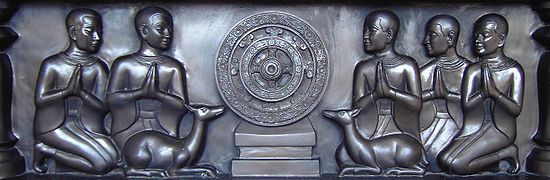
Sarnath, from Saranganath, means "Lord of the Deer" and relates to another old Buddhist story in which the Bodhisattva
is a deer and offers his life to a king instead of the doe the latter is planning to kill. The king is so moved that he creates the park as a sanctuary for deer. The park is still there today.
After attaining Enlightenment the Buddha
, leaving Uruvela, travelled to the Isipatana to join and teach them. He went to them because, using his spiritual powers, he had seen that his five former companions would be able to understand Dharma quickly. While travelling to Sarnath, Gautama Buddha had to cross the Ganges. Having no money with which to pay the ferryman, he crossed the Ganges through the air. When King Bimbisāra
heard of this, he abolished the toll for ascetics. When Gautama Buddha found his five former companions, he taught them, they understood and as a result they also became enlightened. At that time the Sangha
, the community of the enlightened ones, was founded. The sermon Buddha gave to the five monks was his first sermon, called the Dhammacakkappavattana Sutta
. It was given on the full-moon day of Asalha. Buddha subsequently also spent his first rainy season
at Sarnath at the Mulagandhakuti. The Sangha had grown to 60 in number (after Yasa
and his friends had become monks), and Buddha sent them out in all directions to travel alone and teach the Dharma. All 60 monks were Arahants.
Several other incidents connected with the Buddha, besides the preaching of the first sermon, are mentioned as having taken place in Isipatana. Here it was that one day at dawn Yasa
came to the Buddha and became an Arahant. It was at Isipatana, too, that the rule was passed prohibiting the use of sandals made of talipot leaves. On another occasion when the Buddha was staying at Isipatana, having gone there from Rājagaha
, he instituted rules forbidding the use of certain kinds of flesh, including human flesh. Twice, while the Buddha was at Isipatana, Māra
visited him but had to go away discomfited.
Besides the Dhammacakkappavattana Sutta mentioned above, several other suttas were preached by the Buddha while staying at Isipatana, among them
Some of the most eminent members of the Sangha seem to have resided at Isipatana from time to time; among recorded conversations at Isipatana are several between Sariputta and Mahakotthita, and one between Mahākotthita and Citta-Hatthisariputta. Mention is made, too, of a discourse in which several monks staying at Isipatana tried to help Channa
in his difficulties.
According to the Udapāna Jātaka (J.ii.354ff ) there was a very ancient well near Isipatana which, in the Buddha's time, was used by the monks living there.
, there was a large community of monks at Isipatana in the second century B.C. For, we are told that at the foundation ceremony of the Mahā Thūpa in Anurādhapura
, twelve thousand monks were present from Isipatana led by the Elder Dhammasena.
Xuanzang found, at Isipatana, fifteen hundred monks studying the Hīnayāna. In the enclosure of the Sanghārāma was a vihāra about two hundred feet high, strongly built, its roof surmounted by a golden figure of the mango. In the centre of the vihāra was a life-size statue of the Buddha turning the wheel of the Law. To the south-west were the remains of a stone stupa built by King Asoka. The Divy. (389-94) mentions Asoka as intimating to Upagupta his desire to visit the places connected with the Buddha's activities, and to erect thupas there. Thus he visited Lumbinī
, Bodhimūla, Isipatana, Migadāya and Kusinagara; this is confirmed by Asoka's lithic records, e.g. Rock Edict, viii.
In front of it was a stone pillar to mark the spot where the Buddha preached his first sermon. Nearby was another stupa on the site where the Pañcavaggiyas spent their time in meditation before the Buddha's arrival, and another where five hundred Pacceka Buddhas entered Nibbāna. Close to it was another building where the future Buddha Metteyya
received assurance of his becoming a Buddha.
Buddhism flourished in Sarnath in part because of kings and wealthy merchants based in Varanasi
. By the third century Sarnath had become an important center for the arts, which reached its zenith during the Gupta
period (4th to 6th centuries CE). In the 7th century by the time Xuan Zang visited from China, he found 30 monasteries and 3000 monks living at Sarnath.
Sarnath became a major centre of the Sammatiya
school of Buddhism, one of the early Buddhist schools
. However, the presence of images of Heruka
and Tara
indicate that Vajrayana
Buddhism was (at a later time) also practiced here. Also images of Brahminist gods as Shiva
and Brahma
were found at the site, and there is still a Jain temple (at Chandrapuri) located very close to the Dhamekh Stupa.
At the end of the 12th century Sarnath was sacked by Turkish Muslims, and the site was subsequently plundered for building materials.
found the Migadāya represented by a fine wood, covering an area of about half a mile, extending from the great tomb of Dhamekha
on the north to the Chaukundi
mound on the south.
, all the Buddhas preach their first sermon at the Migadāya in Isipatana. It is one of the four avijahitatthānāni (unchanging spots), the others being the bodhi-pallanka, the spot at the gate of Sankassa
, where the Buddha first touched the earth on his return from Tāvatimsa, and the site of the bed in the Gandhakuti in Jetavana
In past ages Isipatana sometimes retained its own name, as it did in the time of Phussa Buddha (Bu.xix.18), Dhammadassī Buddha (BuA.182) and Kassapa Buddha
(BuA.218). Kassapa was born there (ibid., 217). But more often Isipatana was known by different names (for these names see under those of the different Buddhas). Thus in the time of Vipassī Buddha
, it was known as Khema-uyyāna. It is the custom for all Buddhas to go through the air to Isipatana to preach their first sermon. Gotama Buddha, however, walked all the way, eighteen leagues, because he knew that by so doing he would meet Upaka, the Ajivaka, to whom he could be of service.
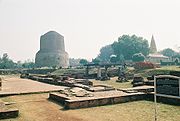 Most of the ancient buildings and structures at Sarnath were damaged or destroyed by the Turks. However, amongst the ruins can be distinguished:
For Buddhists, Sarnath (or Isipatana) is one of four pilgrimage sites designated by Gautama Buddha
, the other three being Kushinagar
, Bodh Gaya, and Lumbini
.
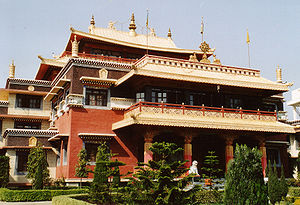
Sarnath has been developed as a place of pilgrimage, both for Buddhists from India and abroad. A number of countries in which Buddhism is a major (or the dominant) religion, among them Thailand, Japan, Tibet, Sri Lanka and Myanmar, have established temples and monasteries in Sarnath in the style that is typical for the respective country. Thus, pilgrims and visitors have the opportunity to experience an overview of Buddhist architecture from various cultures.
Gautama Buddha
Siddhārtha Gautama was a spiritual teacher from the Indian subcontinent, on whose teachings Buddhism was founded. In most Buddhist traditions, he is regarded as the Supreme Buddha Siddhārtha Gautama (Sanskrit: सिद्धार्थ गौतम; Pali: Siddhattha Gotama) was a spiritual teacher from the Indian...
first taught the Dharma
Dharma
Dharma means Law or Natural Law and is a concept of central importance in Indian philosophy and religion. In the context of Hinduism, it refers to one's personal obligations, calling and duties, and a Hindu's dharma is affected by the person's age, caste, class, occupation, and gender...
, and where the Buddhist Sangha
Sangha
Sangha is a word in Pali or Sanskrit that can be translated roughly as "association" or "assembly," "company" or "community" with common goal, vision or purpose...
came into existence through the enlightenment of Kondanna. Sarnath is located 13 kilometres north-east of Varanasi
Varanasi
-Etymology:The name Varanasi has its origin possibly from the names of the two rivers Varuna and Assi, for the old city lies in the north shores of the Ganga bounded by its two tributaries, the Varuna and the Asi, with the Ganges being to its south...
, in Uttar Pradesh
Uttar Pradesh
Uttar Pradesh abbreviation U.P. , is a state located in the northern part of India. With a population of over 200 million people, it is India's most populous state, as well as the world's most populous sub-national entity...
, India
India
India , officially the Republic of India , is a country in South Asia. It is the seventh-largest country by geographical area, the second-most populous country with over 1.2 billion people, and the most populous democracy in the world...
. Singhpur, a village one km away from the site, was the birth place of Shreyansanath
Shreyansanath
Shreyansanath was the eleventh Jain Tirthankar of the present age . According to Jain beliefs, he became a Siddha - a liberated soul which has destroyed all of its karma. Shreyansanath was born to King Vishnu Raja and Queen Vishnu Devi Rani at Sinhpuri, near Sarnath in the Ikshvaku clan...
, the eleventh Tirthankara of Jainism
Jainism
Jainism is an Indian religion that prescribes a path of non-violence towards all living beings. Its philosophy and practice emphasize the necessity of self-effort to move the soul towards divine consciousness and liberation. Any soul that has conquered its own inner enemies and achieved the state...
, and a temple dedicated to him, is an important pilgrimage site
Tirtha
In Jainism, a tīrtha |ford]], a shallow part of a body of water that may be easily crossed") is used to refer both to pilgrimage sites as well as to the four sections of the sangha...
.
Isipatana is mentioned by the Buddha as one of the four places of pilgrimage
Buddhist pilgrimage
The most important places of pilgrimage in Buddhism are located in the Gangetic plains of Northern India and Southern Nepal, in the area between New Delhi and Rajgir. This is the area where Gautama Buddha lived and taught, and the main sites connected to his life are now important places of...
which his devout followers should visit, if they wanted to visit a place for that reason.
Origin of names
Mrigadava means "deer-park". Isipatana is the name used in the Pali CanonPāli Canon
The Pāli Canon is the standard collection of scriptures in the Theravada Buddhist tradition, as preserved in the Pāli language. It is the only completely surviving early Buddhist canon, and one of the first to be written down...
, and means the place where holy men (Pali: isi, Sanskrit: rishi) fell to earth.
The legend says that when the Buddha-to-be was born, some deva
Deva (Buddhism)
A deva in Buddhism is one of many different types of non-human beings who share the characteristics of being more powerful, longer-lived, and, in general, living more contentedly than the average human being....
s came down to announce it to 500 rishis. The rishis all rose into the air and disappeared and their relics fell to the ground. Another explanation for the name is that Isipatana was so called because sages, on their way through the air (from the Himalayas), alight here or start from here on their aerial flight (isayo ettha nipatanti uppatanti cāti-Isipatanam). Pacceka Buddhas, having spent seven days in contemplation in the Gandhamādana, bathe in the Anotatta Lake and come to the habitations of men through the air, in search of alms. They descend to earth at Isipatana. Sometimes the Pacceka Buddhas come to Isipatana from Nandamūlaka-pabbhāra.
Xuanzang
Xuanzang
Xuanzang was a famous Chinese Buddhist monk, scholar, traveler, and translator who described the interaction between China and India in the early Tang period...
quotes the Nigrodhamiga Jātaka (J.i.145ff) to account for the origin of the Migadāya. According to him the Deer Park was the forest gifted by the king of Benares of the Jātaka, where the deer might wander unmolested. The Migadāya was so-called because deer were allowed to roam about there unmolested.
Sarnath, from Saranganath, means "Lord of the Deer" and relates to another old Buddhist story in which the Bodhisattva
Bodhisattva
In Buddhism, a bodhisattva is either an enlightened existence or an enlightenment-being or, given the variant Sanskrit spelling satva rather than sattva, "heroic-minded one for enlightenment ." The Pali term has sometimes been translated as "wisdom-being," although in modern publications, and...
is a deer and offers his life to a king instead of the doe the latter is planning to kill. The king is so moved that he creates the park as a sanctuary for deer. The park is still there today.
Gautama Buddha at Isipatana
The Buddha went from Bodhgaya to Sarnath about 5 weeks after his enlightenment. Before Gautama (the Buddha-to-be) attained enlightenment, he gave up his austere penances and his friends, the Pañcavaggiya monks, left him and went to Isipatana.After attaining Enlightenment the Buddha
Gautama Buddha
Siddhārtha Gautama was a spiritual teacher from the Indian subcontinent, on whose teachings Buddhism was founded. In most Buddhist traditions, he is regarded as the Supreme Buddha Siddhārtha Gautama (Sanskrit: सिद्धार्थ गौतम; Pali: Siddhattha Gotama) was a spiritual teacher from the Indian...
, leaving Uruvela, travelled to the Isipatana to join and teach them. He went to them because, using his spiritual powers, he had seen that his five former companions would be able to understand Dharma quickly. While travelling to Sarnath, Gautama Buddha had to cross the Ganges. Having no money with which to pay the ferryman, he crossed the Ganges through the air. When King Bimbisāra
Bimbisara
Bimbisara was a King, and later, Emperor of the Magadha empire from 543 BC to his death and belonged to the Hariyanka dynasty.-Career:There are many accounts of Bimbisara in the Jain texts and the Buddhist Jatakas, since he was a contemporary of Mahavira and Gautama Buddha. He was the king of...
heard of this, he abolished the toll for ascetics. When Gautama Buddha found his five former companions, he taught them, they understood and as a result they also became enlightened. At that time the Sangha
Sangha
Sangha is a word in Pali or Sanskrit that can be translated roughly as "association" or "assembly," "company" or "community" with common goal, vision or purpose...
, the community of the enlightened ones, was founded. The sermon Buddha gave to the five monks was his first sermon, called the Dhammacakkappavattana Sutta
Dhammacakkappavattana Sutta
The Dhammacakkappavattana Sutta is traditionally the Buddha's first discourse after he attained Bodhi and Nirvāṇa.-Sources:In the Pali Canon, this sutta is contained in the Sutta Pitaka's Saṃyutta Nikāya, chapter 56 The Dhammacakkappavattana Sutta (Pali; Dharmacakra Pravartana Sūtra, Sanskrit;...
. It was given on the full-moon day of Asalha. Buddha subsequently also spent his first rainy season
Vassa
Vassa , also called Rains Retreat, or Buddhist Lent, is the three-month annual retreat observed by Theravada practitioners...
at Sarnath at the Mulagandhakuti. The Sangha had grown to 60 in number (after Yasa
Yasa
Yasa was a bhikkhu during the time of Gautama Buddha. He was the sixth bhikkhu in the Buddha’s sangha and was the sixth to achieve arahanthood. Yasa lived in the 6th century BCE in what is now Uttar Pradesh and Bihar in northern India....
and his friends had become monks), and Buddha sent them out in all directions to travel alone and teach the Dharma. All 60 monks were Arahants.
Several other incidents connected with the Buddha, besides the preaching of the first sermon, are mentioned as having taken place in Isipatana. Here it was that one day at dawn Yasa
Yasa
Yasa was a bhikkhu during the time of Gautama Buddha. He was the sixth bhikkhu in the Buddha’s sangha and was the sixth to achieve arahanthood. Yasa lived in the 6th century BCE in what is now Uttar Pradesh and Bihar in northern India....
came to the Buddha and became an Arahant. It was at Isipatana, too, that the rule was passed prohibiting the use of sandals made of talipot leaves. On another occasion when the Buddha was staying at Isipatana, having gone there from Rājagaha
Rajgir
Rajgir is a city and a notified area in Nalanda district in the Indian state of Bihar. The city of Rajgir was the first capital of the kingdom of Magadha, a state that would eventually evolve into the Mauryan Empire. Its date of origin is unknown, although ceramics dating to about 1000 BC have...
, he instituted rules forbidding the use of certain kinds of flesh, including human flesh. Twice, while the Buddha was at Isipatana, Māra
Mara (demon)
In Buddhism, Māra is the demon that tempted Gautama Buddha by trying to seduce him with the vision of beautiful women who, in various legends, are often said to be Mara's daughters. In Buddhist cosmology, Mara personifies unwholesome impulses, unskillfulness, the "death" of the spiritual life...
visited him but had to go away discomfited.
Besides the Dhammacakkappavattana Sutta mentioned above, several other suttas were preached by the Buddha while staying at Isipatana, among them
- the Anattalakkhana SuttaAnattalakkhana SuttaThe Sutta or , is traditionally recorded as the second discourse delivered by Gautama Buddha. The title translates to the "Not-Self Characteristic Discourse", but is also known as the Pañcavaggiya Sutta or Pañcavargīya Sūtra , meaning the "Group of Five" Discourse.- Contents :In this discourse,...
, - the Saccavibhanga Sutta,
- the Pañca Sutta (S.iii.66f),
- the Rathakāra or Pacetana Sutta (A.i.110f),
- the two Pāsa Suttas (S.i.105f),
- the Samaya Sutta (A.iii.320ff),
- the Katuviya Sutta (A.i.279f.),
- a discourse on the Metteyyapañha of the Parāyana (A.iii.399f), and
- the Dhammadinna Sutta (S.v.406f), preached to the distinguished layman Dhammadinna, who came to see the Buddha.
Some of the most eminent members of the Sangha seem to have resided at Isipatana from time to time; among recorded conversations at Isipatana are several between Sariputta and Mahakotthita, and one between Mahākotthita and Citta-Hatthisariputta. Mention is made, too, of a discourse in which several monks staying at Isipatana tried to help Channa
Channa
Channa is a genus of the Channidae family of snakehead fishes. This genus contains about 29 species, but the most well known are probably northern snakehead and the giant snakehead . Channa has a wide natural distribution extending from Iran in the West, to China in the East, and parts of Siberia...
in his difficulties.
According to the Udapāna Jātaka (J.ii.354ff ) there was a very ancient well near Isipatana which, in the Buddha's time, was used by the monks living there.
Isipatana after the Buddha
According to the MahavamsaMahavamsa
The Mahavamsa is a historical poem written in the Pali language, of the kings of Sri Lanka...
, there was a large community of monks at Isipatana in the second century B.C. For, we are told that at the foundation ceremony of the Mahā Thūpa in Anurādhapura
Anuradhapura
Anuradhapura, , is one of the ancient capitals of Sri Lanka, famous for its well-preserved ruins of ancient Lankan civilization.The city, now a UNESCO World Heritage Site, lies 205 km north of the current capital Colombo in Sri Lanka's North Central Province, on the banks of the historic...
, twelve thousand monks were present from Isipatana led by the Elder Dhammasena.
Xuanzang found, at Isipatana, fifteen hundred monks studying the Hīnayāna. In the enclosure of the Sanghārāma was a vihāra about two hundred feet high, strongly built, its roof surmounted by a golden figure of the mango. In the centre of the vihāra was a life-size statue of the Buddha turning the wheel of the Law. To the south-west were the remains of a stone stupa built by King Asoka. The Divy. (389-94) mentions Asoka as intimating to Upagupta his desire to visit the places connected with the Buddha's activities, and to erect thupas there. Thus he visited Lumbinī
Lumbini
Lumbinī is a Buddhist pilgrimage site in the Rupandehi district of Nepal. It is the place where Queen Mayadevi gave birth to Siddhartha Gautama, who as the Buddha Gautama founded the Buddhist tradition. The Buddha lived between roughly 563 and 483 BCE...
, Bodhimūla, Isipatana, Migadāya and Kusinagara; this is confirmed by Asoka's lithic records, e.g. Rock Edict, viii.
In front of it was a stone pillar to mark the spot where the Buddha preached his first sermon. Nearby was another stupa on the site where the Pañcavaggiyas spent their time in meditation before the Buddha's arrival, and another where five hundred Pacceka Buddhas entered Nibbāna. Close to it was another building where the future Buddha Metteyya
Maitreya
Maitreya , Metteyya , or Jampa , is foretold as a future Buddha of this world in Buddhist eschatology. In some Buddhist literature, such as the Amitabha Sutra and the Lotus Sutra, he or she is referred to as Ajita Bodhisattva.Maitreya is a bodhisattva who in the Buddhist tradition is to appear on...
received assurance of his becoming a Buddha.
Buddhism flourished in Sarnath in part because of kings and wealthy merchants based in Varanasi
Varanasi
-Etymology:The name Varanasi has its origin possibly from the names of the two rivers Varuna and Assi, for the old city lies in the north shores of the Ganga bounded by its two tributaries, the Varuna and the Asi, with the Ganges being to its south...
. By the third century Sarnath had become an important center for the arts, which reached its zenith during the Gupta
Gupta Empire
The Gupta Empire was an ancient Indian empire which existed approximately from 320 to 550 CE and covered much of the Indian Subcontinent. Founded by Maharaja Sri-Gupta, the dynasty was the model of a classical civilization. The peace and prosperity created under leadership of Guptas enabled the...
period (4th to 6th centuries CE). In the 7th century by the time Xuan Zang visited from China, he found 30 monasteries and 3000 monks living at Sarnath.
Sarnath became a major centre of the Sammatiya
Early Buddhist schools
The early Buddhist schools are those schools into which, according to most scholars, the Buddhist monastic saṅgha initially split, due originally to differences in vinaya, and later also due to doctrinal differences and geographical separation of groups of monks.The original saṅgha split into the...
school of Buddhism, one of the early Buddhist schools
Early Buddhist schools
The early Buddhist schools are those schools into which, according to most scholars, the Buddhist monastic saṅgha initially split, due originally to differences in vinaya, and later also due to doctrinal differences and geographical separation of groups of monks.The original saṅgha split into the...
. However, the presence of images of Heruka
Heruka
Heruka is also a name for the Tantric deity Chakrasamvara, for which see.Heruka , is the name of a category of wrathful deities, enlightened beings in Vajrayana Buddhism that adopt a fierce countenance to benefit sentient beings. In China and Japan, it was named as Wisdom King. Herukas represent...
and Tara
Tara (Devi)
In Hinduism, the goddess Tara meaning "star" is the second of the Dasa Mahavidyas or "Great Wisdom [goddesses]", Tantric manifestations of Mahadevi, Kali, or Parvati...
indicate that Vajrayana
Vajrayana
Vajrayāna Buddhism is also known as Tantric Buddhism, Tantrayāna, Mantrayāna, Secret Mantra, Esoteric Buddhism and the Diamond Vehicle...
Buddhism was (at a later time) also practiced here. Also images of Brahminist gods as Shiva
Shiva
Shiva is a major Hindu deity, and is the destroyer god or transformer among the Trimurti, the Hindu Trinity of the primary aspects of the divine. God Shiva is a yogi who has notice of everything that happens in the world and is the main aspect of life. Yet one with great power lives a life of a...
and Brahma
Brahma
Brahma is the Hindu god of creation and one of the Trimurti, the others being Vishnu and Shiva. According to the Brahma Purana, he is the father of Mānu, and from Mānu all human beings are descended. In the Ramayana and the...
were found at the site, and there is still a Jain temple (at Chandrapuri) located very close to the Dhamekh Stupa.
At the end of the 12th century Sarnath was sacked by Turkish Muslims, and the site was subsequently plundered for building materials.
Discovery of Isipatana
Isipatana is identified with the modern Sarnath, six miles from Benares. Alexander CunninghamAlexander Cunningham
Sir Alexander Cunningham KCIE CSI was a British archaeologist and army engineer, known as the father of the Archaeological Survey of India...
found the Migadāya represented by a fine wood, covering an area of about half a mile, extending from the great tomb of Dhamekha
Dhamek Stupa
Dhamek Stupa is a massive stupa located at Sarnath, 13 km away from Varanasi in the state of Uttar Pradesh, India....
on the north to the Chaukundi
Chaukhandi Stupa
Chaukhandi Stupa is an important Buddhist stupa in Sarnath, located 13 kilometres from Varanasi, Uttar Pradesh, India. Stupas are descendents of burial mounds and serve as a shrine for a relic of the Buddha.-History:...
mound on the south.
Legendary characteristics of Isipatana
According to the Buddhist commentarial scripturesAtthakatha
Atthakatha refers to Pali-language Theravadin Buddhist commentaries to the canonical Theravadin Tipitaka. These commentaries give the traditional interpretations of the scriptures. The major commentaries were based on earlier ones, now lost, in Old Sinhalese, which were written down at the same...
, all the Buddhas preach their first sermon at the Migadāya in Isipatana. It is one of the four avijahitatthānāni (unchanging spots), the others being the bodhi-pallanka, the spot at the gate of Sankassa
Sankassa
Sankassa was an ancient city in India. The city came into prominence at the time of Gautama Buddha. According to a Buddhist source, it was thirty leagues from Savatthi...
, where the Buddha first touched the earth on his return from Tāvatimsa, and the site of the bed in the Gandhakuti in Jetavana
Jetavana
Jetavana was one of the most famous of the Buddhist monasteries in India. It was the second monastery donated to Gautama Buddha, after the Veluvana in Rajagaha. Jetavana is located just outside the old city of Savatthi...
In past ages Isipatana sometimes retained its own name, as it did in the time of Phussa Buddha (Bu.xix.18), Dhammadassī Buddha (BuA.182) and Kassapa Buddha
Kassapa Buddha
In Buddhist tradition, Kassapa is the name of a Buddha, the third of the five Buddhas of the present kalpa , and the sixth of the six Buddhas prior to the historical Buddha mentioned in the earlier parts of the Pali Canon . In the Buddhist texts in Sanskrit, this Buddha is known as...
(BuA.218). Kassapa was born there (ibid., 217). But more often Isipatana was known by different names (for these names see under those of the different Buddhas). Thus in the time of Vipassī Buddha
Vipassī Buddha
Vipassi was one of the Twenty-Eight Buddhas. It was the first of the seven past Buddhas who are closest to us which Shakyamuni was the last. He was the last third Buddha among the thousand Buddhas of the decorated kalpa, but Shakyamuni was the fourth among the thousand Buddhas of the benevolent...
, it was known as Khema-uyyāna. It is the custom for all Buddhas to go through the air to Isipatana to preach their first sermon. Gotama Buddha, however, walked all the way, eighteen leagues, because he knew that by so doing he would meet Upaka, the Ajivaka, to whom he could be of service.
Current Features of Isipatana
- The Dhamek StupaDhamek StupaDhamek Stupa is a massive stupa located at Sarnath, 13 km away from Varanasi in the state of Uttar Pradesh, India....
; it is an impressive 128 feet high and 93 feet in diameter. - The Dharmarajika Stupa is one of the few pre-AshokanAshokaAshok Maurya or Ashoka , popularly known as Ashoka the Great, was an Indian emperor of the Maurya Dynasty who ruled almost all of the Indian subcontinent from ca. 269 BC to 232 BC. One of India's greatest emperors, Ashoka reigned over most of present-day India after a number of military conquests...
stupas remaining, although only the foundations remain. The rest of the Dharmarajika Stupa was removed to Varanasi to be used as building materials in the 18h century. At that time, also relics were found in the Dharmarajika Stupa. These relics were subsequently thrown in the Ganges river. - The Chaukhandi StupaChaukhandi StupaChaukhandi Stupa is an important Buddhist stupa in Sarnath, located 13 kilometres from Varanasi, Uttar Pradesh, India. Stupas are descendents of burial mounds and serve as a shrine for a relic of the Buddha.-History:...
commemorates the spot where the Buddha met his first disciples, dating back to the fifth century or earlier and later enhanced by the addition of an octagonal tower of IslamIslamIslam . The most common are and . : Arabic pronunciation varies regionally. The first vowel ranges from ~~. The second vowel ranges from ~~~...
ic origin. In recent years it is undergoing restoration. - The ruins of the Mulagandhakuti vihara mark the place where the Buddha spent his first rainy season.
- The modern Mulagandhakuti Vihara is a monastery built in the 1930s by the Sri Lankan Mahabodhi Society, with beautiful wall paintings. Behind it is the Deer Park (where deer are still to be seen).
- The Ashoka Pillar erected here, originally surmounted by the "Lion Capital of AsokaLion Capital of AsokaThe Lion capital of Ashoka is a sculpture of four "Indian lions" standing back to back. It was originally placed atop the Aśoka pillar at Sarnath, now in the state of Uttar Pradesh, India by Emperor Ashoka circa 250 BC. The pillar, sometimes called the Aśoka Column is still in its original...
" (presently on display at the Sarnath MuseumSarnath MuseumMuseum at Sarnath is museum that houses the findings and excavations at Sarnath, by the Archaeological Survey of India, close to archaeological site.-Overview:...
), was broken during Turk invasions but the base still stands at the original location. - The Sarnath Archeological MuseumSarnath MuseumMuseum at Sarnath is museum that houses the findings and excavations at Sarnath, by the Archaeological Survey of India, close to archaeological site.-Overview:...
houses the famous Ashokan lion capital, which miraculously survived its 45-foot drop to the ground (from the top of the Ashokan Pillar), and became the National Emblem of India and national symbol on the Indian flag. The museum also houses a famous and refined Buddha-image of the Buddha in Dharmachakra-posture. - There is also a Bodhi tree planted by Anagarika DharmapalaAnagarika DharmapalaAnagarika Dharmapala was a leading figure of Buddhism in the twentieth century. He was one of the founding contributors of Sinhalese Buddhist Nationalism and Protestant Buddhism...
which was grown from a cutting of the Bodhi TreeBodhi treeThe Bodhi Tree, also known as Bo , was a large and very old Sacred Fig tree located in Bodh Gaya , under which Siddhartha Gautama, the spiritual teacher and founder of Buddhism later known as Gautama Buddha, is said to have achieved enlightenment, or Bodhi...
at Bodh Gaya.
For Buddhists, Sarnath (or Isipatana) is one of four pilgrimage sites designated by Gautama Buddha
Gautama Buddha
Siddhārtha Gautama was a spiritual teacher from the Indian subcontinent, on whose teachings Buddhism was founded. In most Buddhist traditions, he is regarded as the Supreme Buddha Siddhārtha Gautama (Sanskrit: सिद्धार्थ गौतम; Pali: Siddhattha Gotama) was a spiritual teacher from the Indian...
, the other three being Kushinagar
Kushinagar
Kushinagar , Kusinagar or Kusinara is a town and a nagar panchayat in Kushinagar district in the Indian state of Uttar Pradesh. It is an important Buddhist pilgrimage site, where Gautama Buddha is believed to have attained Parinirvana after his death.-Demographics: India census, Kushinagar had a...
, Bodh Gaya, and Lumbini
Lumbini
Lumbinī is a Buddhist pilgrimage site in the Rupandehi district of Nepal. It is the place where Queen Mayadevi gave birth to Siddhartha Gautama, who as the Buddha Gautama founded the Buddhist tradition. The Buddha lived between roughly 563 and 483 BCE...
.
Modern-Day Pilgrimage to Sarnath
Sarnath has been developed as a place of pilgrimage, both for Buddhists from India and abroad. A number of countries in which Buddhism is a major (or the dominant) religion, among them Thailand, Japan, Tibet, Sri Lanka and Myanmar, have established temples and monasteries in Sarnath in the style that is typical for the respective country. Thus, pilgrims and visitors have the opportunity to experience an overview of Buddhist architecture from various cultures.