

Kushinagar

Encyclopedia
Kushinagar Kusinagar or Kusinara is a town and a nagar panchayat
in Kushinagar district
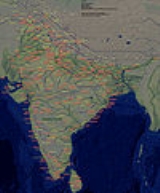
in the India
n state
of Uttar Pradesh
. It is an important Buddhist pilgrimage site, where Gautama Buddha
is believed to have attained Parinirvana
after his death.
, Kushinagar had a population of 17,982. Males constitute 52% of the population and females 48%. Kushinagar has an average literacy rate of 62%, higher than the national average of 59.5%: male literacy is 70%, and female literacy is 54%. In Kushinagar, 15% of the population is under 6 years of age.
 In ancient times, it was known as Kushavati
(Jatakas). It finds mention in epic Ramayan as the city of Kusha
the son of Ram
, the famous king of Ayodhya. Kushinagar was a celebrated center of the Malla
kingdom of ancient India. Later, it would be known as Kushinara, one of the most important four holy sites for Buddhists. At this location, near the Hiranyavati River, Gautama Buddha
attained Parinirvana
(or 'Final Nirvana') after falling ill from eating a meal of a species of mushroom, or possibly pork.
Many of the ruined stupa
s and vihara
s here date back to 3rd century BCE - 5th century CE when prosperity was at its peak. The Mauryan emperor Ashoka
is known to have contributed to significant construction at this site.
Prior to its rediscovery in the 19th century, there was a silence of more than half a millennium at Kasia. Due to violent invasions, Kushinagar lost its vitality and eventually was neglected.
s, and the scene of the Buddha's death. It was twenty-five yojana
s from Rajagaha (DA.ii.609; acc. to Fa Hsien, p. 40, it was twenty-four yojanas from Kapilavatthu) and lay on the high road from Alaka to Rájagaha, the road taken by Bávarí's disciples (SN.v.1012). At that time it was a small city, "a branch-township with wattle-and-daub houses in the midst of the jungle," and Ananda was, at first, disappointed that the Buddha should have chosen it for his Parinibbana. But the Buddha, by preaching the Maha-Sudassana Sutta, pointed out to him that in ancient times it had been Kusavati, the royal city of Maha-Sudassana (D.ii.146).
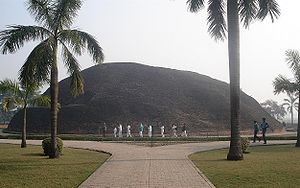 http://www.wikimapia.org/#lat=26.7359619&lon=83.9049429&z=17&l=9&m=s&v=9.]]
It is said that the Buddha had three reasons for coming to Kusinárá to die:
Between Kusinara and Pava
, three gavutas (c. 15 km (9.3 mi)) away (DA.ii.573) - from where the Buddha came to Kusinára on his last journey from Rajagaha, stopping at various places - lay the stream of Kakuttha on the banks of which was the Ambavana; beyond that was the Hiraññavati river, and near the city, in a south-westerly direction, lay the Upavattana, the Sala-grove of the Mallas, which the Buddha made his last resting-place (UdA.238; DA.ii.572f).
After the Buddha's death his body was carried into the city by the southern gate and out of the city by the eastern gate; to the east of the city was Makutabandhana, the shrine of the Mallas, and there the body was cremated. For seven days those assembled at the ceremony held a festival in honour of the relics (D.ii.160f).
As the scene of his death, Kusinara became one of the four holy places declared by the Buddha (in the Mahaparinibbana Sutta
(ii. 140) ) to be fit places of pilgrimage for the pious, the other three being Kapilavatthu (near Lumbini
), Buddhagaya (Bodh Gaya), and Isipatana (Sarnath) (D.ii.140).
Mention is made of other visits paid to Kusinárá by the Buddha, prior to that when his death took place. Thus, once he went there from Ápana and having spent some time at Kusinárá, proceeded to Átumá. The Mallas of Kusinárá were always great admirers of the Buddha, even though not all of them were his followers, and on the occasion of this visit they decided that any inhabitant of Kusinárá who failed to go and meet the Buddha and escort him to the city, would be fined five hundred. It was on this occasion that Roja the Mallan was converted and gave to the Buddha and the monks a supply of green vegetables and pastries (Vin.i.247f). During some of these visits the Buddha stayed in a wood called Baliharana, and there he preached two of the Kusinárá Suttas (A.i.274f; v.79f) and the "Kinti" Sutta (M.ii.238f). A third Kusinárá Sutta he preached while staying at Upavattana. (A.ii.79; for another discourse to some noisy monks at Upavattana, see Ud.iv.2).
According to a late tradition, one-eighth of the Buddha's relics were deposited in a cairn in Kusinárá and honoured by the Mallas (D.ii.167; Bu.xxviii.3).
In Hiouen Thsang's day there still existed towers and Sarighárámas erected to mark the spots connected with the Buddha's last days and obsequies at Kusinárá. According to his account (Beal
. op. cit.li. lii. n) Kusinárá was nineteen yojanas from Vesáli.
A copper plate belonging to the thúpa erected at the site of the Buddha's death has recently been discovered (CAGI.i.714).
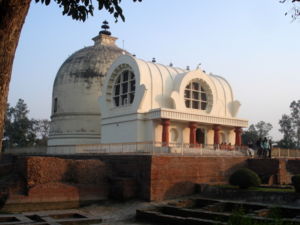 The remains of the Parinirvana Stupa and Parinirvana Temple, when rediscovered, were covered in a 40 foot high mound of bricks surrounded by a dense thorny forest. After E. Buchanan, an officer of the East India Company
, arrived in Kasia in the course of his survey-work, H. H. Wilson, in 1854, made the suggestion that ancient Kushinagar and Kasia were the same. Work resumed around 1861–1862 when General Alexander Cunningham, an archaeological surveyor, would prove the site to be that of Gautama Buddha's passing. A British officer named Mr. A.C.L. Carlleyle followed suit. Excavations began in the late 19th century and many important remnants of the main site such as the Matha Kuar and Ramabhar stupa were unveiled.
related to the life of Gautama Buddha
. The other three are Lumbini
, Bodh Gaya, and Sarnath
.
Today, in Kushinagar, there is a Post Graduate College and an Intermediate college. Today, Kushinagar has many hotels and restaurants for use by tourists.
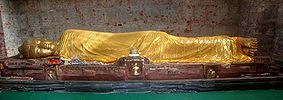
The two places most frequently visited in Kushinagar are the Mahaparinirvana Stupa, which is built on the place of Buddha's Mahaparinirvana (Great Nirvana or passing away), and the place of his cremation, which is 1.6 km away. Close to the Mahaparinirvana Stupa is located a 1500 year old Buddha-image of the Buddha as he attained Parinirvana. The Mahaparinirvana Stupa is surrounded by ruins of ancient monasteries.
The Maitreya Project
plans to build a 500 ft/152m bronze statue of Maitreya
Buddha near Kushinagar (previously planned in Bodhgaya).
Nagar Panchayat
A nagar palika or nagar panchayat is a form of an urban political unit in India comparable to a municipality.An urban centre with more than 30,000 and less than 100,000 inhabitants is classified as a nagar panchayat....
in Kushinagar district
Kushinagar District
Kushinagar District is a district of Uttar Pradesh state in northern India. Padarauna is the district headquarters. The district is named for Kushinagar, a Buddhist pilgrimage site where Gautama Buddha attained parinirvana in the 6th or 5th centuries BCE....
in the India
India
India , officially the Republic of India , is a country in South Asia. It is the seventh-largest country by geographical area, the second-most populous country with over 1.2 billion people, and the most populous democracy in the world...
n state
States and territories of India
India is a federal union of states comprising twenty-eight states and seven union territories. The states and territories are further subdivided into districts and so on.-List of states and territories:...
of Uttar Pradesh
Uttar Pradesh
Uttar Pradesh abbreviation U.P. , is a state located in the northern part of India. With a population of over 200 million people, it is India's most populous state, as well as the world's most populous sub-national entity...
. It is an important Buddhist pilgrimage site, where Gautama Buddha
Gautama Buddha
Siddhārtha Gautama was a spiritual teacher from the Indian subcontinent, on whose teachings Buddhism was founded. In most Buddhist traditions, he is regarded as the Supreme Buddha Siddhārtha Gautama (Sanskrit: सिद्धार्थ गौतम; Pali: Siddhattha Gotama) was a spiritual teacher from the Indian...
is believed to have attained Parinirvana
Parinirvana
In Buddhism, parinirvana is the final nirvana, which occurs upon the death of the body of someone who has attained complete awakening...
after his death.
Demographics
India censusCensus
A census is the procedure of systematically acquiring and recording information about the members of a given population. It is a regularly occurring and official count of a particular population. The term is used mostly in connection with national population and housing censuses; other common...
, Kushinagar had a population of 17,982. Males constitute 52% of the population and females 48%. Kushinagar has an average literacy rate of 62%, higher than the national average of 59.5%: male literacy is 70%, and female literacy is 54%. In Kushinagar, 15% of the population is under 6 years of age.
Ancient history
Kushavati
*Kushavati was a city in Kosala Kingdom as per epic Ramayana. The king of Kosala Raghava Rama installed his son Lava at Sravasti and Kusha at Kushavati. The city is identified to be Kushinagar a town near Gorakhpur....
(Jatakas). It finds mention in epic Ramayan as the city of Kusha
Kusha (Ramayana)
Kusha , in Hindu mythology, was one of the twin sons of Lord Rama and Sita . Born in the Forest after Sita had been banished from Ayodhya, they were educated and trained in military skills and were under the care of Sage Valmiki....
the son of Ram
Rama
Rama or full name Ramachandra is considered to be the seventh avatar of Vishnu in Hinduism, and a king of Ayodhya in ancient Indian...
, the famous king of Ayodhya. Kushinagar was a celebrated center of the Malla
Malla (India)
Malla was one of the solasa mahajanapadas of ancient India mentioned in the Anguttara Nikaya. It was named after the ruling clan of the same name. The Mahabharata mentions the territory as the Mallarashtra . The Malla mahajanapada was situated north of Magadha. It was a small mahajanapada...
kingdom of ancient India. Later, it would be known as Kushinara, one of the most important four holy sites for Buddhists. At this location, near the Hiranyavati River, Gautama Buddha
Gautama Buddha
Siddhārtha Gautama was a spiritual teacher from the Indian subcontinent, on whose teachings Buddhism was founded. In most Buddhist traditions, he is regarded as the Supreme Buddha Siddhārtha Gautama (Sanskrit: सिद्धार्थ गौतम; Pali: Siddhattha Gotama) was a spiritual teacher from the Indian...
attained Parinirvana
Parinirvana
In Buddhism, parinirvana is the final nirvana, which occurs upon the death of the body of someone who has attained complete awakening...
(or 'Final Nirvana') after falling ill from eating a meal of a species of mushroom, or possibly pork.
Many of the ruined stupa
Stupa
A stupa is a mound-like structure containing Buddhist relics, typically the remains of Buddha, used by Buddhists as a place of worship....
s and vihara
Vihara
Vihara is the Sanskrit and Pali term for a Buddhist monastery. It originally meant "a secluded place in which to walk", and referred to "dwellings" or "refuges" used by wandering monks during the rainy season....
s here date back to 3rd century BCE - 5th century CE when prosperity was at its peak. The Mauryan emperor Ashoka
Ashoka
Ashok Maurya or Ashoka , popularly known as Ashoka the Great, was an Indian emperor of the Maurya Dynasty who ruled almost all of the Indian subcontinent from ca. 269 BC to 232 BC. One of India's greatest emperors, Ashoka reigned over most of present-day India after a number of military conquests...
is known to have contributed to significant construction at this site.
Prior to its rediscovery in the 19th century, there was a silence of more than half a millennium at Kasia. Due to violent invasions, Kushinagar lost its vitality and eventually was neglected.
Visits by the Buddha to Kushinagar
At the time of the Buddha, Kushinagar was the capital of the MallaMalla (India)
Malla was one of the solasa mahajanapadas of ancient India mentioned in the Anguttara Nikaya. It was named after the ruling clan of the same name. The Mahabharata mentions the territory as the Mallarashtra . The Malla mahajanapada was situated north of Magadha. It was a small mahajanapada...
s, and the scene of the Buddha's death. It was twenty-five yojana
Yojana
A Yojana is a Vedic measure of distance used in ancient India. The exact measurement is disputed amongst scholars with distances being given between 6 to 15 kilometers ....
s from Rajagaha (DA.ii.609; acc. to Fa Hsien, p. 40, it was twenty-four yojanas from Kapilavatthu) and lay on the high road from Alaka to Rájagaha, the road taken by Bávarí's disciples (SN.v.1012). At that time it was a small city, "a branch-township with wattle-and-daub houses in the midst of the jungle," and Ananda was, at first, disappointed that the Buddha should have chosen it for his Parinibbana. But the Buddha, by preaching the Maha-Sudassana Sutta, pointed out to him that in ancient times it had been Kusavati, the royal city of Maha-Sudassana (D.ii.146).
It is said that the Buddha had three reasons for coming to Kusinárá to die:
- Because it was the proper venue for the preaching of the Mahá-Sudassana Sutta;
- Because Subhadda would visit him there and, after listening to his sermon, would develop meditation and become an arahant while the Buddha was still alive; and
- Because the brahman Doha would be there, after the Buddha's death, to solve the problem of the distribution of his relics (UdA.402f; DA.ii.573f6).
Between Kusinara and Pava
Pava
thumb|right|325px|A stupa built at the place where Cunda's house used to be, at the site of ancient Pava.Pava was a city in ancient India, at the time of Gautama Buddha. It was a city of the Mallas which the Buddha visited during his last journey, going there from Bhogagama and staying at Cunda's...
, three gavutas (c. 15 km (9.3 mi)) away (DA.ii.573) - from where the Buddha came to Kusinára on his last journey from Rajagaha, stopping at various places - lay the stream of Kakuttha on the banks of which was the Ambavana; beyond that was the Hiraññavati river, and near the city, in a south-westerly direction, lay the Upavattana, the Sala-grove of the Mallas, which the Buddha made his last resting-place (UdA.238; DA.ii.572f).
After the Buddha's death his body was carried into the city by the southern gate and out of the city by the eastern gate; to the east of the city was Makutabandhana, the shrine of the Mallas, and there the body was cremated. For seven days those assembled at the ceremony held a festival in honour of the relics (D.ii.160f).
As the scene of his death, Kusinara became one of the four holy places declared by the Buddha (in the Mahaparinibbana Sutta
Mahaparinibbana Sutta
For the Mahayana Mahaparinirvana Sutra see Nirvana Sutra.----The Mahaparinibbana Sutta is a Theravada Buddhist sutta in the Digha Nikaya of the Tipitaka...
(ii. 140) ) to be fit places of pilgrimage for the pious, the other three being Kapilavatthu (near Lumbini
Lumbini
Lumbinī is a Buddhist pilgrimage site in the Rupandehi district of Nepal. It is the place where Queen Mayadevi gave birth to Siddhartha Gautama, who as the Buddha Gautama founded the Buddhist tradition. The Buddha lived between roughly 563 and 483 BCE...
), Buddhagaya (Bodh Gaya), and Isipatana (Sarnath) (D.ii.140).
Mention is made of other visits paid to Kusinárá by the Buddha, prior to that when his death took place. Thus, once he went there from Ápana and having spent some time at Kusinárá, proceeded to Átumá. The Mallas of Kusinárá were always great admirers of the Buddha, even though not all of them were his followers, and on the occasion of this visit they decided that any inhabitant of Kusinárá who failed to go and meet the Buddha and escort him to the city, would be fined five hundred. It was on this occasion that Roja the Mallan was converted and gave to the Buddha and the monks a supply of green vegetables and pastries (Vin.i.247f). During some of these visits the Buddha stayed in a wood called Baliharana, and there he preached two of the Kusinárá Suttas (A.i.274f; v.79f) and the "Kinti" Sutta (M.ii.238f). A third Kusinárá Sutta he preached while staying at Upavattana. (A.ii.79; for another discourse to some noisy monks at Upavattana, see Ud.iv.2).
According to a late tradition, one-eighth of the Buddha's relics were deposited in a cairn in Kusinárá and honoured by the Mallas (D.ii.167; Bu.xxviii.3).
In Hiouen Thsang's day there still existed towers and Sarighárámas erected to mark the spots connected with the Buddha's last days and obsequies at Kusinárá. According to his account (Beal
Samuel Beal
Samuel Beal was an Oriental scholar, and the first Englishman to translate direct from the Chinese the early records of Buddhism, thus throwing light upon Indian history....
. op. cit.li. lii. n) Kusinárá was nineteen yojanas from Vesáli.
A copper plate belonging to the thúpa erected at the site of the Buddha's death has recently been discovered (CAGI.i.714).
Rediscovery
British East India Company
The East India Company was an early English joint-stock company that was formed initially for pursuing trade with the East Indies, but that ended up trading mainly with the Indian subcontinent and China...
, arrived in Kasia in the course of his survey-work, H. H. Wilson, in 1854, made the suggestion that ancient Kushinagar and Kasia were the same. Work resumed around 1861–1862 when General Alexander Cunningham, an archaeological surveyor, would prove the site to be that of Gautama Buddha's passing. A British officer named Mr. A.C.L. Carlleyle followed suit. Excavations began in the late 19th century and many important remnants of the main site such as the Matha Kuar and Ramabhar stupa were unveiled.
Today
Today, Kushinagar is a much-frequented pilgrimage site for Indian and foreign tourists, and temples have been constructed by Indian, Chinese, Sri Lankan, Thai, Burmese, South Korean, Tibetan and Japanese Buddhists, alongside the ruins of monasteries and stupas. Kushinagar is one of the main four Buddhist pilgrimage sitesBuddhist pilgrimage
The most important places of pilgrimage in Buddhism are located in the Gangetic plains of Northern India and Southern Nepal, in the area between New Delhi and Rajgir. This is the area where Gautama Buddha lived and taught, and the main sites connected to his life are now important places of...
related to the life of Gautama Buddha
Gautama Buddha
Siddhārtha Gautama was a spiritual teacher from the Indian subcontinent, on whose teachings Buddhism was founded. In most Buddhist traditions, he is regarded as the Supreme Buddha Siddhārtha Gautama (Sanskrit: सिद्धार्थ गौतम; Pali: Siddhattha Gotama) was a spiritual teacher from the Indian...
. The other three are Lumbini
Lumbini
Lumbinī is a Buddhist pilgrimage site in the Rupandehi district of Nepal. It is the place where Queen Mayadevi gave birth to Siddhartha Gautama, who as the Buddha Gautama founded the Buddhist tradition. The Buddha lived between roughly 563 and 483 BCE...
, Bodh Gaya, and Sarnath
Sarnath
Sarnath or Sārnātha is the deer park where Gautama Buddha first taught the Dharma, and where the Buddhist Sangha came into existence through the enlightenment of Kondanna. Sarnath is located 13 kilometres north-east of Varanasi, in Uttar Pradesh, India...
.
Today, in Kushinagar, there is a Post Graduate College and an Intermediate college. Today, Kushinagar has many hotels and restaurants for use by tourists.
The two places most frequently visited in Kushinagar are the Mahaparinirvana Stupa, which is built on the place of Buddha's Mahaparinirvana (Great Nirvana or passing away), and the place of his cremation, which is 1.6 km away. Close to the Mahaparinirvana Stupa is located a 1500 year old Buddha-image of the Buddha as he attained Parinirvana. The Mahaparinirvana Stupa is surrounded by ruins of ancient monasteries.
The Maitreya Project
Maitreya Project
The Maitreya Project is an international organisation, operating since 1990,set up to construct a 152 metre statue of the Maitreya Buddha, in Kushinagar, Uttar Pradesh, India, along with education and healthcare facilities for the local population...
plans to build a 500 ft/152m bronze statue of Maitreya
Maitreya
Maitreya , Metteyya , or Jampa , is foretold as a future Buddha of this world in Buddhist eschatology. In some Buddhist literature, such as the Amitabha Sutra and the Lotus Sutra, he or she is referred to as Ajita Bodhisattva.Maitreya is a bodhisattva who in the Buddhist tradition is to appear on...
Buddha near Kushinagar (previously planned in Bodhgaya).
Location
Google Maps calculates the coordinates of the Parinirvana Stupa at (26.739177,83.890663), and the Cremation Stupa (Makutabandhana) at (26.735976,83.904924).External links
- Entry on Kusinara (Kushinagar) in the Dictionary of Pali Proper Names
- photos of Kushinagar ruins and stupas
- Photos of Kushinagar