

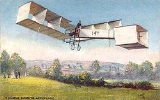
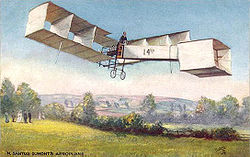
Santos-Dumont 14-bis

Encyclopedia
The 14-bis , also known as (French for "bird of prey"), was a pioneer-era canard
Canard (aeronautics)
In aeronautics, canard is an airframe configuration of fixed-wing aircraft in which the forward surface is smaller than the rearward, the former being known as the "canard", while the latter is the main wing...
biplane
Biplane
A biplane is a fixed-wing aircraft with two superimposed main wings. The Wright brothers' Wright Flyer used a biplane design, as did most aircraft in the early years of aviation. While a biplane wing structure has a structural advantage, it produces more drag than a similar monoplane wing...
designed and built by Brazil
Brazil
Brazil , officially the Federative Republic of Brazil , is the largest country in South America. It is the world's fifth largest country, both by geographical area and by population with over 192 million people...
ian inventor Alberto Santos-Dumont
Alberto Santos-Dumont
Alberto Santos-Dumont , was a Brazilian early pioneer of aviation. The heir of a wealthy family of coffee producers, Santos Dumont dedicated himself to science studies in Paris, France, where he spent most of his adult life....
. On 23 October 1906, in Paris, France, it performed the first officially witnessed unaided takeoff and flight by a heavier-than-air aircraft.
Conception, development, and initial tests
In June 1905, Gabriel VoisinGabriel Voisin
Gabriel Voisin was an aviation pioneer and the creator of Europe's first manned, engine-powered, heavier-than-air aircraft capable of a sustained , circular, controlled flight, including take-off and landing. It was flown by Henry Farman on January 13, 1908 near Paris, France...
tested a glider by having it towed by a fast boat down the River Seine
Seine
The Seine is a -long river and an important commercial waterway within the Paris Basin in the north of France. It rises at Saint-Seine near Dijon in northeastern France in the Langres plateau, flowing through Paris and into the English Channel at Le Havre . It is navigable by ocean-going vessels...
. The glider's wing configuration was made up of Hargrave
Lawrence Hargrave
Lawrence Hargrave was an engineer, explorer, astronomer, inventor and aeronautical pioneer.- Early life :Hargrave was born in Greenwich, England, the second son of John Fletcher Hargrave and was educated at Queen Elizabeth's Grammar School, Kirkby Lonsdale, Westmorland...
cells, a box kite
Box kite
A box kite is a high-performance kite, noted for developing relatively high lift; it is a type within the family of cellular kites. The typical design has four parallel struts. The box is made rigid with diagonal crossed struts. There are two sails, or ribbons, whose width is about a quarter of the...
-type structure that allowed for great lift and structural strength with minimal weight. Voisin was towed into the air and flew for over 500 ft (152.4 m) as the boat pulled him and his aircraft. In the aviation-crazy Paris of the early 1900s, this established the Hargrave cells as a configuration to be developed into heavier-than-air aircraft, not simply into kites. Santos-Dumont lived in Paris at the time, and was by then one of the most active "aeronauts" in Europe, having developed a long series of non-rigid airship
Non-rigid airship
A blimp, or non-rigid airship, is a floating airship without an internal supporting framework or keel. A non-rigid airship differs from a semi-rigid airship and a rigid airship in that it does not have any rigid structure, neither a complete framework nor a partial keel, to help the airbag...
s that displayed unparalleled agility, speed, endurance, and ease of control.
During late 1905 and early 1906, French aviation authorities, seeing the rapid development in aviation at the time, offered prizes for the first heavier-than air machines to be flown for 25 meters and for 100 meters. Ferdinand Ferber, a captain in the French Army
French Army
The French Army, officially the Armée de Terre , is the land-based and largest component of the French Armed Forces.As of 2010, the army employs 123,100 regulars, 18,350 part-time reservists and 7,700 Legionnaires. All soldiers are professionals, following the suspension of conscription, voted in...
, was experimenting with gliders and kept in touch with Octave Chanute
Octave Chanute
Octave Chanute was a French-born American railway engineer and aviation pioneer. He provided the Wright brothers with help and advice, and helped to publicize their flying experiments. At his death he was hailed as the father of aviation and the heavier-than-air flying machine...
and with the Wright brothers
Wright brothers
The Wright brothers, Orville and Wilbur , were two Americans credited with inventing and building the world's first successful airplane and making the first controlled, powered and sustained heavier-than-air human flight, on December 17, 1903...
. Voisin teamed up with Louis Blériot
Louis Blériot
Louis Charles Joseph Blériot was a French aviator, inventor and engineer. In 1909 he completed the first flight across a large body of water in a heavier-than-air craft, when he crossed the English Channel. For this achievement, he received a prize of £1,000...
to develop the boat-towed glider into a fixed-wing aircraft.
At around that time, while watching the Côte d'Azur speedboat races, Santos-Dumont noticed that Antoinette-type engines, made by Léon Levavasseur
Léon Levavasseur
Léon Levavasseur was a powerplant engineer, aircraft designer and inventor. His innovations included the V8 engine, direct fuel injection, and evaporative engine cooling...
, offered great power and were quite lightweight.
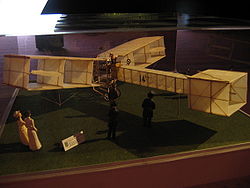
Putting all this together, Santos-Dumont had a Hargrave-cell biplane, powered by an Antoinette engine built. The work was carried out in secret; known only to his team of builders and craftsmen. The wings were at the very back configured in a dihedral, each wing containing three cells. The 24 hp Antoinette sat between the wings, with the pilot's compartment immediately ahead (where the pilot stood), and with the pusher
Pusher configuration
In a craft with a pusher configuration the propeller are mounted behind their respective engine. According to Bill Gunston, a "pusher propeller" is one mounted behind engine so that drive shaft is in compression...
-propeller immediately behind. A movable cell at the nose, actuated by cables originally manufactured for church-tower clocks, allowed for steering and altitude adjustments. This forward-mounted-mini-wing layout would later come to be called a "canard
Canard (aeronautics)
In aeronautics, canard is an airframe configuration of fixed-wing aircraft in which the forward surface is smaller than the rearward, the former being known as the "canard", while the latter is the main wing...
", from the French word for "duck", after a Bleriot aircraft of the same layout
Blériot V
|-See also:-References:...
was said to look like one. The structures of the Santos-Dumont biplane were made of bamboo, with Japanese silk surfaces, and joints made of aluminum, a very exotic material at the time.
The aircraft was transported from Neuilly
Neuilly-sur-Seine
Neuilly-sur-Seine is a commune in the western suburbs of Paris, France. It is located from the center of Paris.Although Neuilly is technically a suburb of Paris, it is immediately adjacent to the city and directly extends it. The area is composed of mostly wealthy, select residential...
, where it was built, to the nearby Bagatelle
Château de Bagatelle
The Château de Bagatelle is a small neoclassical château with a French landscape garden in the Bois de Boulogne in the XVIe arrondissement of Paris...
field adjacent to the chateau of that name in the Bois de Boulogne
Bois de Boulogne
The Bois de Boulogne is a park located along the western edge of the 16th arrondissement of Paris, near the suburb of Boulogne-Billancourt and Neuilly-sur-Seine...
, where it could be tested. In order to simulate flight-like conditions, Santos-Dumont attached the aircraft to the belly of his latest non-rigid airship, the Number 14, creating the first attempt to a hybrid airship
Hybrid airship
"A hybrid airship is an aircraft that combines characteristics of heavier-than-air technology, fixed-wing aircraft or helicopter, and lighter-than-air , aerostat technology."[1]Examples include helicopter/airship hybrids intended for heavy lift applications and dynamic lift airships intended for...
. Due to this configuration, the plane came to be known as "14-bis
BIS
Bis is a prefix or suffix designating the second instance of a thing, thus preceding ter.Bis can also refer to:* Bis , a Scottish pop band* Bis , a high-teens' magazine published by Kobunsha of Japan...
". The forces imposed by the aircraft pulled at the airship's envelope in dangerous ways, nearly tearing it and allowing for limited control. The danger of such tests caused Santos-Dumont and his team to quickly abandon them, although some constructive information was obtained that led to adjustments in the balance and weight placement of the plane.
Santos-Dumont then connected a steel cable to the tops of two poles, one taller than the other, much like a zip-line
Zip-line
A zip-line consists of a pulley suspended on a cable mounted on an incline...
or tyrolienne of today. The aircraft was hung by a rope and attached by a pulley to the steel cable. It was then pulled by a donkey until it rested by the taller pole, and then released and allowed to slide down the cable toward the lower pole. In this manner, the center of gravity of the aircraft was established and adjusted, and much was learned about its stability. Photographs of these tests show the vehicle being pulled up along the cable by the donkey back to the higher position. This gives the appearance that the plane was tested while being pulled by a donkey.
By August 1906, the aircraft was transported back to Bagatelle, where Santos-Dumont performed what would be called today "fast-taxi tests". It was found that the engine was not powerful enough to safely reach flight speeds, and was replaced by a 50 hp Antoinette, a V-8
V8 engine
A V8 engine is a V engine with eight cylinders mounted on the crankcase in two banks of four cylinders, in most cases set at a right angle to each other but sometimes at a narrower angle, with all eight pistons driving a common crankshaft....
design capable of 1,500 rpm. Early September saw greater speeds in ground tests, as well as a minor accident. On the 7 September 1906, the wheels left the ground during an extremely quick hop.
Announcements were made about Santos-Dumont trying for all the aeronautics prizes. Crowds and aviation authorities gathered on the morning of the 13 September 1906. Not all the cylinders were firing during an initial takeoff attempt, but quick repairs allowed for the second run to result in a 13-meter (43 ft) hop, an altitude of about 1 meter having been reached. This did not qualify for the prizes, but earned Santos-Dumont a great deal of attention.
The 14-bis landed at a high angle of attack
Angle of attack
Angle of attack is a term used in fluid dynamics to describe the angle between a reference line on a lifting body and the vector representing the relative motion between the lifting body and the fluid through which it is moving...
, and the propeller at the back struck the ground. Repairs were undertaken. On the 23 October, after a series of engine tests and high-speed ground runs (one of which ended as one wheel came loose, but this was quickly fixed), Santos-Dumont finally pulled the 14-bis into the air. The aircraft flew for over 200 feet at an altitude of about 10 feet (3 m). This earned Santos-Dumont the first of the aviation prizes, 3,000 francs
French franc
The franc was a currency of France. Along with the Spanish peseta, it was also a de facto currency used in Andorra . Between 1360 and 1641, it was the name of coins worth 1 livre tournois and it remained in common parlance as a term for this amount of money...
for a 25-meter-or-greater flight.
The plane required more repairs, as the landing had again damaged it, and Santos-Dumont announced that he should be ready to attempt the 100-meter prize on 12 November. The 14-bis was repaired, and aileron
Aileron
Ailerons are hinged flight control surfaces attached to the trailing edge of the wing of a fixed-wing aircraft. The ailerons are used to control the aircraft in roll, which results in a change in heading due to the tilting of the lift vector...
s were added to the middle of each outermost wing cell (similar to the aileron layout later used in the famous Curtiss Model D
Curtiss Model D
|-See also:-External links:...
Pusher
Pusher configuration
In a craft with a pusher configuration the propeller are mounted behind their respective engine. According to Bill Gunston, a "pusher propeller" is one mounted behind engine so that drive shaft is in compression...
). These ailerons, hinged about their center of gravity with their axes running through the midpoint of the outermost wing bay's forward interplane struts, were actuated by cables attached to the pilot's flightsuit at the shoulders. Movement of the shoulders thus actuated roll control, similarly to the hip-movement roll-actuation control on the Wright Flyer
Wright Flyer
The Wright Flyer was the first powered aircraft, designed and built by the Wright brothers. They flew it four times on December 17, 1903 near the Kill Devil Hills, about four miles south of Kitty Hawk, North Carolina, U.S.The U.S...
.
On the morning of 12 November 1906, the crowds gathered. In a surprise to nearly all there, Voisin also brought a biplane that he and Bleriot had built, and also powered by an Antoinette. Voisin made several takeoff attempts, until one of them damaged the vehicle such that it could not be tested further before being extensively repaired.
As Santos-Dumont allowed the 14-bis to run down the field, a car drove alongside, and Henry Farman
Henry Farman
Henri Farman Henri Farman Henri Farman (26 May 1874 – 17 July 1958 was a French pilot, aviator and aircraft designer and manufacturer with his brother Maurice Farman. His family was British and he took French nationality in 1937.-Biography:...
would drop a plate out of the car each time he observed the wheels of the plane to leave the ground or to touch down again. The first attempt saw a flight of 40 meters, and the second saw two brief flights of 40 and 50 meters. A hurried landing due to the proximity of some trees after this second attempt damaged the wheel axles, and these were fixed during a lunch break. In the afternoon, further flights were of 50 meters and then 82 meters, this one interrupted by the proximity of a polo
Polo
Polo is a team sport played on horseback in which the objective is to score goals against an opposing team. Sometimes called, "The Sport of Kings", it was highly popularized by the British. Players score by driving a small white plastic or wooden ball into the opposing team's goal using a...
barrier. As the sun set, Santos-Dumont attempted one more flight. In order to ensure he would not hit spectators, who by this time were present all over the field, he flew at an altitude of 4 meters. After 22 seconds, he cut the engine power and glided into a landing. He had flown for 220 meters, or over 700 feet, qualifying for the second aviation prize offered for heavier-than-air-aircraft, 1,000 francs for a flight of 100 meters or more.
For all accounts this was the last record flight of the aircraft. The next notable Santos-Dumont flight was 200 meters a year later, on a different model of biplane, this time with the rear rudder.
The first fixed-wing aircraft: The 14-bis versus the Wright Flyers
Wright Flyer
The Wright Flyer was the first powered aircraft, designed and built by the Wright brothers. They flew it four times on December 17, 1903 near the Kill Devil Hills, about four miles south of Kitty Hawk, North Carolina, U.S.The U.S...
or the 14-Bis was the first true airplane
First flying machine
There are conflicting views as to what was the first flying machine.Much of the debate surrounding records of early flying machines depends on the exact definition of what constitutes a "flying machine", "flight", and even "first"....
.
The 1903 Wright Flyer I used a launch rail and undercarriage skids. After 1903 the Wrights added a catapult to assist the takeoff of later versions of their airplanes. The Santos-Dumont 14-bis used wheels and no catapult. To confuse the issue still further, Traian Vuia had hopped his own, four-wheeled landing gear equipped monoplane on March 18, 1906 at Montesson
Montesson
Montesson is a commune in the Yvelines department in the Île-de-France region in north-central France. It is located in the western suburbs of Paris.-External links:* http://www.fotw.net/flags/fr-78-ms.html...
in France for a distance of twelve meters, some six months before the Santos-Dumont 14bis had been "hopped" for the first time. The Vuia pioneer aircraft had no other method of ground contact at any time, other than through its four wire-spoked bicycle-style wheels, set in a rectangular pattern.
The Fédération Aéronautique Internationale
Fédération Aéronautique Internationale
The Fédération Aéronautique Internationale is the world governing body for air sports and aeronautics and astronautics world records. Its head office is in Lausanne, Switzerland. This includes man-carrying aerospace vehicles from balloons to spacecraft, and unmanned aerial vehicles...
, founded in France two years after the Wright's first flight, to keep track of aviation records and other aeronautical activities, stated among its rules that an aircraft should be able to take off under its own power in order to qualify for a record. Many Santos-Dumont fans believe this meant the 14-bis was the first fixed-wing aircraft. Wright supporters emphasize the controlled, sustained maneuvering flights made by the brothers, compared to the subsequent short straight flights of Santos Dumont.
Advocates for Santos Dumont cite a letter attributed to Wilbur Wright to French Army Captain Ferdinand Ferber, part of which says:
From this passage, Santos-Dumont fans could infer that while the Wright Flyer may have been superior in the air, its take-off apparatus made it overly impractical to operate and transport. Alternatively, Wright brothers fans could point to the implication that the scarcity of usable takeoff fields made the Flyer and "pillar" more practical, needing much less open, smooth and level space than the 14-bis.
Many other inventors could also claim the title to the first flying machine
First flying machine
There are conflicting views as to what was the first flying machine.Much of the debate surrounding records of early flying machines depends on the exact definition of what constitutes a "flying machine", "flight", and even "first"....
. From powered, heavier-than-air, but less-than-controllable airplanes, to gliders and balloons, a long series of "flying machines" separately achieved many of the individual criteria that are required of an "airplane". These achievements, most of them first accomplished in the 1800s, include being able to sustain flight (albeit lighter-than-air flight), using thrust to move wings through the air so as to generate enough lift to rise off the ground (albeit not controllably), and creating a winged vehicle that can stay in the air for more than a few seconds and that can be controlled to turn, dive, climb, etc (albeit only gliders that required a loss of altitude to "power" them). For example, Frederick Marriott's Avitor was a slightly-heavier-than-air airship that was fully controllable. It relied primarily on a large hydrogen gas bag providing buoyancy for flight, but it had wings and could only get off the ground by moving forward so that the wings generated the additional aerodynamic lift needed to overcome its weight. Could such a hybrid be "the first heavier-than-air flying machine"? It is only one of many examples of a long history of flying contraptions, so this debate could easily be extended well beyond being about simply the 14-Bis versus the Wright Flyer.
Specifications (14-bis)
Related content
Related development: Santos Dumont's series of dirigibles, and then the Santos-Dumont DemoiselleSantos-Dumont Demoiselle
-External links:...
Comparable aircraft: Wright Flyer
Wright Flyer
The Wright Flyer was the first powered aircraft, designed and built by the Wright brothers. They flew it four times on December 17, 1903 near the Kill Devil Hills, about four miles south of Kitty Hawk, North Carolina, U.S.The U.S...
- Blériot III
Blériot III
-Bibliography:* Phillipps, Brian A. Bleriot: Herald of an Age. Stroud: Tempus, 2000 ISBN0 75241739 8* Hallion, Richard P. 'Taking Flight. New York: Oxford University Press, 2003. ISBN 0 19 516035 5...
- Blériot V
Blériot V
|-See also:-References:...
- Voisin-Farman I
Voisin-Farman I
The 1907 Voisin biplane was the first successful powered aircraft designed by aeronautical engineer and manufacturer Gabriel Voisin. It was used by the French aviator Henri FarmanBorn in France to British parents, Henry Farman took French nationality in 1937 to make the first heavier-than-air...