

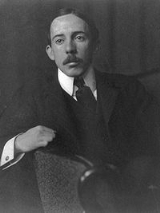
Alberto Santos-Dumont

Encyclopedia
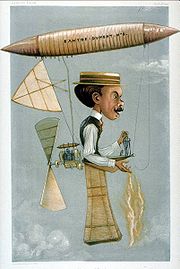
Aviation
Aviation is the design, development, production, operation, and use of aircraft, especially heavier-than-air aircraft. Aviation is derived from avis, the Latin word for bird.-History:...
. The heir of a wealthy family of coffee producers, Santos Dumont dedicated himself to science studies in Paris
Paris
Paris is the capital and largest city in France, situated on the river Seine, in northern France, at the heart of the Île-de-France region...
, France, where he spent most of his adult life.
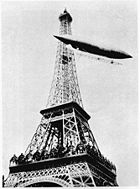
Santos-Dumont designed, built and flew one of the first practical dirigibles. In doing so he demonstrated that routine, controlled flight was possible. This "conquest of the air", in particular his winning the Deutsch de la Meurthe prize on October 19, 1901 on a flight that rounded the Eiffel Tower
Eiffel Tower
The Eiffel Tower is a puddle iron lattice tower located on the Champ de Mars in Paris. Built in 1889, it has become both a global icon of France and one of the most recognizable structures in the world...
, made him one of the most famous people in the world during the early 20th century.
In addition to his pioneering work in airships, Santos-Dumont made the first European public flight of an airplane
Fixed-wing aircraft
A fixed-wing aircraft is an aircraft capable of flight using wings that generate lift due to the vehicle's forward airspeed. Fixed-wing aircraft are distinct from rotary-wing aircraft in which wings rotate about a fixed mast and ornithopters in which lift is generated by flapping wings.A powered...
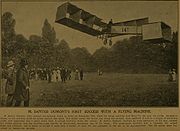
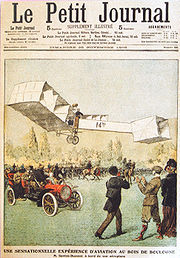
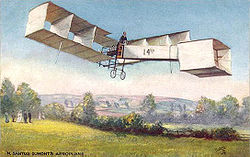
on October 23, 1906. Designated 14-bis or Oiseau de proie (French for "bird of prey"), the flying machine was the first fixed-wing aircraft witnessed by the European press and French aviation authorities to take off and successfully fly. Santos-Dumont is considered the "Father of Aviation" in Brazil, his native country. His flight is the first to have been certified by the Aéro Club de France and the Fédération Aéronautique Internationale (FAI).
Santos-Dumont occupied the 38th chair of the Brazilian Academy of Letters
Academia Brasileira de Letras
Academia Brasileira de Letras is a Brazilian literary non-profit society established at the end of the 19th century by a group of 40 writers and poets inspired by the Académie Française. The first president, Machado de Assis, declared its foundation on December 15, 1896, with the statutes being...
, from 1931 until his death in 1932.
Childhood
Santos-Dumont was born in Cabangu Farm, a farm in the Brazilian town of Palmira, today named Santos DumontSantos Dumont, Minas Gerais
Santos Dumont is a city and municipality in southern Minas Gerais state, Brazil. The geographical coordinates are: latitude 21º27'24" South and longitude 43º33'09". The population is estimated to be 49,137 and the total area of the municipality is 639.1 km2...
in the state of Minas Gerais
Minas Gerais
Minas Gerais is one of the 26 states of Brazil, of which it is the second most populous, the third richest, and the fourth largest in area. Minas Gerais is the Brazilian state with the largest number of Presidents of Brazil, the current one, Dilma Rousseff, being one of them. The capital is the...
, in the Southeast Brazil. He grew up as the sixth of eight children on a coffee
Coffee
Coffee is a brewed beverage with a dark,init brooo acidic flavor prepared from the roasted seeds of the coffee plant, colloquially called coffee beans. The beans are found in coffee cherries, which grow on trees cultivated in over 70 countries, primarily in equatorial Latin America, Southeast Asia,...
plantation
Plantation
A plantation is a long artificially established forest, farm or estate, where crops are grown for sale, often in distant markets rather than for local on-site consumption...
owned by his family in the state of São Paulo
São Paulo (state)
São Paulo is a state in Brazil. It is the major industrial and economic powerhouse of the Brazilian economy. Named after Saint Paul, São Paulo has the largest population, industrial complex, and economic production in the country. It is the richest state in Brazil...
. His French-born father was an engineer
Engineer
An engineer is a professional practitioner of engineering, concerned with applying scientific knowledge, mathematics and ingenuity to develop solutions for technical problems. Engineers design materials, structures, machines and systems while considering the limitations imposed by practicality,...
, and made extensive use of the latest labor-saving inventions on his vast property. So successful were these innovations that Santos-Dumont's father gathered a large fortune and became known as the "Coffee King of Brazil."
He was fascinated by machinery, and while still a young child he learned to drive the steam tractor
Steam tractor
A steam tractor is a vehicle powered by a steam engine which is used for pulling.In North America, the term steam tractor usually refers to a type of agricultural tractor powered by a steam engine, used extensively in the late 19th and early 20th centuries.In Great Britain, the term steam tractor...
s and locomotive
Locomotive
A locomotive is a railway vehicle that provides the motive power for a train. The word originates from the Latin loco – "from a place", ablative of locus, "place" + Medieval Latin motivus, "causing motion", and is a shortened form of the term locomotive engine, first used in the early 19th...
used on his family's plantation. He was also a fan of Jules Verne
Jules Verne
Jules Gabriel Verne was a French author who pioneered the science fiction genre. He is best known for his novels Twenty Thousand Leagues Under the Sea , A Journey to the Center of the Earth , and Around the World in Eighty Days...
and had read all his books before his tenth birthday. He wrote in his autobiography
Autobiography
An autobiography is a book about the life of a person, written by that person.-Origin of the term:...
that the dream of flying came to him while contemplating the magnificent skies of Brazil in the long, sunny afternoons at the plantation.
According to the custom of wealthy families of the time, after receiving basic instruction at home with private instructors including his parents, young Alberto was sent out alone to larger cities to do his secondary studies. He studied for a while in "Colégio Culto à Ciência
Colégio Culto à Ciência
The Colégio Culto à Ciência , currently denominated E.E. Culto à Ciência), is a public secondary school located in the city of Campinas, state of São Paulo, Brazil...
", in Campinas
Campinas
Campinas is a city and municipality located in the coastal interior of the state of São Paulo, Brazil. is the administrative center of the meso-region of the same name, with 3,783,597 inhabitants as of the 2010 Census, consisting of 49 cities....
.
Move to France
In 1891, Alberto's father had an accident while inspecting some machinery. He fell from his horse and became a paraplegic. He decided to sell the plantation and move to Europe with his wife and younger children. At 17, Santos-Dumont left the prestigious Escola de Minas in Ouro PretoOuro Preto
-History:Founded at the end of the 17th century, Ouro Preto was originally called Vila Rica, or "rich village," the focal point of the gold rush and Brazil's golden age in the 18th century under Portuguese rule....
, Minas Gerais, for Paris. Shortly after he arrived, he bought an automobile
Automobile
An automobile, autocar, motor car or car is a wheeled motor vehicle used for transporting passengers, which also carries its own engine or motor...
. Later, he pursued studies in physics
Physics
Physics is a natural science that involves the study of matter and its motion through spacetime, along with related concepts such as energy and force. More broadly, it is the general analysis of nature, conducted in order to understand how the universe behaves.Physics is one of the oldest academic...
, chemistry
Chemistry
Chemistry is the science of matter, especially its chemical reactions, but also its composition, structure and properties. Chemistry is concerned with atoms and their interactions with other atoms, and particularly with the properties of chemical bonds....
, mechanics
Mechanics
Mechanics is the branch of physics concerned with the behavior of physical bodies when subjected to forces or displacements, and the subsequent effects of the bodies on their environment....
, and electricity
Electricity
Electricity is a general term encompassing a variety of phenomena resulting from the presence and flow of electric charge. These include many easily recognizable phenomena, such as lightning, static electricity, and the flow of electrical current in an electrical wire...
with the help of a private tutor.
Balloons and dirigibles
Balloon
A balloon is an inflatable flexible bag filled with a gas, such as helium, hydrogen, nitrous oxide, oxygen, or air. Modern balloons can be made from materials such as rubber, latex, polychloroprene, or a nylon fabric, while some early balloons were made of dried animal bladders, such as the pig...
rides as a passenger. He quickly moved on to piloting balloons himself, and shortly thereafter to designing his own balloons. In 1898, Santos-Dumont flew his first balloon design, the Brésil.
After numerous balloon flights, he turned to the design of steerable balloons, known as dirigibles, that could be propelled through the air rather than drifting along with the wind.
Between 1898 and 1905, he built and flew 11 dirigibles. With air traffic control
Air traffic control
Air traffic control is a service provided by ground-based controllers who direct aircraft on the ground and in the air. The primary purpose of ATC systems worldwide is to separate aircraft to prevent collisions, to organize and expedite the flow of traffic, and to provide information and other...
restrictions still decades in the future, he would float along Paris boulevards at rooftop level in one of his airships, commonly landing in front of a fashionable outdoor cafe for lunch. On one occasion he even flew an airship early one morning to his own apartment at No. 9, Rue Washington, just off Avenue des Champs-Élysées, not far from the Arc de Triomphe
Arc de Triomphe
-The design:The astylar design is by Jean Chalgrin , in the Neoclassical version of ancient Roman architecture . Major academic sculptors of France are represented in the sculpture of the Arc de Triomphe: Jean-Pierre Cortot; François Rude; Antoine Étex; James Pradier and Philippe Joseph Henri Lemaire...
.
To win the Deutsch de la Meurthe prize Santos-Dumont decided to build a bigger craft, the dirigible Number 5. On August 8, 1901 during one of his attempts, his dirigible lost hydrogen gas. It started to descend and was unable to clear the roof of the Trocadero Hotel. A loud explosion was then heard. Santos-Dumont survived the explosion and was left hanging in a basket from the side of the hotel. With the help of the crowd he climbed to the roof without injury.
The zenith of his lighter-than-air career came when he won the Deutsch de la Meurthe prize. The challenge called for a flight from the Parc Saint Cloud to the Eiffel Tower
Eiffel Tower
The Eiffel Tower is a puddle iron lattice tower located on the Champ de Mars in Paris. Built in 1889, it has become both a global icon of France and one of the most recognizable structures in the world...
and back in less than thirty minutes. The winner of the prize needed to maintain an average ground speed of at least 22 km/h (14 mph) to cover the round trip distance of 11 km (6.8 mi) in the allotted time.
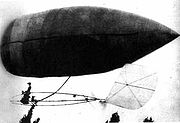
Santos-Dumont number 6
The airship, designated as his #6, was designed and built by Alberto Santos-Dumont. He used it to win the Deutsch prize in 1901. It is considered by many to be the first truly successful airship....
. Immediately after the flight, a controversy broke out around a last minute rule change regarding the precise timing of the flight. There was much public outcry and comment in the press. Finally, after several days of vacillating by the committee of officials, Santos-Dumont was awarded the prize as well as the prize money of 125,000 francs. In a charitable gesture, he donated 75,000 francs of the prize money to the poor of Paris. The balance was given to his workmen as a bonus. An additional matching 125,000 francs was voted to him along with a gold medal by the government of his native Brazil.
Santos-Dumont's aviation feats made him a celebrity in Europe and throughout the world. He won several more prizes and became a friend to millionaires, aviation
Aviation
Aviation is the design, development, production, operation, and use of aircraft, especially heavier-than-air aircraft. Aviation is derived from avis, the Latin word for bird.-History:...
pioneers, and royalty. In 1903 Aida D'Acosta Breckinridge
Aida de Acosta
Aida de Acosta Root Breckinridge was an American socialite and the first female to fly a powered aircraft solo. In 1903, while in Paris with her mother, she caught her first glimpse of dirigibles...
piloted Santos-Dumont's airship. In 1904, he went to the United States and was invited to the White House
White House
The White House is the official residence and principal workplace of the president of the United States. Located at 1600 Pennsylvania Avenue NW in Washington, D.C., the house was designed by Irish-born James Hoban, and built between 1792 and 1800 of white-painted Aquia sandstone in the Neoclassical...
to meet U.S. President
President of the United States
The President of the United States of America is the head of state and head of government of the United States. The president leads the executive branch of the federal government and is the commander-in-chief of the United States Armed Forces....
Theodore Roosevelt
Theodore Roosevelt
Theodore "Teddy" Roosevelt was the 26th President of the United States . He is noted for his exuberant personality, range of interests and achievements, and his leadership of the Progressive Movement, as well as his "cowboy" persona and robust masculinity...
.
In 1904, Santos-Dumont shipped his new airship No. 7 (also called Racer), to St. Louis from Paris in several crates to fly at the Louisiana Purchase Exposition
Louisiana Purchase Exposition
The Louisiana Purchase Exposition, informally known as the Saint Louis World's Fair, was an international exposition held in St. Louis, Missouri, United States in 1904.- Background :...
. It was a new airship, built to compete for the Grand Prize of $100,000, which was to be given to a flying machine (of any sort) that could make three round-trip flights over a 15-mile “L”-shaped course at an overall average speed of 20 miles/hour (later reduced to 15 miles/hour). It was also necessary for the machine to land without damage (to craft or crew) not more than fifty yards from the starting point. Because he was probably the best-known aviator at the time, the Fair committee went to great lengths to ensure his participation, including modifying the rules. However, upon arrival in St. Louis, Santos-Dumont found his airship’s gas bag to be irreparably damaged; sabotage, although suspected, was never proven, and Santos-Dumont did not participate in the contest. In fact, suspicion of the deed, a repeat of a similar incident in Boston, began to focus somewhat absurdly on Santos- Dumont himself, and he indignantly left the Fair and returned immediately to France.
The public eagerly followed his daring exploits. Parisians affectionately dubbed him le petit Santos. The fashionable folk of the day mimicked various aspects of his style of dress from his high collared shirts to his signature Panama hat. He was, and remains to this day, a prominent folk hero in his native Brazil.
Heavier than air aircraft
Fixed-wing aircraft
A fixed-wing aircraft is an aircraft capable of flight using wings that generate lift due to the vehicle's forward airspeed. Fixed-wing aircraft are distinct from rotary-wing aircraft in which wings rotate about a fixed mast and ornithopters in which lift is generated by flapping wings.A powered...
design, and also a helicopter
Helicopter
A helicopter is a type of rotorcraft in which lift and thrust are supplied by one or more engine-driven rotors. This allows the helicopter to take off and land vertically, to hover, and to fly forwards, backwards, and laterally...
. He finally achieved his dream of flying an aircraft on October 23, 1906 by piloting the 14-bis before a large crowd of witnesses for a distance of 60 metres (197 ft) at a height of two to three metres (10 ft). This well-documented event was the first flight verified by the Aéro-Club de France
Aéro-Club de France
The Aéro-Club de France was founded as the Aéro-Club on 20 October 1898 as a society 'to encourage aerial locomotion' by Ernest Archdeacon, Léon Serpollet, Henri de la Valette, Jules Verne and his wife, André Michelin, Albert de Dion, Alberto Santos-Dumont, Henry Deutsch de la Meurthe, and Henry de...
of a powered heavier-than-air machine in Europe and won the Deutsch-Archdeacon Price for the first officially observed flight further than 25 meters.
On November 12, 1906, Santos-Dumont set the first world record recognized by the Federation Aeronautique Internationale by flying 220 metres in 21.5 seconds.
Santos-Dumont made other contributions to the field of aircraft design. He added movable surfaces, the precursor to aileron
Aileron
Ailerons are hinged flight control surfaces attached to the trailing edge of the wing of a fixed-wing aircraft. The ailerons are used to control the aircraft in roll, which results in a change in heading due to the tilting of the lift vector...
s, between the wings in an effort to gain more lateral stability than was offered by the 14-bis wing dihedral. He also pushed for and exploited substantial improvements in engine power-to-weight ratio
Power-to-weight ratio
Power-to-weight ratio is a calculation commonly applied to engines and mobile power sources to enable the comparison of one unit or design to another. Power-to-weight ratio is a measurement of actual performance of any engine or power sources...
, and other refinements in aircraft construction techniques.
Santos-Dumont's final design were the Demoiselle
Santos-Dumont Demoiselle
-External links:...
monoplanes (Nos. 19 to 22). This aircraft was employed as Dumont's personal transportation and he willingly let others make use of his design. The fuselage
Fuselage
The fuselage is an aircraft's main body section that holds crew and passengers or cargo. In single-engine aircraft it will usually contain an engine, although in some amphibious aircraft the single engine is mounted on a pylon attached to the fuselage which in turn is used as a floating hull...
consisted of three specially reinforced bamboo booms, and the pilot sat a seat between the main wheels of a tricycle
Tricycle
A tricycle is a three-wheeled vehicle. While tricycles are often associated with the small three-wheeled vehicles used by pre-school-age children, they are also used by adults for a variety of purposes. In the United States and Canada, adult-sized tricycles are used primarily by older persons for...
landing gear
Landing Gear
Landing Gear is Devin the Dude's fifth studio album. It was released on October 7, 2008. It was his first studio album since signing with the label Razor & Tie. It features a high-profile guest appearance from Snoop Dogg. As of October 30, 2008, the album has sold 18,906 copies.-Track...
. The Demoiselle
Demoiselle
Demoiselle may refer to:* Demoiselle crane, a crane of central Asia* Demoiselle Stakes, a horse race held in New York* Demoiselle Creek, New Brunswick* Santos-Dumont Demoiselle, an early aircraft...
was controlled in flight by a tail unit that functioned both as elevator and rudder
Rudder
A rudder is a device used to steer a ship, boat, submarine, hovercraft, aircraft or other conveyance that moves through a medium . On an aircraft the rudder is used primarily to counter adverse yaw and p-factor and is not the primary control used to turn the airplane...
, and by wing warping
Wing warping
Wing warping was an early system for lateral control of a fixed-wing aircraft. The technique, used and patented by the Wright brothers, consisted of a system of pulleys and cables to twist the trailing edges of the wings in opposite directions...
(No. 20).
In 1908 Santos-Dumont started working with Adolphe Clément
Adolphe Clément
Gustave Adolphe Clément-Bayard was a French entrepreneur...
's Clement-Bayard company to build the Demoiselle No 19. They planned a production run of 100 units, built 50 and sold only 15 for 7,500 francs for each airframe. It was the world's first series production aircraft. By 1909 it was offered with a choice of 3 engines, Clement 20 hp; Wright 4-cyl 30 hp (Clement-Bayard had the license to manufacture Wright engines); and Clement-Bayard 40 hp designed by Pierre Clerget. The Demoiselle achieved 120 km/h.
The Demoiselle airplane could be constructed in only 15 days. Possessing outstanding performance, easily covering 200 m of ground during the initial flights and flying at speeds of more than 100 km/h, the Demoiselle was the last aircraft built by Santos-Dumont. The June 1910 edition of the Popular Mechanics magazine published drawings of the Demoiselle and affirmed that "This machine is better than any other which has ever been built, for those who wish to reach results with the least possible expense and with a minimum of experimenting." American companies sold drawings and parts for Demoiselles for several years afterwards. Santos-Dumont was so enthusiastic about aviation that he released the drawings of Demoiselle for free, thinking that aviation would be the mainstream of a new prosperous era for mankind.
The first fixed-wing aircraft: The 14-bis versus the Wright Flyers
There is still controversy over whether the Wright 1903 Flyer IWright Flyer
The Wright Flyer was the first powered aircraft, designed and built by the Wright brothers. They flew it four times on December 17, 1903 near the Kill Devil Hills, about four miles south of Kitty Hawk, North Carolina, U.S.The U.S...
, or the 14-Bis was the first true airplane.
The Fédération Aéronautique Internationale
Fédération Aéronautique Internationale
The Fédération Aéronautique Internationale is the world governing body for air sports and aeronautics and astronautics world records. Its head office is in Lausanne, Switzerland. This includes man-carrying aerospace vehicles from balloons to spacecraft, and unmanned aerial vehicles...
, founded in France at the beginning of the century to verify aviation records, stated among its rules that an aircraft should be able to take off under its own power in order to qualify for a record. Supporters of Santos-Dumont's claim believe that this means the 14-bis was, technically, the first successful fixed-wing aircraft.
Many other inventors could also claim to have produced the first flying machine
First flying machine
There are conflicting views as to what was the first flying machine.Much of the debate surrounding records of early flying machines depends on the exact definition of what constitutes a "flying machine", "flight", and even "first"....
. A long series of "flying machines" achieved some of the criteria that are required of an "aircraft." These achievements, most of them first accomplished in the 1800s, include being able to sustain flight using lighter-than-air craft, powered machines which could generate enough lift to rise off the ground, but which were not controllable, and unpowered winged vehicles that flew briefly and that could be controlled. For example, Frederick Marriott's Avitor was a slightly-heavier-than-air dirigible that was fully controllable. It relied primarily on a large hydrogen gas bag for flight, but it had wings and could only get off the ground by moving forward so that the wings generated the additional lift needed to overcome its weight. Could such a hybrid be "the first heavier-than-air flying machine"? It is only one of many examples of a long history of flying contraptions, so this debate could easily be extended well beyond being about simply the 14-Bis versus the Wright Flyer.
Wristwatch
The wristwatch had already been invented by Patek Philippe, decades earlier, but Santos-Dumont played an important role in popularizing its use by men in the early 20th century. Before him they were generally worn only by women (as jewels), as men favoured pocket watchesWatch
A watch is a small timepiece, typically worn either on the wrist or attached on a chain and carried in a pocket, with wristwatches being the most common type of watch used today. They evolved in the 17th century from spring powered clocks, which appeared in the 15th century. The first watches were...
.
In 1904, while celebrating his winning of the Deutsch Prize at Maxim's Restaurant
Maxim's Paris
Maxim's is the name of a restaurant in Paris, France, located at No. 3 of the rue Royale. It is known for its art nouveau interior decor.-History:...
in Paris
Paris
Paris is the capital and largest city in France, situated on the river Seine, in northern France, at the heart of the Île-de-France region...
, Santos-Dumont complained to his friend Louis Cartier
Louis Cartier
Louis Cartier was a famous French watchmaker and businessman known worldwide for elegant and extravagant watch designs. He was passionate about mechanical pocket watches and had the goal of creating his own line of timepieces...
about the difficulty of checking his pocket watch to time his performance during flight. Santos-Dumont then asked Cartier to come up with an alternative that would allow him to keep both hands on the controls. Cartier went to work on the problem and the result was a watch with a leather band and a small buckle, to be worn on the wrist.
Santos-Dumont never took off again without his personal Cartier wristwatch, and he used it to check his personal record for a 220 m (730 ft) flight, achieved in 21 seconds, on November 12, 1906. The Santos-Dumont watch was officially displayed on October 20, 1979 at the Paris Air Museum next to the 1908 Demoiselle
Santos-Dumont Demoiselle
-External links:...
, the last aircraft that he built.
Later years
Santos-Dumont bought one of the very early Le ZèbreLe Zèbre
Le Zèbre is a French make of car built between 1909 and 1931 in Puteaux, Seine. The company was founded by Jules Salomon who had been with Georges Richard with finance from Jacques Bizet, son of Georges Bizet the composer....
cars, now on display at the São Paulo car museum.
Santos-Dumont continued to build and fly airplanes
Fixed-wing aircraft
A fixed-wing aircraft is an aircraft capable of flight using wings that generate lift due to the vehicle's forward airspeed. Fixed-wing aircraft are distinct from rotary-wing aircraft in which wings rotate about a fixed mast and ornithopters in which lift is generated by flapping wings.A powered...
. His final flight as a pilot was made in Demoiselle on January 4, 1910. The flight ended in an accident, but the cause was never completely clear. There were few observers and no reporters on the scene. However, in a PBS
Public Broadcasting Service
The Public Broadcasting Service is an American non-profit public broadcasting television network with 354 member TV stations in the United States which hold collective ownership. Its headquarters is in Arlington, Virginia....
documentary about Santos-Dumont it is alleged that the crash was due to a snapped wire.
Santos-Dumont fell seriously ill a few months later. He experienced double vision and vertigo that made it impossible for him to drive, much less fly. He was diagnosed with multiple sclerosis
Multiple sclerosis
Multiple sclerosis is an inflammatory disease in which the fatty myelin sheaths around the axons of the brain and spinal cord are damaged, leading to demyelination and scarring as well as a broad spectrum of signs and symptoms...
. He abruptly dismissed his staff and closed his workshop. His illness soon led to a deepening depression.
In 1911, Santos-Dumont moved from Paris to the French seaside village of Bénerville
Benerville-sur-Mer
Benerville-sur-Mer is a commune in the Calvados department in the Basse-Normandie region in northwestern France.-Population:-References:*...
(now Benerville-sur-Mer) where he took up astronomy as a hobby. Some of the local folk, who knew little of his great fame and exploits in Paris just a few years earlier, mistook his German-made telescope and unusual accent as signs that he was a German spy who was tracking French naval activity. These suspicions eventually led to Santos-Dumont having his rooms searched by the French military police. Upset by the charge, as well as depressed from his illness, he burned all of his papers, plans, and notes. Thus, there is little direct information available about his designs today.
In 1918 (some sources report 1916), he left France to go back to his country of birth, never to return to Europe. His return to Brazil was marred by tragedy. A dozen members of the Brazilian scientific community boarded a seaplane with the intention of paying a flying welcome to the returning aviator on the luxury liner Cap Arcona. Instead, the seaplane crashed with the loss of all on board. The loss deepened Santos-Dumont's growing despondency.
In Brazil, Santos-Dumont bought a small lot on the side of a hill in the city of Petrópolis
Petrópolis
Petrópolis , also known as The Imperial City of Brazil, is a town in the state of Rio de Janeiro, about 65 km from the city of Rio de Janeiro....
, in the mountains near Rio de Janeiro, and in 1918 built a small house there filled with imaginative mechanical gadgetry including an alcohol-fueled heated shower of his own design. The hill was purposefully chosen because of its great steepness as a proof that ingenuity could make it possible to build a comfortable house in that unlikely site. After building it, he used to spend his summers there to escape the heat in Rio, and affectionately called it A Encantada (The Enchanted), after its street, Rua do Encanto (Enchantment Street). The house has its stairs designed in a curious way, each tread alternately hollowed in the right and left, like an alternating tread stair: it allows that the stairs be steep enough to fit the little room available in the house, but still enable people to climb it comfortably. As the first hollow was in the left side of the stairs, people must step first with their right foot to climb it.
Private life
Santos-Dumont, a lifelong bachelor, did seem to have a particular affection for a married Cuban-American woman named Aída de AcostaAida de Acosta
Aida de Acosta Root Breckinridge was an American socialite and the first female to fly a powered aircraft solo. In 1903, while in Paris with her mother, she caught her first glimpse of dirigibles...
. She is the only person, other than himself, that he ever permitted to fly one of his airships. By allowing her to fly his No. 9 airship she most likely became the first woman to pilot a powered aircraft. Until the end of his life he kept a picture of her on his desk alongside a vase of fresh flowers. Nonetheless, there is no indication that Santos-Dumont and Acosta stayed in touch after her flight. Upon Santos-Dumont's death Acosta was reported as saying that she hardly knew the man.
He is also known to not only have often used an equal sign (=) between his two surnames in place of a hyphen, but also seems to have preferred that practice, to display equal respect for his father's French ethnicity and the Brazilian ethnicity of his mother.
Death
Alberto Santos-Dumont – seriously ill, and said to be depressed over his multiple sclerosisMultiple sclerosis
Multiple sclerosis is an inflammatory disease in which the fatty myelin sheaths around the axons of the brain and spinal cord are damaged, leading to demyelination and scarring as well as a broad spectrum of signs and symptoms...
(not confirmed) and the use of aircraft in warfare – is believed to have committed suicide by hanging himself in the city of Guarujá
Guarujá
Guarujá is a municipality in the São Paulo state of Brazil. The population in 2006 was 305,171, the population density is 1,969.47/km² and the area is 143 km². This place name comes from the Tupi language, and mean "narrow path". The population is highly urbanized.-Geography:Guarujá is...
in São Paulo
São Paulo
São Paulo is the largest city in Brazil, the largest city in the southern hemisphere and South America, and the world's seventh largest city by population. The metropolis is anchor to the São Paulo metropolitan area, ranked as the second-most populous metropolitan area in the Americas and among...
, on July 23, 1932. He was buried in the Cemitério São João Batista
Cemitério São João Batista
Cemitério São João Batista is a private cemetery in the neighborhood of Botafogo, Rio de Janeiro owned and operated by the Santa Casa da Misericórdia do Rio de Janeiro a charitable organization with a Catholic identity founded by the Portuguese]] in Rio during the colonial era...
in Rio de Janeiro
Rio de Janeiro
Rio de Janeiro , commonly referred to simply as Rio, is the capital city of the State of Rio de Janeiro, the second largest city of Brazil, and the third largest metropolitan area and agglomeration in South America, boasting approximately 6.3 million people within the city proper, making it the 6th...
. There are many monuments commemorating him in the country of his birth and elsewhere. His house in Petrópolis
Petrópolis
Petrópolis , also known as The Imperial City of Brazil, is a town in the state of Rio de Janeiro, about 65 km from the city of Rio de Janeiro....
, Brazil is now a museum.
Legacy

- Santos DumontSantos-Dumont (crater)Santos-Dumont is a small lunar impact crater that lies in the northern end of the Montes Apenninus range at the eastern edge of the Mare Imbrium. This feature was previously designated Hadley B prior to being given a name by the IAU...
is a small lunarMoonThe Moon is Earth's only known natural satellite,There are a number of near-Earth asteroids including 3753 Cruithne that are co-orbital with Earth: their orbits bring them close to Earth for periods of time but then alter in the long term . These are quasi-satellites and not true moons. For more...
impact craterImpact craterIn the broadest sense, the term impact crater can be applied to any depression, natural or manmade, resulting from the high velocity impact of a projectile with a larger body...
that lies in the northern end of the Montes ApenninusMontes ApenninusMontes Apenninus are a rugged mountain range on the northern part of the Moon's near side. They are named after the Apennine Mountains in Italy....
range at the eastern edge of the Mare ImbriumMare ImbriumMare Imbrium, Latin for "Sea of Showers" or "Sea of Rains", is a vast lunar mare filling a basin on Earth's Moon and one of the larger craters in the Solar System. Mare Imbrium was created when lava flooded the giant crater formed when a very large object hit the Moon long ago... - The aviator gives his name to the city of Santos DumontSantos Dumont, Minas GeraisSantos Dumont is a city and municipality in southern Minas Gerais state, Brazil. The geographical coordinates are: latitude 21º27'24" South and longitude 43º33'09". The population is estimated to be 49,137 and the total area of the municipality is 639.1 km2...
, in the state of Minas GeraisMinas GeraisMinas Gerais is one of the 26 states of Brazil, of which it is the second most populous, the third richest, and the fourth largest in area. Minas Gerais is the Brazilian state with the largest number of Presidents of Brazil, the current one, Dilma Rousseff, being one of them. The capital is the...
, Brazil. In this municipality is located the Cabangu farm, where he was born. The Faculdades Santos Dumont is a group of private higher learning colleges in the city. - The city of DumontDumont, São PauloDumont is a city in the state of São Paulo in Brazil. The population in 2003 is 6,988 and the area is 111.25 km². The elevation is 595 m. It is named in honor of Alberto Santos-Dumont.The city is also known worldwide for producing the famous and tasty "Sausage of Dumont"...
, in the state of São PauloSão PauloSão Paulo is the largest city in Brazil, the largest city in the southern hemisphere and South America, and the world's seventh largest city by population. The metropolis is anchor to the São Paulo metropolitan area, ranked as the second-most populous metropolitan area in the Americas and among...
, near Ribeirão PretoRibeirão PretoRibeirão Preto is a municipality and city in the Northeastern region of the state of São Paulo in Brazil. It is nicknamed Brazilian California, because of a combination of an economy based on agrobusiness plus high technology, wealth and sunny weather all year long. With 605,114 inhabitants,...
is so named because it is located where it used to be one the largest coffeeCoffeeCoffee is a brewed beverage with a dark,init brooo acidic flavor prepared from the roasted seeds of the coffee plant, colloquially called coffee beans. The beans are found in coffee cherries, which grow on trees cultivated in over 70 countries, primarily in equatorial Latin America, Southeast Asia,...
farms in the world, between 1870 and 1890. The farm was owned by Alberto Santos-Dumont's father. It was sold in 1896 to a British company, the Dumont Coffee Company. - The airportAirportAn airport is a location where aircraft such as fixed-wing aircraft, helicopters, and blimps take off and land. Aircraft may be stored or maintained at an airport...
for domestic flights of Rio de JaneiroRio de JaneiroRio de Janeiro , commonly referred to simply as Rio, is the capital city of the State of Rio de Janeiro, the second largest city of Brazil, and the third largest metropolitan area and agglomeration in South America, boasting approximately 6.3 million people within the city proper, making it the 6th...
is also named after him (see Santos Dumont Regional AirportSantos Dumont Regional AirportSantos Dumont Airport is the second major airport serving Rio de Janeiro, Brazil. It is named after the Brazilian aviation pioneer Alberto Santos Dumont ....
) - The Rodovia Santos DumontRodovia Santos DumontRodovia Santos Dumont is a highway in the state of São Paulo, Brazil.It runs in a North-South direction and interconnects the cities of Campinas, Indaiatuba, Salto, Itu and Sorocaba, crossing with two other major highways, Rodovia Castelo Branco, nearby Sorocaba, and the Rodovia dos Bandeirantes...
is a highwayHighwayA highway is any public road. In American English, the term is common and almost always designates major roads. In British English, the term designates any road open to the public. Any interconnected set of highways can be variously referred to as a "highway system", a "highway network", or a...
in the state of São Paulo. - The Brazilian Air Force (Command of Aeronautics) awards the Santos Dumont Medal of Merit to important personalities in the world of aviation. The state government of Minas Gerais has a similar medal.
- The Réseau Santos Dumont is a cooperative universityUniversityA university is an institution of higher education and research, which grants academic degrees in a variety of subjects. A university is an organisation that provides both undergraduate education and postgraduate education...
network between France and Brazil, instituted by the French and Brazilian Ministries of Education in 1994, with 26 universities in each country. - The American Office of Naval ResearchOffice of Naval ResearchThe Office of Naval Research , headquartered in Arlington, Virginia , is the office within the United States Department of the Navy that coordinates, executes, and promotes the science and technology programs of the U.S...
of San Diego, CaliforniaCaliforniaCalifornia is a state located on the West Coast of the United States. It is by far the most populous U.S. state, and the third-largest by land area...
named one of its research airships as the 600B Santos Dumont. - The Historic and Cultural Institute of Aeronautics of Brazil has instituted the Santos Dumont Annual Prize of Journalism to the best reports in the media about aeronautics.
- The Lycée Polyvalent Santos Dumont is a lyceum in Saint-CloudSaint-CloudSaint-Cloud is a commune in the western suburbs of Paris, France. It is located from the centre of Paris.Like other communes of the Hauts-de-Seine such as Marnes-la-Coquette, Neuilly-sur-Seine or Vaucresson, Saint-Cloud is one of the wealthiest cities in France, ranked 22nd out of the 36500 in...
, France - Tens of thousands of streets, avenues, plazas, schools, monuments, etc., are dedicated to the national hero in Brazil.
- He is mentioned as a pioneer of aviation, specifically in the area of dirigibles, in the 1984 novel by Robert A. HeinleinRobert A. HeinleinRobert Anson Heinlein was an American science fiction writer. Often called the "dean of science fiction writers", he was one of the most influential and controversial authors of the genre. He set a standard for science and engineering plausibility and helped to raise the genre's standards of...
entitled Job: A Comedy of JusticeJob: A Comedy of JusticeJob: A Comedy of Justice is a novel by Robert A. Heinlein published in 1984. The title is a reference to the biblical Book of Job and James Branch Cabell's book Jurgen, A Comedy of Justice...
. - The official Brazilian Presidential Aircraft, an Airbus Corporate JetAirbusAirbus SAS is an aircraft manufacturing subsidiary of EADS, a European aerospace company. Based in Blagnac, France, surburb of Toulouse, and with significant activity across Europe, the company produces around half of the world's jet airliners....
tail number FAB2101, was named Alberto Santos Dumont. - A popular Chilean rock band of the 1990s adopted the name Santos Dumont.
- A short story by H.G. Wells, "The Truth About Pyecraft", includes a reference to Santos Dumont and his skill as an aviator.
- The aviator gives his name to a boutique Aircraft Management and Consultancy Company, Santos Dumont, founded in May 2004.
See also
- First flying machineFirst flying machineThere are conflicting views as to what was the first flying machine.Much of the debate surrounding records of early flying machines depends on the exact definition of what constitutes a "flying machine", "flight", and even "first"....
- AirshipAirshipAn airship or dirigible is a type of aerostat or "lighter-than-air aircraft" that can be steered and propelled through the air using rudders and propellers or other thrust mechanisms...
- Aviation historyAviation historyThe history of aviation has extended over more than two thousand years from the earliest attempts in kites and gliders to powered heavier-than-air, supersonic and hypersonic flight.The first form of man-made flying objects were kites...
- List of early flying machines
- List of firsts in aviation
- List of Santos-Dumont aircraft
- List of years in aviation
- History of watchesHistory of watchesWatches evolved from portable spring driven clocks, which first in the 15th century. Portable timepieces were made possible by the invention of the mainspring...
- History of timekeeping devicesHistory of timekeeping devicesFor thousands of years, devices have been used to measure and keep track of time. The current sexagesimal system of time measurement dates to approximately 2000 BC, in Sumer. The Ancient Egyptians divided the day into two 12-hour periods, and used large obelisks to track the movement of the Sun...
External links
- U. S. Centennial of Flight Commission Dumont
- Alberto Santos Dumont Article by writer Patricia Nell WarrenPatricia Nell WarrenPatricia Nell Warren is an openly lesbian American author and journalist.-Biography:Primarily known as an author, Warren is also commonly known as "the mother of Frontrunners" - the Gay, Lesbian, Bisexual, and Transgender running/walking clubs that have been started in Los Angeles and other large...
. - History of Aviation: Brazil, American Institute of Aeronautics and Astronautics.