


San Fermín

Encyclopedia
The festival of San Fermín (or Sanfermines) in the city of Pamplona
(Navarre
, Spain
), is a deeply rooted celebration held annually from 12:00, 6 July, when the opening of the fiesta is marked by setting off the pyrotechnic chupinazo, to midnight 14 July, with the singing of the Pobre de Mí. While its most famous event is the encierro, or the running of the bulls, which happens at 8:00 am from July 7th to July 14th, the week-long celebration involves many other traditional and folkloric
events. It is known locally as Sanfermines and is held in honor of Saint Fermin
, the co-patron of Navarre. Its events were central to the plot of The Sun Also Rises
, by Ernest Hemingway
, which brought it to the general attention of English-speaking people. It has become probably the most internationally renowned fiesta
in Spain. Over 1,000,000 people come to watch this festival.
of senatorial rank in Pamplona in the 3rd century, who was converted to Christianity by Saint Honestus
, a disciple of Saint Saturninus
. According to tradition, he was baptised by Saturninus (in Navarre also known as Saint Cernin) at the spot now known as the "Small Well of Saint Cernin" Fermin was ordained a priest in Toulouse and returned to Pamplona as its first bishop. On a later preaching voyage, Fermin was beheaded
in Amiens
, France; and is now considered a martyr
in the Catholic Church. It is believed he died on September 25, AD 303. There is no written record of veneration in Pamplona of the Saint until the 12th century. Saint Fermin, as well as Saint Francis Xavier
, are now the two patrons
of Navarre. At Pamplona, Saint Fermin; is now sometimes said to have met his end by being dragged through the streets of Pamplona by bull
s, a fate more commonly attributed to his mentor, Saturnin.
came to be organized as a part of the tradition. Specifically, they were first documented in the 14th century. On the other hand religious ceremonies honoring the saint were held on October 10. However in 1591 they were transferred to the 7th of July to take place at the same time as the fair; when Pamplona's weather is better. This is considered to be the beginning of the Sanfermines. At that time they lasted two days but they were extended until the 10th and nowadays endure until the 14th. During medieval times acts included an opening speech, musicians, tournaments, theatre, bullfights, dances or even fireworks. Bullrunning appears in 17th and 18th century chronicles together with the presence of foreigners and the first concerns on the excessive drinking and dissolute behavior during the event. The Giant's Parade was created by the end in the mid of the 19th century. The first official bullring
was constructed in 1844.
's book The Sun Also Rises
and his job as a journalist. He was greatly amused in his first visit in 1923 coming back many times until 1959. Hemingway was also deeply fond of bullrunnings and bullfights. Different city locations are famous in part due to the fact that the writer used to visit them, such as the La perla hotel, or the Iruña café.
). The rocket is launched at 12:00 noon on the 6th of July from a city hall balcony with thousands of people celebrating the act in the city hall square and other locations in Pamplona.
As the square is crowded of people during the chupinazom the use of flip-flops is not advised for this act, although this year it has been forbidden to carry glass bottles.
played by the city band. The councilors would be stuck for hours sometimes being unable to exit the City Hall. The procession was finally removed from the festival calendar for political reasons as extremists used the "Riau-Riau" to promote unrest and clashes with authorities, police and other participants. Nevertheless in recent years it has been held unofficially without the participation of the members of the city council.
along the streets in the old part of Pamplona. Saint Fermín is accompanied by dancers and street entertainers, such as the Gigantes and the Cabezudos and different political and religious authorities.
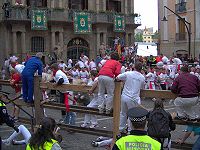 The running of the bulls involves hundreds of people running in front of six bulls and another six steers down an 825-metre (0.51 mile) stretch of narrow streets of a section of the old town of Pamplona. The event begins at 8 a.m. when a first firecracker
is lit to announce the release of the bulls from their corral. It is held between the 7th and the 14th. Runners gather earlier at the beginning of the itinerary to ask for the protection of the Saint by singing a chant three times before a small statue of San Fermin which has been placed in a raised niche in a wall. A second cracker signals that the last bull has left the corral. There are six fighting bulls accompanied by eight not fighting bulls (often white and brown coloured) that guide them to the "plaza" and followed by three more not fighting bulls, the "brush group". There are also some shepherds guiding the bulls, wearing green T-shirts and long poles. The run ends in the Pamplona's bullring
taking a mean time of around 3 minutes where the bulls would be held until the afternoons bullfight when they would be killed. Once all of the bulls have entered the arena, a third rocket is released while a fourth firecracker indicates that the bulls are in their bullpens and the run has concluded. The event is dangerous. Since 1925, 15 people have been killed during the event –– most recently on 10 July 2009 -- and every year between 200 and 300 people are injured during the run although most injuries are contusions due to falls and are not serious. There are several basic rules to respect if you want to run:
- Don't try to touch the bulls. You take the risk of getting his attention over yourself.
- If you fall down, don't try to raise. Protect your head and lie in fetal position until the group passes.
- Notice that a bull runs faster than you and that a single bull is more dangerous than the group.
-Take the bend of "Mercaderes" from the interior side, as the bulls often hit or even fall in the exterior side and can squash on the walls.
-Don't carry photocameras or backpacks.
After the end of the run young cows with wrapped horns are released in the bullring and toss the participants, to the amusement of the crowd.
(in English giants and big-heads respectively), with the giants figures being 150 years old. In this exciting but danguerous ``sport´´ died a lot of peopleItalic textThe eight giants figures were built by the painter from Pamplona Tadeo Amorena in 1860, and represent four pairs of kings and queens of four different races and places (Europe, Asia, America and Africa). Their size is around 4 metres each and are carried by a dancer inside a wooden structure. During the parade giants dance following the rhythm of traditional music. The remaining 17 figures include 6 kilikis, 5 big-heads, and 6 zaldikos and were built at different times between 1860 and 1941. Kilikis and big-heads are caricaturesque, but human-like figures that are carried as helmets. Big-heads masks are up to 1 metre high and kilikis slightly smaller. While big-heads simply precede the giants and wave their hands at spectators, kilikis run after children and carry a foam
truncheon which they use to hit them with. Zaldikos are figures representing horses with its hiker and also run after children with a truncheon.
every morning in the "Plaza de los Fueros", a square close to the city citadel, although they were formerly held in the bullring. Sports include stone lifting
, wood cutting
, or hay bale lifting. On the other hand the Jai alai
tournament of Sanfermin is a prestigious competition of this variety of basque pelota. It is held in one of the courts
of the city. Betting is common during these events.
park. Fireworks spectacles have been known to occur in Sanfermin as far back as 1595. Since the year 2000 an international fireworks contest is held. Thousands of people watch them seated on the grass around the citadel.
Pamplona
Pamplona is the historial capital city of Navarre, in Spain, and of the former kingdom of Navarre.The city is famous worldwide for the San Fermín festival, from July 6 to 14, in which the running of the bulls is one of the main attractions...
(Navarre
Navarre
Navarre , officially the Chartered Community of Navarre is an autonomous community in northern Spain, bordering the Basque Country, La Rioja, and Aragon in Spain and Aquitaine in France...
, Spain
Spain
Spain , officially the Kingdom of Spain languages]] under the European Charter for Regional or Minority Languages. In each of these, Spain's official name is as follows:;;;;;;), is a country and member state of the European Union located in southwestern Europe on the Iberian Peninsula...
), is a deeply rooted celebration held annually from 12:00, 6 July, when the opening of the fiesta is marked by setting off the pyrotechnic chupinazo, to midnight 14 July, with the singing of the Pobre de Mí. While its most famous event is the encierro, or the running of the bulls, which happens at 8:00 am from July 7th to July 14th, the week-long celebration involves many other traditional and folkloric
Folklore
Folklore consists of legends, music, oral history, proverbs, jokes, popular beliefs, fairy tales and customs that are the traditions of a culture, subculture, or group. It is also the set of practices through which those expressive genres are shared. The study of folklore is sometimes called...
events. It is known locally as Sanfermines and is held in honor of Saint Fermin
Saint Fermin
Saint Fermin of Amiens is one of many locally venerated Catholic saints. Fermin is the co-patron of Navarra, where his feast, the 'San Fermín' in the capital Pamplona, is forever associated with the Encierro or 'Running of the Bulls' made famous by Ernest Hemingway...
, the co-patron of Navarre. Its events were central to the plot of The Sun Also Rises
The Sun Also Rises
The Sun Also Rises is a 1926 novel written by American author Ernest Hemingway about a group of American and British expatriates who travel from Paris to the Festival of San Fermín in Pamplona to watch the running of the bulls and the bullfights. An early and enduring modernist novel, it received...
, by Ernest Hemingway
Ernest Hemingway
Ernest Miller Hemingway was an American author and journalist. His economic and understated style had a strong influence on 20th-century fiction, while his life of adventure and his public image influenced later generations. Hemingway produced most of his work between the mid-1920s and the...
, which brought it to the general attention of English-speaking people. It has become probably the most internationally renowned fiesta
Festival
A festival or gala is an event, usually and ordinarily staged by a local community, which centers on and celebrates some unique aspect of that community and the Festival....
in Spain. Over 1,000,000 people come to watch this festival.
Saint Fermin
Fermin is said to have been the son of a RomanAncient Rome
Ancient Rome was a thriving civilization that grew on the Italian Peninsula as early as the 8th century BC. Located along the Mediterranean Sea and centered on the city of Rome, it expanded to one of the largest empires in the ancient world....
of senatorial rank in Pamplona in the 3rd century, who was converted to Christianity by Saint Honestus
Saint Honestus
Saint Honestus was, according to Christian tradition, a disciple of Saturninus of Toulouse and a native of Nîmes. Saturninus and Honestus evangelized in Spain, and Honestus was martyred at Pampeluna during the persecutions of Aurelian...
, a disciple of Saint Saturninus
Saturnin
Saint Saturnin of Toulouse , with a feast day entered for November 29, was one of the "Apostles to the Gauls" sent out during the consulate of Decius and Gratus to Christianize Gaul after the persecutions under Emperor Decius had all but dissolved the small Christian communities...
. According to tradition, he was baptised by Saturninus (in Navarre also known as Saint Cernin) at the spot now known as the "Small Well of Saint Cernin" Fermin was ordained a priest in Toulouse and returned to Pamplona as its first bishop. On a later preaching voyage, Fermin was beheaded
Decapitation
Decapitation is the separation of the head from the body. Beheading typically refers to the act of intentional decapitation, e.g., as a means of murder or execution; it may be accomplished, for example, with an axe, sword, knife, wire, or by other more sophisticated means such as a guillotine...
in Amiens
Amiens
Amiens is a city and commune in northern France, north of Paris and south-west of Lille. It is the capital of the Somme department in Picardy...
, France; and is now considered a martyr
Martyr
A martyr is somebody who suffers persecution and death for refusing to renounce, or accept, a belief or cause, usually religious.-Meaning:...
in the Catholic Church. It is believed he died on September 25, AD 303. There is no written record of veneration in Pamplona of the Saint until the 12th century. Saint Fermin, as well as Saint Francis Xavier
Francis Xavier
Francis Xavier, born Francisco de Jasso y Azpilicueta was a pioneering Roman Catholic missionary born in the Kingdom of Navarre and co-founder of the Society of Jesus. He was a student of Saint Ignatius of Loyola and one of the first seven Jesuits, dedicated at Montmartre in 1534...
, are now the two patrons
Patron saint
A patron saint is a saint who is regarded as the intercessor and advocate in heaven of a nation, place, craft, activity, class, clan, family, or person...
of Navarre. At Pamplona, Saint Fermin; is now sometimes said to have met his end by being dragged through the streets of Pamplona by bull
Bull
Bull usually refers to an uncastrated adult male bovine.Bull may also refer to:-Entertainment:* Bull , an original show on the TNT Network* "Bull" , an episode of television series CSI: Crime Scene Investigation...
s, a fate more commonly attributed to his mentor, Saturnin.
Medieval period to the 19th century
The celebration of the festival has its origin in the combination of two different medieval events. Commercial secular fairs were held at the beginning of the summer. As cattle merchants came into town with their animals, eventually bullfightingBullfighting
Bullfighting is a traditional spectacle of Spain, Portugal, southern France and some Latin American countries , in which one or more bulls are baited in a bullring for sport and entertainment...
came to be organized as a part of the tradition. Specifically, they were first documented in the 14th century. On the other hand religious ceremonies honoring the saint were held on October 10. However in 1591 they were transferred to the 7th of July to take place at the same time as the fair; when Pamplona's weather is better. This is considered to be the beginning of the Sanfermines. At that time they lasted two days but they were extended until the 10th and nowadays endure until the 14th. During medieval times acts included an opening speech, musicians, tournaments, theatre, bullfights, dances or even fireworks. Bullrunning appears in 17th and 18th century chronicles together with the presence of foreigners and the first concerns on the excessive drinking and dissolute behavior during the event. The Giant's Parade was created by the end in the mid of the 19th century. The first official bullring
Bullring
A bullring is an arena where bullfighting is performed. Bullrings are often associated with Spain, but they can also be found in neighboring countries and the New World...
was constructed in 1844.
Modern times
The worldwide fame of the modern festival, and the great number of foreign visitors it receives every year, are closely related to the description by Ernest HemingwayErnest Hemingway
Ernest Miller Hemingway was an American author and journalist. His economic and understated style had a strong influence on 20th-century fiction, while his life of adventure and his public image influenced later generations. Hemingway produced most of his work between the mid-1920s and the...
's book The Sun Also Rises
The Sun Also Rises
The Sun Also Rises is a 1926 novel written by American author Ernest Hemingway about a group of American and British expatriates who travel from Paris to the Festival of San Fermín in Pamplona to watch the running of the bulls and the bullfights. An early and enduring modernist novel, it received...
and his job as a journalist. He was greatly amused in his first visit in 1923 coming back many times until 1959. Hemingway was also deeply fond of bullrunnings and bullfights. Different city locations are famous in part due to the fact that the writer used to visit them, such as the La perla hotel, or the Iruña café.
Chupinazo
The opening of the fiesta is marked by setting off the pyrotechnic chupinazo (or txupinazo in Basque languageBasque language
Basque is the ancestral language of the Basque people, who inhabit the Basque Country, a region spanning an area in northeastern Spain and southwestern France. It is spoken by 25.7% of Basques in all territories...
). The rocket is launched at 12:00 noon on the 6th of July from a city hall balcony with thousands of people celebrating the act in the city hall square and other locations in Pamplona.
As the square is crowded of people during the chupinazom the use of flip-flops is not advised for this act, although this year it has been forbidden to carry glass bottles.
Riau-Riau
The Riau-Riau was a mass activity held on 6 July. The members of the city council would parade from the City Hall to a nearby chapel dedicated to Saint Fermín. Protesting youths would mass blocking the way, dancing to the Astrain WaltzWaltz
The waltz is a ballroom and folk dance in time, performed primarily in closed position.- History :There are several references to a sliding or gliding dance,- a waltz, from the 16th century including the representations of the printer H.S. Beheim...
played by the city band. The councilors would be stuck for hours sometimes being unable to exit the City Hall. The procession was finally removed from the festival calendar for political reasons as extremists used the "Riau-Riau" to promote unrest and clashes with authorities, police and other participants. Nevertheless in recent years it has been held unofficially without the participation of the members of the city council.
San Fermin procession
The most important day of the festival is 7 July, when thousands of people accompany the medieval statue of Saint FerminSaint Fermin
Saint Fermin of Amiens is one of many locally venerated Catholic saints. Fermin is the co-patron of Navarra, where his feast, the 'San Fermín' in the capital Pamplona, is forever associated with the Encierro or 'Running of the Bulls' made famous by Ernest Hemingway...
along the streets in the old part of Pamplona. Saint Fermín is accompanied by dancers and street entertainers, such as the Gigantes and the Cabezudos and different political and religious authorities.
Pobre de mí
After nine days of partying, the people of Pamplona meet in the Townhall Plaza at midnight on 14 July, singing the traditional mournful notes of the Pobre de Mí ('Poor Me'), in a candlelit ending.Running of the bulls
Firecracker
A firecracker is a small explosive device primarily designed to produce a large amount of noise, especially in the form of a loud bang; any visual effect is incidental to this goal. They have fuses, and are wrapped in a heavy paper casing to contain the explosive compound...
is lit to announce the release of the bulls from their corral. It is held between the 7th and the 14th. Runners gather earlier at the beginning of the itinerary to ask for the protection of the Saint by singing a chant three times before a small statue of San Fermin which has been placed in a raised niche in a wall. A second cracker signals that the last bull has left the corral. There are six fighting bulls accompanied by eight not fighting bulls (often white and brown coloured) that guide them to the "plaza" and followed by three more not fighting bulls, the "brush group". There are also some shepherds guiding the bulls, wearing green T-shirts and long poles. The run ends in the Pamplona's bullring
Plaza de Toros de Pamplona
Plaza de Toros de Pamplona is a bullring in Pamplona, Spain. It is currently used for bull fighting. The stadium holds 19,529 people. It was built in 1922. It is the ending point of the famous Running of the bulls during the festival of San Fermín....
taking a mean time of around 3 minutes where the bulls would be held until the afternoons bullfight when they would be killed. Once all of the bulls have entered the arena, a third rocket is released while a fourth firecracker indicates that the bulls are in their bullpens and the run has concluded. The event is dangerous. Since 1925, 15 people have been killed during the event –– most recently on 10 July 2009 -- and every year between 200 and 300 people are injured during the run although most injuries are contusions due to falls and are not serious. There are several basic rules to respect if you want to run:
- Don't try to touch the bulls. You take the risk of getting his attention over yourself.
- If you fall down, don't try to raise. Protect your head and lie in fetal position until the group passes.
- Notice that a bull runs faster than you and that a single bull is more dangerous than the group.
-Take the bend of "Mercaderes" from the interior side, as the bulls often hit or even fall in the exterior side and can squash on the walls.
-Don't carry photocameras or backpacks.
After the end of the run young cows with wrapped horns are released in the bullring and toss the participants, to the amusement of the crowd.
Giants and big-heads parade
Every day, during the morning, there is a parade of gigantes y cabezudosGigantes y cabezudos
Many Spanish festivals include costumed figures known as gigantes y cabezudos, roughly, “Giants and Big-Heads”, or, in Catalan, gegants i capgrossos...
(in English giants and big-heads respectively), with the giants figures being 150 years old. In this exciting but danguerous ``sport´´ died a lot of peopleItalic textThe eight giants figures were built by the painter from Pamplona Tadeo Amorena in 1860, and represent four pairs of kings and queens of four different races and places (Europe, Asia, America and Africa). Their size is around 4 metres each and are carried by a dancer inside a wooden structure. During the parade giants dance following the rhythm of traditional music. The remaining 17 figures include 6 kilikis, 5 big-heads, and 6 zaldikos and were built at different times between 1860 and 1941. Kilikis and big-heads are caricaturesque, but human-like figures that are carried as helmets. Big-heads masks are up to 1 metre high and kilikis slightly smaller. While big-heads simply precede the giants and wave their hands at spectators, kilikis run after children and carry a foam
Foam
-Definition:A foam is a substance that is formed by trapping gas in a liquid or solid in a divided form, i.e. by forming gas regions inside liquid regions, leading to different kinds of dispersed media...
truncheon which they use to hit them with. Zaldikos are figures representing horses with its hiker and also run after children with a truncheon.
Traditional sports
There are exhibitions and competitions of Basque rural sportsBasque rural sports
Basque rural sports, known as Herri Kirolak in Basque, is the term used for a number of sports competitions rooted in the traditional lifestyles of the Basque people...
every morning in the "Plaza de los Fueros", a square close to the city citadel, although they were formerly held in the bullring. Sports include stone lifting
Harrijasotzaileak
Stone lifting is a popular form of herri kirol or rural sport in the Basque Country in which stones or various shapes and sizes must be lifted off the ground and onto the shoulder....
, wood cutting
Aizkolaritza
Aizkolaritza is the Basque name for a type of wood-chopping competition. They are a popular form of herri kirol in the Basque Country...
, or hay bale lifting. On the other hand the Jai alai
Jai alai
Jai alai is a sport involving a ball bounced off a walled space. It is a variety of Basque Pelota. The term, coined by Serafin Baroja in 1875, is also often loosely applied to the fronton where the sport is played...
tournament of Sanfermin is a prestigious competition of this variety of basque pelota. It is held in one of the courts
Fronton (court)
A Fronton is a two walled or single walled court used as playing area for Basque pelota.-History:The front wall of the first frontons in villages was usually the wall of a church...
of the city. Betting is common during these events.
Bullfight
Every afternoon between the 7th and 14th there is a bullfight in which the 6 bulls that have been driven to the bullring during the bullrunning of that day are killed. It begins at 18:30. In addition the 6th a bullfight with younger bulls and not fully trained bullfighters is performed while the 6th features bullfighters on horses (in Spanish "rejoneo"). While the bullring of the city is the third in size of the world, it is full every afternoon and tickets are hard to find.Fireworks
Every night a firework spectacle is held at the citadelCitadel
A citadel is a fortress for protecting a town, sometimes incorporating a castle. The term derives from the same Latin root as the word "city", civis, meaning citizen....
park. Fireworks spectacles have been known to occur in Sanfermin as far back as 1595. Since the year 2000 an international fireworks contest is held. Thousands of people watch them seated on the grass around the citadel.