
All Topics  
The Sun Also Rises

 
The Sun Also Rises

   Email Print
   Bookmark   Link


The Sun Also Rises


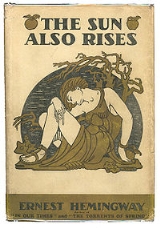
The Sun Also Rises is the first major novel
Novel

File:2009 stapelweise Neuerscheinungen im Buchladen.JPGA novel is today a long narrative in literary prose. The genre has historical roots both in the fields of the medieval and early modern Romance and in the tradition of the novella....
 by Ernest Hemingway
Ernest Hemingway

Ernest Miller Hemingway was an American novelist, short story author, and journalist. He was part of the 1920s expatriate community in Paris, France, and one of the veterans of World War I later known as "the Lost Generation"....
. Published in 1926
1926 in literature

The year 1926 in literature involved some significant events and new books....
, the plot centers on a group of expatriate
Expatriate

An expatriate is a person temporarily or permanently Residency in a country and culture other than that of the person's upbringing or legal residence....
 Americans
United States

The United States of America is a Federal government constitutional republic comprising U.S. state and a federal district. The country is situated mostly in central North America, where its Contiguous United States and Washington, D.C., the Capital districts and territories, lie between the Pacific Ocean and Atlantic Oceans, Borders of the U...
 in Europe during the 1920s. The book's title, selected by Hemingway (at the recommendation of his publisher) is taken from Ecclesiastes
Ecclesiastes

Ecclesiastes is a book of the Hebrew Bible. The English name derives from the Greek language translation of the Hebrew #Title.The main speaker in the book, identified by the name or title Qohelet, introduces himself as "son of David, and king in Jerusalem." The work consists of personal or autobiographic matter, at times expressed in aph...
 1:5: "The sun also ariseth, and the sun goeth down, and hasteth to his place where he arose." Hemingway's original title for the work was Fiesta, which was used in the British, German and Spanish editions of the novel.

Time
Time (magazine)

Time is a weekly United States newsmagazine, similar to Newsweek and U.S. News & World Report. A European edition is published from London....
 magazine included the novel in its TIME 100 Best English-language Novels from 1923 to 2005.

Plot summary
The novel explores the lives and values of the so-called "Lost Generation
Lost Generation

The 'Lost Generation' is a phrase made popular by American author Ernest Hemingway in his first published novel The Sun Also Rises. Often it is used to refer to a group of United States literary notables who lived in Paris and other parts of Europe, some after military service in the World War I....
," chronicling the experiences of Jake Barnes and several acquaintances on their pilgrimage to Pamplona
Pamplona

Pamplona is the capital city of Navarre, Spain and of the former kingdom of Navarre.The city is famous worldwide for the San Ferm?n festival, from July 6 to 14, in which the running of the bulls or encierro is one of the main attractions....
 for the annual fiesta
Fiesta

Fiesta can mean:*A Spanish-derived word for festival, party, celebration, or holiday.*Ford Fiesta, a model of car produced by Ford.*Fiesta , the line of Homer Laughlin China Co....
 and bull fights.


Discussion
Ask a question about 'The Sun Also Rises'
Start a new discussion about 'The Sun Also Rises'
Answer questions from other users
Full Discussion Forum


Encyclopedia


The Sun Also Rises is the first major novel
Novel

File:2009 stapelweise Neuerscheinungen im Buchladen.JPGA novel is today a long narrative in literary prose. The genre has historical roots both in the fields of the medieval and early modern Romance and in the tradition of the novella....
 by Ernest Hemingway
Ernest Hemingway

Ernest Miller Hemingway was an American novelist, short story author, and journalist. He was part of the 1920s expatriate community in Paris, France, and one of the veterans of World War I later known as "the Lost Generation"....
. Published in 1926
1926 in literature

The year 1926 in literature involved some significant events and new books....
, the plot centers on a group of expatriate
Expatriate

An expatriate is a person temporarily or permanently Residency in a country and culture other than that of the person's upbringing or legal residence....
 Americans
United States

The United States of America is a Federal government constitutional republic comprising U.S. state and a federal district. The country is situated mostly in central North America, where its Contiguous United States and Washington, D.C., the Capital districts and territories, lie between the Pacific Ocean and Atlantic Oceans, Borders of the U...
 in Europe during the 1920s. The book's title, selected by Hemingway (at the recommendation of his publisher) is taken from Ecclesiastes
Ecclesiastes

Ecclesiastes is a book of the Hebrew Bible. The English name derives from the Greek language translation of the Hebrew #Title.The main speaker in the book, identified by the name or title Qohelet, introduces himself as "son of David, and king in Jerusalem." The work consists of personal or autobiographic matter, at times expressed in aph...
 1:5: "The sun also ariseth, and the sun goeth down, and hasteth to his place where he arose." Hemingway's original title for the work was Fiesta, which was used in the British, German and Spanish editions of the novel.

Time
Time (magazine)

Time is a weekly United States newsmagazine, similar to Newsweek and U.S. News & World Report. A European edition is published from London....
 magazine included the novel in its TIME 100 Best English-language Novels from 1923 to 2005.

Plot summary


The novel explores the lives and values of the so-called "Lost Generation
Lost Generation

The 'Lost Generation' is a phrase made popular by American author Ernest Hemingway in his first published novel The Sun Also Rises. Often it is used to refer to a group of United States literary notables who lived in Paris and other parts of Europe, some after military service in the World War I....
," chronicling the experiences of Jake Barnes and several acquaintances on their pilgrimage to Pamplona
Pamplona

Pamplona is the capital city of Navarre, Spain and of the former kingdom of Navarre.The city is famous worldwide for the San Ferm?n festival, from July 6 to 14, in which the running of the bulls or encierro is one of the main attractions....
 for the annual fiesta
Fiesta

Fiesta can mean:*A Spanish-derived word for festival, party, celebration, or holiday.*Ford Fiesta, a model of car produced by Ford.*Fiesta , the line of Homer Laughlin China Co....
 and bull fights. Barnes' genitals had been mutilated as the result of an injury incurred during World War I
World War I

World War I, or the First World War , was a global military conflict which involved the Great powers, organized into two opposing military alliances: the Allies of World War I and the Central Powers....
; he is subsequently unable to consummate a sexual relationship with Brett Ashley, although he is still attracted to her. The story follows Jake and his various companions across France
France

France , officially the French Republic , is a country whose Metropolitan France is located in Western Europe and that also comprises various Overseas departments and territories of France....
 and Spain
Spain

Spain or the Kingdom of Spain , is a country located in Southern Europe on the Iberian Peninsula.The Spanish constitution does not establish any official denomination of the country, even though Espa?a , Estado espa?ol and Naci?n espa?ola are used interchangeably....
. Initially, Jake seeks peace away from Brett by taking a fishing trip to Burguete, deep within the Spanish hills, with companion Bill Gorton, another veteran of the war. The fiesta in Pamplona is the setting for the eventual meeting of all the characters, who play out their various desires and anxieties, alongside a great deal of drinking.

Main characters

Jake Barnes: The narrator of the story, Barnes is an American veteran of World War I
World War I

World War I, or the First World War , was a global military conflict which involved the Great powers, organized into two opposing military alliances: the Allies of World War I and the Central Powers....
 who suffered physical injuries that have made him physiologically impotent, and unable to pursue a sexual relationship with Brett. Having lost direction of his life as a result of his experiences during the war, Barnes attempts to content himself through hard work, drinking, and bull fights.

Lady Ashley, or Brett: Brett is the object of lust for most of the male characters of the book. Portrayed as elusive and promiscuous, Brett, like Barnes, also lacks direction in life and finds emptiness in activities that she would have normally enjoyed during pre-war times. She is engaged to Michael.

Robert Cohn: His status as an outsider as a result of being Jewish has caused Cohn to develop an inferiority complex
Inferiority complex

An inferiority complex, in the fields of psychology and psychoanalysis, is a feeling that one is inferior to others in some way. Such feelings can arise from an imagined or actual inferiority in the afflicted person....
. Despite attempts to be civil and courteous, Cohn is the object of scorn from other characters. The novel's plot turns on his attempt to recover a brief affair he had with Brett, leading him to tag along with the group of expatriates, much to their collective vexation.

Michael Campbell: A Scottish veteran of the war, Michael is close friends with Jake and Bill, and engaged to Brett. Though he attempts to hide his contempt for Cohn, his fiery temper usually manifests itself during periods of heavy drinking.

Bill Gorton: An old friend of Barnes, Bill is also a veteran of the war and is less cruel than Michael in his attitudes towards Cohn. Despite also being a heavy drinker, Bill is often more light-hearted than the rest of his peers.

Pedro Romero: The star bullfighter of the fiesta, Romero is introduced to Jake and his friends, falls in love with Brett, and then they split up when they recognize her inability to commit to a sustained relationship. His autonomy, steadfastness, and commitment make him a model for Jake, who possesses none of these qualities even though he aspires to them. Furthermore, the younger Pedro Romero having been born in 1905 represents the younger Civic Generation, often referred to as the Greatest Generation
Greatest Generation

The Greatest Generation is a term coined by journalist Tom Brokaw to describe the generation of United States who grew up during the deprivation of the Great Depression, and then went on to fight in World War II, as well as those whose productivity within the war's home front made a decisive material contribution to the war effort....
. This served to further demonstrate the Lost Generation's feelings of insecurity and disillusionment compared to their next-younger Generation.

Major themes

The novel has heavy undercurrents of suppressed emotions and buried values. Its weary and aimless expatriates serve as metaphors for society's lost optimism
Optimism

Optimism is an outlook on life such that one maintains a view of the world as a positive place, or one's personal situation as a positive one. It is the philosophical opposite of pessimism....
 and innocence after the war. The topic of war is rarely discussed explicitly by any of the characters, but its effects are alluded to through the sexual impotence of Jake and his war wound, and the behavior of the other characters, whom Carlos Baker described as "floundering in an emulsion of ennui and alcohol." The war is also present as the tragedy that affects the way characters are able to deal with themselves, and post-war society. The themes of the novel are cast against the background of the Biblical quotation the book opens with: "One generation passeth away, and another generation cometh; but the earth abideth forever" (Ecclesiastes
Ecclesiastes

Ecclesiastes is a book of the Hebrew Bible. The English name derives from the Greek language translation of the Hebrew #Title.The main speaker in the book, identified by the name or title Qohelet, introduces himself as "son of David, and king in Jerusalem." The work consists of personal or autobiographic matter, at times expressed in aph...
 1:4).

Criticism

The Sun Also Rises is considered one of Hemingway's best novels alongside A Farewell to Arms
A Farewell to Arms

A Farewell to Arms is a semi-autobiographical novel written by Ernest Hemingway, first published in 1929. Much of the novel was written at Pfeiffer House and Carriage House in Piggott, Arkansas....
 and For Whom the Bell Tolls
For Whom the Bell Tolls

For Whom the Bell Tolls is a novel by Ernest Hemingway published in 1940. It tells the story of Robert Jordan, a young American in the International Brigades attached to an anti-fascist guerilla unit during the Spanish Civil War....
. It is considered ground-breaking in its economic use of language for creating atmosphere and recording dialogue. Upon its publication, many U.S. critics denounced its focus on aimless, promiscuous, and generally licentious characters. On the other hand, it was extremely popular with a young and international readership. Since then, the novel has gained general recognition as a modernist masterpiece.

While most critics tend to take the characters seriously, some have argued that the novel is satirical in its portrayal of love and romance. It shows Jake and Cohn, the two male protagonists, vying for the affections of Brett, who is clearly unworthy of the naive praise they heap on her (Cohn openly, Jake implicitly). This could be true in the sense that all of Hemingway's writing "pokes fun at" humans, their vulnerabilities and foibles. However, Hemingway is usually considered too dismayed with the human condition to have been anything but serious, and the situations of his characters so pathetic as to have moved well beyond simple sarcasm.

In The Sun Also Rises, gender issues are dealt with very seriously by critics, though there is little consensus among them. Some critics charge that the depiction of Brett as a 'liberated woman' is intrinsic to her divisiveness in relationships throughout the novel, and therefore that Hemingway saw strong women as causing trouble, particularly for the men who otherwise dominate the novel. The reading of Brett as a 'strong' or 'liberated woman' is itself debatable, however, as she seems unable to live outside a heterosexual relationship. Twice divorced, she has a sexual relationship with almost every man she meets, which suggests a neurotic and necessarily unsuccessful craving for security rather than independence from men. In this reading, Brett is as much a victim of the war and its destruction of social mores as are the male characters. Other critics have argued that Brett signifies the castration of Jake, meanwhile defenders suggest that Brett actually becomes the main character by being the only person Jake is truly interested in. Although the reasons vary significantly from critic to critic, the majority of critical opinion still labels Brett's character as an expression of misogyny
Misogyny

Misogyny is hatred of women or girls. It is parallel to misandry?the hatred of men. Misogyny is also comparable with misanthropy which is the hatred of humanity generally....
.

Another point of criticism is Hemingway's depiction of character Robert Cohn, a Jewish man who is often the subject of mockery by his peers. Though some critics have interpreted this as anti-Semitism on the part of Hemingway, defenders of the book argue that Cohn is depicted in a sympathetic manner, mocked not due to his religion but due to his failure to serve during World War I. Interestingly, Hemingway is reported to have said that Cohn was the "hero" of the book, and Harold Loeb
Harold Loeb

Harold Albert Loeb was an United States figure active in the arts in Paris in the 1920's. Loeb attended Princeton University where he boxed. Loeb served in World War I and after the War was Ernest Hemingway's sparring partner....
, the Jewish writer who served as a model for Cohn, defended Hemingway from charges of anti-Semitism.

See also

  • The Moderns
    The Moderns

    The Moderns is a 1988 film by Alan Rudolph, which takes place in 1926 Paris during the period of the Lost Generation and at the height of modernist literature....