

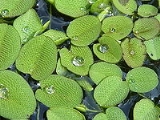
Salvinia

Encyclopedia
Salvinia, a genus
in the family
Salviniaceae
, is a floating fern
named in honor of Antonio Maria Salvini, a 17th Century Italian scientist. The genus was published by Séguier
, in Pl. Veron. 3: 52. 1754. About ten species
exist.
Salvinia is related to the other water ferns, including the Mosquito fern Azolla. Recent sources include both Azolla and Salvinia in Salviniaceae, although each genus was formerly given its own family.
Salvinia, like the other ferns in order
Salviniales are heterosporous, producing spores of differing sizes. However, leaf development in Salvinia is unique. The upper side of the floating leaf, which appears to face the stem axis, is morphologically abaxial (J. G. Croxdale 1978, 1979, 1981).
The plants pose a particular hindrance on certain lakes, having choked off much of the water in Lake Bistineau
near Doyline
in Webster Parish
, Louisiana
. Other problems have persisted in a second Webster Parish site, Caney Lakes Recreation Area
.
, Mexico
, West Indies, Central America
, South America
, Eurasia
and Africa
, including Madagascar
.
(Salvinia molesta) is a commonly introduced invasive weed in warm climates. It grows rapidly and forms dense mats over still waters. It is native to South America. A tiny weevil
, Cyrtobagous salviniae
, has been used successfully to control giant salvinia.
S. natans is commonly used in aquariums as a decorative floating plant.http://www.tropica.dk/productcard_1.asp?id=011
Genus
In biology, a genus is a low-level taxonomic rank used in the biological classification of living and fossil organisms, which is an example of definition by genus and differentia...
in the family
Family (biology)
In biological classification, family is* a taxonomic rank. Other well-known ranks are life, domain, kingdom, phylum, class, order, genus, and species, with family fitting between order and genus. As for the other well-known ranks, there is the option of an immediately lower rank, indicated by the...
Salviniaceae
Salviniaceae
Salviniaceae , is a family of ferns....
, is a floating fern
Fern
A fern is any one of a group of about 12,000 species of plants belonging to the botanical group known as Pteridophyta. Unlike mosses, they have xylem and phloem . They have stems, leaves, and roots like other vascular plants...
named in honor of Antonio Maria Salvini, a 17th Century Italian scientist. The genus was published by Séguier
Jean-François Séguier
Jean François Séguier was a French astronomer and botanist from Nîmes.His botanical works include Plantae Veronenses, seu Stirpium quae in agro Veronensi repriuntur ....
, in Pl. Veron. 3: 52. 1754. About ten species
Species
In biology, a species is one of the basic units of biological classification and a taxonomic rank. A species is often defined as a group of organisms capable of interbreeding and producing fertile offspring. While in many cases this definition is adequate, more precise or differing measures are...
exist.
Salvinia is related to the other water ferns, including the Mosquito fern Azolla. Recent sources include both Azolla and Salvinia in Salviniaceae, although each genus was formerly given its own family.
Salvinia, like the other ferns in order
Order (biology)
In scientific classification used in biology, the order is# a taxonomic rank used in the classification of organisms. Other well-known ranks are life, domain, kingdom, phylum, class, family, genus, and species, with order fitting in between class and family...
Salviniales are heterosporous, producing spores of differing sizes. However, leaf development in Salvinia is unique. The upper side of the floating leaf, which appears to face the stem axis, is morphologically abaxial (J. G. Croxdale 1978, 1979, 1981).
The plants pose a particular hindrance on certain lakes, having choked off much of the water in Lake Bistineau
Lake Bistineau
250px|right|thumb|Lake Bistineau south of [[Doyline, Louisiana|Doyline]], [[Louisiana]]Lake Bistineau is a long, narrow waterway of , wide and long located in Webster, Bossier, and Bienville parishes in northwestern Louisiana. The lake is fed by Dorcheat Bayou, Clark’s Bayou, and other smaller...
near Doyline
Doyline, Louisiana
Doyline is a village in southwestern Webster Parish, Louisiana, United States. The population was 841 at the 2000 census. It is part of the Minden Micropolitan Statistical Area....
in Webster Parish
Webster Parish, Louisiana
Webster Parish is a parish located in the U.S. state of Louisiana. The seat of the parish is Minden. In 2010, its population was 41,207....
, Louisiana
Louisiana
Louisiana is a state located in the southern region of the United States of America. Its capital is Baton Rouge and largest city is New Orleans. Louisiana is the only state in the U.S. with political subdivisions termed parishes, which are local governments equivalent to counties...
. Other problems have persisted in a second Webster Parish site, Caney Lakes Recreation Area
Caney Lakes Recreation Area
Not to be confused with another Caney Lake at Jimmie Davis State Park southwest of Chatham in Jackson Parish, LouisianaCaney Lakes Recreation Area, located the Kisatchie National Forest north of Minden in Webster Parish in northwestern Louisiana, offers opportunities for bicycling, hiking,...
.
Distribution
Mostly tropical, North AmericaNorth America
North America is a continent wholly within the Northern Hemisphere and almost wholly within the Western Hemisphere. It is also considered a northern subcontinent of the Americas...
, Mexico
Mexico
The United Mexican States , commonly known as Mexico , is a federal constitutional republic in North America. It is bordered on the north by the United States; on the south and west by the Pacific Ocean; on the southeast by Guatemala, Belize, and the Caribbean Sea; and on the east by the Gulf of...
, West Indies, Central America
Central America
Central America is the central geographic region of the Americas. It is the southernmost, isthmian portion of the North American continent, which connects with South America on the southeast. When considered part of the unified continental model, it is considered a subcontinent...
, South America
South America
South America is a continent situated in the Western Hemisphere, mostly in the Southern Hemisphere, with a relatively small portion in the Northern Hemisphere. The continent is also considered a subcontinent of the Americas. It is bordered on the west by the Pacific Ocean and on the north and east...
, Eurasia
Eurasia
Eurasia is a continent or supercontinent comprising the traditional continents of Europe and Asia ; covering about 52,990,000 km2 or about 10.6% of the Earth's surface located primarily in the eastern and northern hemispheres...
and Africa
Africa
Africa is the world's second largest and second most populous continent, after Asia. At about 30.2 million km² including adjacent islands, it covers 6% of the Earth's total surface area and 20.4% of the total land area...
, including Madagascar
Madagascar
The Republic of Madagascar is an island country located in the Indian Ocean off the southeastern coast of Africa...
.
Description
Small, floating aquatics with creeping stems, branched, bearing hairs but no true roots. Leaves in whorls of 3, with 2 leaves green, sessile or short-petioled, flat, entire, and floating, 1 leaf finely dissected, petiolate, rootlike, and pendent. Submerged leaves bearing sori that are surrounded by basifixed membranous indusia (sporocarps); sporocarps of 2 types, bearing either megasporangia that are few in number (ca. 10), each with single megaspore, or many microsporangia, each with 64 microspores. Spores of 2 kinds and sizes, both globose, trilete. Megagametophytes and microgametophytes protruding through sporangium wall; megagametophytes floating on water surface with archegonia directed downward; microgametophytes remaining fixed to sporangium wall. The small, hairlike growths, known as microgametical follicles, are not known to have any productive function, and are currently a biological mystery.Economic Uses
Giant salviniaGiant salvinia
Salvinia molesta, commonly known as giant salvinia or kariba weed after it infested a large portion of the reservoir of the same name, is an aquatic fern, native to south-eastern Brazil. It is a free floating plant that does not attach to the soil, but instead remains buoyant on the surface of a...
(Salvinia molesta) is a commonly introduced invasive weed in warm climates. It grows rapidly and forms dense mats over still waters. It is native to South America. A tiny weevil
Weevil
A weevil is any beetle from the Curculionoidea superfamily. They are usually small, less than , and herbivorous. There are over 60,000 species in several families, mostly in the family Curculionidae...
, Cyrtobagous salviniae
Cyrtobagous salviniae
Cyrtobagous salviniae is a species of weevil known as the salvinia weevil. It is used as an agent of biological pest control against the noxious aquatic plant giant salvinia ....
, has been used successfully to control giant salvinia.
S. natans is commonly used in aquariums as a decorative floating plant.http://www.tropica.dk/productcard_1.asp?id=011