
Home      Discussion      Topics      Dictionary      Almanac
Signup       Login
Ring laser gyroscope

Ring laser gyroscope

Overview
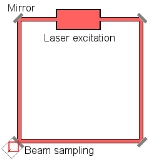
A ring laser gyroscope consists of a ring laser
Ring laser
A ring laser is a laser in which the laser cavity has the shape of a ring. Light in ring lasers has two possible directions of propagation: clockwise and counter-clockwise....

 having two counter-propagating modes over the same path in order to detect rotation. It operates on the principle of the Sagnac effect
Sagnac effect
The Sagnac effect , named after French physicist Georges Sagnac, is a phenomenon encountered in interferometry that is elicited by rotation. The Sagnac effect manifests itself in a setup called ring interferometry. A beam of light is split and the two beams are made to follow a trajectory in...

 which shifts the nulls of the internal standing wave pattern in response to angular rotation. Interference between the counter-propagating beams, observed externally, reflects shifts in that standing wave pattern, and thus rotation.
Discussion
Ask a question about 'Ring laser gyroscope'
Start a new discussion about 'Ring laser gyroscope'
Answer questions from other users
Full Discussion Forum
 
Unanswered Questions
Recent Discussions
Encyclopedia
A ring laser gyroscope consists of a ring laser
Ring laser
A ring laser is a laser in which the laser cavity has the shape of a ring. Light in ring lasers has two possible directions of propagation: clockwise and counter-clockwise....

 having two counter-propagating modes over the same path in order to detect rotation. It operates on the principle of the Sagnac effect
Sagnac effect
The Sagnac effect , named after French physicist Georges Sagnac, is a phenomenon encountered in interferometry that is elicited by rotation. The Sagnac effect manifests itself in a setup called ring interferometry. A beam of light is split and the two beams are made to follow a trajectory in...

 which shifts the nulls of the internal standing wave pattern in response to angular rotation. Interference between the counter-propagating beams, observed externally, reflects shifts in that standing wave pattern, and thus rotation.

Description


The first experimental ring laser gyroscope was demonstrated in the US by Macek and Davis in 1963. Various organizations worldwide subsequently developed ring-laser technology further. Many tens of thousands of RLGs are operating in inertial navigation system
Inertial navigation system
An inertial navigation system is a navigation aid that uses a computer, motion sensors and rotation sensors to continuously calculate via dead reckoning the position, orientation, and velocity of a moving object without the need for external references...

s and have established high accuracy, with better than 0.01°/hour bias uncertainty, and mean time between failures in excess of 60,000 hours.


Ring laser gyroscopes can be used as the stable elements (for one degree of freedom each) in an inertial reference system. The advantage of using an RLG is that there are no moving parts. Compared to the conventional spinning gyroscope
Gyroscope
A gyroscope is a device for measuring or maintaining orientation, based on the principles of angular momentum. In essence, a mechanical gyroscope is a spinning wheel or disk whose axle is free to take any orientation...

, this means there is no friction, which in turn means there will be no inherent drift terms. Additionally, the entire unit is compact, lightweight and virtually indestructible, making it suitable for use in aircraft. Unlike a mechanical gyroscope, the device does not resist changes to its orientation.
Primary applications of the laser gyro include navigation systems on commercial airliners, ships and spacecraft, where RLGs are often part of Air Data Inertial Reference Unit
Air Data Inertial Reference Unit
An Air Data Inertial Reference Unit is a key component of the integrated Air Data Inertial Reference System , that supplies air data and inertial reference information to the pilots' Electronic Flight Instrument System displays as well as other systems on the aircraft such as the engines,...

s. In these applications, it has replaced its mechanical counterpart, the Inertial guidance system.

Principle of operation


A certain rate of rotation induces a small difference between the time it takes light to traverse the ring in the two directions according to the Sagnac effect
Sagnac effect
The Sagnac effect , named after French physicist Georges Sagnac, is a phenomenon encountered in interferometry that is elicited by rotation. The Sagnac effect manifests itself in a setup called ring interferometry. A beam of light is split and the two beams are made to follow a trajectory in...

. This introduces a tiny separation between the frequencies of the counter-propagating beams, a motion of the standing wave
Standing wave
In physics, a standing wave – also known as a stationary wave – is a wave that remains in a constant position.This phenomenon can occur because the medium is moving in the opposite direction to the wave, or it can arise in a stationary medium as a result of interference between two waves traveling...

 pattern within the ring, and thus a beat pattern when those two beams are interfered outside the ring. Therefore the net shift of that interference pattern follows the rotation of the unit in the plane of the ring.

RLGs, while more accurate than mechanical gyroscopes, suffer from an effect known as "lock-in" at very slow rotation rates. When the ring laser is hardly rotating, the frequencies of the counter-propagating laser modes become almost identical. In this case crosstalk in between the counter-propagating beams can allow for injection locking so that the standing wave "gets stuck" in a preferred phase, thus locking the frequency of each beam to each other rather than responding to gradual rotation.

Forced dithering can largely overcome this problem. The ring laser cavity is rotated clockwise and anti-clockwise about its axis using a mechanical spring driven at its resonance frequency. This ensures that the angular velocity of the system is usually far from the lock-in threshold. Typical rates are 400 Hz, with a peak dither velocity of 1 arc-second per second. Dither does not fix the lock-in problem completely, as each time the direction of rotation is reversed, a short time interval exists in which the rotation rate is near zero and lock-in can briefly occur. In a technically more complicated solution the gyro assembly is not rotated back and forth, but in one direction only at a constant angular rate.

A related device is the fibre optic gyroscope
Fibre optic gyroscope
A fibre optic gyroscope senses changes in orientation, thus performing the function of a mechanical gyroscope. However its principle of operation is instead based on the interference of light which has passed through a coil of optical fibre which can be as long as 5 km.Two beams from a laser...

 which also operates on the basis of the Sagnac effect
Sagnac effect
The Sagnac effect , named after French physicist Georges Sagnac, is a phenomenon encountered in interferometry that is elicited by rotation. The Sagnac effect manifests itself in a setup called ring interferometry. A beam of light is split and the two beams are made to follow a trajectory in...

, but in which the ring is not a part of the laser. Rather, an external laser injects counter-propagating beams into an optical fiber
Optical fiber
An optical fiber is a flexible, transparent fiber made of a pure glass not much wider than a human hair. It functions as a waveguide, or "light pipe", to transmit light between the two ends of the fiber. The field of applied science and engineering concerned with the design and application of...

 ring, and rotation of the system then causes a relative phase shift between those beams when interfered after their pass through the fiber ring proportional to the rate of rotation. This is therefore less sensitive than the RLG in which the externally observed phase shift is proportional to the accumulated rotation itself, not its derivative. However the sensitivity of the fiber gyro
Fibre optic gyroscope
A fibre optic gyroscope senses changes in orientation, thus performing the function of a mechanical gyroscope. However its principle of operation is instead based on the interference of light which has passed through a coil of optical fibre which can be as long as 5 km.Two beams from a laser...

 is enhanced by having a long optical fiber
Optical fiber
An optical fiber is a flexible, transparent fiber made of a pure glass not much wider than a human hair. It functions as a waveguide, or "light pipe", to transmit light between the two ends of the fiber. The field of applied science and engineering concerned with the design and application of...

 coiled for compactness, but in which the Sagnac effect
Sagnac effect
The Sagnac effect , named after French physicist Georges Sagnac, is a phenomenon encountered in interferometry that is elicited by rotation. The Sagnac effect manifests itself in a setup called ring interferometry. A beam of light is split and the two beams are made to follow a trajectory in...

 is multiplied according to the number of turns.

Examples of RLG applications

  • Airbus A320
    Airbus A320
    The Airbus A320 family is a family of short- to medium-range, narrow-body, commercial passenger jet airliners manufactured by Airbus Industrie.Airbus was originally a consortium of European aerospace companies, and is now fully owned by EADS. Airbus's name has been Airbus SAS since 2001...

  • Agni III
  • ASM-135 US Anti-satellite missile.
  • Boeing 777
    Boeing 777
    The Boeing 777 is a long-range, wide-body twin-engine jet airliner manufactured by Boeing Commercial Airplanes. It is the world's largest twinjet and is commonly referred to as the "Triple Seven". The aircraft has seating for over 300 passengers and has a range from , depending on model...

  • B-52H with the AMI upgrade.
  • EF-111 Raven
  • F-15E Strike Eagle
    F-15 Eagle
    The McDonnell Douglas F-15 Eagle is a twin-engine, all-weather tactical fighter designed by McDonnell Douglas to gain and maintain air superiority in aerial combat. It is considered among the most successful modern fighters with over 100 aerial combat victories with no losses in dogfights...

  • HAL Tejas
    HAL Tejas
    The HAL Tejas is a lightweight multirole fighter developed by India. It is a tailless, compound delta-wing design powered by a single engine. It came from the Light Combat Aircraft programme, which began in the 1980s to replace India's ageing MiG-21 fighters...

  • MC-130E Combat Talon I and MC-130H Combat Talon II
  • MQ-1C Warrior
    MQ-1C Warrior
    |-See also:-External links:* * * * *...

  • MK39 Ship's Internal Navigation System used in NATO surface ships and submarines
  • P3 Orion (with upgrade)
  • Shaurya missile
    Shaurya missile
    The Shaurya missile is a canister launched Hypersonic surface-to-surface tactical missile developed by the Indian Defence Research and Development Organization for use by the Indian Armed Forces. It has a range of between 750 to 1900 km and is capable of carrying a payload of one ton...

    .
  • MH-60R , MH-60S , SH60F and SH60B Seahawk helicopters
  • Sukhoi Su-30MKI
  • Trident I and II Missiles

See also

  • Laser applications
    Laser applications
    Many scientific, military, medical and commercial laser applications have been developed since the invention of the laser in the 1958. The coherency, high monochromaticity, and ability to reach extremely high powers are all properties which allow for these specialized applications.-Scientific:In...

  • Laser construction
    Laser construction
    A laser is constructed from three principal parts:*An energy source ,*A gain medium or laser medium, and*Two or more mirrors that form an optical resonator.-Pump source:...

  • Laser science
    Laser science
    Laser science or laser physics is a branch of optics that describes the theory and practice of lasers.Laser science is principally concerned with quantum electronics, laser construction, optical cavity design, the physics of producing a population inversion in laser media, and the temporal...

  • List of lasers
  • Active laser medium
    Active laser medium
    The active laser medium is the source of optical gain within a laser. The gain results from the stimulated emission of electronic or molecular transitions to a lower energy state from a higher energy state...

  • Optical ring resonators
    Optical ring resonators
    An optical ring resonator is a set of three or more waveguides in which at least one is a closed loop coupled to one input waveguide and one output waveguides...

  • Inertial guidance system
  • Fibre optic gyroscope
    Fibre optic gyroscope
    A fibre optic gyroscope senses changes in orientation, thus performing the function of a mechanical gyroscope. However its principle of operation is instead based on the interference of light which has passed through a coil of optical fibre which can be as long as 5 km.Two beams from a laser...

  • Air Data Inertial Reference Unit
    Air Data Inertial Reference Unit
    An Air Data Inertial Reference Unit is a key component of the integrated Air Data Inertial Reference System , that supplies air data and inertial reference information to the pilots' Electronic Flight Instrument System displays as well as other systems on the aircraft such as the engines,...

  • Accelerometers

External links