

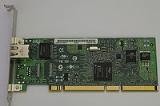
PCI-X

Encyclopedia
PCI-X, short for PCI-eXtended, is a computer bus
and expansion card
standard that enhances the 32-bit PCI Local Bus for higher bandwidth demanded by servers
. It is a double-wide version of PCI, running at up to four times the clock speed, but is otherwise similar in electrical implementation and uses the same protocol. It has been replaced in modern designs by the similar-sounding PCI Express
, with a completely different connector and a very different logical design, being a single narrow but fast serial connection instead of a number of slower connections in parallel.
There is also a 64-bit PCI specification electrically different but with the same connector as PCI-X.
, HP
, and Compaq
and submitted for approval in 1998. It was an effort to codify proprietary server
extensions to the PCI local bus to address several shortcomings in PCI, and increase performance of high bandwidth devices, such as Gigabit Ethernet, Fibre Channel
, and Ultra3 SCSI
cards, and allow processors to be interconnected in clusters.
In PCI, a transaction that cannot be completed immediately is postponed by either the target or the initiator issuing retry-cycles, during which no other agents can use the PCI bus. Since PCI lacks a split-response mechanism to permit the target to return data at a later time, the bus remains occupied by the target issuing retry-cycles until the read data is ready. In PCI-X, after the master issues the request, it disconnects from the PCI bus, allowing other agents to use the bus. The split-response containing the requested data is generated only when the target is ready to return all of the requested data. Split-responses increase bus efficiency by eliminating retry-cycles, during which no data can be transferred across the bus.
PCI also suffered from the relative scarcity of unique interrupt lines. With only 4 interrupt lines (INTA/B/C/D), systems with many PCI devices require multiple functions to share an interrupt line, complicating host-side interrupt-handling. PCI-X added MSI, an interrupt system using writes to host-memory. In MSI-mode, the function's interrupt is not signaled by asserting an INTx line. Instead, the function performs a memory-write to a system-configured region in host-memory. Since the content and address are configured on a per-function basis, MSI-mode interrupts are dedicated instead of shared. A PCI-X system allows both MSI-mode interrupts and legacy INTx interrupts to be used simultaneously (though not by the same function.)
The lack of registered I/Os limited PCI to a maximum frequency of 66 MHz. PCI-X I/Os are registered to the PCI clock, usually through means of a PLL to actively control I/O delay the bus pins. The improvement in setup time allows an increase in frequency to 133 MHz.
Some devices, most notably Gigabit Ethernet cards, SCSI controllers (Fibre Channel and Ultra320), and cluster interconnects could by themselves saturate the PCI bus' 133 MB/s bandwidth. Ports using a bus speed doubled to 66 MHz and a bus width doubled to 64 bits (with the pin count increased to 184 from 124), in combination or not, have been implemented. These extensions were loosely supported as optional parts of the PCI 2.x standards, but device compatibility beyond the basic 133 MB/s continued to be difficult.
Developers eventually used the combined 64-bit and 66-MHz extension as a foundation, and, anticipating future needs, established 66-MHz and 133-MHz variants with a maximum bandwidth of 532 MB/s and 1064 MB/s respectively. The joint result was submitted as PCI-X to the PCI Special Interest Group
(Special Interest Group
of the Association for Computing Machinery
). Subsequent approval made it an open standard
adoptable by all computer developers. The PCI SIG controls technical support, training, and compliance testing for PCI-X. IBM, Intel, Microelectronics, and Mylex were to develop supporting chipsets. 3Com
and Adaptec
were to develop compatible peripherals. To accelerate PCI-X adoption by the industry, Compaq offered PCI-X development tools at their Web site. All major chip makers generally now have or have had some variant of PCI-X in their product lines.
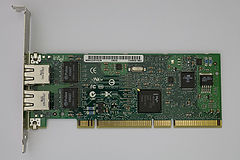 PCI-X revised the conventional PCI standard by doubling the maximum clock speed (from 66 MHz to 133 MHz) and hence the amount of data exchanged between the computer processor and peripherals. Conventional PCI supports up to 64 bits
at 66 MHz (though anything above 32 bits at 33 MHz is seen only in high-end systems) and additional bus standards move 32 bits at 66 MHz or 64 bits at 33 MHz. The theoretical maximum amount of data exchanged between the processor and peripherals with PCI-X is 1.06 GB/s, compared to 133 MB/s with standard PCI. PCI-X also improves the fault tolerance of PCI, allowing, for example, faulty cards to be reinitialized or taken offline.
PCI-X is not compatible with the older 5-volt I/O, which the first revision of PCI used exclusively. Starting with PCI 2.x, 3.3 volt I/O was supported, with which PCI-X is backward compatible. Apart from this, PCI-X and 3.3 volt PCI cards generally can be intermixed on a PCI-X bus, but bus speed will be limited to the clock frequency of the slowest card, an inherent limitation of PCI's shared bus topology. For example, when a PCI 2.3, 66-MHz peripheral is installed into a PCI-X bus capable of 133 MHz, the entire bus backplane will be limited to 66 MHz. To get around this limitation and the voltage compatibility issue, many motherboards have multiple PCI/PCI-X buses, with one bus intended for use with high-speed PCI-X peripherals, and the other bus intended for general-purpose peripherals.
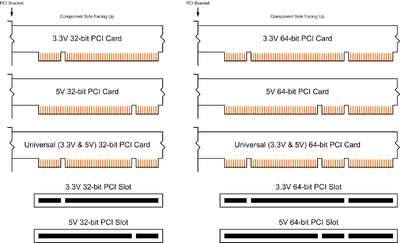 All PCI-X cards or slots have a 64-bit implementation and vary as follows:
or bus controller.
Despite the various theoretical advantages of PCI-X 2.0 and its backward compatibility with PCI-X and PCI devices, it has not been implemented on a large scale (as of 2008). This lack of implementation primarily is because hardware vendors have chosen to integrate PCI Express
instead.
, commonly abbreviated as PCI-E or PCIe, although the cards themselves are totally incompatible and look different. The reason for this confusion is that "PCI-X" sounds similar to "PCI Express". While they are both high-speed computer buses for internal peripherals, they differ in many ways. The first is that PCI-X is a parallel interface that is directly backward compatible with all but the oldest (5-volt) standard PCI devices. PCIe is a serial bus with a different physical interface that was designed to supersede both PCI and PCI-X.
PCI-X and standard PCI buses may run on a PCIe bridge, similar to the way ISA
buses ran on standard PCI buses in some computers. PCIe also matches PCI-X and even PCI-X 2.0 in maximum bandwidth. PCIe 1.0 x1 offers 250 MB/s in each direction, and up to 32 lanes (x32) is currently supported, giving a maximum of 8 GB/s in each direction.
PCI-X has technological and economical disadvantages compared to PCI-Express. The 64-bit parallel interface requires difficult trace routing, because, as with all parallel interfaces, the signals from the bus must arrive simultaneously or within a very short window, and noise from adjacent slots may cause interference. The serial interface of PCIe suffers fewer such problems and therefore does not requires such complex and expensive designs. PCI-X buses, like standard PCI, are half-duplex bidirectional, whereas PCIe buses are full-duplex bidirectional. PCI-X buses run only as fast as the slowest device, whereas PCIe devices are able to independently negotiate the bus speed. Also, PCI-X slots are longer than PCIe 1x through PCIe 16x, which makes it impossible to make short cards for PCI-X. PCI-X slots take quite a bit of space on motherboards, which can be a problem for ATX
and smaller form factors.
Computer bus
In computer architecture, a bus is a subsystem that transfers data between components inside a computer, or between computers.Early computer buses were literally parallel electrical wires with multiple connections, but the term is now used for any physical arrangement that provides the same...
and expansion card
Expansion card
The expansion card in computing is a printed circuit board that can be inserted into an expansion slot of a computer motherboard or backplane to add functionality to a computer system via the expansion bus.One edge of the expansion card holds the contacts that fit exactly into the slot...
standard that enhances the 32-bit PCI Local Bus for higher bandwidth demanded by servers
Server (computing)
In the context of client-server architecture, a server is a computer program running to serve the requests of other programs, the "clients". Thus, the "server" performs some computational task on behalf of "clients"...
. It is a double-wide version of PCI, running at up to four times the clock speed, but is otherwise similar in electrical implementation and uses the same protocol. It has been replaced in modern designs by the similar-sounding PCI Express
PCI Express
PCI Express , officially abbreviated as PCIe, is a computer expansion card standard designed to replace the older PCI, PCI-X, and AGP bus standards...
, with a completely different connector and a very different logical design, being a single narrow but fast serial connection instead of a number of slower connections in parallel.
There is also a 64-bit PCI specification electrically different but with the same connector as PCI-X.
Background
PCI-X was developed jointly by IBMIBM
International Business Machines Corporation or IBM is an American multinational technology and consulting corporation headquartered in Armonk, New York, United States. IBM manufactures and sells computer hardware and software, and it offers infrastructure, hosting and consulting services in areas...
, HP
Hewlett-Packard
Hewlett-Packard Company or HP is an American multinational information technology corporation headquartered in Palo Alto, California, USA that provides products, technologies, softwares, solutions and services to consumers, small- and medium-sized businesses and large enterprises, including...
, and Compaq
Compaq
Compaq Computer Corporation is a personal computer company founded in 1982. Once the largest supplier of personal computing systems in the world, Compaq existed as an independent corporation until 2002, when it was acquired for US$25 billion by Hewlett-Packard....
and submitted for approval in 1998. It was an effort to codify proprietary server
Server (computing)
In the context of client-server architecture, a server is a computer program running to serve the requests of other programs, the "clients". Thus, the "server" performs some computational task on behalf of "clients"...
extensions to the PCI local bus to address several shortcomings in PCI, and increase performance of high bandwidth devices, such as Gigabit Ethernet, Fibre Channel
Fibre Channel
Fibre Channel, or FC, is a gigabit-speed network technology primarily used for storage networking. Fibre Channel is standardized in the T11 Technical Committee of the InterNational Committee for Information Technology Standards , an American National Standards Institute –accredited standards...
, and Ultra3 SCSI
SCSI
Small Computer System Interface is a set of standards for physically connecting and transferring data between computers and peripheral devices. The SCSI standards define commands, protocols, and electrical and optical interfaces. SCSI is most commonly used for hard disks and tape drives, but it...
cards, and allow processors to be interconnected in clusters.
In PCI, a transaction that cannot be completed immediately is postponed by either the target or the initiator issuing retry-cycles, during which no other agents can use the PCI bus. Since PCI lacks a split-response mechanism to permit the target to return data at a later time, the bus remains occupied by the target issuing retry-cycles until the read data is ready. In PCI-X, after the master issues the request, it disconnects from the PCI bus, allowing other agents to use the bus. The split-response containing the requested data is generated only when the target is ready to return all of the requested data. Split-responses increase bus efficiency by eliminating retry-cycles, during which no data can be transferred across the bus.
PCI also suffered from the relative scarcity of unique interrupt lines. With only 4 interrupt lines (INTA/B/C/D), systems with many PCI devices require multiple functions to share an interrupt line, complicating host-side interrupt-handling. PCI-X added MSI, an interrupt system using writes to host-memory. In MSI-mode, the function's interrupt is not signaled by asserting an INTx line. Instead, the function performs a memory-write to a system-configured region in host-memory. Since the content and address are configured on a per-function basis, MSI-mode interrupts are dedicated instead of shared. A PCI-X system allows both MSI-mode interrupts and legacy INTx interrupts to be used simultaneously (though not by the same function.)
The lack of registered I/Os limited PCI to a maximum frequency of 66 MHz. PCI-X I/Os are registered to the PCI clock, usually through means of a PLL to actively control I/O delay the bus pins. The improvement in setup time allows an increase in frequency to 133 MHz.
Some devices, most notably Gigabit Ethernet cards, SCSI controllers (Fibre Channel and Ultra320), and cluster interconnects could by themselves saturate the PCI bus' 133 MB/s bandwidth. Ports using a bus speed doubled to 66 MHz and a bus width doubled to 64 bits (with the pin count increased to 184 from 124), in combination or not, have been implemented. These extensions were loosely supported as optional parts of the PCI 2.x standards, but device compatibility beyond the basic 133 MB/s continued to be difficult.
Developers eventually used the combined 64-bit and 66-MHz extension as a foundation, and, anticipating future needs, established 66-MHz and 133-MHz variants with a maximum bandwidth of 532 MB/s and 1064 MB/s respectively. The joint result was submitted as PCI-X to the PCI Special Interest Group
PCI-SIG
The PCI-SIG or Peripheral Component Interconnect Special Interest Group is an electronics industry consortium responsible for specifying the Peripheral Component Interconnect , PCI-X, and PCI Express computer buses....
(Special Interest Group
Special Interest Group
A Special Interest Group is a community with an interest in advancing a specific area of knowledge, learning or technology where members cooperate to effect or to produce solutions within their particular field, and may communicate, meet, and organize conferences...
of the Association for Computing Machinery
Association for Computing Machinery
The Association for Computing Machinery is a learned society for computing. It was founded in 1947 as the world's first scientific and educational computing society. Its membership is more than 92,000 as of 2009...
). Subsequent approval made it an open standard
Open standard
An open standard is a standard that is publicly available and has various rights to use associated with it, and may also have various properties of how it was designed . There is no single definition and interpretations vary with usage....
adoptable by all computer developers. The PCI SIG controls technical support, training, and compliance testing for PCI-X. IBM, Intel, Microelectronics, and Mylex were to develop supporting chipsets. 3Com
3Com
3Com was a pioneering digital electronics manufacturer best known for its computer network infrastructure products. The company was co-founded in 1979 by Robert Metcalfe, Howard Charney, Bruce Borden, and Greg Shaw...
and Adaptec
Adaptec
Adaptec is a computer hardware brand owned by PMC-Sierra that is used on some of its host adapters for connecting storage devices to computers. The production line of Adaptec is in Indonesia. Products are made to interface with SCSI, Serial ATA, and Serial attached SCSI. Some of its host adapters...
were to develop compatible peripherals. To accelerate PCI-X adoption by the industry, Compaq offered PCI-X development tools at their Web site. All major chip makers generally now have or have had some variant of PCI-X in their product lines.
Technical description
64-bit
64-bit is a word size that defines certain classes of computer architecture, buses, memory and CPUs, and by extension the software that runs on them. 64-bit CPUs have existed in supercomputers since the 1970s and in RISC-based workstations and servers since the early 1990s...
at 66 MHz (though anything above 32 bits at 33 MHz is seen only in high-end systems) and additional bus standards move 32 bits at 66 MHz or 64 bits at 33 MHz. The theoretical maximum amount of data exchanged between the processor and peripherals with PCI-X is 1.06 GB/s, compared to 133 MB/s with standard PCI. PCI-X also improves the fault tolerance of PCI, allowing, for example, faulty cards to be reinitialized or taken offline.
PCI-X is not compatible with the older 5-volt I/O, which the first revision of PCI used exclusively. Starting with PCI 2.x, 3.3 volt I/O was supported, with which PCI-X is backward compatible. Apart from this, PCI-X and 3.3 volt PCI cards generally can be intermixed on a PCI-X bus, but bus speed will be limited to the clock frequency of the slowest card, an inherent limitation of PCI's shared bus topology. For example, when a PCI 2.3, 66-MHz peripheral is installed into a PCI-X bus capable of 133 MHz, the entire bus backplane will be limited to 66 MHz. To get around this limitation and the voltage compatibility issue, many motherboards have multiple PCI/PCI-X buses, with one bus intended for use with high-speed PCI-X peripherals, and the other bus intended for general-purpose peripherals.
Distinction from 64-bit PCI
The 64-bit PCI connector can be distinguished from 32-bit by being longer, and from PCI-X by having three segments, with the one in the middle much shorter than the others. PCI-X slots can be distinguished from 64-bit PCI as the small segment is first, instead of in the center. 32-bit PCI cards will function properly in a PCI-X slot, but PCI-X cards do not work in a standard 32 bit PCI slot.. Many 64-bit PCI cards are designed to function normally, with some loss of speed, in 32-bit slots.Versions
- Cards
- 66 MHz (added in Rev. 1.0)
- 100 MHz (implemented by a 133 MHz adapter on some servers)
- 133 MHz (added in Rev. 1.0)
- 266 MHz (added in Rev. 2.0)
- 533 MHz (added in Rev. 2.0)
- Slots
- 66 MHz (can be found on older servers)
- 133 MHz (most common on modern servers)
- 266 MHz (rare, being replaced by PCI-e)
- 533 MHz (rare, being replaced by PCI-e)
PCI-X 2.0
In 2003, the PCI SIG ratified PCI-X 2.0. It adds 266-MHz and 533-MHz variants, yielding roughly 2.15 GB/s and 4.3 GB/s throughput, respectively. PCI-X 2.0 makes additional protocol revisions that are designed to help system reliability and add Error-correcting codes to the bus to avoid re-sends. To deal with one of the most common complaints of the PCI-X form factor, the 184-pin connector, 16-bit ports were developed to allow PCI-X to be used in devices with tight space constraints. Similar to PCI-Express, PtP functions were added to allow for devices on the bus to talk to each other without burdening the CPUCentral processing unit
The central processing unit is the portion of a computer system that carries out the instructions of a computer program, to perform the basic arithmetical, logical, and input/output operations of the system. The CPU plays a role somewhat analogous to the brain in the computer. The term has been in...
or bus controller.
Despite the various theoretical advantages of PCI-X 2.0 and its backward compatibility with PCI-X and PCI devices, it has not been implemented on a large scale (as of 2008). This lack of implementation primarily is because hardware vendors have chosen to integrate PCI Express
PCI Express
PCI Express , officially abbreviated as PCIe, is a computer expansion card standard designed to replace the older PCI, PCI-X, and AGP bus standards...
instead.
Confusion with PCI-Express
PCI-X is often confused by name with PCI ExpressPCI Express
PCI Express , officially abbreviated as PCIe, is a computer expansion card standard designed to replace the older PCI, PCI-X, and AGP bus standards...
, commonly abbreviated as PCI-E or PCIe, although the cards themselves are totally incompatible and look different. The reason for this confusion is that "PCI-X" sounds similar to "PCI Express". While they are both high-speed computer buses for internal peripherals, they differ in many ways. The first is that PCI-X is a parallel interface that is directly backward compatible with all but the oldest (5-volt) standard PCI devices. PCIe is a serial bus with a different physical interface that was designed to supersede both PCI and PCI-X.
PCI-X and standard PCI buses may run on a PCIe bridge, similar to the way ISA
Industry Standard Architecture
Industry Standard Architecture is a computer bus standard for IBM PC compatible computers introduced with the IBM Personal Computer to support its Intel 8088 microprocessor's 8-bit external data bus and extended to 16 bits for the IBM Personal Computer/AT's Intel 80286 processor...
buses ran on standard PCI buses in some computers. PCIe also matches PCI-X and even PCI-X 2.0 in maximum bandwidth. PCIe 1.0 x1 offers 250 MB/s in each direction, and up to 32 lanes (x32) is currently supported, giving a maximum of 8 GB/s in each direction.
PCI-X has technological and economical disadvantages compared to PCI-Express. The 64-bit parallel interface requires difficult trace routing, because, as with all parallel interfaces, the signals from the bus must arrive simultaneously or within a very short window, and noise from adjacent slots may cause interference. The serial interface of PCIe suffers fewer such problems and therefore does not requires such complex and expensive designs. PCI-X buses, like standard PCI, are half-duplex bidirectional, whereas PCIe buses are full-duplex bidirectional. PCI-X buses run only as fast as the slowest device, whereas PCIe devices are able to independently negotiate the bus speed. Also, PCI-X slots are longer than PCIe 1x through PCIe 16x, which makes it impossible to make short cards for PCI-X. PCI-X slots take quite a bit of space on motherboards, which can be a problem for ATX
ATX
ATX is a motherboard form factor specification developed by Intel in 1995 to improve on previous de facto standards like the AT form factor. It was the first big change in computer case, motherboard, and power supply design in many years, improving standardization and interchangeability of parts...
and smaller form factors.
Further reading
- PCI Bus Demystified; 2nd Ed; Doug Abbott; 250 pages; 2004; ISBN 9780750677394.
- PCI-X System Architecture; 1st Ed; Tom Shanley; 752 pages; 2000; ISBN 9780201726824.
- PCI & PCI-X Hardware and Software Architecture & Design; 5th Ed; Ed Solari; 1140 pages; 2001; ISBN 9780929392639.