

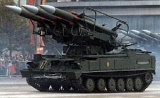
SA-6 Gainful

Encyclopedia
The 2K12 "Kub" mobile surface-to-air missile
system is a Soviet low to medium-level air defence system designed to protect ground forces from air attack. "2К12" is the GRAU
designation of the system. Kub is known in the west by its NATO reporting name
"Gainful" as well as the US Department of Defense designation SA-6.
Each 2K12 battery consists of a number of similar tracked vehicles, one of which carries the 1S91 (SURN vehicle, NATO designation "Straight Flush") 25 kW G
/H band
radar
(range 75 km/47 miles) equipped with a continuous wave
illuminator, in addition to an optical sight. The battery usually also includes four triple-missile transporter erector launcher
s (TELs) and four trucks each carrying three spare missiles and a crane. TEL is based on a GM-578
chassis, while the 1S91 radar vehicle on a GM-568, all developed and produced by MMZ.
The systems design was the responsibility of the now Tikhomirov Scientific Research Institute of Instrument Design
(NIIP). In addition to NIIP several other design bureaus were involved in the creation of the Kub missile system including the now JSC Metrowagonmash
(former MMZ)which designed and produced the chassis of the self-propelled components. Many of the design bureaus would later go on to co-operate in the development of the successor to the 2K12 "Kub", the 9K37 "Buk"
First trials of the missile system were started at the end of 1959 to discover a series of problems:
Those failures resulted in some 'orgchanges': In August 1961 Toropov was replaced by Lyapin as the Chief Designer of Vympel and in January 1962 Tikhomirov was replaced by Figurovskiy as the Chief Designer of NIIP Still, the work wasn't intensified. Before 1963 only 11 of 83 missiles fired had the seeker head installed, only 3 launches were successful.
Kub downed its first ever air target on February 18, 1963 during the state trials at Donguz artillery testing range, Orenburg Oblast
. It was an Ilyushin Il-28
bomber.
The system entered an extended testing period between 1959 and 1966, after overcoming the technical difficulties of producing the 2K12 "Kub" the system was accepted into service on the 23rd January, 1967 and went into production that same year.
It is sometimes claimed that the M-11 Shtorm (SA-N-3) naval system is a version of the 3M9 but this is not the case, as the M-11 Shtorm is a separate system and, unusually for Russian surface-to-air missiles, has no land-based variant.
The 2K12 "Kub" was recommended for modernisation work in 1967 with the goal of improving combat characteristics (longer range, improved ECCM
, reliability and reaction time). A modernised variant underwent trial testing in 1972 eventually being adopted in 1973 as the "Kub-M1". The system underwent another modernisation between 1974 and 1976, against the general combat characteristics of the system were improved with the "Kub-M3" clearing testing and entering service in 1976.
After the Chief designer Ardalion Rastov
visited Egypt in 1971 to see Kub in operation he came to the certain conclusion for the development of a new system, called Buk, where each TEL should have its own fire control radar (TELAR) and is able to engage multiple targets from multiple directions at the same time.
The final major development of the Kub missile system was achieved during the development of its successor, the 9K37 "Buk" in 1974. Although the Buk is the successor to Kub it was decided that both systems could share some interoperability, the result of this decision was the "Kub-M4" system. The Kub-M4 used Kub-M3 components which could receive fire control information from the 9А310 transporter erector launcher and radar (TELAR) of the 9K37 Buk. The advantage interoperability was an increase in the number of fire control channels and available missiles for each system as well as a faster service entry for Buk system components. The Kub-M4 was adopted into service in 1978 following completion of state trails.
Some early development interpretations of Buk missile system heavily utilized the Kub components including the 3M9 missile.
There are several plans to integrate a active radar homing
missiles into Kub. For instance, Polish
WZU of Grudziadz
shows a project of Sparrow
-armed Kub at the MSPO 2008 defence exhibition in Kielce
. It is reported also that Vympel initiated some work to use its RVV-AE air-to-air missile to modernise the Kvadrat SAM system.
Also, the Czech company RETIA presented a SURN (fire control radar) upgrade featuring an optical channel and new multiple-function color displays as well as the radar upgrade and the IFF system.
 The 2K12 system shares a lot of components with the 2K11 Krug (SA-4) system. In many ways they are designed to complement each other; 2K11 is effective at long ranges and high altitudes, 2K12 at medium ranges and intermediate altitudes.
The system is able to acquire and begin tracking targets using the 1С91 самоходных установок разведки и наведения ("Self-propelled Installation for Reconnaissance and Guidance" / NATO: "Straight Flush" radar) at 75 km (46.6 mi) and begin illumination and guidance at 28 km (17.4 mi). IFF
is also performed using this radar. It can only guide one or two missiles to a single target at any time. The missile is initially command guided with terminal semi active radar homing (SARH), with target illumination provided by the "Straight Flush" radar. Detonation is via either the impact or proximity fuze
. On the latest models, this vehicle is also fitted with an optical tracking system which allows engagement without the use of the radar (for active RF emissions stealth reasons, or due to heavy ECM
jamming
) in which case the effective altitude is limited to 14 km/46000 ft. The optical tracking method also allows engagements to altitudes below that where the radar is able to track targets. Maximum target speed is around Mach
2 for head-on engagements and Mach 1 for tail-chase engagements. Top speed of the missile is approximately Mach 2.8.
In contrast to the elaborate Patriot missile or even the simpler Hawk system fielded by US forces, most of the system rides on two tracked self-propelled vehicles, rather than towed or mounted on trucks, and either the launcher or control vehicle can be set to launch in only 15 minutes after changing location.
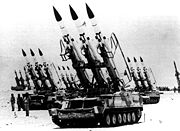
The fairly large missiles have an effective range of 4–24 km (2.5–15 miles) and an effective altitude of 50–14000 m (164–45,931 ft). The missile weighs 599 kg (1321 lb) and the warhead weighs 56 kg (123 lb). Top missile speed is approx. Mach
2.8. The combined propulsion system 9D16K included solid fuel
rocket motor which, when burned out, forms the combustion chamber for a ramjet
in a pioneering design putting this missile far ahead of its contemporaries in terms of propulsion.
The missile was fitted with a semi-active radar seeker 1SB4, designed by MNII Agat, which was able to track the target by Doppler
frequency since the start. Chief Designer of the seeker head was Yu.N. Vekhov, since 1960 - I.G. Akopyan.
In 1977 a new version, the 3M9M1 (DoD designation SA-6B) was created with three missiles fitted onto a different chassis (the same as that of the 9K37 "Buk" (NATO reporting name "Gadfly" / DoD SA-11 ), the 2K12 effective replacement) with an integrated "Fire Dome" missile guidance radar. For comparisons between the 2K12, 9K37, see the 9K37 Buk entry.
An earlier incremental upgrade saw the 2K12 missiles replaced with the 2K12E versions and this system was known as Kvadrat ("Квадрат", meaning square). This name was derived from the most common arrangement pattern of the military vehicles of the 2K12 complex, when the 1C91 radar is located at the center and 4x2P25 TELs at the vertices
of a square around the radar.
While 1S31 antenna was installed on the upper section of the superstructure and the 1S11 on the lower, they could turn around independently. To make the height of the vehicle lower the central cylinder was able to hide inside the prime mover.
The acquisition range of the radar was reported as 50 km (31 mi) for the Phantom II type target.
Total weight of the 1S91 vehicle with a crew of 4 was 20.3 ton
nes and 2P25 vehicle with 3 missiles and a crew of 3 was 19.5 t.
The "Spoon Rest" and "Thin Skin" are mounted on a truck, "Long Track" on a tracked vehicle (a modified AT-T) and "Flat Face" on a van. It is unknown what kind of mounting the "Score Board" has.
Without the P-40 "Long Track" mobile radar vehicle, the 2K12 is unable to track aircraft at high altitudes.
. They were used to having air superiority over the battlefield. The highly mobile 2K12 took a heavy toll on the slower A-4 Skyhawk
and even the F-4 Phantom, forming a protective umbrella until they could be removed. The radar warning receivers on the Israeli aircraft did not alert the pilot to the fact that he was being illuminated by the radar. Once the RWRs were reprogrammed and tactics changed, the 2K12 was no longer such a grave threat. Pilots dubbed the 2K12 the "Three Fingers of Death", in reference to the launcher's appearance.
The superior low altitude performance of the weapon, and its new CW semi-active missile seeker resulted in a much higher success rate compared to the earlier SA-2 and SA-3 systems. While exact losses continue to be disputed, around 40 aircraft are usually cited as lost to SAM shots, and the 2K12 / SA-6 proved most effective of the three weapons.
 The Syrians also deployed the SA-6 to Lebanon in 1981 after the Israelis shot down Syrian helicopters near Zahlé
. The SAM batteries were placed in the Bekaa Valley near the Beirut
-Damascus
road. They remained close to the existing Syrian air defense system but could not be fully integrated into it. Early in the 1982 Lebanon war
, the Israeli Air Force
concentrated on the SAM threat in the Beqaa Valley
, launching Operation Mole Cricket 19
. The result was a complete success. Several SA-6 batteries, along with SA-2s and SA-3s, were destroyed in a single day. While Syria's own air defenses remained largely intact, its forces in Lebanon were left exposed to attacks by Israeli strike aircraft for the remainder of the war.
s armed with Martel anti-radiation missiles.
In March, the Chadian
rebels captured Ouadi Doum air base and captured practically the whole heavy equipment used for the defense of this airfield intact. Most of this equipment was transported to France and the USA in the following days, but some SA-6s remained in Chad.
With this catastrophe, the Libya
n occupation of the northern Chad – and the annexation of the Aouzou Strip – was over: by 30 March, also the bases at Faya Largeau and Aouzou had to be abandoned. The LARAF now has got a completely different task: its Tu-22Bs were to attack the abandoned bases and destroy as much equipment left there as possible. First such strikes were flown in April, and they continued until the 8 August 1987, when two Tu-22Bs which tried to strike Aouzou, were ambushed by a captured SA-6 battery used by the Chadian Army, and one of the bombers shot down.
. It had flown 4 combat missions before being lost.
Two days before, a B-52G was damaged by a SAM which could have been an SA-6 or an SA-3.
In any case, the SA-6 threat was largely controlled by Allied EW assets together with the older SA-2 and SA-3 missile systems. Most of the losses were due to IR guided SAMs.
forces, using modified SA-6s were successful in shooting down
Scott O'Grady
's F-16 in 1995 and 2-3 AN-2 used as night bombers with improvised 100 kg bombs.
One Mi-17 was shot down by Bosnian Serbs Kub on May 28, killing the Bosnian Minister Irfan Ljubijankić
, a few other politicians, and the helicopter's Ukrainian mercenary crew.
During the Kosovo war in Spring 1999, on the first night of the war (March 24./25.), a Yugoslav Air Force MiG-29 flown by Maj. Predrag Milutinović was downed by a Kub battery in a friendly fire incident, while approaching Niš Airport after an unsuccsesful engagement with NATO aircraft.
Yugoslav air defence had twenty-two SA-6 batteries. Using shoot and scoot tactics, the self-propelled ground system demonstrated a good surviability with only three radars lost in the face of nearly four-hundred AGM-88 shots, but the system proved to be very ineffective having fired 477 missiles without a single success, at the same time. As comparison the fixed SA-2 and SA-3 sites demonstrated a similar low rate success, but suffered losses to around 66 to 80 percent.
According to the then-commander of Air force and air defense General Spasoje Smiljanjić 2K12 Kub had 46 shooting with 70 rockets. Of the 20 missile battery fired only 16 battery.
Affected, with material evidence, two unmanned aerial vehicles. And by 'assessment of conditions and the elements of fire' hit by 13 planes and two helicopters.
 - 20+
- 20+
Surface-to-air missile
A surface-to-air missile or ground-to-air missile is a missile designed to be launched from the ground to destroy aircraft or other missiles...
system is a Soviet low to medium-level air defence system designed to protect ground forces from air attack. "2К12" is the GRAU
Grau
Grau is a German word meaning "gray" and a Catalan word meaning "grade". It may refer to:* BAP Almirante Grau , a De Zeven Provinciën class cruiser in service with the Peruvian Navy* Grau Käse, Tyrolean grey cheese...
designation of the system. Kub is known in the west by its NATO reporting name
NATO reporting name
NATO reporting names are classified code names for military equipment of the Eastern Bloc...
"Gainful" as well as the US Department of Defense designation SA-6.
Each 2K12 battery consists of a number of similar tracked vehicles, one of which carries the 1S91 (SURN vehicle, NATO designation "Straight Flush") 25 kW G
G band
-NATO G band:The G band in the modern sense is the range of radio frequencies from 4 GHz to 6 GHz in the electromagnetic spectrum. This is equal to wave lengths between 7.5 cm and 5 cm...
/H band
H band
H band can refer to two different regions of the electromagnetic spectrum, in the radio and near-infrared.-Radio:The H band is the range of radio frequencies from 6 GHz to 8 GHz in the electromagnetic spectrum. This is equal to wave lengths between 5 cm and 3.75 cm...
radar
Radar
Radar is an object-detection system which uses radio waves to determine the range, altitude, direction, or speed of objects. It can be used to detect aircraft, ships, spacecraft, guided missiles, motor vehicles, weather formations, and terrain. The radar dish or antenna transmits pulses of radio...
(range 75 km/47 miles) equipped with a continuous wave
Continuous wave
A continuous wave or continuous waveform is an electromagnetic wave of constant amplitude and frequency; and in mathematical analysis, of infinite duration. Continuous wave is also the name given to an early method of radio transmission, in which a carrier wave is switched on and off...
illuminator, in addition to an optical sight. The battery usually also includes four triple-missile transporter erector launcher
Transporter erector launcher
A transporter erector launcher is a vehicle with an integrated prime mover that can carry, elevate to firing position and launch one or more missiles. Such vehicles exist for both surface-to-air missiles and surface-to-surface missiles...
s (TELs) and four trucks each carrying three spare missiles and a crane. TEL is based on a GM-578
GM chassis
thumb|300px|[[Tor missile system]] on GM-5955 chassis.GM is a series of tracked vehicle chassis. Generally, the series is produced by Metrovagonmash , part of the Transmashholding since 2002...
chassis, while the 1S91 radar vehicle on a GM-568, all developed and produced by MMZ.
Development
The development of the 2K12 "Kub" was started after 18 July 1958 at the request of the CPSU Central Committee. The system was set the requirements of being able to engage aerial targets flying at speeds of 420–600 m/s at altitudes of 100 m to 7 km (4 mi) at ranges up to 20 km (12 mi), with a single shot kill probability of at least 0.7.The systems design was the responsibility of the now Tikhomirov Scientific Research Institute of Instrument Design
Tikhomirov Scientific Research Institute of Instrument Design
JSC V.V. Tikhomirov Scientific Research Institute of Instrument Design is a joint stock company, one of the major Russian enterprises in the development of weaponry control systems for fighter planes and mobile medium range anti-aircraft SAM defense vehicles.The institute was created on March 1,...
(NIIP). In addition to NIIP several other design bureaus were involved in the creation of the Kub missile system including the now JSC Metrowagonmash
Metrowagonmash
Metrowagonmash is an engineering company in Russia.The company is located in Mytishchi, near Moscow and until 1992 it was known as Mitishi Machine-building factory ....
(former MMZ)which designed and produced the chassis of the self-propelled components. Many of the design bureaus would later go on to co-operate in the development of the successor to the 2K12 "Kub", the 9K37 "Buk"
First trials of the missile system were started at the end of 1959 to discover a series of problems:
- low power for the missile radar seeker and badly designed nose cone,
- missile air inlets design failure,
- low quality of heat shield inside the afterburner chamber (titanium was replaced by steel).
Those failures resulted in some 'orgchanges': In August 1961 Toropov was replaced by Lyapin as the Chief Designer of Vympel and in January 1962 Tikhomirov was replaced by Figurovskiy as the Chief Designer of NIIP Still, the work wasn't intensified. Before 1963 only 11 of 83 missiles fired had the seeker head installed, only 3 launches were successful.
Kub downed its first ever air target on February 18, 1963 during the state trials at Donguz artillery testing range, Orenburg Oblast
Orenburg Oblast
Orenburg Oblast is a federal subject of Russia . Its administrative center is the city of Orenburg. From 1938 to 1957, it bore the name Chkalov Oblast in honor of Valery Chkalov...
. It was an Ilyushin Il-28
Ilyushin Il-28
The Ilyushin Il-28 is a jet bomber aircraft of the immediate postwar period that was originally manufactured for the Soviet Air Force. It was the USSR's first such aircraft to enter large-scale production. It was also licence-built in China as the Harbin H-5. Total production in the USSR was 6,316...
bomber.
The system entered an extended testing period between 1959 and 1966, after overcoming the technical difficulties of producing the 2K12 "Kub" the system was accepted into service on the 23rd January, 1967 and went into production that same year.
It is sometimes claimed that the M-11 Shtorm (SA-N-3) naval system is a version of the 3M9 but this is not the case, as the M-11 Shtorm is a separate system and, unusually for Russian surface-to-air missiles, has no land-based variant.
The 2K12 "Kub" was recommended for modernisation work in 1967 with the goal of improving combat characteristics (longer range, improved ECCM
Electronic counter-countermeasures
Electronic counter-countermeasures is a part of electronic warfare which includes a variety of practices which attempt to reduce or eliminate the effect of electronic countermeasures on electronic sensors aboard vehicles, ships and aircraft and weapons such as missiles. ECCM is also known as...
, reliability and reaction time). A modernised variant underwent trial testing in 1972 eventually being adopted in 1973 as the "Kub-M1". The system underwent another modernisation between 1974 and 1976, against the general combat characteristics of the system were improved with the "Kub-M3" clearing testing and entering service in 1976.
After the Chief designer Ardalion Rastov
Ardalion Rastov
Ardalion Ardalionovich Rastov is a Soviet engineer and chief designer of both Kub and Buk self-propelled missile launchers.Graduated from radiotechnical faculty of Moscow Energy Institute in 1949...
visited Egypt in 1971 to see Kub in operation he came to the certain conclusion for the development of a new system, called Buk, where each TEL should have its own fire control radar (TELAR) and is able to engage multiple targets from multiple directions at the same time.
The final major development of the Kub missile system was achieved during the development of its successor, the 9K37 "Buk" in 1974. Although the Buk is the successor to Kub it was decided that both systems could share some interoperability, the result of this decision was the "Kub-M4" system. The Kub-M4 used Kub-M3 components which could receive fire control information from the 9А310 transporter erector launcher and radar (TELAR) of the 9K37 Buk. The advantage interoperability was an increase in the number of fire control channels and available missiles for each system as well as a faster service entry for Buk system components. The Kub-M4 was adopted into service in 1978 following completion of state trails.
Some early development interpretations of Buk missile system heavily utilized the Kub components including the 3M9 missile.
There are several plans to integrate a active radar homing
Active radar homing
Active radar homing is a missile guidance method in which a guided missile contains a radar transceiver and the electronics necessary for it to find and track its target autonomously...
missiles into Kub. For instance, Polish
Poles
thumb|right|180px|The state flag of [[Poland]] as used by Polish government and diplomatic authoritiesThe Polish people, or Poles , are a nation indigenous to Poland. They are united by the Polish language, which belongs to the historical Lechitic subgroup of West Slavic languages of Central Europe...
WZU of Grudziadz
Grudziadz
Grudziądz is a city in northern Poland on the Vistula River, with 96 042 inhabitants . Situated in the Kuyavian-Pomeranian Voivodeship , the city was previously in the Toruń Voivodeship .- History :-Early history:...
shows a project of Sparrow
AIM-7 Sparrow
The AIM-7 Sparrow is an American, medium-range semi-active radar homing air-to-air missile operated by the United States Air Force, United States Navy and United States Marine Corps, as well as various allied air forces and navies. Sparrow and its derivatives were the West's principal beyond visual...
-armed Kub at the MSPO 2008 defence exhibition in Kielce
Kielce
Kielce ) is a city in central Poland with 204,891 inhabitants . It is also the capital city of the Świętokrzyskie Voivodeship since 1999, previously in Kielce Voivodeship...
. It is reported also that Vympel initiated some work to use its RVV-AE air-to-air missile to modernise the Kvadrat SAM system.
Also, the Czech company RETIA presented a SURN (fire control radar) upgrade featuring an optical channel and new multiple-function color displays as well as the radar upgrade and the IFF system.
Description
The system is able to acquire and begin tracking targets using the 1С91 самоходных установок разведки и наведения ("Self-propelled Installation for Reconnaissance and Guidance" / NATO: "Straight Flush" radar) at 75 km (46.6 mi) and begin illumination and guidance at 28 km (17.4 mi). IFF
Identification friend or foe
In telecommunications, identification, friend or foe is an identification system designed for command and control. It is a system that enables military and national interrogation systems to identify aircraft, vehicles, or forces as friendly and to determine their bearing and range from the...
is also performed using this radar. It can only guide one or two missiles to a single target at any time. The missile is initially command guided with terminal semi active radar homing (SARH), with target illumination provided by the "Straight Flush" radar. Detonation is via either the impact or proximity fuze
Proximity fuze
A proximity fuze is a fuze that is designed to detonate an explosive device automatically when the distance to target becomes smaller than a predetermined value or when the target passes through a given plane...
. On the latest models, this vehicle is also fitted with an optical tracking system which allows engagement without the use of the radar (for active RF emissions stealth reasons, or due to heavy ECM
Electronic countermeasures
An electronic countermeasure is an electrical or electronic device designed to trick or deceive radar, sonar or other detection systems, like infrared or lasers. It may be used both offensively and defensively to deny targeting information to an enemy...
jamming
Radar jamming and deception
Radar jamming and deception is the intentional emission of radio frequency signals to interfere with the operation of a radar by saturating its receiver with noise or false information...
) in which case the effective altitude is limited to 14 km/46000 ft. The optical tracking method also allows engagements to altitudes below that where the radar is able to track targets. Maximum target speed is around Mach
Mach number
Mach number is the speed of an object moving through air, or any other fluid substance, divided by the speed of sound as it is in that substance for its particular physical conditions, including those of temperature and pressure...
2 for head-on engagements and Mach 1 for tail-chase engagements. Top speed of the missile is approximately Mach 2.8.
In contrast to the elaborate Patriot missile or even the simpler Hawk system fielded by US forces, most of the system rides on two tracked self-propelled vehicles, rather than towed or mounted on trucks, and either the launcher or control vehicle can be set to launch in only 15 minutes after changing location.
Missiles
The fairly large missiles have an effective range of 4–24 km (2.5–15 miles) and an effective altitude of 50–14000 m (164–45,931 ft). The missile weighs 599 kg (1321 lb) and the warhead weighs 56 kg (123 lb). Top missile speed is approx. Mach
Mach number
Mach number is the speed of an object moving through air, or any other fluid substance, divided by the speed of sound as it is in that substance for its particular physical conditions, including those of temperature and pressure...
2.8. The combined propulsion system 9D16K included solid fuel
Solid fuel
Solid fuel refers to various types of solid material that are used as fuel to produce energy and provide heating, usually released through combustion....
rocket motor which, when burned out, forms the combustion chamber for a ramjet
Ramjet
A ramjet, sometimes referred to as a stovepipe jet, or an athodyd, is a form of airbreathing jet engine using the engine's forward motion to compress incoming air, without a rotary compressor. Ramjets cannot produce thrust at zero airspeed and thus cannot move an aircraft from a standstill...
in a pioneering design putting this missile far ahead of its contemporaries in terms of propulsion.
The missile was fitted with a semi-active radar seeker 1SB4, designed by MNII Agat, which was able to track the target by Doppler
Doppler
-Doppler effect and its applications:* Doppler effect* Doppler beaming* Doppler broadening* Doppler cooling** Doppler cooling limit* Doppler echocardiography** Doppler ultrasound, also called Doppler sonography** Transcranial doppler* Doppler fetal monitor...
frequency since the start. Chief Designer of the seeker head was Yu.N. Vekhov, since 1960 - I.G. Akopyan.
In 1977 a new version, the 3M9M1 (DoD designation SA-6B) was created with three missiles fitted onto a different chassis (the same as that of the 9K37 "Buk" (NATO reporting name "Gadfly" / DoD SA-11 ), the 2K12 effective replacement) with an integrated "Fire Dome" missile guidance radar. For comparisons between the 2K12, 9K37, see the 9K37 Buk entry.
An earlier incremental upgrade saw the 2K12 missiles replaced with the 2K12E versions and this system was known as Kvadrat ("Квадрат", meaning square). This name was derived from the most common arrangement pattern of the military vehicles of the 2K12 complex, when the 1C91 radar is located at the center and 4x2P25 TELs at the vertices
Vertex (geometry)
In geometry, a vertex is a special kind of point that describes the corners or intersections of geometric shapes.-Of an angle:...
of a square around the radar.
1S91 radar
SURN 1S91 vehicle included two radar station - a target acquisition and distribution radar 1S11 and a continuous wave illuminator 1S31, in addition to an IFF interrogator and an optical channel.While 1S31 antenna was installed on the upper section of the superstructure and the 1S11 on the lower, they could turn around independently. To make the height of the vehicle lower the central cylinder was able to hide inside the prime mover.
The acquisition range of the radar was reported as 50 km (31 mi) for the Phantom II type target.
Total weight of the 1S91 vehicle with a crew of 4 was 20.3 ton
Ton
The ton is a unit of measure. It has a long history and has acquired a number of meanings and uses over the years. It is used principally as a unit of weight, and as a unit of volume. It can also be used as a measure of energy, for truck classification, or as a colloquial term.It is derived from...
nes and 2P25 vehicle with 3 missiles and a crew of 3 was 19.5 t.
Additional radar
The 2K12 can also be used at a regimental level, if used as such it can be accompanied by a number of additional radar systems for extended air search at longer range and lower altitude, to supplement the 1S91 "Straight Flush". These systems include the:- P-12P-12 radarThe P-12 "Yenisei" was an early 2D VHF radar developed and operated by the former Soviet Union.-Development:...
"Spoon Rest", a VHF early warning radar (also used by the SA-2), with a 200 kilometres (124.3 mi) range. - P-40P-40 radarThe P-40 "Armour" or 1S12 is a 3-D UHF radar developed and operated by the former Soviet Union.-Development:...
"Long Track", an E bandE bandThe NATO E band is the range of radio frequencies from 2 GHz to 3 GHz in the electromagnetic spectrum. This is equal to wave lengths between 15 cm and 10 cm. The E band is in the upper UHF range of the radio spectrum...
early warning radar (also used by the SA-4 and SA-8, with a 370 kilometres (229.9 mi) range. - P-15P-12 radarThe P-12 "Yenisei" was an early 2D VHF radar developed and operated by the former Soviet Union.-Development:...
"Flat Face A", a UHF early warning radar (also used by the SA-3, with a 150 kilometres (93.2 mi) range. - "Thin Skin" or "Side Net" E bandE bandThe NATO E band is the range of radio frequencies from 2 GHz to 3 GHz in the electromagnetic spectrum. This is equal to wave lengths between 15 cm and 10 cm. The E band is in the upper UHF range of the radio spectrum...
height finding radar (also used by the SA-2, SA-4 and SA-5, range 240 km/148 miles) - "Score Board" IFFIFFIFF, Iff or iff may refer to:Technology/Science:* Identification friend or foe, an electronic radio-based identification system using transponders...
radar
The "Spoon Rest" and "Thin Skin" are mounted on a truck, "Long Track" on a tracked vehicle (a modified AT-T) and "Flat Face" on a van. It is unknown what kind of mounting the "Score Board" has.
Without the P-40 "Long Track" mobile radar vehicle, the 2K12 is unable to track aircraft at high altitudes.
Yom Kippur War
The 2K12 surprised the Israelis in the 1973 Yom Kippur WarYom Kippur War
The Yom Kippur War, Ramadan War or October War , also known as the 1973 Arab-Israeli War and the Fourth Arab-Israeli War, was fought from October 6 to 25, 1973, between Israel and a coalition of Arab states led by Egypt and Syria...
. They were used to having air superiority over the battlefield. The highly mobile 2K12 took a heavy toll on the slower A-4 Skyhawk
A-4 Skyhawk
The Douglas A-4 Skyhawk is a carrier-capable ground-attack aircraft designed for the United States Navy and United States Marine Corps. The delta winged, single-engined Skyhawk was designed and produced by Douglas Aircraft Company, and later McDonnell Douglas. It was originally designated the A4D...
and even the F-4 Phantom, forming a protective umbrella until they could be removed. The radar warning receivers on the Israeli aircraft did not alert the pilot to the fact that he was being illuminated by the radar. Once the RWRs were reprogrammed and tactics changed, the 2K12 was no longer such a grave threat. Pilots dubbed the 2K12 the "Three Fingers of Death", in reference to the launcher's appearance.
The superior low altitude performance of the weapon, and its new CW semi-active missile seeker resulted in a much higher success rate compared to the earlier SA-2 and SA-3 systems. While exact losses continue to be disputed, around 40 aircraft are usually cited as lost to SAM shots, and the 2K12 / SA-6 proved most effective of the three weapons.
1982 Lebanon war
Zahlé
Zahlé is the capital and largest city of Beqaa Governorate, Lebanon. With around 50,000 inhabitants, it is the fourth largest city in Lebanon, after Beirut, Tripoli and Jounieh...
. The SAM batteries were placed in the Bekaa Valley near the Beirut
Beirut
Beirut is the capital and largest city of Lebanon, with a population ranging from 1 million to more than 2 million . Located on a peninsula at the midpoint of Lebanon's Mediterranean coastline, it serves as the country's largest and main seaport, and also forms the Beirut Metropolitan...
-Damascus
Damascus
Damascus , commonly known in Syria as Al Sham , and as the City of Jasmine , is the capital and the second largest city of Syria after Aleppo, both are part of the country's 14 governorates. In addition to being one of the oldest continuously inhabited cities in the world, Damascus is a major...
road. They remained close to the existing Syrian air defense system but could not be fully integrated into it. Early in the 1982 Lebanon war
1982 Lebanon War
The 1982 Lebanon War , , called Operation Peace for Galilee by Israel, and later known in Israel as the Lebanon War and First Lebanon War, began on 6 June 1982, when the Israel Defense Forces invaded southern Lebanon...
, the Israeli Air Force
Israeli Air Force
The Israeli Air Force is the air force of the State of Israel and the aerial arm of the Israel Defense Forces. It was founded on May 28, 1948, shortly after the Israeli Declaration of Independence...
concentrated on the SAM threat in the Beqaa Valley
Beqaa Valley
The Beqaa Valley is a fertile valley in east Lebanon. For the Romans, the Beqaa Valley was a major agricultural source, and today it remains Lebanon’s most important farming region...
, launching Operation Mole Cricket 19
Operation Mole Cricket 19
Operation Mole Cricket 19 was a suppression of enemy air defenses campaign launched by the Israeli Air Force against Syrian targets on June 9, 1982, at the outset of the 1982 Lebanon War. The operation was the first time in history that a Western air force successfully destroyed a Soviet-built...
. The result was a complete success. Several SA-6 batteries, along with SA-2s and SA-3s, were destroyed in a single day. While Syria's own air defenses remained largely intact, its forces in Lebanon were left exposed to attacks by Israeli strike aircraft for the remainder of the war.
Poland
On 19 August 2003, a Polish Air Force Su-22M4K was accidentally shot down by friendly fire during an exercise by a Polish SA-6 battery. The aircraft was flying 21 km from the coast over the Baltic Sea near Ustka. The pilot ejected and was rescued after two hours in the water. He subsequently died in a C-295M crash on 23 January 2008.Libya
The system was deployed by Libya during the border dispute with Chad and proved a threat for French aircraft, however on January 7, 1987 these were successful in destroying an SA-6 radar site in the Faya Largeau area with SEPECAT JaguarSEPECAT Jaguar
The SEPECAT Jaguar is an Anglo-French jet ground attack aircraft, originally used by the British Royal Air Force and the French Armée de l'Air in the close air support and nuclear strike role, and still in service with several export customers, notably the Indian Air Force and the Royal Air Force...
s armed with Martel anti-radiation missiles.
In March, the Chadian
Chadian
Chadian may refer to:* Something of, from, or related to the country of Chad* A person from Chad, or of Chadian descent. For information about the Chadian people, see Demographics of Chad and Culture of Chad. For specific persons, see List of Chadians...
rebels captured Ouadi Doum air base and captured practically the whole heavy equipment used for the defense of this airfield intact. Most of this equipment was transported to France and the USA in the following days, but some SA-6s remained in Chad.
With this catastrophe, the Libya
Libya
Libya is an African country in the Maghreb region of North Africa bordered by the Mediterranean Sea to the north, Egypt to the east, Sudan to the southeast, Chad and Niger to the south, and Algeria and Tunisia to the west....
n occupation of the northern Chad – and the annexation of the Aouzou Strip – was over: by 30 March, also the bases at Faya Largeau and Aouzou had to be abandoned. The LARAF now has got a completely different task: its Tu-22Bs were to attack the abandoned bases and destroy as much equipment left there as possible. First such strikes were flown in April, and they continued until the 8 August 1987, when two Tu-22Bs which tried to strike Aouzou, were ambushed by a captured SA-6 battery used by the Chadian Army, and one of the bombers shot down.
Iraq
A USAF F-16 (serial 87-228) was shot down on January 19, 1991 by an SA-6. It was combat loss number 10 in Operation Desert Storm. The pilot, Captain Harry 'Mike' Roberts, ejected safely, but was taken prisoner. The aircraft was on a mission to attack the Air Defense Headquarters Building in BaghdadBaghdad
Baghdad is the capital of Iraq, as well as the coterminous Baghdad Governorate. The population of Baghdad in 2011 is approximately 7,216,040...
. It had flown 4 combat missions before being lost.
Two days before, a B-52G was damaged by a SAM which could have been an SA-6 or an SA-3.
In any case, the SA-6 threat was largely controlled by Allied EW assets together with the older SA-2 and SA-3 missile systems. Most of the losses were due to IR guided SAMs.
Bosnia and Kosovo
Army of Republika SrpskaArmy of Republika Srpska
The Army of Republika Srpska ; Serbian, Bosnian, Croatian Vojska Republike Srpske ) also referred to as the Bosnian Serb Army, was the military of today's Republika Srpska which was then the "Serbian Republic of Bosnia and Herzegovina", a self-proclaimed state within the internationally recognized...
forces, using modified SA-6s were successful in shooting down
Mrkonjic Grad incident
The Mrkonjić Grad incident was the shooting down of a United States Air Force F-16C by a Bosnian Serb Army SA-6 surface-to-air missile near Mrkonjić Grad, Bosnia and Herzegovina, on June 2, 1995...
Scott O'Grady
Scott O'Grady
Scott Francis O'Grady is a former USAF Captain and former United States Air Force fighter pilot who gained prominence after the June 2, 1995 Mrkonjić Grad incident, in which he ejected over Bosnia when his F-16C was shot down by a Bosnian Serb SA-6 while he was patrolling the no-fly zone...
's F-16 in 1995 and 2-3 AN-2 used as night bombers with improvised 100 kg bombs.
One Mi-17 was shot down by Bosnian Serbs Kub on May 28, killing the Bosnian Minister Irfan Ljubijankić
Irfan Ljubijankic
Dr. Irfan Ljubijankić was a Bosnian facial surgeon, classical music composer, politician and diplomat. He was a good friend of Yusef Islam ....
, a few other politicians, and the helicopter's Ukrainian mercenary crew.
During the Kosovo war in Spring 1999, on the first night of the war (March 24./25.), a Yugoslav Air Force MiG-29 flown by Maj. Predrag Milutinović was downed by a Kub battery in a friendly fire incident, while approaching Niš Airport after an unsuccsesful engagement with NATO aircraft.
Yugoslav air defence had twenty-two SA-6 batteries. Using shoot and scoot tactics, the self-propelled ground system demonstrated a good surviability with only three radars lost in the face of nearly four-hundred AGM-88 shots, but the system proved to be very ineffective having fired 477 missiles without a single success, at the same time. As comparison the fixed SA-2 and SA-3 sites demonstrated a similar low rate success, but suffered losses to around 66 to 80 percent.
According to the then-commander of Air force and air defense General Spasoje Smiljanjić 2K12 Kub had 46 shooting with 70 rockets. Of the 20 missile battery fired only 16 battery.
Affected, with material evidence, two unmanned aerial vehicles. And by 'assessment of conditions and the elements of fire' hit by 13 planes and two helicopters.
Operators
- Cameroon - 100+ - Reports of eight SA-6 systems transferred to Iran from Russia in 1995/1996. – - 15 systems (60 launchers total) delivered starting in 1978 – in service only as IVC 3M20M3 Peniye missile training target imitator system
External links
- Kub system walkarounds
- Kub 3M9 (SA-6 Gainful) at Federation of American ScientistsFederation of American ScientistsThe Federation of American Scientists is a nonpartisan, 501 organization intent on using science and scientific analysis to attempt make the world more secure. FAS was founded in 1945 by scientists who worked on the Manhattan Project to develop the first atomic bombs...
website - ZRK-SD Kub/Kvadrat at Aeronautics.ru
- Air Defense Radars (Russia) at Aeronautics.ru
- Needles in the Haystack - Hunting Mobile Electronic Targets, Maj Michael Pietrucha, USAF
- Radar Sites near the North Gate, photos of Soviet radars at Area 51Area 51Area 51 is a military base, and a remote detachment of Edwards Air Force Base. It is located in the southern portion of Nevada in the western United States, 83 miles north-northwest of downtown Las Vegas. Situated at its center, on the southern shore of Groom Lake, is a large military airfield...
North Gate - Photos of Polish Kub