

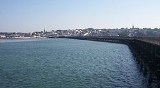
Ryde Pier

Encyclopedia
Ryde Pier is an early 19th century pier
serving the town of Ryde
, on the Isle of Wight
, off the south coast of England
.
had the uncomfortable experience of coming ashore on the back of a porter and then, depending on the state of the tide, having to walk as far as half a mile across wet sand before reaching the town. The need for a pier was obvious, especially if the town was to attract the wealthy and fashionable visitors who were beginning to patronise other seaside resort
s across England
.
and its foundation stone was laid on 29 June 1813. The completed pier opened on 26 July 1814, and had, as it still has, a timber-planked promenade. The structure was originally wholly timber, and measured 527m. By 1833, extensions took the overall length to 681m. It is this pre-Victorian structure which has, with some modifications, carried pedestrians and vehicles ever since.
s took passengers from the pier head to the esplanade
. Prior to the construction of the railway pier, the tramway continued to Ryde Railway Station at St Johns Road
. From 1886 to 1927 the trams were powered by electricity from a third rail
, and from then until 1969 the trams were petrol-powered.
On 12 July 1880 a third pier was opened, alongside the first two, providing a direct steam railway link to the pier-head. The railway line was owned jointly by the London, Brighton and South Coast Railway
and London and South Western Railway
, as far as Ryde St Johns Road, to connect with their ship services to Portsmouth. However, trains were run by the independent Isle of Wight Railway
and Isle of Wight Central Railway
, who owned the tracks beyond St John's Road and operated through services to Ventnor
and Cowes
via Newport
respectively.
In 1895 a concert pavilion was constructed at the pier-head and over the next sixteen years the original wooden piles were replaced in cast iron. It was at Ryde Pier that the Empress Eugénie landed from Sir John Burgoyne's yacht "The Gazelle" after her flight from Paris
in 1870.
The pier head was remodelled in the 1930s using concrete, and during the Second World War the pier was used for military purposes, with various modifications made to accommodate this.
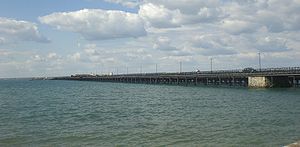 The Concert Pavilion was at the centre of the narrative in Philip Norman
's book, Babycham
Night; the author's family ran the venue when it was known as the Seagull Ballroom in the 1950s. Relatives of his produced the eponymous champagne perry
. The pavilion was later demolished, a few of the rotting piles are plainly visible, around the edge of an extended car parking area constructed in 2010, with the remainder shortened and hidden beneath the new structure.
The tramway closed in 1969 and the structure was partially dismantled. This has left the disused and decaying tramway pier between the railway and promenade piers. The remaining structure has proved useful as a base for structures for temporary diversions from the promenade pier, such as when a ship sliced through the latter in 1974. In autumn 2010 the whole length was fitted with a temporary deck to provide a walkway during re-building works to the Promenade Pier.
Ryde Pier was made a Grade II listed building in 1976. In the early 1980s a modern waiting area, including some of the original buildings, replaced the original Victorian
waiting rooms at the pier-head. Further modifications of these facilities were made in 2009, including the provision of a conservatory-style refreshment area with views across the water towards Ryde. In May 2011 existing lighting columns on the Promenade Pier were fitted with Victorian-style brackets and lanterns.
, with the Island Line
train running from Ryde Pier Head
station (at the pier head), via Ryde Esplanade down to the eastern side of the Island. The Wightlink
catamaran
runs regularly between Ryde
and Portsmouth
. It is possible to drive along the pier, and there is car parking on the large pier head.
From August 2010 to March 2011, Ryde Pier was closed to all vehicles as structural work underneath the promenade pier failed to pass a regular inspection by Trant. The pier remained open to pedestrians, who from October 2010 used temporary decking on the tramway pier whilst much of the promenade pier was being renewed. Some Wightlink foot passengers were given permission to use Island Line train services free of charge between Ryde Interchange and the Pier Head. Work to extend the structure of the Pier Head to allow for additional car parking continued during this period. The renewal work being complete, the promenade pier has now re-opened.
By 1900 use of the bathing facilities was declining, and the pier gradually became derelict. In the austerity of the First World War it was considered redundant and a hazard, and in 1916 it's demolition was authorised by Act of Parliament. By the 1920's it had gone. Until the construction of Ryde Harbour marina in the 1980's the outline of the shore-end abutment could be made out in the sea wall near the Ryde Pavilion, and at low spring tides the stumps of the piles could be seen in the sand some way offshore. Now not a trace remains.
It's position across the end of the steep final section of Union Street created a difficult 90-degree turn for drivers. In 1930 a bus descending Union Street took the turn into Pier Street too fast and overturned, killing several passengers and pedestrians, and damaging the south front of the Pier Hotel. At the inquest the Pier Hotel was found to be a driving hazard, and instead of being repaired it was ordered to be demolished. By 1931 the Pier Hotel and the entire range of buildings back to the end of St. Thomas's Street had been removed, and Pier Street itself ceased to exist, becoming part of The Esplanade.
Pier
A pier is a raised structure, including bridge and building supports and walkways, over water, typically supported by widely spread piles or pillars...
serving the town of Ryde
Ryde
Ryde is a British seaside town, civil parish and the most populous town and urban area on the Isle of Wight, with a population of approximately 30,000. It is situated on the north-east coast. The town grew in size as a seaside resort following the joining of the villages of Upper Ryde and Lower...
, on the Isle of Wight
Isle of Wight
The Isle of Wight is a county and the largest island of England, located in the English Channel, on average about 2–4 miles off the south coast of the county of Hampshire, separated from the mainland by a strait called the Solent...
, off the south coast of England
England
England is a country that is part of the United Kingdom. It shares land borders with Scotland to the north and Wales to the west; the Irish Sea is to the north west, the Celtic Sea to the south west, with the North Sea to the east and the English Channel to the south separating it from continental...
.
Before the pier
Before the pier was built, passengers to RydeRyde
Ryde is a British seaside town, civil parish and the most populous town and urban area on the Isle of Wight, with a population of approximately 30,000. It is situated on the north-east coast. The town grew in size as a seaside resort following the joining of the villages of Upper Ryde and Lower...
had the uncomfortable experience of coming ashore on the back of a porter and then, depending on the state of the tide, having to walk as far as half a mile across wet sand before reaching the town. The need for a pier was obvious, especially if the town was to attract the wealthy and fashionable visitors who were beginning to patronise other seaside resort
Seaside resort
A seaside resort is a resort, or resort town, located on the coast. Where a beach is the primary focus for tourists, it may be called a beach resort.- Overview :...
s across England
England
England is a country that is part of the United Kingdom. It shares land borders with Scotland to the north and Wales to the west; the Irish Sea is to the north west, the Celtic Sea to the south west, with the North Sea to the east and the English Channel to the south separating it from continental...
.
The original pier
The pier was designed by John Kent of SouthamptonSouthampton
Southampton is the largest city in the county of Hampshire on the south coast of England, and is situated south-west of London and north-west of Portsmouth. Southampton is a major port and the closest city to the New Forest...
and its foundation stone was laid on 29 June 1813. The completed pier opened on 26 July 1814, and had, as it still has, a timber-planked promenade. The structure was originally wholly timber, and measured 527m. By 1833, extensions took the overall length to 681m. It is this pre-Victorian structure which has, with some modifications, carried pedestrians and vehicles ever since.
Additions
A second 'tramway' pier was built next to the first pier, opening on 29 August 1864. Horse-drawn tramTram
A tram is a passenger rail vehicle which runs on tracks along public urban streets and also sometimes on separate rights of way. It may also run between cities and/or towns , and/or partially grade separated even in the cities...
s took passengers from the pier head to the esplanade
Esplanade
An esplanade is a long, open, level area, usually next to a river or large body of water, where people may walk. The original meaning of esplanade was a large, open, level area outside fortress or city walls to provide clear fields of fire for the fortress' guns...
. Prior to the construction of the railway pier, the tramway continued to Ryde Railway Station at St Johns Road
Ryde St John's Road railway station
Ryde St John's Road is a railway station on the Island Line, and serves the town of Ryde, Isle of Wight. The station is south of Ryde Pier Head—the Island Line's northern terminus. When the station opened in 1864, it was known as Ryde railway station, as it was the northern terminus of the...
. From 1886 to 1927 the trams were powered by electricity from a third rail
Third rail
A third rail is a method of providing electric power to a railway train, through a semi-continuous rigid conductor placed alongside or between the rails of a railway track. It is used typically in a mass transit or rapid transit system, which has alignments in its own corridors, fully or almost...
, and from then until 1969 the trams were petrol-powered.
On 12 July 1880 a third pier was opened, alongside the first two, providing a direct steam railway link to the pier-head. The railway line was owned jointly by the London, Brighton and South Coast Railway
London, Brighton and South Coast Railway
The London, Brighton and South Coast Railway was a railway company in the United Kingdom from 1846 to 1922. Its territory formed a rough triangle, with London at its apex, practically the whole coastline of Sussex as its base, and a large part of Surrey...
and London and South Western Railway
London and South Western Railway
The London and South Western Railway was a railway company in England from 1838 to 1922. Its network extended from London to Plymouth via Salisbury and Exeter, with branches to Ilfracombe and Padstow and via Southampton to Bournemouth and Weymouth. It also had many routes connecting towns in...
, as far as Ryde St Johns Road, to connect with their ship services to Portsmouth. However, trains were run by the independent Isle of Wight Railway
Isle of Wight Railway
The Isle of Wight Railway was a railway company on the Isle of Wight, United Kingdom. The company owned 14 miles of railway line and its headquarters were at Sandown...
and Isle of Wight Central Railway
Isle of Wight Central Railway
The Isle of Wight Central Railway was a railway company on the Isle of Wight, United Kingdom. At its peak the company owned 21½ miles of railway line, and it also operated trains on some additional lines it did not own. Trains were first run on what became its lines in 1862, although the company...
, who owned the tracks beyond St John's Road and operated through services to Ventnor
Ventnor railway station
Ventnor railway station was the terminus of the Isle of Wight Railway line from Ryde.The station lay on a ledge above sea level which had to be quarried into the hill side. The station was immediately outside a long tunnel through St. Boniface Down. A lack of space meant that a turntable was...
and Cowes
Cowes railway station
Cowes Railway Station took pride in being the “prettiest station on the Garden Isle” . Opened in 1862, the very first on the island as part of the inaugural “Cowes and Newport” railway it expanded to three platforms as the railway branched out towards Ryde in the years before the motor bus began...
via Newport
Newport railway station (IoWCR Isle of Wight)
Newport railway station was established in 1862 with the opening of the Cowes and Newport. It was enlarged in December 1875 when the lines to Ryde and Ventnor were opened. The station was also used by the Freshwater, Yarmouth and Newport Railway from its opening in 1888 until 1913, when that...
respectively.
In 1895 a concert pavilion was constructed at the pier-head and over the next sixteen years the original wooden piles were replaced in cast iron. It was at Ryde Pier that the Empress Eugénie landed from Sir John Burgoyne's yacht "The Gazelle" after her flight from Paris
Paris
Paris is the capital and largest city in France, situated on the river Seine, in northern France, at the heart of the Île-de-France region...
in 1870.
The pier head was remodelled in the 1930s using concrete, and during the Second World War the pier was used for military purposes, with various modifications made to accommodate this.
Philip Norman (author)
Philip Norman is an English novelist, biographer, journalist and playwright.Norman grew up in Ryde, Isle of Wight. He attended Ryde School, and his father, Clive Norman, ran the Seagull Ballroom on Ryde Pier. He described his childhood in his book Babycham Night...
's book, Babycham
Babycham
Babycham is the trade name of a light, sparkling perry invented by Francis Edwin Showering , a brewer in Shepton Mallet in Somerset, England; the name is now owned by Constellation Europe Limited. Launched in the United Kingdom in 1953, the drink was marketed with pioneering television...
Night; the author's family ran the venue when it was known as the Seagull Ballroom in the 1950s. Relatives of his produced the eponymous champagne perry
Perry
Perry is an alcoholic beverage made from fermented pears. Perry has been common for centuries in Britain, particularly in the Three Counties of Gloucestershire, Herefordshire and Worcestershire, and in parts of south Wales; and France, especially Normandy and Anjou.In more recent years, commercial...
. The pavilion was later demolished, a few of the rotting piles are plainly visible, around the edge of an extended car parking area constructed in 2010, with the remainder shortened and hidden beneath the new structure.
The tramway closed in 1969 and the structure was partially dismantled. This has left the disused and decaying tramway pier between the railway and promenade piers. The remaining structure has proved useful as a base for structures for temporary diversions from the promenade pier, such as when a ship sliced through the latter in 1974. In autumn 2010 the whole length was fitted with a temporary deck to provide a walkway during re-building works to the Promenade Pier.
Ryde Pier was made a Grade II listed building in 1976. In the early 1980s a modern waiting area, including some of the original buildings, replaced the original Victorian
Victorian architecture
The term Victorian architecture refers collectively to several architectural styles employed predominantly during the middle and late 19th century. The period that it indicates may slightly overlap the actual reign, 20 June 1837 – 22 January 1901, of Queen Victoria. This represents the British and...
waiting rooms at the pier-head. Further modifications of these facilities were made in 2009, including the provision of a conservatory-style refreshment area with views across the water towards Ryde. In May 2011 existing lighting columns on the Promenade Pier were fitted with Victorian-style brackets and lanterns.
The pier today
Today the pier is still a major gateway for passenger traffic to and from the Isle of WightIsle of Wight
The Isle of Wight is a county and the largest island of England, located in the English Channel, on average about 2–4 miles off the south coast of the county of Hampshire, separated from the mainland by a strait called the Solent...
, with the Island Line
Island Line, Isle of Wight
The Island Line is a railway line on the Isle of Wight, running some from Ryde Pier Head to Shanklin down the eastern side of the island. The line was electrified in 1967. Trains connect with passenger ferries to Portsmouth Harbour at Ryde Pier Head, and these ferries in turn connect with the...
train running from Ryde Pier Head
Ryde Pier Head railway station
Ryde Pier Head railway station is one of three stations in the town of Ryde on the Isle of Wight. Situated at the end of the town's pier, it is adjacent to the terminal for the Wightlink fast catamaran service connecting the island with Portsmouth on the UK mainland...
station (at the pier head), via Ryde Esplanade down to the eastern side of the Island. The Wightlink
Wightlink
Wightlink is a ferry company operating routes between Hampshire and the Isle of Wight in southern England.Their core routes are car ferries from Lymington to Yarmouth and Portsmouth to Fishbourne...
catamaran
Catamaran
A catamaran is a type of multihulled boat or ship consisting of two hulls, or vakas, joined by some structure, the most basic being a frame, formed of akas...
runs regularly between Ryde
Ryde
Ryde is a British seaside town, civil parish and the most populous town and urban area on the Isle of Wight, with a population of approximately 30,000. It is situated on the north-east coast. The town grew in size as a seaside resort following the joining of the villages of Upper Ryde and Lower...
and Portsmouth
Portsmouth
Portsmouth is the second largest city in the ceremonial county of Hampshire on the south coast of England. Portsmouth is notable for being the United Kingdom's only island city; it is located mainly on Portsea Island...
. It is possible to drive along the pier, and there is car parking on the large pier head.
From August 2010 to March 2011, Ryde Pier was closed to all vehicles as structural work underneath the promenade pier failed to pass a regular inspection by Trant. The pier remained open to pedestrians, who from October 2010 used temporary decking on the tramway pier whilst much of the promenade pier was being renewed. Some Wightlink foot passengers were given permission to use Island Line train services free of charge between Ryde Interchange and the Pier Head. Work to extend the structure of the Pier Head to allow for additional car parking continued during this period. The renewal work being complete, the promenade pier has now re-opened.
Victoria Pier
For a few decades Ryde had a second pier, the Victoria Pier, a few hundred yards to the east of the original, and still existing, pier. It was promoted by the Stokes Bay Pier and Railway Company to provide a landing for a rival ferry service from Gosport. It opened in 1864 as the main pier was getting it's tramway addition. Being somewhat shorter than Ryde Pier it could not be used at all states of the tide, so offered little competition to the main Ryde Pier to Portsmouth ferry services. When the Stokes Bay company was acquired by the London & South Western Railway in 1875 the ferry service ceased, and Victoria Pier became a pleasure pier only, with public baths at the head and a swimming platform at the dry end.By 1900 use of the bathing facilities was declining, and the pier gradually became derelict. In the austerity of the First World War it was considered redundant and a hazard, and in 1916 it's demolition was authorised by Act of Parliament. By the 1920's it had gone. Until the construction of Ryde Harbour marina in the 1980's the outline of the shore-end abutment could be made out in the sea wall near the Ryde Pavilion, and at low spring tides the stumps of the piles could be seen in the sand some way offshore. Now not a trace remains.
The Pier Hotel
The Royal Pier Hotel was built soon after the original pier to serve the increasing trade and passenger traffic attracted by the new pier. It stood on Pier Street opposite the bottom of Union Street for a hundred years, becoming a well-known local landmark, until disaster struck.It's position across the end of the steep final section of Union Street created a difficult 90-degree turn for drivers. In 1930 a bus descending Union Street took the turn into Pier Street too fast and overturned, killing several passengers and pedestrians, and damaging the south front of the Pier Hotel. At the inquest the Pier Hotel was found to be a driving hazard, and instead of being repaired it was ordered to be demolished. By 1931 the Pier Hotel and the entire range of buildings back to the end of St. Thomas's Street had been removed, and Pier Street itself ceased to exist, becoming part of The Esplanade.