


Ruled surface

Encyclopedia
Geometry
Geometry arose as the field of knowledge dealing with spatial relationships. Geometry was one of the two fields of pre-modern mathematics, the other being the study of numbers ....
, a surface
Surface
In mathematics, specifically in topology, a surface is a two-dimensional topological manifold. The most familiar examples are those that arise as the boundaries of solid objects in ordinary three-dimensional Euclidean space R3 — for example, the surface of a ball...
S is ruled if through every point of S there is a straight line that lies on S. The most familiar examples are the plane
Plane (mathematics)
In mathematics, a plane is a flat, two-dimensional surface. A plane is the two dimensional analogue of a point , a line and a space...
and the curved surface of a cylinder
Cylinder (geometry)
A cylinder is one of the most basic curvilinear geometric shapes, the surface formed by the points at a fixed distance from a given line segment, the axis of the cylinder. The solid enclosed by this surface and by two planes perpendicular to the axis is also called a cylinder...
or cone
Cone (geometry)
A cone is an n-dimensional geometric shape that tapers smoothly from a base to a point called the apex or vertex. Formally, it is the solid figure formed by the locus of all straight line segments that join the apex to the base...
. Other examples are a conical surface
Conical surface
In geometry, a conical surface is the unbounded surface formed by the union of all the straight lines that pass through a fixed point — the apex or vertex — and any point of some fixed space curve — the directrix — that does not contain the apex...
with elliptical
Ellipse
In geometry, an ellipse is a plane curve that results from the intersection of a cone by a plane in a way that produces a closed curve. Circles are special cases of ellipses, obtained when the cutting plane is orthogonal to the cone's axis...
directrix, the right conoid
Right conoid
In geometry, a right conoid is a ruled surface generated by a family of straight lines that all intersect perpendicularly a fixed straight line, called the axis of the right conoid....
, the helicoid
Helicoid
The helicoid, after the plane and the catenoid, is the third minimal surface to be known. It was first discovered by Jean Baptiste Meusnier in 1776. Its name derives from its similarity to the helix: for every point on the helicoid there is a helix contained in the helicoid which passes through...
, and the tangent developable
Tangent developable
The tangent developable of a space curve \gamma is a ruled surface of the form \gamma+s \gamma^\prime. Intuitively it is the union of the tangent lines to the space curve....
of a smooth curve
Curve
In mathematics, a curve is, generally speaking, an object similar to a line but which is not required to be straight...
in space.
A ruled surface can always be described (at least locally) as the set of points swept by a moving straight line. For example, a cone is formed by keeping one point of a line fixed whilst moving another point along a circle
Circle
A circle is a simple shape of Euclidean geometry consisting of those points in a plane that are a given distance from a given point, the centre. The distance between any of the points and the centre is called the radius....
.
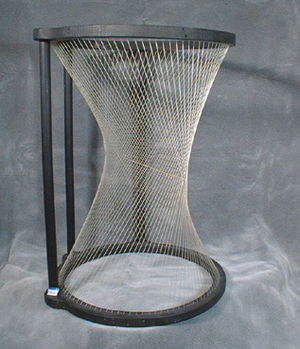
A surface is doubly ruled if through every one of its points there are two distinct lines that lie on the surface. The hyperbolic paraboloid and the hyperboloid of one sheet are doubly ruled surfaces. The plane is the only surface which contains three distinct lines through each of its points.
The properties of being ruled or doubly ruled are preserved by projective maps, and therefore are concepts of projective geometry
Projective geometry
In mathematics, projective geometry is the study of geometric properties that are invariant under projective transformations. This means that, compared to elementary geometry, projective geometry has a different setting, projective space, and a selective set of basic geometric concepts...
. In algebraic geometry ruled surfaces are sometimes considered to be surfaces in affine or projective space over a field, but they are also sometimes considered as abstract algebraic surfaces without an embedding into affine or projective space, in which case "straight line" is understood to mean an affine or projective line.
Parametric representation
The "moving line" view means that a ruled surface has a parametric representationParametric equation
In mathematics, parametric equation is a method of defining a relation using parameters. A simple kinematic example is when one uses a time parameter to determine the position, velocity, and other information about a body in motion....
of the form

where
 is the generic point on the surface,
  is point that traces a curve lying on the surface, and
  is a unit-length vector that traces a curve on the unit sphere
Unit sphere
In mathematics, a unit sphere is the set of points of distance 1 from a fixed central point, where a generalized concept of distance may be used; a closed unit ball is the set of points of distance less than or equal to 1 from a fixed central point...
. Thus, for example, if one uses

one obtains a ruled surface that contains the Möbius strip
Möbius strip
The Möbius strip or Möbius band is a surface with only one side and only one boundary component. The Möbius strip has the mathematical property of being non-orientable. It can be realized as a ruled surface...
.
Alternatively, a ruled surface can be parametrized
Parametric model
In statistics, a parametric model or parametric family or finite-dimensional model is a family of distributions that can be described using a finite number of parameters...
as
 , where
  and
and  are two non-intersecting curves lying on the surface. In particular, when
  and
and  move with constant speed along two skew lines
Skew lines
In solid geometry, skew lines are two lines that do not intersect and are not parallel. Equivalently, they are lines that are not coplanar. A simple example of a pair of skew lines is the pair of lines through opposite edges of a regular tetrahedron...
, the surface is a hyperbolic paraboloid, or a piece of an hyperboloid of one sheet.
Developable surface
A developable surfaceDevelopable surface
In mathematics, a developable surface is a surface with zero Gaussian curvature. That is, it is a "surface" that can be flattened onto a plane without distortion . Conversely, it is a surface which can be made by transforming a plane...
is a surface that can be (locally) unrolled onto a flat plane without tearing or stretching it. If a developable surface lies in three-dimensional Euclidean space, and is complete
Complete space
In mathematical analysis, a metric space M is called complete if every Cauchy sequence of points in M has a limit that is also in M or, alternatively, if every Cauchy sequence in M converges in M....
, then it is necessarily ruled, but the converse is not always true. For instance, the cylinder and cone are developable, but the general hyperboloid of one sheet is not. More generally, any developable surface in three-dimensions is part of a complete ruled surface, and so itself must be locally ruled. There are surfaces embedded in four dimensions which are however not ruled.
Ruled surfaces in algebraic geometry
In algebraic geometry, ruled surfaces were originally defined as projective surfaces in projective space containing a straight line through any given point. This immediately implies that there is a projective line on the surface through any given point, and this condition is now often used as the definition of a ruled surface: ruled surfaces are defined to be abstract projective surfaces satisfying this condition that there is a projective line though any point. This is equivalent to saying that they are birational to the product of a curve and a projective line. Sometimes a ruled surface is defined to be one satisfying the stronger condition that it has a fibration over a curve with fibers that are projective lines. This excludes the projective plane, which has a projective line though every point but cannot be written as such a fibration.Ruled surfaces appear in the Enriques classification of projective complex surfaces, because every algebraic surface of Kodaira dimension
Kodaira dimension
In algebraic geometry, the Kodaira dimension κ measures the size of the canonical model of a projective variety V.The definition of Kodaira dimension, named for Kunihiko Kodaira, and the notation κ were introduced in the seminar.-The plurigenera:...
−∞ is a ruled surface (or a projective plane, if one uses the restrictive definition of ruled surface).
Every minimal projective ruled surface other than the projective plane is the projective bundle of a 2-dimensional vector bundle over some curve. The ruled surfaces with base curve of genus 0 are the Hirzebruch surface
Hirzebruch surface
In mathematics, a Hirzebruch surface is a ruled surface over the projective line. They were studied by .-Definition:The Hirzebruch surfaceΣn is the P1 bundle over P1associated to the sheafO+O.\...
s.
Ruled surfaces in architecture
Doubly ruled surfaces are the inspiration for curved hyperboloid structureHyperboloid structure
Hyperboloid structures are architectural structures designed with hyperboloid geometry. Often these are tall structures such as towers where the hyperboloid geometry's structural strength is used to support an object high off the ground, but hyperboloid geometry is also often used for decorative...
s that can be built with a latticework
Latticework
Latticework is a framework consisting of a criss-crossed pattern of strips of building material, typically wood or metal. The design is created by crossing the strips to form a network...
of straight elements, namely:
- Hyperbolic paraboloids, such as saddle roofSaddle roofA saddle roof is one which follows a convex curve about one axis and a concave curve about the other. The hyperbolic paraboloid form has been used for roofs at various times since it is easily constructed from straight sections of lumber, steel, or other conventional materials...
s. - Hyperboloids of one sheet, such as cooling towerCooling towerCooling towers are heat removal devices used to transfer process waste heat to the atmosphere. Cooling towers may either use the evaporation of water to remove process heat and cool the working fluid to near the wet-bulb air temperature or in the case of closed circuit dry cooling towers rely...
s and some trash binWaste containerA waste container is a container for temporarily storing refuse and waste. Different terms are in use, depending on the language area, the design and material and the respective site .The most general terms are waste receptacle and container bin.Common terms include dustbin ,...
s.
The RM-81 Agena
RM-81 Agena
The RM-81 Agena was an American rocket upper stage and satellite support bus which was developed by Lockheed initially for the canceled WS-117L reconnaissance satellite program...
rocket engine
Rocket engine
A rocket engine, or simply "rocket", is a jet engineRocket Propulsion Elements; 7th edition- chapter 1 that uses only propellant mass for forming its high speed propulsive jet. Rocket engines are reaction engines and obtain thrust in accordance with Newton's third law...
employed straight cooling channels that were laid out in a ruled surface to form the throat of the nozzle
Nozzle
A nozzle is a device designed to control the direction or characteristics of a fluid flow as it exits an enclosed chamber or pipe via an orifice....
section.
See also
- Differential geometry of ruled surfaces
- ConoidConoidIn geometry, a conoid is a Catalan surface all of whose rulings intersect a fixed line, called the axis of the conoid. If all its rulings are perpendicular to its axis, then the conoid is called a right conoid....
- HelicoidHelicoidThe helicoid, after the plane and the catenoid, is the third minimal surface to be known. It was first discovered by Jean Baptiste Meusnier in 1776. Its name derives from its similarity to the helix: for every point on the helicoid there is a helix contained in the helicoid which passes through...
- Rational normal scroll, ruled surface built from two rational normal curves